Introduction
Malaysia's transport sector carries a branding problem few industries match. Airlines are still recovering from crisis-era damage to their reputations. Bus platforms compete on cultural relevance as much as price. Public transit systems struggle with multi-modal fragmentation that leaves commuters confused and brand equity scattered across operators with no unifying logic.
These aren't just operational challenges — they're branding failures with measurable consequences.
This article examines real transport branding case studies from Malaysia, extracts the strategic lessons in each, and identifies what separates brands that merely move people from brands that genuinely connect with them.
TLDR:
- Malaysia's transport brands navigate multicultural audiences, government-linked expectations, and low loyalty in price-sensitive markets
- RedBus Malaysia grew 10% in brand equity by attaching to food culture rather than promoting booking features
- Crisis recovery for airlines requires internal transformation before visual rebranding
- Fragmented public transport brand experiences erode trust and reduce ridership
- Cultural embedding and unified experience design drive long-term transport brand equity
Why Transport Branding in Malaysia Is a Different Challenge
Transport brands in Malaysia face pressure unlike most other sectors. They must serve a multicultural population comprising 69.9% Bumiputera, 22.8% Chinese, and 6.6% Indian audiences. They balance government-linked expectations with commercial imperatives. They compete in a market where price sensitivity is high and brand loyalty is low.
The result? Many transport brands fall into the "utility trap" — where the brand becomes so associated with functional outcomes (getting from A to B, booking a ticket) that it loses the ability to build emotional equity or charge a premium.
Consider these figures: private transport accounts for 83% of all trips in Kuala Lumpur, while public transport modal share sits at just 4%. Vehicle ownership stands at nearly 900 vehicles per 1,000 residents. When consumers view transport purely as utility, switching costs disappear and brand loyalty evaporates.
Research from the IPA Databank shows that price-discounting tactics increase price sensitivity, while emotional brand-building campaigns are twice as likely to reduce it. For transport brands trapped in utility positioning, this creates a vicious cycle: compete on price, train customers to care only about price, lose the ability to differentiate.
Breaking out of that cycle demands more than a logo refresh. It requires rethinking brand salience — how positioning, cultural relevance, and audience engagement work together to make a transport brand the instinctive first choice. The case studies below show what that looks like in practice.
Case Study 1: RedBus — From Booking Utility to Cultural Travel Brand
The Strategic Problem
RedBus entered Malaysia in 2015 and grew to hold approximately 37% of the online bus market. The platform works with 200 bus operators across 6,000+ routes, serving 3.5 million passengers annually and processing around 24,000 bookings per day. Malaysia is now RedBus's largest market outside India by both users and revenue.
Despite high usage, the brand faced a core strategic problem: it was perceived narrowly as a transactional booking tool. Decisions were last-minute and price-driven, which capped growth potential. The brand asked a harder question: How do you create demand upstream, before someone has already decided to travel?
The Food Map Strategy
RedBus used Google Maps' My Maps feature to pin food destinations across Malaysia and link each to a corresponding bus route. This moved the brand from "where to book" to "where to go" — placing it in the travel planning moment, not just the purchase moment.
The approach tapped into Malaysia's food culture, where street food and regional specialties form a core part of national identity. Instead of promoting booking features, RedBus attached itself to a category Malaysians already cared about: food discovery.
Key strategic moves:
- Launched with an in-person creator panel (not a press conference), with food creators and entrepreneurs including the co-founder of myBurgerLab
- Partnered with over 170 TikTok, Instagram, and YouTube food creators to amplify discovery
- Encouraged user submissions to keep the map growing organically, positioning it as a national cultural initiative rather than a promotional list
- Scheduled the campaign outside festive travel periods, targeting brand awareness when there was no natural travel trigger
Outcomes and Strategic Lesson
The campaign delivered measurable brand impact:
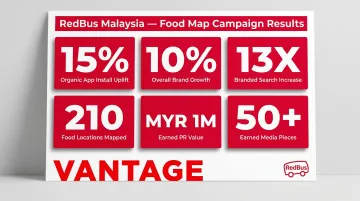
- 15% uplift in organic app installs across Android and iOS
- 10% overall brand growth
- 13X increase in daily branded search interest for "RedBus" and "Food Map"
- 210 food locations mapped by campaign end (starting from 160+ locations, expanded via 550+ user recommendations)
- MYR 1 million in estimated PR value, plus US$114,000 in social value from creator amplification
- 50+ pieces of earned media coverage including Berita Harian, Utusan Malaysia, and Bernama
Brand salience grows when a brand attaches itself to something people already care about — not by amplifying product features. RedBus gained visibility by making food travel more accessible, not by promoting its booking platform.
Case Study 2: Malaysia Airlines — When Crisis Forces a Brand to Rebuild from Within
The Crisis Context
Malaysia Airlines faced severe brand damage following two major aviation tragedies: MH370 disappeared on March 8, 2014, and MH17 was shot down on July 17, 2014, killing all 298 people on board. The airline became a textbook example of a brand forced to confront the limits of surface-level rebranding.
The instinct many airlines follow after a crisis is predictable: logo changes, aircraft repaints, and renaming. This rarely works on its own.
The Korean Air Comparative
Korean Air offers a clear comparison. After KAL 007 was shot down in 1983, killing 269 people, the airline renamed, repainted, and changed logos.
But crashes continued — most notably Flight 801 in Guam in 1997 (229 of 254 killed) and Cargo Flight 6316 in Shanghai in 1999 (9 killed). By 1999, South Korea's President called the airline's safety record "an embarrassment to the nation."
Recovery came only after deep internal transformation. Korean Air invested $200 million in safety programs and undertook a series of structural changes:
- Purchased new crash-warning systems across its fleet
- Hired foreign pilots and U.S. safety experts
- Brought in consultants from Boeing and Delta Air Lines to address cockpit communication culture
- Tackled hierarchical norms that were suppressing co-pilot input during critical decisions
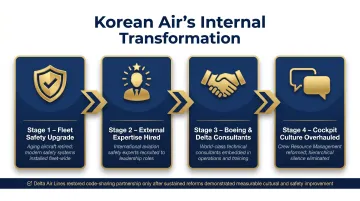
Delta suspended code-sharing in April 1999 and restored it only in spring 2002 — after these reforms took hold.
The Lesson for Malaysia Airlines
For Malaysia Airlines, analysis published in 2014 warned explicitly: "Any rebranding must be synchronized with the unveiling of a structural overhaul, otherwise it could be seen as just window dressing." The brand's trust deficit stemmed not just from the tragedies themselves, but from how they were managed and communicated. Audiences experienced the airline as an adversary rather than an ally.
CEO Christoph Mueller later cut 6,000 jobs and reduced suppliers from 20,000 to approximately 2,500, shifting the airline's focus from a global carrier to a regional one. In January 2026, the airline launched a global campaign titled "Time for new chapters", spotlighting expanded networks including long-haul routes to London, Seoul, and Shanghai.
The transferable branding principle: For transport brands, trust underlies all brand equity. When that trust breaks, rebranding is not the first chapter of recovery — it's the last. External identity work only lands credibly once the internal transformation (operational, cultural, communicative) is already underway.
Case Study 3: Malaysia's Public Transport Ecosystem — Branding Fragmentation as Strategic Risk
The Multi-Modal Challenge
Malaysia's public transport system operates through multiple operators, payment systems, and apps — but no unified brand experience ties them together. Prasarana Malaysia Berhad, a 100% government-owned company, manages LRT, MRT, KL Monorail, and stage bus services through sub-brands including RapidKL (Klang Valley), Rapid Penang, and Rapid Kuantan.
The digital brand MyRapid PULSE provides journey planning for Klang Valley and Penang commuters, adding yet another layer to an already fragmented landscape.
Despite Prasarana's stated purpose of "Advancing Mobility, Enriching Experiences," brand fragmentation creates friction at nearly every commuter touchpoint. The UX evidence below shows exactly where that friction accumulates.
UX as Brand Experience
A UX case study by Aashna Sehgal Ray documented pain points across KL's public transport that are brand experience problems:
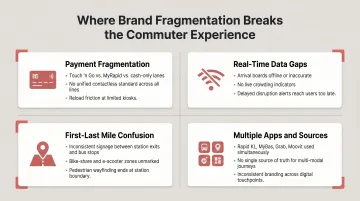
Payment fragmentation:
- Users can only top up cards over the counter or at kiosks with no online management
- No low-balance alerts
- If card balance runs out on a bus, users must return to a train station to reload
Real-time data gaps:
- Lack of real-time data on bus and train delays
- Users rely on printed schedules
- Third-party apps (Moovit, Google Maps) described as "often unreliable" for KL routes
First-last mile confusion:
- Lack of clarity on bus stop locations
- Inconsistent information about getting to and from train stations
Multiple apps and sources:
- No unified platform incorporating all transport modes (LRT, MRT, buses) with accurate data
- Users must "scour through multiple different sources"
Taken together, these pain points reveal a consistent pattern: when users encounter inconsistent information, disconnected apps, and unclear route signage, they don't blame the individual touchpoint. They blame the brand. Each friction point erodes trust in the entire network — and makes commuters more likely to return to their cars.
The Strategic Implication
For government-linked transport bodies and large operators, brand architecture is not just about logos. It is a decision framework — one that determines which experiences should feel unified, which can be differentiated, and how to design consistently across every commuter touchpoint.
Two questions define that framework in practice:
- Where must consistency be non-negotiable? Payment systems, wayfinding, and real-time information need a single, coherent voice — fragmentation here costs riders directly.
- Where can sub-brands operate independently? Route-specific branding or regional identity can vary, as long as the parent network experience remains intact.
What These Cases Reveal: 4 Principles for Effective Transport Branding in Malaysia
Principle 1: Cultural Embedding Over Feature Promotion
RedBus's Food Map showed that transport brands grow faster when they attach to existing cultural passions (food, community, identity) than when they amplify functional benefits (price, speed, convenience).
IPA Databank analysis finds that "fame" campaigns — those generating word-of-mouth and cultural conversation — more than double the likelihood of reducing price sensitivity versus other campaign types. For brands in mature, price-sensitive categories, cultural embedding is not a nice-to-have — it is a strategic imperative.
In Malaysia's multicultural market, this principle carries extra weight. Food culture crosses ethnic boundaries and provides a shared national identity point. Brands that invest in culturally rooted storytelling consistently outperform those that apply generic regional messaging.
Principle 2: Brand Salience Must Be Built Outside Peak Demand Moments
RedBus deliberately scheduled its Food Map campaign outside festive travel periods, targeting brand awareness when there was no natural travel trigger. Brands built only for peak moments become invisible in between — long-term equity requires presence across the full consumer mindset, not just at the point of purchase.
Research bears this out: major reductions in price sensitivity require 3+ years of consistent brand building, and no 3-month campaign in the IPA Databank achieved meaningful pricing effects. The optimal budget split between long-term brand building and short-term activation sits at approximately 60:40.
For transport brands: This means investing in brand presence during off-peak periods, building mental availability before the moment of need, and resisting the temptation to concentrate all marketing spend around festive booking windows.
Principle 3: Trust Is Infrastructure, Not Aesthetics
The Malaysia Airlines case illustrates that brand signals (logos, colours, taglines) can only carry meaning if the underlying experience validates them. Korean Air's recovery came not from repainting aircraft but from investing $200 million in safety programs, hiring outside experts, and overhauling cockpit culture.
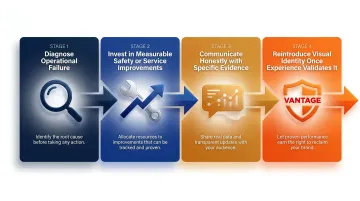
For transport brands in particular, safety, reliability, and communication are the brand — not the visual identity layered on top. When internal operations fail, external branding cannot restore trust. Crisis recovery requires structural transformation first:
- Diagnosing and fixing the operational failure driving the trust breakdown
- Investing in measurable safety or service improvements before any brand refresh
- Communicating changes honestly, with specific evidence rather than campaign promises
- Reintroducing visual identity only once the experience consistently backs it up
Principle 4: Unified Brand Experience Reduces Friction and Builds Loyalty
Drawing from the KL public transport UX case, fragmented brand experiences in multi-modal systems create confusion that erodes consumer trust in the entire network. Payment fragmentation, real-time data gaps, and disconnected journey planning tools are not just operational issues — they are brand architecture failures with direct impact on rider retention.
For government-linked transport operators and large mobility platforms: Brand architecture decisions must prioritise which experiences should feel unified (payment, information, customer service) and which can be differentiated (route-specific messaging, regional sub-brands). Then design must follow strategy consistently across every touchpoint.
What Transport Brands in Malaysia Should Consider Next
Transport brands — whether mobility platforms, airlines, or public operators — should audit their brand positioning not just at the visual identity level, but at the strategic level:
Ask these questions:
- What moment in the consumer journey does our brand occupy — and is that moment early enough to influence decisions?
- Are we competing on price because that's our strategy, or because we've failed to build brand salience outside of purchase moments?
- When trust breaks down, are we investing in internal transformation or just surface-level rebranding?
- Across our multi-modal or multi-operator system, where is brand fragmentation creating friction — and what experiences should feel unified?
The Malaysia context adds another layer of complexity. Culturally-rooted brand strategy is important in Malaysia's multicultural market, where no single cultural cue works universally. Brands that invest in audience research and localised narrative building — as RedBus did with food culture — tend to outperform those that apply generic regional messaging.
Vantage Branding works with organisations across Singapore and Malaysia on exactly these challenges — developing brand strategies tailored to complex, multi-stakeholder environments. For transport and government-linked brands in the region, that means grounded positioning work: audience research, brand architecture, and stakeholder alignment built around how people in this market actually think and travel.
Frequently Asked Questions
What makes transport branding different from branding in other industries?
Transport brands are uniquely tied to safety, reliability, and public trust. A single operational failure — a delayed fleet, a safety incident — can undo years of brand investment far faster than in most consumer categories.
How did RedBus grow its brand in Malaysia beyond being a booking platform?
RedBus used culturally relevant food travel content to enter the planning mindset earlier and build brand salience outside of peak booking periods. By attaching to Malaysia's food culture, the brand achieved 10% brand growth and a 13X increase in branded search interest.
When should a transport company consider a full rebrand versus a brand refresh?
A refresh updates visual identity while retaining equity; a revitalisation re-engages the market with renewed energy; a full rebrand involves complete repositioning. Crisis or major strategic shifts typically trigger the latter, but only once internal transformation is already underway.
How important is cultural relevance in Malaysian transport marketing?
Malaysia's multicultural consumer base means campaigns that tap into shared cultural values (food, community, local pride) achieve broader reach and deeper brand resonance than generic messaging. Cultural embedding reduces price sensitivity and builds long-term brand equity.
How can transport brands measure the success of a branding campaign?
RedBus tracked success through a 15% organic app install uplift, a 13X increase in branded search interest, and MYR 1 million in PR value. Broader indicators include brand awareness scores, brand perception shifts, and changes in organic traffic over time.