Introduction
Walk into any Malaysian shopping mall and you'll see the same playbook: loyalty points, flash sales, cashback offers. Brands compete on price, not preference. These tactics generate transactions — but they don't build the emotional commitment that keeps customers from leaving the moment a competitor offers 10% more.
Sustainable brand loyalty in Malaysia requires two foundations: a clearly defined brand architecture and culturally resonant strategies that reflect how Malaysian consumers think, feel, and interact with brands. This blog breaks down both — what brand architecture actually means in a Malaysian context, and which cultural dynamics determine whether your brand earns genuine loyalty or just repeat transactions.
TLDR
- Brand loyalty in Malaysia is built on emotional connection and cultural relevance — rewards programs alone won't sustain it
- Brand architecture defines how your portfolio is structured, directly shaping consumer trust and retention
- Malaysia's diverse, mobile-first market requires clear brand structure and consistent omnichannel presence
- Aligning architecture with loyalty strategy drives long-term brand equity and lasting customer retention
The Malaysian Brand Loyalty Landscape in 2025
Malaysia's loyalty program market is projected to surpass US$1 billion by 2028, growing at a compound annual growth rate (CAGR) of 9.3% from a base of US$720.9 million in 2024. For businesses operating in Malaysia, loyalty is no longer a nice-to-have: it's a commercial priority with measurable revenue and retention outcomes.
Yet the mechanics of loyalty are shifting. Malaysian consumers increasingly reject transactional reward schemes in favor of experience-driven brand relationships that connect on a human level. With 99.6% of individuals using mobile phones and 98.3% accessing the internet, Malaysia is a mobile-first market where brand experiences must follow consumers across digital and physical touchpoints seamlessly.
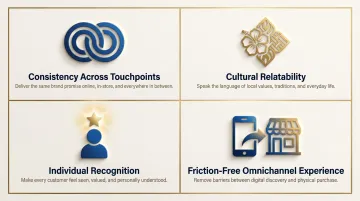
E-wallet adoption reinforces this further. 65% of Malaysians aged 25-34 now use digital wallets for non-cash payments, up 20% from 2024. That shift in payment behaviour signals a broader expectation: brands must meet consumers where they already are, and deliver consistently. Today's Malaysian consumer demands:
- Consistency across touchpoints — social, app, in-store, and customer service
- Cultural relatability that feels authentic to Malaysian routines and values
- Recognition as individuals, not just transaction IDs
- Friction-free movement between online and offline experiences
What Brand Architecture Is—and Why It's the Foundation of Loyalty
Brand architecture is the strategic framework that organizes a company's portfolio of brands, sub-brands, and products—determining how they relate to each other and how they are presented to consumers. It's fundamentally a trust and clarity decision, not a design or org-chart exercise.
The Direct Link Between Architecture and Loyalty
When consumers understand which brand they're engaging with and what it stands for, they develop trust faster. Conversely, unclear or contradictory brand relationships create confusion that erodes loyalty—particularly in Malaysia where consumers interact with large conglomerates across multiple touchpoints.
Example: PETRONAS
PETRONAS operates as a branded house—PETRONAS Dagangan (retail), PETRONAS Chemicals, and PETRONAS Lubricants International all carry the master brand. This coherent architecture helped PETRONAS hold Malaysia's most valuable brand title for 15 consecutive years, reaching US$14.4 billion in brand value.
Consumers associate PETRONAS with trust and value for money. Because the architecture is clear, that trust transfers across every business unit in the portfolio.
The Internal Business Benefit
A clear architecture helps companies:
- Allocate marketing investment efficiently
- Avoid brand cannibalization
- Create a master brand halo that lifts all sub-brands
- Enable loyalty to transfer across the portfolio without diluting individual brand identities
For growing Malaysian businesses expanding into new product lines, services, or geographies, getting the architecture right early prevents costly rebranding later. Vantage Branding works with businesses at this structural stage—defining brand relationships and portfolio logic before new extensions launch, so each new offering reinforces rather than fragments the master brand.
The Four Brand Architecture Models: Which One Fits Your Malaysian Brand?
No single model is universally correct—the right choice depends on your company's growth stage, audience diversity, and strategic goals. Here is how each model works—and which Malaysian businesses are already putting them to use.
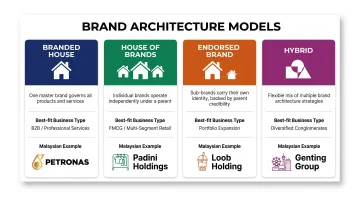
Branded House (Monolithic Architecture)
One master brand stretches across all products and services. Google is the obvious reference point—Google Maps, Google Drive, and Google Ads all carry the same name, building equity with every touchpoint.
In Malaysia, this model suits B2B companies, professional services firms, and any business where reputation concentrates in a single name. Every customer interaction reinforces the same brand, so awareness compounds over time.
House of Brands
Each product operates as a fully independent brand with little visible connection to the parent company. Procter & Gamble is the classic example—Tide, Gillette, and Pampers each stand alone in the market.
This structure works for FMCG players, retail conglomerates, and businesses serving consumer segments that cannot overlap. Padini Holdings runs this playbook well: Padini, Padini Authentics, Brands Outlet, Vincci, Seed, Miki Kids, and P&Co each target different shoppers with no requirement to feel related.
Endorsed Brand Architecture
Sub-brands carry their own identities but display a visible link to the parent for credibility—Courtyard by Marriott and Residence Inn by Marriott being the familiar global examples.
Loob Holding demonstrates this in Malaysia. Its portfolio—Tealive, Bask Bear Coffee (140+ outlets), WonderBrew Kombucha, and Happy Potato (90 stores)—operates under distinct brand identities. The Loob Holding name provides a credibility endorsement that smooths market entry for each new concept without constraining its individual positioning.
Hybrid Architecture
Most established Malaysian conglomerates operate on hybrid architectures—a pragmatic combination of the models above. Genting Group spans casinos, hospitality, plantations, and energy, with varying degrees of master-brand linkage. Some businesses carry the Genting name prominently; others operate more independently.
The risk here is drift. Without explicit governance rules—covering when sub-brands can deviate from the master brand's visual identity, tone, and values—hybrid architectures slide into inconsistency that leaves consumers uncertain about what the group actually stands for.
| Model | Best Fit | Malaysian Example |
|---|---|---|
| Branded House | B2B, professional services | — |
| House of Brands | FMCG, multi-segment retail | Padini Holdings |
| Endorsed Brand | New market entry, portfolio expansion | Loob Holding |
| Hybrid | Diversified conglomerates | Genting Group |
Five Strategies to Build Lasting Brand Loyalty in Malaysia
Strategy 1: Lead with Emotional Branding, Not Just Rewards
Malaysian consumers respond to brands that make them feel recognized and valued as individuals. Nearly one in three consumers in Asia-Pacific join loyalty programs to forge lasting connections with beloved brands, surpassing the global average.
Three practices make the difference:
- Personalized communication that acknowledges purchase history and preferences
- Empathetic customer service that remembers returning buyers
- Authentic storytelling that connects brand values to customer identity
A Malaysian consumer survey found that "when your customer support agent remembers a returning buyer, when a birthday message feels genuine—these are the things that spark a sense of belonging." Brands should audit whether their current communications feel like a person speaking or a pipeline delivering transactions.
Strategy 2: Build Cultural Relatability Into Your Brand Voice
Brands cannot fake local connection in Malaysia's diverse, culturally aware market. Cultural relatability must be intentional—built into brand naming, tone of voice, campaign themes, and product design.
Tealive, founded by Bryan Loo, shifted its brand philosophy from "Always more than tea" to "Brewing Positivity," centering on emotion and belonging. The brand introduced Malaysia's first halal-certified kombucha (WonderBrew) and localized flavor palettes that resonate with Malaysian tastes—cultural adaptation that goes well beyond surface-level marketing.
Padini takes a different route. Operating multiple fashion brands (Padini, Brands Outlet, Vincci, Seed), the group maintains a homegrown identity that Malaysian consumers recognize as locally authentic. Accessible pricing and consistent quality build loyalty through cultural familiarity rather than aspiration.
Strategy 3: Deliver Radical Consistency Across All Touchpoints
Loyalty is not built in a single transaction—it is reinforced or undermined across many interactions. Brands must audit tone of voice, service standards, pricing, and policies across all channels—social, in-store, app, and customer service—to ensure alignment.
PETRONAS has maintained its position as Malaysia's most valuable brand for 15 consecutive years by delivering cohesive communication across contexts. The brand expanded into sonic branding in 2020, seeking to "achieve 100% recognition" across touchpoints—a commitment to consistency that extends far beyond visual identity.
The result: consumers perceive PETRONAS as both "trustworthy" and "value for money." That combination—earned through consistent delivery across retail, chemicals, lubricants, and corporate communications—is rare, and rarely accidental.
Strategy 4: Commit to Omnichannel Integration
Malaysian consumers navigate fluidly between digital and physical touchpoints and expect their brand experience to follow them seamlessly. Over 80% of Malaysian consumers rely on mobile devices for shopping, and 99.7% of internet users engage with social networking platforms.
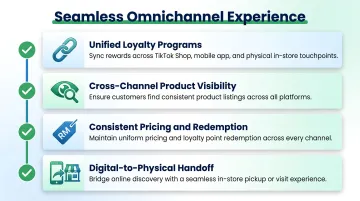
In practice, omnichannel integration means:
- Loyalty programs that work consistently whether customers are on TikTok Shop, a mobile app, or in a physical store
- Product availability visible across channels before purchase decisions are made
- Consistent pricing and redemption mechanics regardless of where the sale closes
- Clean handoffs between digital discovery and in-store fulfillment
Malaysia's e-commerce market is growing at approximately 13% annually, with platforms like TikTok Shop and Shopee intensifying competition. Brands that fragment their experience across channels don't just frustrate customers—they hand them to competitors who've made the effort to connect the dots.
Omnichannel integration addresses how customers move within your brand. Brand architecture addresses how they move across it.
Strategy 5: Use Brand Architecture to Amplify Loyalty Across Your Portfolio
When sub-brands clearly inherit trust from a strong master brand—as in an endorsed or branded house model—loyalty earned in one touchpoint transfers more easily to another. This is how brands scale loyalty rather than rebuilding it from scratch with every new product or market entry.
Research confirms: Parent brand preference exerts a positive effect on brand extension loyalty, shaped by brand extension attitude and trust. Consumers perceive higher brand personality transfer when a direct naming strategy is applied—when the parent brand name appears in the extension.
Loob Holding demonstrates this in action. Tealive's established reputation for quality supports the market entry of newer brands like Bask Bear Coffee and WonderBrew Kombucha—each benefits from the group's credibility rather than starting from zero. Bryan Loo has described the strategy as prioritizing models that are "highly duplicable and scale very quickly." That scalability depends as much on architecture as it does on operations.
Navigating Malaysia's Multicultural Market Through Brand Strategy
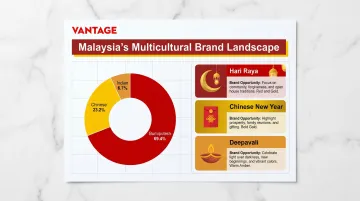
Malaysia's multicultural society—69.4% Bumiputera, 23.2% Chinese, 6.7% Indian—adds unique complexity to building brand loyalty. Malay, Chinese, Tamil, and Bumiputera consumers may have distinct cultural values, communication preferences, and seasonal touchpoints (Hari Raya, Chinese New Year, Deepavali).
The Strategic Balance
Brands must maintain a consistent brand core—values, purpose, visual identity—while allowing tactical flexibility in how campaigns, language, and product variations are executed for different communities. This is why some Malaysian brands choose endorsed or hybrid architectures: they allow cultural customisation without losing master brand coherence.
RHB Bank: Emotional storytelling across cultures RHB Bank released "The Reunion Dinner," a three-minute Chinese New Year film during COVID-19 lockdowns about a virtual Lunar New Year celebration. Result: 18.3 million views within 10 days and a 37% year-on-year increase in customer satisfaction scores among the Chinese-Malaysian demographic.
McDonald's Malaysia: Dialect-level localisation McDonald's created hyper-localised billboards using state-specific dialects (Penang Hokkien, Kadazan-Dusun in Sabah, football slang in Johor) paired with region-popular menu items—demonstrating cultural customisation that reinforces rather than fragments brand identity.
The Risk of Cultural Tone-Deafness
Cultural sensitivity is not an optional layer to add at campaign execution—it must be embedded into brand strategy from the architecture level. A misaligned message in one cultural context can damage loyalty across the entire customer base.
Cautionary example: Watsons Malaysia In 2017, Watsons released a Hari Raya video featuring a woman in blackface who is "transformed" to reveal paler skin, with the caption "Only at Watson's you'll be beautiful." The backlash was immediate—accusations of racism, sexism, and colorism forced video removal and a public apology.
Strategic recommendation: Research confirms that 90% of consumers prefer brands that align with faith-based values during Ramadan. Festivals aren't just promotional windows—they create moments of genuine emotional openness that brands rarely get elsewhere.
Loyalty built during these high-intensity periods tends to endure well beyond the season itself. Brands that show up authentically—not just promotionally—at these moments are the ones consumers remember.
Frequently Asked Questions
What is brand architecture and why does it matter for Malaysian businesses?
Brand architecture is the strategic framework organising a company's portfolio of brands and sub-brands. It matters because it directly affects consumer clarity, trust, and loyalty—especially in a diverse market like Malaysia where brand confusion is costly.
What drives brand loyalty among Malaysian consumers?
Loyalty in Malaysia is driven by emotional connection, cultural relatability, consistency across touchpoints, and responsive engagement. Malaysian consumers now prioritise experience-driven relationships over transactional rewards and price promotions.
What is the difference between a Branded House and a House of Brands?
A Branded House uses one master brand across all products (e.g., Google), while a House of Brands maintains independent brands under a parent company (e.g., P&G with Tide, Gillette, Pampers). The right model depends on your target audiences and strategic goals.
How can SMEs in Malaysia build brand loyalty without large marketing budgets?
Clarity of brand identity, cultural relevance, and consistency in customer experience are high-impact, low-cost loyalty builders. Getting brand strategy right early cuts wasted spend and lets SMEs compete on emotional connection—not marketing budgets.
How does Malaysia's cultural diversity affect brand loyalty strategy?
Malaysia's multicultural market requires a consistent core identity with tactical flexibility for different cultural communities. This balance needs to be built into brand architecture—not patched in at campaign level—to avoid fragmentation and cultural missteps.