Introduction
Malaysia sits in one of the world's most competitive tourism regions, yet struggles to differentiate itself from Thailand, Bali, and Singapore in the minds of international travellers. The country recorded 28.24 million international arrivals in 2024, surpassing its pre-COVID peak of 26.1 million in 2019. Tourism contributed 15.1% of Malaysia's GDP in 2024 — RM291.9 billion in gross value added. Sheer visitor volume hasn't translated into brand strength.
Between 2010 and 2019, Malaysia's arrivals remained relatively flat while Thailand's surged approximately 150%. Malaysia has compelling assets — rainforest adventure destinations, genuine multi-ethnic cuisine, and one of Southeast Asia's most layered cultural landscapes. The stagnation came down to brand strategy, not product.
This article examines the evolution of Malaysia's destination brand, why past approaches fell short, and actionable strategies across niche tourism pillars, digital channels, and stakeholder alignment that can strengthen Malaysia's tourism brand going forward. With Visit Malaysia 2026 underway, this is the clearest window in a decade to reposition Malaysia's destination brand for long-term growth.
TLDR:
- "Malaysia Truly Asia" built recognition, but modern travellers respond to experience-led storytelling
- Adventure, food, eco-tourism, and cultural tourism are Malaysia's strongest differentiation pillars
- Stakeholder alignment and digital-first strategies are foundational to any destination brand effort
- Visit Malaysia 2026 is the strongest near-term window to reposition Malaysia's destination brand
What Is Tourism Branding? (And Why Malaysia Needs to Get It Right)
Tourism branding comprises two components: the brand (a destination's core identity rooted in its natural, cultural, historical, and experiential assets) and branding (how that identity is consistently communicated across every touchpoint of the traveller's journey).
Branding isn't cosmetic. It's not a tagline refresh or a logo redesign. It's a strategic exercise that defines what a destination stands for and how that promise is delivered from initial research through post-visit engagement.
Malaysia needs to get this right because Southeast Asia is intensely competitive, with well-funded destinations investing heavily in differentiated positioning. The country's tourism arrivals remained largely flat for nearly a decade while competitors surged ahead, despite Malaysia possessing outstanding natural and cultural assets.
According to the World Economic Forum's Travel & Tourism Development Index 2024, Malaysia ranks 35th globally—behind Indonesia (22nd) but ahead of Thailand (47th). Yet Malaysia ranks 2nd globally in price competitiveness. This divergence between volume (Southeast Asia's most-visited country in 2024–2025) and overall competitiveness ranking reveals the core challenge: Malaysia has won on volume but not on brand differentiation or visitor yield.
That gap between arrivals and yield is, at its root, a branding problem. The brand must be grounded in what Malaysia genuinely offers — not aspirational claims that diverge from visitor reality:
- Authentic positioning builds trust and drives repeat visitation
- Misaligned positioning erodes brand equity and generates negative word-of-mouth when expectations don't match experience
The Evolution of Malaysia's Tourism Brand: Lessons from "Malaysia Truly Asia"
The Birth of a Brand Icon
The "Malaysia Truly Asia" campaign launched in 1999 with a powerful strategic insight: Malaysia is a genuine multicultural microcosm—the only country home to communities from the major civilisations of the Malay Archipelago, China, India, and indigenous Borneo. This positioning was factually defensible and distinctively differentiated.
The campaign delivered early results. Visit Malaysia Year 1990 nearly doubled arrivals from 4.8 million to 7.4 million. By VMY 2007, arrivals reached 20.97 million.
Its success stemmed from cohesive execution across Malaysia Airlines, AirAsia, and the hospitality sector. All three delivered a unified brand experience — destination co-branding working at its most effective.
Why the Brand Lost Momentum
Despite its early strength, the brand gradually declined post-2015 due to several structural failures:
- Absence of institutionalised brand DNA shared across stakeholders
- Loss of sustained commitment from industry partners
- Failure to quantify and track brand equity as it was being built
- No permanent brand custodian or governance structure to safeguard long-term direction
Even a powerful destination brand erodes without continuous investment, shared brand values across stakeholders, and measurable governance. Brands fade not because the positioning is wrong — commitment wanes long before the positioning does.
The Road to 2026: Restoration and Reinvention
Tourism Malaysia restored "Malaysia Truly Asia" in 2019 for the Visit Truly Asia Malaysia 2020 campaign. The brand's resilience after years of reduced investment demonstrates the strength of its original positioning and the long shelf-life of well-built destination branding.
That restored momentum set the stage for the most ambitious iteration yet. Visit Malaysia 2026 officially launched on January 1, 2026, with the campaign anchored by three headline commitments:
- 70 brands across hospitality, transport, retail, and entertainment joined the coalition
- 43 million international visitors targeted for the year
- 300+ events planned across the calendar

This signals a clear shift from single-campaign thinking to sector-wide brand collaboration. Whether it holds depends on whether governance can maintain consistency across this complex stakeholder network.
Core Tourism Branding Strategies for Malaysia
Strategy 1: Move from Mass Broadcast to Targeted, Experience-Led Campaigns
Modern travellers are not a monolith and respond poorly to broad, generic destination advertising. The strategic shift is from long-form television commercials presenting Malaysia as a broad concept, toward segmented campaigns speaking directly to distinct traveller personas:
- Adventure seekers drawn to rainforests, dive sites, and highland trails
- Food enthusiasts following Malaysia's UNESCO-recognised culinary heritage
- Eco-conscious explorers prioritising low-impact, nature-based experiences
- Cultural learners seeking authentic engagement with Malay, Chinese, and Indian traditions
Skift research found that travellers increasingly choose destinations for culture and entertainment experiences rather than traditional sightseeing. Each segment requires its own narrative, channel, and tone.
Strategy 2: Build Direct-to-Consumer Digital Relationships
Digital platforms allow tourism boards to build ongoing, measurable relationships with prospective travellers through email capture, retargeting, content marketing, and social media—rather than relying on one-time campaign exposures. This structural shift requires changes in how tourism marketing teams operate and measure success.
Digital is a relationship-building platform, not a broadcast channel. Destinations International reports that 81% of travellers use social media to research destinations before booking, and 48% use it for initial inspiration.
Strategy 3: Use Niche Influencer Marketing Over Broad Celebrity Campaigns
Partnerships with targeted content creators—adventure travel influencers, culinary storytellers, sustainability advocates, cultural experience creators—produce more authentic and credible content than generalist advertising.
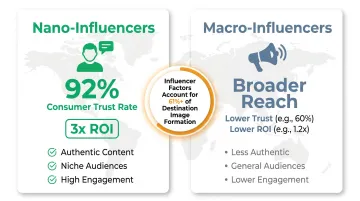
Research published in PLOS ONE found that influencer marketing factors account for over 61% of how a destination's image is formed, with trust, word of mouth, and content quality as the most influential predictors of success. The study recommends prioritising genuine, trustworthy influencers over those who merely have large followings.
Further research shows that 92% of consumers trust nano-influencer recommendations more than traditional ads or celebrity endorsements, and nano-influencers deliver 3x the ROI of macro-influencers.
Strategy 4: Invest in Best-in-Class Tourism Products Before Scaling Marketing
Marketing cannot compensate for underdeveloped or inauthentic tourism products. Investment in genuinely immersive, memorable, and authentic experiences must accompany—or precede—branding investment.
A heritage homestay mirroring the true rhythms of local community life delivers a brand story that no advertisement can manufacture. Product development and brand communication must advance together.
Strategy 5: Establish Structured Brand Governance with Measurable Targets
Without a clear brand strategy covering target audiences, messaging hierarchies, experience standards, and brand equity metrics, tourism marketing investment is guesswork. Destinations with formal brand plans—covering crisis scenarios, channel governance, and performance benchmarks—outperform those operating on ad hoc campaign logic.
This is where specialist brand strategy work matters. Vantage Branding works with destination and government clients to develop structured brand frameworks: audience positioning, messaging architecture, and the metrics to track brand equity over time.
Niche Tourism Pillars Malaysia Should Brand Around
Malaysia cannot win regional tourism competition by attempting to be everything to everyone. Its branding must concentrate on specific pillars where the country holds genuine competitive advantage—assets and experiences that neither Thailand, Bali, nor Singapore can authentically claim.
Adventure Tourism
The global adventure tourism market was valued at USD 483.3 billion in 2023 and is projected to grow at a CAGR of over 15.2% through 2032. Malaysia's assets in this space are not generic—they are verifiable world-firsts and globally ranked destinations.
Malaysia's adventure credentials include:
- Mount Kinabalu: Highest peak in Maritime Southeast Asia at 4,095 metres, in Kinabalu Park, a UNESCO World Heritage Site since 2000, hosting 5,000–6,000 plant species
- Sipadan Island: Ranked among the top 5 dive sites globally, with government-regulated access capped at 176 permits daily to preserve marine ecosystems
- Borneo's ancient rainforests: One of the world's oldest tropical ecosystems, offering multi-day trekking and wildlife immersion
- Cave systems in Ipoh and Mulu: Underground exploration ranging from accessible day trips to technical expeditions
That scarcity—a world-class dive site with capped access, a UNESCO-listed peak—is a branding asset. It signals exclusivity, not limitation.
Culinary Tourism
The UNWTO Global Report on Food Tourism found that 88.2% of destination organisations consider gastronomy a strategic element in defining destination brand and image—with over one-third of tourist spending going directly to food.
Malaysia's food culture offers a depth of story that few destinations can match:
- Laksa's regional diversity: Penang Asam Laksa, Nyonya Laksa, Johor Laksa, Sarawak Laksa—four distinct dishes that map out a culinary journey across the country
- Kopitiam coffee culture: Multi-generational coffee shops where Malay, Chinese, and Indian communities have shared tables for over a century
- George Town's hawker heritage: UNESCO World Heritage recognition for living, multi-cultural culinary traditions
- Cross-cultural street food: Malay, Chinese, Indian, and indigenous cooking traditions blending in combinations found nowhere else in Southeast Asia
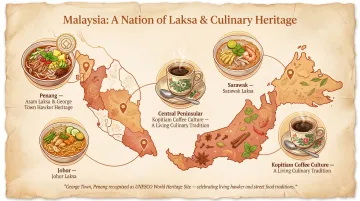
This is not food as backdrop—it is food as identity. Serious culinary travellers seek exactly this kind of layered, place-specific authenticity.
Eco-Tourism
The global ecotourism market was valued at USD 235.54 billion in 2023 and is projected to reach USD 665.20 billion by 2030—a 16% CAGR driven by travellers actively choosing destinations based on environmental credentials.
Malaysia's biodiversity case is genuinely exceptional:
- Recognised as one of the world's 17 megadiverse countries
- Forests covering approximately 54% of total land area, including ancient primary rainforest
- Endemic megafauna: Bornean orangutan, rhinoceros hornbill, Malayan tapir
- Rafflesia—the world's largest flower—found only in Malaysian Borneo and Peninsular Malaysia
- Community-led programmes connecting visitors directly with indigenous forest knowledge
For destination branding, this is tangible proof. The conservation narrative gives Malaysia a credible "protect what you experience" story that eco-conscious travellers respond to.
Cultural Tourism
Malaysia's multicultural heritage—the coexistence of Malay, Chinese, Indian, and indigenous communities—creates cultural experiences that no neighbouring destination can replicate. This is not manufactured diversity; it is centuries of layered history still visibly alive.
Specific branding opportunities include:
- Peranakan (Baba-Nyonya) heritage: George Town preserves pre-revolutionary Chinese architectural and religious practices—clan houses, temples, and ceremonies—representing a cultural lineage that no longer exists in mainland China
- Multi-faith urban corridors: Mosques, Hindu temples, and Buddhist sanctuaries within walking distance of each other, enabling multi-faith cultural itineraries in a single afternoon
- Immersive local life experiences: "Travel and learn" programmes placing visitors inside everyday community life rather than behind a tour bus window
- UNESCO World Heritage recognition: George Town and Melaka inscribed in 2008 for their "unique architectural and cultural townscape without parallel anywhere in East and South East Asia"
That final point is not marketing copy—it is UNESCO's direct assessment. For destination branding, third-party validation of this scale is rare and should be front and centre in Malaysia's cultural tourism narrative.
Stakeholder Alignment, Digital Strategy, and Brand Consistency
Stakeholder buy-in is the most difficult—and most consequential—element of destination brand delivery. The actual brand experience is created by hundreds of frontline players: hotel staff, tour guides, transport operators, food vendors. If they don't understand and embody the destination brand, even the best marketing strategy produces disappointed visitors and negative word-of-mouth.
The Malaysia Tourism 2026 model unifying 70+ brands under one marketing strategy demonstrates how multi-stakeholder brand alignment can be structured at scale. However, scale creates risk. Without formal governance defining how these diverse brands deliver the "Malaysia Truly Asia" promise consistently, the coalition risks brand dilution.
Strong governance also shapes how content is created and distributed. Authentic storytelling—destination videos, social media engagement, visitor-generated content—builds long-term brand recognition that paid advertising alone cannot sustain.
This content strategy also drives direct website traffic, enabling tourism boards and hospitality brands to own their relationship with travellers and reduce dependence on intermediaries.
Maintaining brand consistency across national and state levels presents unique challenges. Malaysia's branding complexity partly stems from individual states—Penang, Sabah, Sarawak, Langkawi—each carrying strong, distinct identities. A successful national tourism brand must serve as a coherent umbrella under which state brands can coexist and reinforce—not contradict—the national narrative.
Three structural priorities emerge from this challenge:
- Stakeholder governance: Clear protocols defining how frontline operators and state bodies express the national brand
- Content alignment: Unified storytelling guidelines that allow regional voices without fragmenting the national message
- Brand architecture: A tiered framework placing the national identity above—but not over—state-level brands
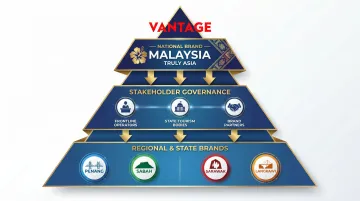
Vantage Branding works with destination and government organisations on exactly these structural challenges—developing brand architecture that creates coherence across complex, multi-stakeholder environments while preserving what makes each region distinct.
Frequently Asked Questions
What is the tourism tagline of Malaysia?
Malaysia's primary tourism tagline is "Malaysia Truly Asia," first launched in 1999. It was restored by Tourism Malaysia in 2019 after a period of reduced emphasis and continues as the foundation of Malaysia's destination brand today.
What is branding in tourism marketing?
Tourism branding is the strategic process of defining and consistently communicating a destination's unique identity: its assets, values, and experiences. It operates across every stage of the traveller's journey, from initial awareness through to post-visit loyalty and advocacy.
What is an example of co-branding in Malaysia?
The Visit Malaysia 2026 initiative is a strong example, with 70+ brands across hospitality, transport, retail, and entertainment co-branded under a single destination marketing strategy. An earlier model is the partnership between Tourism Malaysia, Malaysia Airlines, and AirAsia under the "Malaysia Truly Asia" banner.
What is the tagline of Visit Malaysia 2026?
Visit Malaysia 2026 operates under the "Malaysia Truly Asia" brand umbrella, with "Surreal Experiences" as the campaign's creative theme song. The campaign targets 43 million international visitors with over 300 events scheduled throughout the year.
How does Malaysia differentiate itself from destinations like Thailand or Bali?
Malaysia's differentiator lies in its cultural plurality, adventure assets in Borneo, diverse culinary landscape, and growing eco-tourism credentials. Neither Thailand nor Bali offers the same combination, which gives Malaysia a distinct and ownable position in the regional tourism market.
What role does digital marketing play in Malaysia's tourism branding?
Digital marketing lets destination brands build direct relationships with traveller segments through targeted content, influencer partnerships, and data-driven retargeting. For Malaysia, a shift toward digital-first investment is essential for reaching today's experience-seeking international visitors.