In November 2025, Maersk launched its largest contract logistics facility in Asia Pacific—a nearly 180,000-square-metre mega distribution centre in Shah Alam with 100,000 pallet positions. This RM530 million investment signals that global logistics giants see Malaysia as more than a transit hub; they're betting on it as a value-added distribution nerve centre for the region.
Yet as the sector grows and attracts more international competition, Malaysian maritime companies face a new challenge: it's no longer enough to operate well—you must be seen, trusted, and chosen. Many companies still treat branding as an afterthought, relying on relationships and technical capability alone. That approach worked when the industry was insular and domestic. Today, with digital procurement channels, international partnerships, and sophisticated buyers conducting extensive research before engagement, a weak or unclear brand becomes a competitive liability.
This article explores what's driving Malaysia's maritime industry growth, the branding challenges that come with it, and the strategies companies can use to build a brand that commands attention in local and global markets.
TLDR
- Malaysia's maritime sector spans petroleum, shipping, ports, shipbuilding, and logistics—growing in regional importance
- Rising competition and foreign investment are pushing Malaysian maritime firms to stand out or lose contracts
- For maritime SMEs, commoditised services and long B2B sales cycles make it hard to compete on anything but price
- Effective branding requires clear positioning, consistent identity, and stakeholder-specific messaging
- A credible digital presence and verifiable sustainability credentials have become deciding factors for buyers
Malaysia's Maritime Industry: Growth Drivers and Opportunities
Malaysia's merchant fleet ranks among the region's most significant. According to UNCTAD maritime profile data, Malaysia operates a diverse fleet of propelled seagoing merchant vessels, with the country ranking 30th globally in deadweight tonnage ownership. The country's 2023 Logistics Performance Index ranking of 26th globally reflects the competitiveness that underpins this maritime strength.
Strategic Geography as Competitive Advantage
Malaysia straddles the Malacca Strait—one of the world's busiest shipping lanes—positioning the nation between the Indian and Pacific Oceans. That position translates directly into commercial opportunity: virtually all major Asia-Pacific trade routes pass through Malaysian waters.
Port Klang handled 14.64 million TEUs in 2024 and ranked 10th globally in Lloyd's List Top 100 Ports. Westports processed 10.97 million TEUs in 2023, while Northport handled 3.67 million TEUs. Expansion projects are ambitious: Westports 2 targets capacity of up to 27 million TEUs, and the proposed Carey Island third port concept is designed for 30 million TEUs.
Government Policy and Infrastructure Investment
Malaysia's government has committed to maritime sector development through targeted policy and funding. The Malaysia Shipping Development Fund, announced by the Transport Ministry in 2025, aims to boost national shipping capacity. The Shipping Master Plan 2017-2022 set targets to increase Malaysian participation in energy shipping, intra-ASEAN routes, and offshore support vessel segments.
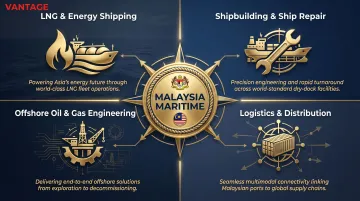
Four sub-sectors are driving this growth — each with distinct brand positioning needs:
- LNG and Energy Shipping: MISC Berhad operates 30 LNG vessels plus one LNG bunker vessel under PETRONAS. High-value, long-term charters mean brand reputation directly influences contract decisions.
- Shipbuilding and Ship Repair: With an order book of RM12 billion for shipbuilding and RM1 billion for ship repair across roughly 100 shipyards, buyers here prioritize technical capability, delivery reliability, and quality assurance — all brand-communicable attributes.
- Offshore Oil and Gas Engineering: This sector serves domestic and regional energy projects, where brand differentiation depends on demonstrating safety records, engineering expertise, and regulatory compliance.
- Logistics and Distribution: Malaysia is positioning itself as an Asia-Pacific logistics hub, competing on speed, supply chain integration, and end-to-end visibility — attributes that require clear, consistent brand messaging to land with procurement teams.
Branding Challenges Unique to the Malaysian Maritime Sector
The Commoditisation Problem
Many Malaysian maritime companies offer technically similar services: ship repair, offshore engineering, logistics handling. When buyers see little functional difference between providers, price becomes the default differentiator—driving margins down and making hard-won expertise invisible.
Without a strong brand narrative that articulates unique value, companies struggle to justify premium pricing. A ship repair yard that positions itself solely on "quality and reliability" sounds identical to every competitor. One that positions itself on "fastest turnaround for container vessels under 10,000 TEU with zero safety incidents in 15 years" has created a defensible space.
B2B Complexity and Long Sales Cycles
Maritime contracts involve multiple stakeholders: procurement officers focus on cost efficiency, operations managers want technical proof, and executives weigh strategic fit and track record. Each group needs a different reason to trust you.
According to the 2024 Edelman-LinkedIn B2B Thought Leadership Impact Report, B2B buyers increasingly conduct self-directed research before engaging vendors—making brand visibility and clarity critical before you ever get a meeting.
Sales cycles in maritime can span months or years. During that time, brand perception shapes whether your company stays on the shortlist or gets eliminated before you even get a meeting.
The SME Resource Gap
Many Malaysian maritime businesses—independent ship repair yards, marine services firms, offshore support vessel operators—are SMEs with limited marketing budgets. They can't afford large-scale advertising campaigns or in-house marketing teams.
This makes focused, strategic branding even more critical. Clarity beats volume. These four essentials outperform scattered efforts with ten times the budget:
- A well-defined positioning statement that sets you apart from competitors
- Consistent visual identity across all touchpoints
- A professional website that builds credibility before first contact
- Two strong case studies that demonstrate results, not just capabilities
Why Branding Is Now a Strategic Priority for Maritime Companies
Changing Buyer Behaviour
Historically, maritime business was relationship-driven. You knew the right people, you got the contract. That still matters, but Forrester analysis highlights that digital natives are rewriting B2B buying—buyers progress far through evaluation digitally before contacting vendors. Your brand's digital presence now determines whether you're even considered.
When international logistics operators, shipowners, or energy companies evaluate Malaysian suppliers, they start with online research. If your website looks outdated, your messaging is generic, and your LinkedIn presence is inactive, you've lost credibility before the first conversation.
Brand as Business Performance Driver
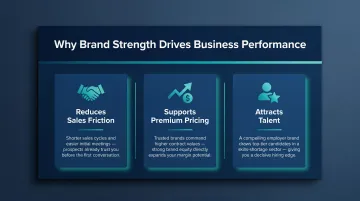
A strong brand delivers measurable business outcomes:
- Reduces sales friction: Easier to get meetings, shorter time to close
- Supports premium pricing: Buyers pay more for trusted, proven brands
- Attracts talent: Critical in a sector facing documented skills shortages—BIMCO and ICS estimated a need for an additional 89,510 officers by 2026
Trust and Risk Mitigation
In maritime, contract values run into millions, and operational stakes are enormous. Delays in offshore engineering projects cost millions per day. Buyers are risk-averse.
A strong brand signals reliability, technical credibility, and operational stability. Visual consistency and clear messaging build this perception steadily — and thought leadership accelerates it. When two companies offer similar technical capability, the one with a professional, coherent brand identity wins.
Reputational Risk and Recovery
Maritime incidents—safety failures, environmental breaches, legal disputes—travel fast in a tight-knit industry. Dark fleet ship-to-ship transfers off east coast Malaysia more than doubled in 2024, with incidents like the July 2024 collision involving Hafnia Nile and Ceres I raising reputational and environmental concerns.
A well-managed brand provides a credibility buffer. Companies with strong reputational equity recover faster from incidents because stakeholders give them the benefit of the doubt.
Attracting International Partnerships
Credibility built through brand also determines who gets invited to the table. As Malaysia's maritime sector grows, local companies increasingly need to partner with or supply to international operators — and a professional, internationally recognisable brand is the entry requirement. Global partners expect clear corporate identity, consistent communications, and demonstrated sector expertise before technical conversations even begin.
Key Branding Strategies for Maritime Companies in Malaysia
Defining Your Brand Positioning
Brand positioning is the distinct space your company occupies in target buyers' minds relative to alternatives. It sits at the intersection of what you do best, what the market needs, and what competitors aren't offering.
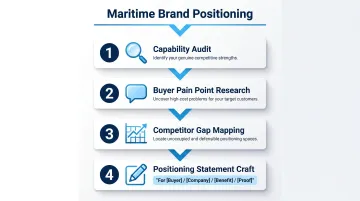
How to define your positioning:
- Audit your capabilities—what are you genuinely better at than competitors?
- Research buyer pain points—what problems cost your target customers time, money, or contracts?
- Map competitor positioning—where are the gaps?
- Craft a positioning statement: "For [target buyer], [your company] is the [category] that [unique benefit] because [proof/reason to believe]."
Choose a specific lane. Generalist maritime brands are forgettable. Differentiated positioning creates memory:
- Technical specialization: "Deep-water engineering for offshore wind installations"
- Speed and reliability: "48-hour guaranteed turnaround for container vessel repairs under 5,000 TEU"
- Sustainability leadership: "First Malaysian LNG operator with IMO-certified CII A-rating fleet"
Consider a Malaysian ship repair yard competing on price alone — margin pressure squeezes every quote. After repositioning as "Southeast Asia's specialist in fast-turnaround tanker repairs with zero environmental incidents," the same yard attracts premium clients willing to pay for speed and safety assurance.
Building a Visual and Verbal Brand Identity
A maritime brand identity includes:
- Logo and mark system
- Colour palette
- Typography
- Imagery style (photography, illustration)
- Tone of voice
- Messaging hierarchy
Critical requirement: The identity must work across diverse applications—corporate communications, vessel livery, PPE and safety signage, digital platforms, exhibition stands, tendering documents.
Common mistakes Malaysian maritime SMEs make:
- Inconsistent logo usage across materials (different versions, colours, placements)
- Generic taglines: "Quality, Reliability, Trust" (sounds like everyone else)
- Websites presenting technical specs without communicating value or story
- No defined visual system for photography (mix of stock images and low-quality site photos)
These inconsistencies undermine credibility with international buyers who expect professionalism and coherence.
Communicating to Multiple Stakeholders
Maritime B2B branding must address different buyer concerns simultaneously:
- CEO: Strategic partnership fit, track record, long-term stability
- Procurement officer: Compliance, cost efficiency, contract terms
- Operations manager: Technical proof, responsiveness, safety record
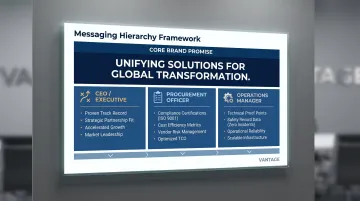
A single undifferentiated message fails all three — but the fix isn't three separate brands. It's a structured messaging hierarchy.
Develop a messaging hierarchy:
- Core brand promise (applies to all audiences): "Reliable offshore engineering delivered safely, on time, every time"
- Stakeholder-specific messages:
- For executives: "20-year track record supporting Malaysia's largest offshore operators"
- For procurement: "ISO 9001, ISO 14001, and OHSAS 18001 certified with transparent pricing"
- For operations: "Average project delivery 12% faster than industry standard with 99.7% safety compliance"
Building this framework requires both branding expertise and an understanding of how maritime procurement decisions actually work. Vantage Branding has worked with maritime authorities including MPA and marine companies like Vallianz across Southeast Asia, developing messaging that speaks to each stakeholder layer without losing overall brand coherence.
Building a Future-Ready Maritime Brand: Digital Presence and Sustainability
Establishing a Digital Brand Presence
International buyers and partners search online before face-to-face engagement. Your digital presence is your first impression.
Most impactful digital brand investments for Malaysian maritime companies:
- A professional website — clearly structured, mobile-optimised, and fast-loading — that shows who you serve, what you do differently, and proof of capability through project case studies and certifications
- An active LinkedIn company page with regular project updates and industry commentary; executives should maintain profiles with thought leadership content
- Long-form case studies and technical articles that build SEO visibility and signal expertise — a detailed offshore project write-up outperforms a generic "about us" page every time
Sustainability as a Brand Differentiator
The global maritime industry faces significant decarbonisation pressure. IMO's 2023 Strategy targets net-zero GHG emissions by or around 2050, with a 2030 checkpoint to reduce total annual GHG emissions by at least 20% (striving for 30%) and a 2040 checkpoint of at least 70% (striving for 80%) against a 2008 baseline.
For Malaysian maritime companies, building a sustainability narrative is becoming a brand differentiator for attracting international clients and staying ahead of regulatory requirements.
What credible sustainability branding looks like:
- Specific, measurable targets with a baseline year — "Reducing fleet emissions intensity by 25% by 2030 vs. 2023" carries far more weight than "committed to sustainability"
- Verified compliance data: EEXI and CII ratings, MARPOL Annex VI adherence, lifecycle GHG figures
- Concrete investment signals: dual-fuel vessel orders, shore power infrastructure, hull efficiency retrofits
Greenwashing — generic pledges, cherry-picked metrics, or stock wind turbine imagery with no operational link — is increasingly easy for informed clients and regulators to spot.
Malaysian industry leaders are setting the benchmark. PETRONAS has committed to net-zero carbon emissions by 2050, with a 25% absolute reduction by 2030 versus 2019 and zero routine flaring by the same date.
MISC has moved further into new energy, developing ammonia dual-fuel Aframax tankers, ammonia-fuelled LR2 vessels with proton-exchange membrane fuel cells, and LCO2 carriers purpose-built for carbon capture logistics.
Smaller companies don't need to match those investments to build credibility. Communicating specific, verifiable progress is enough: "First Malaysian ship repair yard offering cold-ironing shore power connections" or "Achieved 15% fuel efficiency improvement through hull coating upgrades."
Frequently Asked Questions
What industries make up Malaysia's maritime sector?
Malaysia's maritime sector includes petroleum and gas offshore services, shipping (dry cargo, tankers, LNG), port operations, shipbuilding and ship repair, fisheries, and maritime tourism. Each sub-sector has distinct commercial dynamics and buyer profiles.
Why is branding important for maritime companies in Malaysia?
As international competition increases and buyers conduct more digital research before engaging vendors, a strong brand builds credibility, differentiates on more than price, and accelerates trust-building with high-value clients. For Malaysian maritime companies competing across regional markets, brand strength directly shapes which tenders you get considered for.
What makes maritime branding different from branding in other industries?
Maritime branding involves B2B complexity with multi-stakeholder decision-making, long sales cycles (often 6-18 months), and high-stakes trust requirements. Unlike consumer or short-cycle B2B branding, maritime brands must maintain credibility across technical, financial, and operational audiences simultaneously.
How can a small Malaysian marine company build a strong brand on a limited budget?
Focus over breadth: define clear positioning, maintain visual consistency across all materials, invest in a professional website, and develop two or three strong case studies demonstrating proven capability. Apply for government grants like the Enterprise Development Grant, which provides up to 50% cost support for eligible SMEs.
How does sustainability impact maritime branding in Malaysia?
As IMO regulations tighten and international clients apply ESG standards to their supply chains, maritime companies that can credibly communicate sustainability practices gain a competitive edge in global tendering. Companies that can't demonstrate this risk losing access to international tenders where ESG compliance is now a baseline requirement.
What should a Malaysian maritime company look for when choosing a branding agency?
Prioritize agencies with B2B and industrial sector experience, proven ability to develop stakeholder-specific messaging, and ideally experience with maritime or marine clients in Southeast Asia. Look for strategic capability, not just creative design execution.