Introduction
Malaysian consumers are increasingly brand-savvy, and loyalty is harder to earn than ever — yet many businesses in Malaysia choose to rebrand without fully understanding the loyalty consequences that follow. In a market as culturally layered and digitally connected as Malaysia, a rebrand is never just a logo change. It reshapes how customers emotionally and transactionally relate to a brand — sometimes deepening trust, sometimes fracturing it permanently.
With Malaysia's loyalty programme market projected to reach USD 957.9 million by 2030, growing at 13.2% annually, a mishandled rebrand doesn't just dent brand equity — it walks customers straight to competitors. This article breaks down the risks that erode loyalty, the conditions that strengthen it, and how Malaysian brands can navigate the transition without losing the customers they've worked hardest to keep.
TLDR
- Done well, rebranding in Malaysia deepens loyalty; done poorly, it erases years of emotional equity
- Malaysian consumers are especially sensitive to authenticity in brand transitions — multicultural identity and social media scrutiny make missteps highly visible
- Failed rebrands typically fail to communicate "why" the change is happening or disconnect too sharply from familiar brand identity
- Successful rebrands evolve the brand's purpose without abandoning emotional connections loyal customers already hold
- When grounded in customer insight, rebranding can reset stagnant loyalty and attract new segments without losing the ones you already have
Why Rebranding and Loyalty Are Deeply Linked in Malaysia's Market
Malaysian loyalty runs deeper than transactions. It carries emotional, cultural, and habitual weight — which means a rebrand touches all three dimensions at once. Familiarity, trust, and shared values hold these bonds together, and a poorly executed rebrand can unravel them quickly.
Malaysia's loyalty landscape is commercially significant and growing rapidly. The market was valued at USD 503.8 million in 2025 and is projected to reach USD 957.9 million by 2030, expanding at 13.2% CAGR. That trajectory makes loyalty a force rebranding decisions directly touch — and can disrupt.
Trust Across Malaysia's Multicultural Society
Malaysian consumers across Malay, Chinese, Indian, and other communities place high value on familiarity and trust in the brands they use regularly. According to the 2024 Edelman Trust Barometer, trust in business reached 75% in Malaysia, up 7 points year-on-year, with 86% of Malaysians trusting their employer.
A rebrand that feels sudden or unexplained can be perceived as the brand abandoning its original relationship with its community. In a market where 87% of adults aged 18+ are active on social media, word-of-mouth communities on WhatsApp, Facebook, and Instagram can amplify negative sentiment before a brand has a chance to clarify its message.
Brand Equity as a Loyalty Store
Years of positive brand interactions build equity that loyal customers have invested in emotionally and behaviourally. A rebrand draws directly from this stored equity. Research confirms that brand attitudes and word-of-mouth communication sequentially mediate the relationship between brand equity and consumer loyalty — renewing that equity when handled well, or depleting it when not.
Two Malaysian cases show how much execution style shapes the outcome:
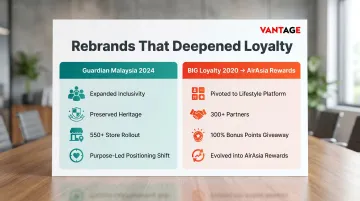
- Guardian Malaysia's 2024 "Own Your Beautiful" campaign shifted positioning from beauty as an end result to celebrating the journey of self-improvement — expanding inclusivity rather than replacing the brand's original promise
- BIG Loyalty (AirAsia) pivoted from an airline rewards programme to a lifestyle platform, then offered a 100% bonus points giveaway to ease existing members through the change
How Rebranding Can Undermine Customer Loyalty
The Identity Rupture Problem
When a rebrand changes too many brand signals at once — name, visual identity, tone, positioning — loyal customers can feel disoriented or abandoned. They no longer recognise the brand they chose to trust.
A 2025 peer-reviewed study of 351 consumers in a retail rebrand found that customers with strong emotional attachment to the original brand had negative attitudes toward rebranding — perceiving it as a "breach of trust."
The research identified an "Attached Consumer Paradox": the most loyal customers are the most resistant to rebranding, whilst non-attached customers are more flexible.
Breaking the Habit Loop
Many Malaysian consumers are habitual buyers. They return to a brand not because they consciously evaluate it each time, but because it has become part of their routine — their Saturday morning coffee stop, their monthly pharmacy visit, their preferred airline.
A rebrand that disrupts visual or experiential familiarity breaks this habit loop and opens the door to competitor switching. Two common triggers:
- Familiar packaging replaced without warning, removing the recognition cue at point of purchase
- Store layout or service experience changed dramatically, forcing customers to relearn their routine
Both remove the mental shortcut that made choosing your brand effortless.
The "Why Weren't We Told?" Factor
Rebrands announced without adequate customer communication create suspicion. In Malaysia's digitally connected environment — where 25.1 million people use social media and WhatsApp ranks as the most-used platform — negative sentiment can spread rapidly through community groups before a brand has a chance to control the narrative.
Research on electronic word-of-mouth in Malaysia confirms that social media conversations significantly influence purchase intentions across demographic groups, particularly Generation Z.
Long-Tenured Customers Are Most Vulnerable
The longer a customer has been loyal, the more they feel personally invested in the old brand. When perceived similarity between old and new brand is low, attached consumers react with hostility. For long-tenure customers, a brand change feels less like a business decision and more like a personal rejection — and that is a harder sentiment to recover from than simple unfamiliarity.
Category-Specific Risks in High-Trust Sectors
In sectors with high trust requirements — healthcare, financial services, F&B — loyalty is closely tied to a sense of reliability. Rebranding in these categories carries heightened risk because the brand signals customers rely on for safety and consistency are the very elements being changed.
A study of Malaysian Airline System's rebrand to Malaysia Airlines Berhad after the MH370/MH17 crises found that whilst rebranding had a significant positive effect on reputation and loyalty, 41% of respondents still preferred to fly with the airline despite the crises. In high-trust categories, even a well-executed rebrand needs time and consistent follow-through before loyalists fully transfer their trust to the new identity.
How a Thoughtful Rebrand Can Deepen Loyalty
Evolution, Not Revolution
Successful rebrands in Malaysia preserve core brand values and emotional meaning whilst refreshing the expression. This approach signals growth rather than abandonment, so loyal customers see a brand becoming better, not disappearing.
Academic research on brand evolution identifies "Brand Ambidexterity" as the ability to simultaneously maintain consistency (protecting heritage) and pursue relevance (innovation). These are dual imperatives, not opposing forces.
Strong emotional brand attachment acts as a "buffer effect." Established trust allows loyal consumers to contextualise change as strategic rather than betrayal.
Guardian Malaysia: Purpose-Led Deepening
Guardian's November 2024 "Own Your Beautiful" rebrand succeeded because it expanded inclusivity rather than replacing its original promise. The campaign shifted positioning from beauty as an "end result" to celebrating the "journey of self-improvement" — including external, emotional, and physical dimensions.
The rebrand challenged traditional Asian beauty standards — thinness, fairness — in favour of holistic well-being and individuality. This made existing customers feel more seen and valued. Rolling out across 550+ stores nationwide, the campaign modernised the brand whilst reinforcing the values built over its roughly 50-year heritage.
What made Guardian's approach work:
- Expanded the original promise rather than replacing it
- Addressed contemporary values (inclusivity, self-acceptance) without abandoning familiarity
- Maintained consistent visual presence across all 550+ physical touchpoints
Reigniting Dormant Loyalty
Guardian's case also illustrates a broader dynamic: loyalty can quietly become passive. Customers stick with a brand out of inertia rather than genuine enthusiasm, and a well-executed rebrand can re-engage them by reintroducing the brand as something worth actively choosing again.
When brands evolve their purpose or reposition around contemporary values, they invite dormant customers to rediscover why they chose the brand originally, now with renewed relevance.
BIG Loyalty: Broadening the Value Proposition
BIG Loyalty's pivot from an airline rewards programme to a lifestyle platform demonstrates rebranding used to broaden the loyalty proposition. Originally launched in 2010 as AirAsia BIG Loyalty, the programme rebranded in September 2020 to reflect expansion beyond flights, with over 300 partners across lifestyle, travel, and financial services.
To cushion the transition, BIG Loyalty offered 100% bonus points throughout September 2020 when members shopped with participating partners or converted points. This strategy made the rebrand feel like a gain rather than a loss for existing members, rewarding loyalty through the transition itself.
By 2026, the programme (now operating as AirAsia Rewards) had evolved into one of the largest points platforms in ASEAN, demonstrating how rebranding can attract new loyal segments without discarding existing ones.
Common Mistakes Malaysian Brands Make When Rebranding
Rebranding to Distract, Not Improve
Some Malaysian brands rebrand to distract from declining sales or reputation issues rather than to genuinely evolve. Customers who have followed a brand closely can tell the difference — and a rebrand that signals cosmetic change rather than real improvement accelerates trust erosion rather than halting it.
A rebrand cannot fix fundamental product failures, poor service, or operational dysfunction. When customers recognise a rebrand as misdirection, the new identity becomes associated with those same failures — compounding the original damage.
Cultural Insensitivity in a Multicultural Market
Malaysia's diverse consumer base means that changes to brand colours, imagery, or language carry symbolic weight across different communities. Colours have specific cultural meanings:
- Red: Luck, prosperity, celebration — highly significant for Chinese communities
- Gold: Wealth, success, prestige — universally valued
- White: Mourning and misfortune in East Asian traditions
- Green: Health, harmony, sustainability — also significant in Islamic culture
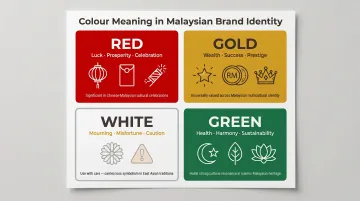
Research on colour psychology in Asia confirms that brands must use "cultural precision" to ensure colours align with local traditions. A rebrand that overlooks these cultural nuances risks alienating segments that were previously loyal.
Not Bringing Loyal Customers on the Journey
Most rebrands are revealed as a finished product rather than a shared transition — and that framing costs brands their most valuable asset: loyal customers who could have championed the change.
Common signs a brand has failed to bring customers along:
- Customers first hear about the rebrand through news coverage or social media rumour
- No direct communication arrives before or at launch explaining the "why"
- Long-time customers feel the change happened to them, not with them
- Loyal advocates become critics rather than champions
Strategies to Protect Customer Loyalty Before, During, and After a Rebrand
Before the Rebrand — Conduct Loyalty Segmentation
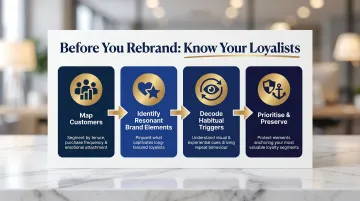
Start by identifying which customer segments are most loyal and most vulnerable to disruption. Their emotional connection to existing brand signals should inform which identity elements are preserved versus changed.
Key steps:
- Map customers by tenure, purchase frequency, and emotional attachment
- Identify which brand elements resonate most strongly with long-tenured loyalists
- Understand which visual or experiential cues trigger habitual behaviour
- Prioritise preserving elements that anchor the most valuable loyalty segments
This kind of loyalty segmentation is at the heart of what Vantage Branding's Brand Discovery and Brand Research services are designed to do: surface stakeholder expectations, audience insights, and market dynamics before any strategic identity decisions are made.
During the Rebrand — Communicate with Transparency and Frequency
Loyal customers need to hear about the rebrand early, understand the reasoning behind it, and see themselves reflected in the new brand direction.
Communication best practices:
- Announce the rebrand to loyal customers first (before public launch)
- Explain the business and customer reasons for change
- Show how the new brand builds on (not replaces) what they value
- Use every available channel — in-store, email, social media, community platforms
- Address concerns openly and respond to questions quickly
In Malaysia's high-connectivity environment, brands must engage across WhatsApp groups, Facebook communities, and Instagram comment sections where loyal customers gather.
After the Rebrand — Reinforce Loyalty Through Recognition
Post-rebrand is the highest risk period for loyalty erosion. Brands should actively reward loyal customers who stay through the transition.
Loyalty reinforcement tactics:
- Exclusive previews of new products or services
- Bonus loyalty points or special offers for existing members
- Personalised outreach thanking long-term customers for their continued support
- Early access to new features or premium tiers
- Public recognition of loyal customer stories
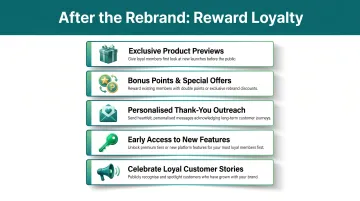
Each of these actions signals to customers that their relationship with the brand matters — and that the rebrand is an evolution, not an erasure.
Frequently Asked Questions
Does brand loyalty still exist?
Brand loyalty still exists but has evolved. Today it is harder to earn and more conditional, driven by purpose alignment, product quality, and consistent experience rather than familiarity alone. In Malaysia's growing loyalty market, loyalty programmes and brand trust remain commercially powerful forces.
Do Gen Z have brand loyalty?
Gen Z loyalty is real, but it works differently. They commit to brands whose values match their own and that offer authentic, personalised experiences — and they will switch quickly if a brand's actions contradict its stated identity. Research shows 84% of people globally need to share values with a brand to use it, and 58% of Gen Z assume inaction if brands stay silent on societal issues.
Does rebranding always hurt customer loyalty?
Rebranding does not automatically damage loyalty. The outcome depends on how much of the brand's core identity is preserved, how clearly the change is communicated, and how existing customers are supported through the transition. Well-executed rebrands can actually deepen loyalty by renewing relevance.
How long does it take to rebuild customer loyalty after a rebrand in Malaysia?
Recovery timelines vary by industry and rebrand scope. Global benchmarks suggest 60% of brands see a 10-20% dip in foot traffic in the first six months, with well-executed rebrands stabilising within 12 months and showing strong results by year three. Proactive communication and loyalty rewards during the transition can shorten that recovery window considerably.
What is the biggest risk of rebranding for Malaysian businesses?
The biggest risk is breaking the emotional contract loyal customers have with the existing brand — particularly in Malaysia where cultural familiarity and word-of-mouth communities amplify negative reactions quickly. Rebrands that change too much too fast without explanation are most vulnerable to this outcome.
Can a rebrand attract new loyal customers without alienating existing ones?
Yes, when the rebrand expands the brand's relevance rather than replacing its identity. BIG Loyalty demonstrated this by broadening appeal from airline travellers to lifestyle consumers whilst using 100% bonus points rewards to retain existing members through the transition. The key is preserving core emotional connections whilst opening new pathways to value.