Brand equity refers to the added value a brand brings to a product or service beyond its functional attributes. This value lives in the minds of consumers and directly influences their choices, loyalty, and willingness to pay a premium. In Malaysia's multicultural landscape, where Malay Muslim, Chinese, and Indian communities bring distinct values and expectations, brand equity becomes even more critical.
This article explores what brand equity means in the Malaysian context, the specific dimensions that resonate with Malaysian consumers, how cultural and religious factors shape brand perceptions, and what businesses can do to build equity intentionally in this complex market.
TLDR
- Brand equity — the value consumers attach to a brand beyond the product itself — is a primary driver of purchase decisions in Malaysia
- Malaysia's multicultural society means different communities respond to different brand signals; equity is not one-size-fits-all
- Religiosity moderates brand equity perception among Muslim consumers, making halal certification a decisive trust signal
- Brand trust and brand awareness most consistently drive purchase intention among Malaysian consumers
- Global brands leverage prestige and quality signals; local brands win through cultural authenticity and community connection
Understanding the Core Dimensions of Brand Equity in the Malaysian Context
The Consumer-Based Brand Equity Framework
The Consumer-Based Brand Equity (CBBE) framework, developed by Keller in 1993, remains the foundational model for understanding brand equity in Malaysia. It defines brand equity through four dimensions: brand awareness, brand associations, perceived quality, and brand loyalty. This framework is the most widely applied in Malaysian brand research, providing a reliable structure for measuring how consumers perceive and value brands.
Malaysian studies have validated this four-factor model across industries ranging from fast food to telecommunications, consistently showing that all four dimensions influence purchase intent and consumer trust.
Brand Awareness: The Entry Point
In Malaysia's crowded marketplace, being top-of-mind is the first filter consumers apply. Brands that Malaysian consumers recognize and recall are far more likely to be considered.
Research on Malaysian fast food brands reveals that brand awareness contributes greater variance to brand trust, attitudinal loyalty, and overall brand equity than perceived quality alone. This finding challenges the assumption that quality is paramount—in reality, if consumers don't know your brand exists, quality becomes irrelevant.
Why awareness matters so much in Malaysia:
- High media fragmentation across ethnic communities requires multi-channel visibility
- Social media and mobile-first behaviour means brand recall happens in seconds
- Word-of-mouth travels rapidly through tight-knit community networks
Brand Associations: The Emotional Connection
Brand associations are the thoughts, feelings, and imagery consumers link to a brand. In the Malaysian context, these associations extend beyond product attributes to include cultural symbols, halal status, community relevance, and country-of-origin perceptions.
Strong associations create emotional brand attachment that shields brands against competitive threats. A brand tied to family values, community responsibility, or Islamic principles resonates deeply with the segments that prioritise those values — building loyalty that price promotions alone cannot displace.
Perceived Quality: The Trust Signal
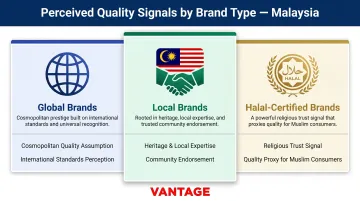
Perceived quality is not the actual quality of a product but the consumer's judgment about it. In Malaysia, quality signals differ significantly by consumer segment.
How each brand type establishes quality differs sharply:
- Global brands benefit from "cosmopolitan quality" perception — the assumption that international brands maintain higher standards
- Local brands must demonstrate category-specific competence, often relying on heritage, local expertise, or community endorsement to establish credibility
- Halal-certified brands carry a trust signal that functions as a quality proxy for Malaysia's Muslim-majority consumer base
Brand Loyalty: The Community Dimension
Loyalty in Malaysia often has a community dimension that makes it more complex than simple repeat purchase behaviour. Malaysian consumers who feel a brand reflects their identity — ethnic, religious, or lifestyle — tend to exhibit stronger attitudinal loyalty.
This identity-rooted loyalty is harder to earn, but it also means that switching costs are not purely financial. When a brand becomes part of how a consumer defines themselves, competitor discounts rarely tip the balance.
How Malaysia's Multicultural and Religious Landscape Shapes Brand Equity
The Demographic Reality
Malaysia's population breaks down to approximately 70.4% Bumiputera (predominantly Malay Muslim), 22.4% Chinese, and 6.5% Indian, placing it among Southeast Asia's most ethnically diverse markets. Each community carries distinct values, traditions, and brand expectations.
This diversity means a single brand positioning rarely captures all consumer segments equally. Successful brands either pursue focused cultural resonance with a primary segment or craft layered communication strategies that authentically engage multiple communities. Generic positioning risks weak equity across all segments.
The Malay Muslim Consumer Segment
For Malaysia's majority segment, religious compliance is a foundational trust signal. Halal certification is not merely a product attribute—it's a brand equity builder.
Malaysia's halal industry contributes 7.94% to GDP, equivalent to RM118.2 billion, demonstrating the economic significance of halal compliance. JAKIM, appointed as the sole halal certifying authority through the Trade Descriptions Act 2011, has elevated halal branding from a niche consideration to a market-wide equity signal that even non-Muslim consumers recognise as a quality marker.
Islamic Branding as a Brand Equity Strategy
Brands that embed Islamic values—not just halal certification but ethical business practices, Islamic Corporate Social Responsibility (ICSR), and community responsibility—achieve brand resonance that goes beyond transactional loyalty.
Research on Muslim Malaysian consumers shows that Islamic branding and its antecedents account for 47% of the variance in brand resonance—nearly half of how deeply Muslim consumers connect with a brand traces directly to Islamic values alignment.
Chinese and Indian Consumer Communities
These two segments share a common thread—both respond to sustained trust—but the trust-building mechanisms differ:
- Chinese Malaysian consumers favour heritage brands with proven quality tracks. Family recommendations and long-term consistency carry more weight than campaign-driven awareness.
- Indian Malaysian consumers prioritise community engagement and cultural relevance. Brands that acknowledge Deepavali, speak to community values, and avoid cultural blind spots build notably stronger equity.
Neither segment responds well to surface-level cultural gestures.
The practical implication is straightforward: success in Malaysia requires either focused cultural resonance with a primary segment or authentic, layered engagement across communities. Brands that acknowledge Hari Raya, Chinese New Year, and Deepavali with genuine cultural understanding—not tokenistic marketing—build equity across segments simultaneously.
Global vs. Local Brand Equity: What Malaysian Consumers Actually Prefer
The Perceived Brand Globalness vs. Localness Dynamic
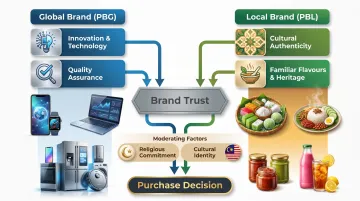
Global brands tend to signal quality, prestige, and reliability—particularly in electronics, luxury goods, and banking. Local brands earn loyalty through cultural authenticity, community belonging, and familiar value.
Research on Malaysian consumer preferences shows that both Perceived Brand Globalness (PBG) and Perceived Brand Localness (PBL) influence brand trust and brand equity, but through different pathways. The key bridge is brand trust—consumers gravitate toward whichever brand type they trust more in a given product category.
How trust mediates the global-local preference:
- In high-tech categories, global brands often win on trust due to perceived innovation and quality control
- In food and beverage, local brands may win on trust through cultural authenticity and familiar flavours
- Religious commitment and cultural identity strongly mediate which brand type consumers trust
The "Glocal" Opportunity
These research findings point to a practical opening: brands that blend global quality signals with genuine local adaptation can build equity on both fronts at once.
McDonald's Malaysia is a clear example. It was the first QSR in Malaysia to be officially recognised halal by JAKIM, maintains active halal certificates across product categories, and offers locally adapted menu items like the Nasi Lemak Burger and Bubur Ayam McD.
The result is a brand that carries global prestige without feeling foreign—it earns trust from consumers on cultural and religious grounds, not just product quality.
How Strong Brand Equity Translates to Business Outcomes in Malaysia
Direct Impact on Purchase Intention
Brand equity directly drives purchase intention in the Malaysian market. Consumers with high brand equity perceptions are more likely to choose a brand over competitors, pay a price premium, and recommend the brand to others.
Research in Malaysia's healthcare sector confirms that three dimensions each carry a positive, significant impact on purchase intention:
- Perceived quality — how consumers evaluate a brand's overall standard
- Brand awareness — the ease with which a brand comes to mind
- Brand association — the attributes and values consumers connect to it
This pattern appears consistently across industries, from fast food to financial services.
Reducing Perceived Risk
Malaysian consumers—particularly in high-involvement categories like healthcare, financial services, and food—rely heavily on brand equity signals to reduce purchase risk. Trust, reputation, and association all serve as mental shortcuts when the stakes feel high.
Post-COVID research found that 79% of Malaysian respondents became more health-conscious, making brand equity a critical decision factor in healthcare. When choosing medical providers, dietetics services, or health products, consumers use brand equity as a proxy for safety, competence, and reliability.
The Loyalty-to-Advocacy Pipeline
In Malaysia's social and community-oriented culture, loyal customers become active brand advocates—through family referrals, community endorsements, and social media sharing.
Research on Malaysian fast food consumers found that word-of-mouth has a statistically significant positive relationship with all four measured dimensions of brand equity:
- Brand image
- Brand loyalty
- Brand preference
- Brand leadership
Brand equity built today generates referrals tomorrow — a compounding return that paid acquisition cannot replicate.
Building Brand Equity in Malaysia: Strategic Considerations for Brands
Start with Deep Consumer Insight
Building brand equity in Malaysia requires understanding not just demographics but psychographics, cultural values, religious sensitivities, and community dynamics. Brands that invest in research-backed brand positioning before execution build equity faster and more durably than those relying on assumptions.
Critical insight areas:
- Ethnic community values and consumption patterns
- Religious compliance requirements and expectations
- Digital behaviour and platform preferences
- Price sensitivity and value perceptions by segment
Consistency Across All Touchpoints
Brand equity is built through repeated, consistent brand experiences—from product quality to customer service, packaging, digital presence, and community engagement.
Malaysia's mobile-first market has 25.1 million social media users spread across YouTube (25.1 million), Facebook (23.1 million), and TikTok (19.3 million). Every interaction across these platforms is a brand equity moment — and inconsistency erodes trust faster here than in less digitally connected markets.
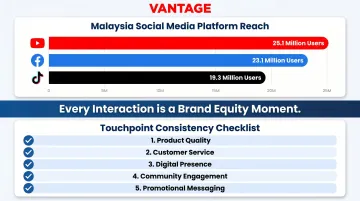
Touchpoint consistency checklist:
- Product quality meets or exceeds expectations consistently
- Customer service reflects brand values across channels
- Digital presence maintains brand voice and visual identity
- Community engagement aligns with brand positioning
- Promotional messaging stays culturally appropriate and authentic
Work with Culturally Aware Brand Partners
For businesses operating in or entering the Malaysian market, working with an experienced Asia-focused branding agency can accelerate equity building in this complex, diverse consumer landscape.
Vantage Branding is a Singapore-based agency offering brand strategy, identity design, and communications services across Malaysia and Southeast Asia. Their work focuses on positioning brands for specific market contexts — accounting for cultural nuances, religious sensitivities, and the multicultural dynamics that shape Malaysian consumer behaviour.
Frequently Asked Questions
What is brand equity and why does it matter for businesses in Malaysia?
Brand equity is the added consumer-perceived value of a brand beyond its functional product. In Malaysia's highly competitive and culturally diverse market, strong brand equity drives purchase decisions, enables price premiums, and creates long-term customer loyalty that protects against competitive threats.
How does Malaysia's multicultural society affect consumer responses to brand equity?
Malay Muslim, Chinese, and Indian communities each respond to different brand equity signals based on distinct cultural values. Brands must either focus on a primary segment or develop culturally nuanced strategies to build resonance across multiple communities.
What role does halal certification play in building brand equity in Malaysia?
For Malaysia's Malay Muslim majority, halal certification is more than a product attribute — it's a trust marker that directly influences purchase decisions. Its influence extends across food, healthcare, and personal care categories.
How does brand awareness influence consumer purchase decisions in Malaysia?
Brand awareness is the entry point of brand equity in Malaysia's crowded marketplace. Consumers are more likely to consider, trust, and purchase brands they recognise — making visibility a prerequisite for all other equity-building efforts.
What is the difference between global and local brand equity in the Malaysian market?
Global brands build equity through quality perception, prestige, and reliability signals, especially in categories like electronics and luxury goods. Local brands build equity through cultural authenticity, community connection, and value positioning. The most successful brands in Malaysia often blend both approaches.
How can businesses build strong brand equity in Malaysia?
Building strong brand equity in Malaysia requires:
- Deep insight into the cultural and religious values of your target communities
- Consistent brand experiences across every consumer touchpoint
- Culturally sensitive positioning that respects community expectations
- Sustained engagement with the specific audiences your brand serves