Introduction
Malaysia's symphony orchestras sit at a distinctive cultural crossroads — drawing on Malay, Chinese, Indian, and indigenous traditions while competing for audiences against streaming platforms, pop concerts, and an endless scroll of digital distractions.
The perception of classical music as foreign or inaccessible suppresses ticket sales. Aging demographics compound the problem, threatening the long-term sustainability of institutions that depend on consistent audience renewal.
Branding now separates thriving orchestras from struggling ones. The Malaysian Philharmonic Orchestra (MPO) generated RM9.2 million in ticket sales in 2024, with social media driving 30% of purchases — proof that strategic positioning moves tickets.
This article examines the Malaysian orchestra landscape, the branding challenges these institutions face, and case studies with transferable lessons for arts organizations across the region.
TLDR:
- The MPO anchors Malaysia's orchestral sector, with state and youth ensembles filling out the ecosystem
- Perception barriers, aging audiences, and weak digital presence limit growth
- Crossover programming (film scores, pop collaborations) drives ticket sales
- Regional orchestra brands succeed through audience segmentation and consistent identity
- Cultural institutions must balance artistic prestige with public accessibility in their branding
Malaysia's Symphony Orchestra Landscape
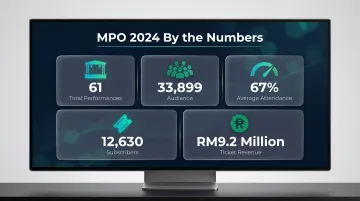
The Malaysian orchestral ecosystem is anchored by the Malaysian Philharmonic Orchestra (MPO), founded in 1997 and giving its inaugural performance on 17 August 1998. Funded by Petronas and comprising musicians recruited through worldwide auditions, the MPO is Malaysia's only full-time professional symphony orchestra. In 2024, the MPO presented 61 performances to 33,899 attendees across its 920-seat home venue, Dewan Filharmonik Petronas (DFP), achieving a 67% average attendance rate.
Beyond the MPO, the sector includes:
- Penang Philharmonic Orchestra (PPO): An amateur ensemble of approximately 80 musicians funded by the State of Penang, performing at Dewan Sri Pinang
- Malaysian Philharmonic Youth Orchestra (MPYO): 46 young musicians aged 10-28 receiving mentorship from 13 MPO tutors
- Selangor Philharmonic Orchestra and other community ensembles filling regional gaps
The Symbolic Weight of Dewan Filharmonik Petronas
DFP sits on Level Two of Tower Two, Petronas Twin Towers, in Kuala Lumpur City Centre. It's Malaysia's first purpose-built classical music hall, designed by Cesar Pelli with acoustics by Kirkegaard Associates. Beyond its technical excellence, DFP carries a dual identity: a serious cultural institution operating inside one of the world's most recognisable corporate landmarks. That tension—prestige versus accessibility—runs through every branding decision the MPO makes.
In 2024, DFP extended its reach through the DFP Seni Festival, drawing approximately 50,000 visitors over two days with 22 performances, 7 flashmobs, and 17 local handicraft booths. The numbers tell a clear story: the venue is actively courting audiences who would never buy a season ticket.
The Multicultural Branding Opportunity
Malaysia's multiracial population—comprising Malay, Chinese, Indian, and indigenous communities—creates both opportunity and challenge for orchestral branding. Orchestras that default to a Eurocentric image risk alienating large audience segments from the outset.
Those that make deliberate programming choices tend to reach further. Tactics that have worked across the region include:
- Programming Malaysian and Southeast Asian composers alongside Western repertoire
- Framing concerts around cultural festivals (Hari Raya, Chinese New Year, Deepavali)
- Collaborating with local artists to create hybrid performances
- Designing bilingual or multilingual audience communications
Each of these moves is also a branding decision — and the case studies below show exactly how Malaysian orchestras have navigated them.
The Branding Challenges Facing Malaysian Orchestras
The Elitism Perception Barrier
Classical orchestras in Southeast Asia face a persistent image problem: they're perceived as foreign, formal, and inaccessible. An academic evaluation of the Singapore Symphony Orchestra identified a "split personality" in orchestra branding—black-tie events and luxury sponsors (Steinway, Piaget) project elite high culture, while free park concerts signal community accessibility. This brand dichotomy prevents casual listeners from transitioning into paid ticket holders.
Globally, the Classical Pulse 2026 study found formality and "not knowing enough" about the music are primary deterrents, with 25% citing ticket prices as barriers. For Malaysian orchestras, closing that gap means deliberate positioning around emotional storytelling, cultural relevance, and low-barrier entry experiences.
The Audience Ageing Crisis
Orchestras typically skew toward older, higher-income demographics. The Singapore Symphony Orchestra's average audience age is 41 years, with over 50% in the 25-44 age bracket—relatively young by classical standards. However, many Malaysian ensembles lack data on their own demographics, making it difficult to target younger Malaysians strategically.
The data is more encouraging than the demographics suggest:
- 15% of Gen Z and Millennials interested in classical music identify as "dedicated followers"—nearly double Gen X (8%) and triple Boomers (5%)
- Over 80% of young people who've attended a classical concert did so within the past year
The appetite clearly exists. Orchestras just need to meet younger audiences where they are—on social media, at crossover events, and through accessible programming.
Weak Brand Differentiation
That audience challenge is compounded by a branding one. Many Malaysian orchestras lack a distinctive voice or visual identity, and generic positioning—"we play classical music"—fails to stand out in a crowded cultural market. International rebrands show what's possible:
- San Francisco Symphony repositioned from traditional arts institution to "boundary-pushing cultural platform," achieving a 19% year-over-year increase in donor participation
- Boston Symphony Orchestra adopted a "digital-first" brand architecture in 2024, unifying four sub-brands and launching Pride Night and Dia de Muertos concerts to appeal to diverse audiences
Malaysian orchestras rarely invest in brand strategy at this level. Without it, communications stay inconsistent and audiences have little reason to feel the organisation is speaking to them.
Funding Dependency and Corporate Identity Tension
The MPO relies on Petronas patronage; the PPO on state government support. This creates brand tension when an orchestra's identity becomes entangled with its sponsor's corporate identity rather than its own artistic mission. The MPO's patron is YABhg. Tun Dr. Siti Hasmah Haji Mohd Ali, and its home venue (DFP) is owned by KLCC Property Holdings Berhad—both Petronas entities.
Corporate funding is essential, but over-identification with a single sponsor narrows how audiences perceive the institution. The MPO needs to communicate an artistic vision that stands independently of its corporate affiliation.
Underdeveloped Digital Presence
Despite dramatic growth—MPO's Facebook reach surged from 4.6 million (2023) to 58.4 million (2024) and Instagram reach from 685,000 to 17.5 million—the numbers tell an incomplete story. Reach is up, but most Malaysian orchestras still treat digital channels as broadcast platforms rather than engagement tools. Behind-the-scenes content, musician spotlights, and short-form video can humanise the brand; too many ensembles post only performance schedules and ticket links.
Case Study: Malaysian Philharmonic Orchestra and the Dewan Filharmonik Petronas Brand
Background and Scale
Founded in 1997 with its first performance in August 1998, the MPO operates under Petronas patronage. Current Music Director Junichi Hirokami (appointed 2025) and Resident Conductor Gerard Salonga (2018-present) lead an ensemble of 45 listed musicians. The MPO has released 21 CDs and toured domestically (George Town, Ipoh, Johor Bahru, Kota Kinabalu, Kuching) and internationally (Singapore, Japan, Korea, Australia, China, Taiwan, Vietnam).
In 2024:
- 61 total performances (43 MPO concerts, 12 DFP-programmed, 6 chamber)
- 33,899 total audience with 67% average attendance in a 920-seat hall
- 12,630 total subscribers
- RM20.2 million total income (excluding donations); RM9.2 million (46%) from ticket sales
Navigating Dual Identity: National Orchestra vs. Corporate Entity
The MPO's brand identity is inseparable from Petronas. DFP sits in the Twin Towers complex, and the orchestra's patron and venue owner are both Petronas-linked. This creates real brand synergies: a world-class venue, stable funding, and corporate infrastructure.
But it also creates tension. Does the MPO exist primarily to serve Petronas' CSR objectives, or to advance Malaysia's musical culture?
The MPO's communications balance both. Its website positions the orchestra as Malaysia's flagship ensemble, emphasizing artistic excellence, international collaborations, and cultural relevance. Yet Petronas branding is omnipresent in venue signage, program materials, and public messaging — the ongoing challenge of maintaining artistic credibility while acknowledging corporate support.
Audience Development Initiatives
The MPO has developed wide-ranging programs to democratize access:
Education and Outreach
Launched in 1999, the MPO Education and Outreach Programme delivered 51 activities reaching 9,092 attendees in 2024, including:
- MPO Lecture Series: 19 masterclasses/workshops, 597 attendees
- Showcases: 11 events, 5,107 attendees
- Education Outreach/Talent Scout: 9 sessions, 1,516 individuals
- Music Camps: Side-by-side performances with MPO mentorship
The MPYO-CIMB partnership funded 2 music camps in 2024, impacting 60 young musicians. Fifteen MPYO members performed side-by-side with the MPO in a benefit concert.
Community Programming
The DFP Seni Festival drew approximately 50,000 people over two days, featuring 22 performances, 7 flashmobs, and 17 local handicraft booths. Generasi DFP, a platform for emerging Malaysian talent, staged 3 concerts in 2024 with 14 acts selected from over 100 submissions.
Together, these initiatives extend the MPO's reach well beyond the concert hall — and that reach shows up directly in how the orchestra markets itself.
Visual Brand and Marketing Materials
The MPO's visual identity employs the Petronas color palette and logo system, creating consistency across concert collateral, digital presence, and environmental graphics. However, the orchestra has not undergone a comprehensive brand refresh comparable to the San Francisco or Boston symphonies.
Marketing materials emphasize specific performances and artists rather than institutional messaging. Social media was the top driver of ticket sales at 30%, followed by radio ads (26%), media coverage (16%), and key opinion leaders (14%). Total media exposure value reached RM38.2 million in 2024.
Key Campaign: Symphonic Ghibli
The MPO's highest-selling show in 2024 was Symphonic Ghibli, generating RM1.6 million in ticket revenue across 7 performances and reaching approximately 6,300 audience members. This crossover programming — performing beloved Studio Ghibli film scores — illustrates a clear entry-point strategy: low-barrier, emotionally resonant experiences that bring new audiences into the orchestral space.
Other successful crossovers included Harry Potter live-to-film (4 sold-out performances, ~3,600 people) and Symphonic Anime 5 (2 sold-out shows).
Programming, in this sense, is a branding decision. By pairing the MPO's name with beloved film scores, the orchestra reshapes how audiences perceive it — as accessible and emotionally resonant, not just formally classical.
Audience Development Approaches: What Has Worked
Entry-Point Programming
Orchestras design specific concerts to serve as low-barrier introductions:
- Film scores: Harry Potter, Star Wars, Studio Ghibli
- Pops nights: Crossover with pop artists
- Collaborative performances: Local artists bringing their fan bases
The MPO's Season 2026 features Star Wars: A New Hope (in-concert, May 2026), Resonance: Shila Amzah in Harmony (crossover with Malaysian pop artist), A Tribute to Sharifah Aini (celebrating a beloved Malaysian singer), and Charles Yang Reloaded (violin/vocals crossover).
The MPO offers a 20% discount for "Pops" or "Film In Concert" package purchases (minimum 3 concerts), signaling strategic bundling for entry-point audiences. Historically, the MPO has collaborated with Siti Nurhaliza, Sheila Majid, M Nasir, and other Malaysian icons.
School and University Partnerships
The NUS Symphony Orchestra Malaysia Tour (23 February – 1 March 2026) demonstrated how university partnerships create genuine community touchpoints:
- Visited Muar and Kuala Lumpur
- Performed at Dewan Filharmonik Petronas and Sunway University Performing Arts Centre
- Included masterclasses led by MPO musicians
- Featured side-by-side rehearsals with the Selangor Philharmonic Orchestra
University orchestras build familiarity among young Malaysians, creating a pipeline of future patrons who associate orchestral music with positive social experiences rather than intimidating formality.
Digital and Social Content Strategy
The MPO's social media growth—Facebook reach increasing 12x and Instagram reach 25x between 2023 and 2024—demonstrates the power of strategic digital engagement. The MPO maintains active presence on Facebook, Instagram, TikTok, YouTube, X, LinkedIn, and Spotify.
Effective content includes:
- Behind-the-scenes rehearsal footage
- Musician spotlights and interviews
- Short-form performance clips
- Educational explainers
- Performance previews and teasers
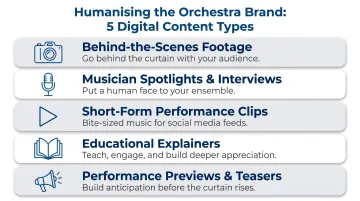
This humanizes the brand, making musicians relatable rather than distant virtuosos.
Community and Cultural Programming
The Malaysian Chamber Showcase (May 2026) brings together MPO and MPYO musicians in an intimate chamber format — the kind of programming that signals genuine investment in local artistic identity. Programming Malaysian and Southeast Asian composers alongside Western repertoire makes a practical statement: this orchestra belongs here.
When audiences see their own cultural references on stage, the institution stops feeling like an imported art form and starts feeling like a shared one.
Lessons from Comparative Orchestra Branding in the Region
Singapore Symphony Orchestra: Insight-Led Brand Architecture
The Singapore Symphony Orchestra (SSO) offers a useful regional comparison for how insight-led branding creates lasting coherence. Their strategy is anchored in understanding what motivates audiences at each stage of the musical journey.
The SSO operates a multi-tiered brand structure including the flagship orchestra, the Singapore National Youth Orchestra, and specialist series. The SSO's dual positioning — formal for subscription concerts, casual for community outreach — risks creating brand confusion if not managed deliberately.
However, the SSO's collaboration with TwoSet Violin (social media violinists with 4 million YouTube subscribers) resulted in 80-85% of attendees being first-time symphonic concertgoers. SSO YouTube subscribers grew from approximately 20,000 to 45,000 following this strategy.
The Transferable Model
The most successful orchestra brands in the region:
- Define their artistic positioning beyond "we play classical music"
- Build brand architecture around distinct audience segments — casual concertgoers, serious patrons, young audiences, families
- Maintain consistent visual and messaging identity across all touchpoints: concert programs, digital channels, education materials, community communications
- Use audience data to inform strategy, not gut feeling or tradition
Vantage Branding's work with the SSO put this model into practice. By mapping audience motivations and barriers, the agency developed a brand strategy built on emotional resonance and a contemporary visual identity — moving the SSO beyond institutional formality toward broader audience engagement.
Malaysian orchestras facing similar challenges can draw directly from this approach to unify their identity across programs and touchpoints.
Actionable Takeaways for Arts Organizations in Malaysia
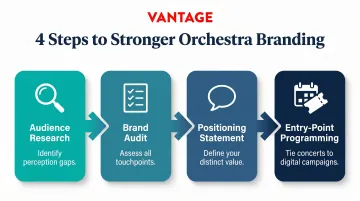
Malaysian orchestras can take immediate branding steps:
1. Start with audience research — find out where perception gaps exist before changing anything else:
- Survey current patrons and lapsed attendees
- Run focus groups with non-attenders to identify barriers
- Analyze social media sentiment and engagement data
- Map audience demographics against census data
2. Audit your brand touchpoints — inconsistency erodes trust faster than most organizations realize:
- Review all visual materials (logos, colors, typography)
- Assess messaging across website, social media, and print collateral
- Evaluate venue branding and environmental graphics
- Identify and prioritize the gaps
3. Write a clear positioning statement — one that goes beyond "we play classical music":
- Define what makes your orchestra distinct
- Articulate the emotional and cultural value you deliver
- Connect that value explicitly to Malaysian audiences
4. Build an entry-point programming strategy tied to digital campaigns:
- Schedule film-score and crossover concerts quarterly
- Develop social media content around each entry-point event
- Track first-time attendee conversion rates
- Build digital-to-ticket sales funnels
The Core Branding Challenge
Cultural institutions carry a dual mandate: artistic excellence and public access. Both must be reflected in brand strategy.
Brand too heavily toward prestige, and you lose younger audiences. Brand too hard for accessibility, and you risk undermining the artistic authority that gives the institution its value. The orchestras that grow are the ones that treat these as complementary, not competing.
The MPO's success with Symphonic Ghibli—high-quality orchestral performance of culturally beloved music—exemplifies this balance. The concert delivered artistic excellence while maximizing accessibility, drawing 6,300 people and generating RM1.6 million.
Frequently Asked Questions
Where is Dewan Filharmonik Petronas?
Dewan Filharmonik Petronas is at Level Two, Tower Two, Petronas Twin Towers, Kuala Lumpur City Centre, 50088 Kuala Lumpur. It is the home of the Malaysian Philharmonic Orchestra and Malaysia's first purpose-built classical concert hall.
What is the Malaysian Philharmonic Orchestra?
The MPO is Malaysia's flagship professional symphony orchestra, founded in 1997 and funded by Petronas. It comprises musicians recruited through worldwide auditions and performs approximately 43 concerts annually at Dewan Filharmonik Petronas, reaching over 33,000 attendees.
How do symphony orchestras attract younger audiences in Malaysia?
Common approaches include film score concerts (Harry Potter, Star Wars, Studio Ghibli), influencer collaborations, and short-form digital content such as behind-the-scenes footage and musician spotlights. School and university partnerships build longer-term audience pipelines for millennial and Gen Z engagement.
What role does corporate sponsorship play in Malaysian orchestra branding?
Corporate patronage—Petronas' support of the MPO being the clearest example—provides essential funding and infrastructure. The risk is brand identity tension: when an orchestra's image becomes too tied to its sponsor, maintaining artistic credibility and institutional independence requires deliberate positioning.
How does Malaysia's cultural diversity affect orchestra audience development?
Orchestras must develop programming and communications that resonate across Malay, Chinese, Indian, and indigenous communities. Featuring Malaysian and Southeast Asian composers, marking cultural festivals through orchestral arrangements, and partnering with local artists signals cultural relevance—rather than projecting a Eurocentric classical identity.
What branding strategies work best for arts organisations in Southeast Asia?
Audience segmentation, clear artistic positioning, consistent visual identity, and community-rooted programming deliver the strongest results. Orchestras that define a distinct value proposition and invest in coherent brand architecture consistently outperform those relying on tradition or past reputation alone.