Introduction
Malaysia's hospitality sector is more competitive than it has ever been. From boutique Penang shophouses to Langkawi beach resorts, operators are fighting for the same guests—yet many properties still treat branding as a cosmetic afterthought. A new logo and a campaign launch rarely build the loyal audiences that sustain long-term growth.
That gap between effort and outcome becomes costly at this scale. Malaysia welcomed 38 million foreign visitors in 2025, making it ASEAN's most visited destination for two consecutive years. With Visit Malaysia 2026 targeting 43 million arrivals and RM329 billion in revenue, the stakes are high.
Properties without a clear brand foundation default to OTA dependency and price wars, compressing margins and eroding guest loyalty.
This article draws actionable insights from real hospitality branding patterns observed across Malaysia, helping hotel, resort, F&B, and destination operators understand what separates brands that build loyal audiences from those that compete purely on price.
Why Branding Defines Success in Malaysia's Hospitality Sector
Malaysia's hospitality market is at a critical crossroads. In 2024, the country welcomed 25.02 million international visitors—a 24.2% increase from 2023. Yet with 5,592 registered hotels and 361,563 rooms competing for those arrivals, occupancy rates remain modest: the nationwide average sits at 51.1%, with even Kuala Lumpur achieving only 62.3%.
The competitive pressure is real. OTAs now account for 63.4% of independent hotel bookings globally, up from 61.3% in 2024. More concerning: between 2019 and 2025, hotel RevPAR increased 19%, but cost of acquisition increased 25%—outpacing revenue gains and compressing profit margins.
The Shift in Traveller Expectations
Today's Malaysian and international guests seek more than room rates. The paid experiences market is now valued at $250–310 billion annually, growing at approximately 14% per year. Affluent travellers across Asia Pacific are reducing trip frequency but spending more per trip, prioritising cultural immersion, wellness, and personalized service over standardized offerings.
That spending shift translates directly into a brand opportunity. Travellers now choose properties for what they stand for—authentic architecture, regional cuisine, cultural storytelling—not just availability and price. Malaysian properties, with their layered heritage and multicultural identity, have the raw material to command this premium. But raw material alone isn't enough; brand strategy has to connect it to every guest touchpoint.
The Cost of Weak Branding
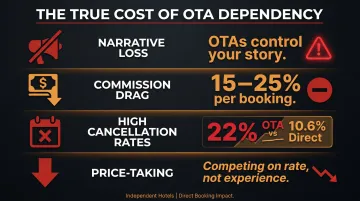
Without a clear brand foundation, hospitality properties fall into a predictable trap: OTA dependency. The consequences compound quickly:
- Narrative loss: Third-party platforms control how your property is described and discovered
- Commission drag: OTA rates run 15–25% per booking, directly eroding margins
- Higher cancellation rates: OTA bookings cancel at roughly double the rate of direct bookings (22% vs. 10.6%)
- Price-taking, not price-making: Competing on availability and rate rather than experience
Boutique hotels without strong brand identities end up racing to the bottom. A defined brand is what lets properties stop competing on rate and start commanding it.
Key Elements of Effective Hospitality Branding in Malaysia
Cultural Authenticity as the Brand Core
The strongest Malaysian hospitality brands root their identity in the country's multicultural heritage—Malay, Chinese, Indian, and indigenous traditions woven together. This creates brand DNA that global chains cannot replicate.
Consider the competitive advantage:
- Over 33.3% of tourist spending in Malaysia is devoted to food, with 97% of Malaysians expressing strong appreciation for their own local cuisine
- Malaysia is home to 4 UNESCO World Heritage Sites, including the Historic Cities of Melaka and George Town, which protect multicultural streetscapes and heritage architecture
- Properties that incorporate authentic local materials, Peranakan design, regional culinary experiences, and cultural programming create differentiation that withstands competitive pressure
Authenticity isn't cosmetic—it's structural. The brand must be built on what genuinely exists: the architecture, the location, the culinary heritage, the stories embedded in the property itself.
The Brand vs. Branding Distinction
Many operators conflate the brand with branding—and that confusion is costly.
The brand is your DNA—the visual, historical, environmental, and cultural assets of your property. It's what you are: a 1920s Straits Chinese shophouse, a rainforest eco-lodge, a beachfront wellness retreat—your location, architecture, heritage, culinary philosophy, and service culture combined.
Branding is how that DNA comes to life across every guest touchpoint—from initial online research through booking, arrival, stay, and post-visit engagement. It's the consistent narrative that connects discovery to loyalty.
The mistake: investing in branding (new logos, campaigns, social media) without first defining the brand. Without that foundation, campaigns produce noise rather than recognition.
Consistency Across the Customer Journey
Effective hospitality branding is not a campaign—it's a continuous narrative. Guests form impressions at multiple stages:
- Discovery: First impressions form through social media, OTA listings, and search — before a guest ever visits your website
- Consideration: Website experience, photography, and reviews either confirm or undercut initial interest
- Booking: Ease of process, confirmation messaging, pre-arrival touchpoints
- Arrival: Physical environment, staff interaction, sensory experience
- Stay: Service quality, in-room details, F&B experience, amenity design
- Post-visit: Follow-up communication and loyalty touchpoints determine whether a guest becomes a repeat visitor or just a transaction
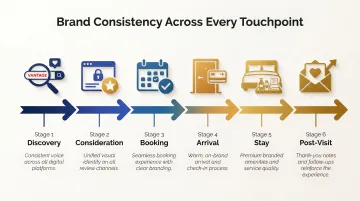
Brand consistency at each stage matters more than creative execution. If your website promises boutique heritage charm but your check-in process feels transactional, the brand promise breaks.
Stakeholder Buy-In and Frontliner Alignment
Brand identity delivers value only when all stakeholders—especially frontline staff—understand and embody the brand promise. In hospitality, staff function as hosts, storytellers, and destination ambassadors, not transactional service workers.
Properties that invest in internal brand alignment see measurable results:
- Consistent guest experience regardless of which staff member serves them
- Authentic storytelling that brings the property's heritage and culture to life
- Reduced staff turnover as employees connect to a meaningful brand mission
- Organic content generation as staff become brand advocates
This requires documentation: brand guidelines, service standards, staff training materials, and ongoing reinforcement through internal communications.
Balancing Identity with Operational Systems
Malaysian hospitality brands—especially boutique and independent properties—must balance character and warmth with structured SOPs. Many operators fear that systemisation dilutes authenticity. In practice, the opposite holds. SOPs protect authenticity by ensuring every guest receives the same quality experience—creating the reliable foundation that lets genuine personality come through consistently.
Properties that document their brand standards, service sequences, and guest journey protocols perform better during growth phases and recover faster during disruptions.
Case Study Insights: What Malaysia's Hospitality Brands Teach Us
Malaysia's hospitality landscape offers valuable branding lessons—from heritage boutique hotels to destination marketing strategies to content-led digital approaches. These patterns reveal what works, what doesn't, and why.
Lesson 1: Authenticity-Driven Properties Win on Loyalty, Not Just Occupancy
Properties in heritage destinations like Penang, Malacca, and Ipoh that built their brand around restored architecture, Peranakan design, and cultural programming consistently attract repeat visitors and generate organic content from guests—reducing acquisition costs over time.
The Cheong Fatt Tze Mansion (The Blue Mansion), George Town, Penang
This property demonstrates authenticity-led branding at its most deliberate. Built in 1897 by Chinese merchant Cheong Fatt Tze, the mansion is a masterpiece of Straits Chinese Eclectic architecture.
It incorporates traditional Chinese courtyard design, European stained glass, Scottish cast iron, and meticulous Feng Shui alignment—each element intentional, none decorative.
Purchased in 1989 to prevent demolition, the mansion underwent major restoration in 1995 using traditional methods, including lime mixed with natural indigo dye for its iconic blue walls. Today it operates as an 18-room boutique hotel and museum, managed by Straits Indigo Sdn. Bhd., and expanded to three properties: The Blue Mansion, The Qing Suites, and The Townhouses.
Brand positioning: "A heritage-led collection crafted for the intentional traveller," with core values of sense of place, unhurried wellbeing, and calm thoughtful grace.
Recognition achieved through authentic brand foundation:
- 2000: UNESCO "Most Excellent Project" — Asia Pacific Heritage Awards
- 2011: Named "One of 10 Greatest Mansions in the World" by Lonely Planet
- 2021: World Luxury Hotels Awards — Luxury Heritage Hotel (Global) Winner
- 2026: Tatler Best Hotels Malaysia and Tatler Best-in-Class Hotel awards
- Featured in Crazy Rich Asians, Indochine, and international media including BBC, CNN, and Discovery Travel & Living
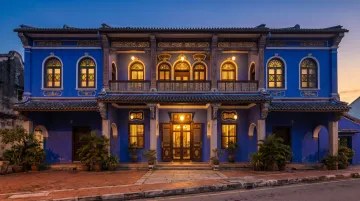
The property's brand strength doesn't come from marketing campaigns—it comes from authentic restoration, cultural storytelling, and guest experience consistency that generates word-of-mouth and media coverage organically.
Lesson 2: Destination Brands Need a Clear Proposition Built on Real Assets
Destination and state-level tourism brands in Malaysia succeed when their proposition is built on what they genuinely offer—natural assets, indigenous culture, ecological uniqueness—not aspirational but hollow messaging.
Langkawi: UNESCO Global Geopark as destination brand
Designated a UNESCO Global Geopark in 2007, Langkawi has a globally recognised brand asset. Visitor arrivals have grown steadily: 1.09 million (2021), 2.58 million (2022), 2.81 million (2023), 2.90 million (2024), and 3.22 million (2025).
Yet a 2019 academic study found that while stakeholders accept the Geopark as a global brand, most remain "confused about the Geopark concept in terms of implementation" and the specific actions needed to protect it. Designation alone doesn't create brand value. Consistent activation and stakeholder alignment do.
Sarawak: Regenerative tourism and cultural brand
Sarawak has positioned itself around regenerative tourism and indigenous cultural heritage. The Rainforest World Music Festival drew over 22,000 attendees in June 2025, positioned not just as a music event but as "a movement of purpose" focused on environmental stewardship, cultural diplomacy, and meaningful tourism.
Sarawak's ecotourism strategy is described as "a deliberate, strategic pillar of development" in government planning—one where policy, stakeholder action, and marketing align around a single, grounded proposition.
That alignment is the lesson. Destination brands that lack it tend to rely on media spend rather than meaning, producing flat visitor growth and no differentiation from competing markets.
Lesson 3: Digital is a Relationship Tool, Not a Broadcast Channel
Malaysian hospitality brands that treat social media and digital platforms as broadcast channels—one-way, campaign-driven—underperform compared to those that use digital to build direct-to-consumer relationships.
Industry-level data reveals the challenge:
- Traditional search engine usage for travel research fell from 51% to 36%; consumer use of AI platforms for travel research more than doubled
- 41% of independent hotels report using AI tools, compared to 80% of hotel chains
- 82% of hotels plan to increase AI usage within the next 12 months
Properties that succeed digitally focus on:
- Email capture and retargeting to build owned audiences
- Branded content that tells their story across video, photography, and blog formats
- Community management that engages past and potential guests in two-way conversation
- User-generated content that amplifies authentic guest experiences
The pattern holds across markets: properties that own their digital narrative and build direct relationships reduce OTA dependency, lower acquisition costs, and improve guest lifetime value. The channel is secondary. The relationship is the brand asset.
How Malaysian Hospitality Brands Can Use Digital Storytelling
Experience-related content is critical for hospitality brands in Malaysia because it drives organic discovery and allows properties to own their narrative—not rely on OTA descriptions or third-party reviews alone.
The Mechanics of a Content-Led Brand System
A property's brand story becomes the anchor for all digital content—guiding visual identity choices, social media tone, website copy, and email marketing. This ensures every piece of content reinforces the same brand DNA.
Consider the data on user-generated content:
- 92% of consumers trust word-of-mouth and UGC more than traditional brand advertising
- 77% of people have purchasing decisions influenced by a brand's use of UGC
- 32–39% of millennials will not book a hotel if the brand does not use UGC in its digital marketing
- UGC is rated 9.8x more impactful than influencer content and 2.5x more authentic than branded content
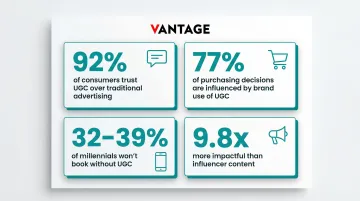
Yet 71% of resorts and hotels do not have UGC galleries on their websites, and 82% of hospitality brands still source visuals through professional photographers or stock photos. That gap is where brands lose credibility with the guests most likely to book.
The Role of Data and Technology
Digital tools allow Malaysian hospitality brands to stay connected with past and potential guests beyond a single visit or campaign, building long-term relationships that lower acquisition costs over time.
Essential systems include:
- Email marketing automation for pre-arrival, during-stay, and post-visit engagement
- Retargeting pixels to re-engage website visitors who didn't book
- CRM systems to track guest preferences, stay history, and lifecycle stage
- Booking engine integration to reduce friction in the direct booking path
RevPAR grew 19% between 2019 and 2025, but cost of acquisition grew 25%. Direct bookings are not just a channel strategy—they are a margin protection strategy.
Using Local Collaborations as Content Anchors
Malaysian properties can build on collaborations with local artisans, chefs, cultural practitioners, and community organisations as authentic content anchors that differentiate the brand and generate media coverage, social sharing, and repeat engagement.
Examples include:
- Heritage walking tours led by local historians
- Cooking classes featuring regional cuisines and family recipes
- Artisan workshops (batik printing, rattan weaving, pottery)
- Partnerships with cultural festivals and performances
- Farm-to-table dining experiences with local producers
These collaborations create content that is shareable, culturally grounded, and specific enough to the property that no competitor can simply copy the formula.
Common Hospitality Branding Mistakes in Malaysia
Mistake 1: Treating Branding as Cosmetic
Many Malaysian hospitality businesses invest in logo redesigns, new taglines, or advertising campaigns without addressing the underlying brand experience—service consistency, product quality, or guest journey design.
This approach is wasteful and unsustainable. A beautiful logo on a website cannot compensate for:
- Inconsistent service standards across shifts or locations
- Disconnection between brand promise and actual guest experience
- Lack of staff understanding of what the brand stands for
- Poor operational systems that create friction at key touchpoints
Branding is not a veneer applied after the fact. What guests experience at every touchpoint — from check-in to checkout — is your brand in action.
Mistake 2: Building for Stakeholders, Not Guests
Some properties create experiences designed to satisfy internal stakeholders or investors rather than grounded in what target guest segments actually want.
This manifests as:
- Facilities that look impressive in renderings but don't serve guest needs
- Brand messaging written for board presentations, not customer acquisition
- Design choices that reflect owner preferences, not target market expectations
- Pricing strategies disconnected from perceived value
Brand strategy must be built around real guest insights, not aspirations. Know your target segment's decision criteria, pain points, and what they genuinely value — then build your brand to serve them, not to impress your shareholders.
Mistake 3: Neglecting Post-Visit Brand Relationships
Malaysian hospitality brands frequently underinvest in post-stay engagement—follow-up emails, loyalty touchpoints, content that keeps past guests connected to the brand.
The guest relationship should not end at checkout. Ongoing engagement is one of the highest-ROI branding activities available:
- Post-stay follow-up to thank guests, request feedback, and encourage reviews
- Seasonal offers tailored to past guest preferences
- Content newsletters that share destination stories, property updates, and cultural insights
- Loyalty programs that reward repeat visits with meaningful benefits
- Exclusive pre-access to new offerings, events, or experiences
These touchpoints keep your property front of mind when guests plan their next trip—and reduce the likelihood they'll default to OTA search for their return visit.
Building a Future-Ready Hospitality Brand in Malaysia
Malaysia's hospitality brands must prioritize strategic fundamentals to thrive in the Visit Malaysia 2026 environment and beyond.
Invest in Niche Experiential Pillars
Rather than competing as a generic destination, focus on specific experiential pillars:
- Ecotourism: Malaysia's NTP 2020–2030 explicitly targets becoming the world's "Top of Mind Ecotourism Destination"
- Culinary heritage: With 33.3% of tourist spending devoted to food and 97% domestic cuisine appreciation, gastronomic experiences are a competitive advantage
- Wellness: Affluent Asia Pacific travellers now prioritize wellness as a primary reason for travel
- Cultural immersion: Authentic engagement with Malaysia's multicultural heritage creates experiences global chains cannot replicate
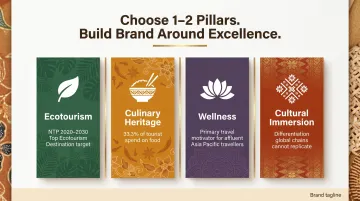
Choose one or two pillars that align with your property's authentic assets, and build your brand around excellence in those areas.
Create Best-in-Class Products Before Amplifying Them
Branding cannot compensate for a mediocre product. Before investing in marketing campaigns, ensure your property delivers a genuinely excellent guest experience. That means fixing operational inconsistencies, training staff thoroughly, refining service standards, and documenting your processes.
Once those foundations are solid, amplify through branding and marketing.
Build Direct Data Relationships with Target Segments
The shift from search engines to AI-powered research tools, combined with rising acquisition costs, makes direct relationships with guests more valuable than ever. Invest in:
- Owned email lists built through website capture, booking confirmations, and post-stay engagement
- First-party data systems that track guest preferences and behaviour
- Personalization engines that tailor communications to individual guest profiles
- Direct booking incentives that reward guests for bypassing OTAs
These systems reduce your reliance on third-party platforms and improve profit margins over time.
Document Your Brand Strategy
A written brand plan is not optional. Properties and destinations that operate without a documented brand strategy are guessing. Those with a clear brand plan—including crisis protocols—demonstrably perform better during disruptions and recovery periods.
Your brand plan should cover:
- Positioning: what you stand for, who you serve, and why you're different
- Identity guidelines: visual and verbal standards across all touchpoints
- Guest journey map: every touchpoint from discovery to post-visit loyalty
- Service standards: SOPs that protect consistency and quality
- Communications framework: how the brand expresses itself across channels
- Crisis protocols: how to protect brand equity when disruptions hit
Hospitality operators across Malaysia looking to build a strategically grounded brand can benefit from working with a regional specialist. Vantage Branding is a Singapore-based brand consultancy that works with hospitality and destination brands across Malaysia and Asia, helping them develop brand strategy, identity, and communications grounded in genuine market insight.
Frequently Asked Questions
What makes hospitality branding in Malaysia different from other markets?
Malaysia's multicultural heritage—Malay, Chinese, Indian, and indigenous cultures—combined with diverse landscapes and growing traveller demand for authentic, culturally immersive experiences, makes branding uniquely complex. Properties that successfully weave these cultural assets into their brand DNA create differentiation that cannot be replicated by standardised global chains.
How do boutique hotels in Malaysia build a strong brand identity?
Boutique hotels build strong identities by rooting their brand in authentic local assets: heritage architecture, regional cuisine, cultural storytelling, and location-specific design. Consistent expression across every guest touchpoint—from social media to in-room experience—creates the coherent brand narrative that drives loyalty.
What are the most common hospitality branding mistakes in Malaysia?
The three main pitfalls are: treating branding as a cosmetic exercise (logo and tagline only) without addressing underlying service quality and guest experience; building for internal stakeholders instead of target guests; and neglecting post-visit relationship-building that drives repeat visits and reduces acquisition costs.
How important is cultural authenticity in Malaysian hospitality branding?
Authenticity is a primary competitive advantage. Travellers increasingly choose properties offering a genuine sense of place over standardised chain experiences. Malaysian properties rich in heritage and multicultural identity are well-positioned to deliver this—but only when brand strategy is built on real cultural assets, not surface-level aesthetics.
How can a Malaysian hotel or resort measure the success of its branding?
Key indicators include:
- Direct booking rates and repeat visit frequency
- Cost of guest acquisition and customer lifetime value
- Organic guest-generated content and social media engagement
- Brand sentiment across review platforms and email list growth
When should a Malaysian hospitality business consider rebranding?
Rebranding makes sense when the current brand no longer reflects the property's actual experience, when entering a new market segment, or when flat performance signals lost differentiation. It should never be cosmetic—it must be strategic, research-grounded, and aligned with operational capability.