Building a Brand That Works in Malaysia
Malaysia is one of the most structurally complex branding environments in Southeast Asia. With a population of 58.1% Malay, 22.4% Chinese, and 6.5% Indian citizens — plus indigenous communities in Sabah and Sarawak — the market resists any single-audience approach.
A campaign that resonates in Kuala Lumpur's cosmopolitan core might fall flat in Penang's heritage districts or misfire entirely in Johor's cross-border market. Urban sophistication meets distinct regional identities, and what works in Singapore rarely translates without serious adaptation.
Many businesses invest heavily in logos, social media calendars, and polished taglines — then wonder why market penetration stalls. The gap isn't execution; it's strategy. Without positioning grounded in cultural intelligence, even the most visually striking brand goes unnoticed. Malaysian consumers evaluate authenticity before they evaluate features — and trust is built through demonstrated cultural understanding, not just digital presence.
This guide covers the strategic layer most businesses skip: from brand audit and positioning to cultural adaptation, multichannel execution, regional diversity, and using Malaysia as your ASEAN gateway.
TLDR:
- Malaysia's three-way ethnic diversity demands deliberate cultural localisation at every touchpoint
- At 97.4% digital penetration, reach is easy — trust still favours brands that reflect local culture
- Festive seasons are storytelling moments, not just promotional windows
- Regional differences between KL, Penang, Johor, and East Malaysia require tailored execution
- Strong Malaysian brand positioning creates a replicable blueprint for broader ASEAN expansion
Why Malaysia Demands a Distinct Brand Strategy
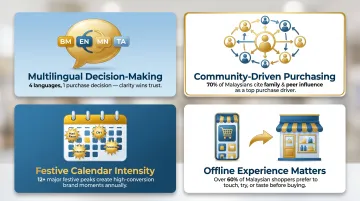
Malaysia runs deeper than its digital numbers suggest. Internet penetration stands at 97.4% with 28.68 million social media users, making it one of the most connected markets in Southeast Asia. Yet foreign brands still face a 15-point trust deficit compared to domestic ones, and 73% of consumers prefer brands that authentically reflect local culture. Connectivity gets you in front of people. Cultural fluency determines whether they trust you.
Key structural factors that set Malaysia apart:
- Multilingual decision-making: Consumers switch between Bahasa Malaysia, English, Mandarin, and Tamil depending on context — each language carries different emotional registers and trust signals
- Community-driven purchasing: Word-of-mouth and personal interaction heavily influence buying decisions, particularly in ethnic enclaves where digital ads alone won't close the gap
- Festive calendar intensity: Hari Raya, Chinese New Year, Deepavali, and national celebrations overlap throughout the year, creating concentrated periods of emotional brand engagement
- Offline experience matters: Despite high digital adoption, 80% of mobile local searches convert to offline purchases within 24 hours — physical touchpoints remain critical
The cost of cultural missteps is immediate and public. Watsons Malaysia pulled a 2017 Hari Raya campaign after social media backlash over a blackface scene promoting skin lightening. Malaysia Airlines renamed its 2014 "Bucket List" contest following international condemnation — launched just months after two separate tragedies.
Prasarana removed a 2025 deodorant ad from LRT lines over accusations of racial and religious insensitivity. Each case unfolded across Malaysia's hyper-engaged social media ecosystem, eroding trust faster than any campaign could rebuild it.
Applying a Singapore-centric or global template without localization carries real reputational exposure. Colors, tone, imagery, and messaging that land well in one cultural context can alienate or cause offence in another — and in Malaysia, that feedback arrives publicly and fast.
Starting With Insight: The Brand Audit and Positioning Foundation
Brand strategy starts with understanding, not expression. Most businesses rush to design and deployment before establishing clear positioning — which leads to fragmented messaging, inconsistent execution, and poor market fit. In Malaysia's multicultural environment, that gap shows up as fragmented positioning across communities.
Mapping the Brand From Four Angles
A brand audit tailored for Malaysia should cover four lenses:
Category and industry culture — What meanings, expectations, and narratives are shifting in your sector? Are trust signals evolving differently across ethnic communities?
Competitive landscape — Where are competitors clustered in terms of positioning, tone, and cultural alignment? Where is credible white space?
Customer research — What are the real behaviors, motivations, and unmet needs across different audience segments?
In Malaysia, this research must be segmented by community. Generalized surveys administered in a single language often miss how trust triggers and purchasing motivations differ across Malay, Chinese, and Indian audiences.
Internal brand essence — What can your business genuinely and consistently deliver? Positioning is only credible if it's supported by operational reality.
Building the Positioning Platform
The audit outputs feed directly into your positioning platform, which defines:
- Target audience — Who you serve, with demographic and psychographic specificity
- Value proposition — The functional and emotional benefits you deliver
- Brand personality — How you sound, feel, and behave across touchpoints
- Brand role — The job your brand performs in customers' lives
Positioning is the decision-making compass that guides communication, product experience, hiring, and partner selection. For companies entering Malaysia from Singapore or other markets, this is the moment to decide how much the brand identity should be adapted versus maintained consistently — and that choice should be driven by insight, not assumption.
Working with a branding partner experienced in the Singapore-Malaysia corridor, such as Vantage Branding, can help you navigate the adapt-vs-maintain decision with research grounded in both markets. Research shows that maintaining brand consistency can boost revenue by 10-20% — but consistency must accommodate cultural adaptation, not override it.
Cultural Intelligence: Adapting Your Brand for Malaysia's Multicultural Market
Cultural intelligence is competitive advantage. Brands that understand Malaysia's multicultural market earn trust faster, convert better, and generate stronger word-of-mouth. Those that miss the mark risk public backlash and lasting reputational damage.
Language, Symbolism, and Visual Identity
Malaysia's multilingual reality means that Bahasa Malaysia, English, Mandarin, and Tamil each carry different registers, emotional tones, and audience expectations. Translating a campaign is not the same as culturally adapting it — tone, humor, imagery, and even color all require adjustment.
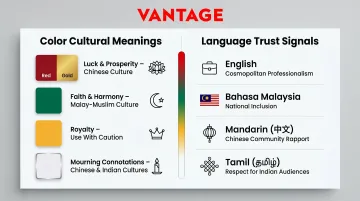
Color carries cultural weight:
- Red and gold resonate strongly with Chinese Malaysians, symbolizing luck, prosperity, and wealth — essential for Chinese New Year campaigns
- Green holds significance for Malay-Muslim audiences, representing Islam, paradise, and faith
- Yellow is reserved for royalty in Malaysia; using it carelessly can signal disrespect
- White is associated with purity in some contexts but also with mourning and funerals, particularly for Chinese and Indian communities
A single brand color palette cannot serve all three major communities without careful contextual adaptation. Red packaging works for Chinese New Year but may need green or purple accents during Hari Raya.
Language adaptation goes beyond translation. Research shows that 75% of consumers are more likely to repurchase if customer care is offered in their native language, and 65% prefer native-language websites even if content quality is lower. Each language carries distinct trust signals for Malaysian audiences:
- English conveys cosmopolitan professionalism
- Bahasa Malaysia signals national inclusion
- Mandarin builds rapport with Chinese communities
- Tamil demonstrates respect for Indian audiences
The Festive Calendar as a Strategic Brand Tool
Malaysia's festive calendar — Hari Raya, Chinese New Year, Deepavali, and national celebrations — is not just a content marketing opportunity. It's a moment when consumer attention, purchasing intent, and emotional openness to brands are all elevated simultaneously. Retail sales reached a record RM163.7 billion in December 2025, reflecting the concentrated economic impact of closely timed festivals.
The most effective brands in Malaysia treat festive engagement as a storytelling platform. They build narratives around shared values — family, community, resilience, generosity — rather than running superficial themed promotions.
Petronas sets the standard. The national oil company's Hari Raya and Merdeka Day campaigns are treated as cultural events, not commercials. Petronas Raya 2025 campaign "Anak Siapa Ni?" won Merit for Best Use of Cultural Insights at the Kancil Awards, exploring the concept of "rezeki" (blessings) through guests visiting during Raya. The brand has won multiple Putra Brand Awards, and its campaigns generate over 1.5 million views within days of launch.
Halal compliance is non-negotiable for reaching Malay-Muslim consumers. JAKIM governs halal certification under the Trade Descriptions Act 2011, with false halal claims carrying fines up to RM500,000. Research shows 80% of consumers are more confident in products carrying the official JAKIM halal logo. For brands entering the Malaysian market, visible and verifiable halal status is a trust signal that extends well beyond religious compliance.
Executing Your Brand Strategy: Digital and Offline Channels
An effective brand execution strategy in Malaysia must be multichannel — combining digital platforms with offline touchpoints. Digital reach is universal, but trust and conversion require physical interaction.
Digital platform priorities:
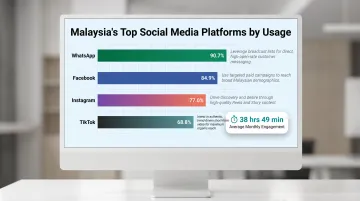
- WhatsApp (90.7% monthly usage) — Essential for customer service and direct communication
- Facebook (84.9% monthly usage) — Broadest demographic reach, ideal for community building
- TikTok (68.8% monthly usage, but 38 hours 49 minutes monthly engagement) — Highest time-per-user, critical for younger demographics
- Instagram (77.0% monthly usage) — Visual storytelling and aspirational brand positioning
Content must be tailored per platform, not repurposed uniformly. TikTok demands short-form, trend-driven content. Facebook favors longer community-focused narratives. Instagram requires polished visual storytelling.
86% of Malaysian consumers are influenced by social media advertisements, but influence doesn't equal trust — cultural alignment still determines whether that influence converts.
Offline Brand Activation
Mall pop-ups, roadshows, and product launches allow consumers to interact physically with the brand, which builds trust in ways digital campaigns alone cannot. Greater KL retail is shifting toward experiential retail strategies, with landlords introducing experience-led offerings to differentiate and sustain footfall. These activations are most effective when anchored in cultural moments (festivals, community events) and localized to specific cities.
Local Search Visibility
97% of Malaysian consumers use search engines to find local businesses, and "near me" searches have grown by over 900% in recent years. Brands entering the Malaysian market should ensure their Google Business Profile is complete and accurate, with city-specific targeting:
- KL/Klang Valley: Hyperlocal neighbourhood targeting (Mont Kiara, Bangsar, Damansara Heights)
- Penang: Bilingual search optimisation (English and Mandarin), visual content showcasing heritage and food culture
- Johor Bahru: Cross-border search traffic from Singaporeans, emphasising SGD payment acceptance and proximity to checkpoints
Regional Branding: Accounting for Malaysia's Geographic Diversity
Malaysia is not a monolithic market. Kuala Lumpur is cosmopolitan and fast-moving; Penang carries a distinct heritage identity with a significant Chinese population; Johor is shaped by cross-border consumer traffic from Singapore.
Sabah and Sarawak are a different story entirely. East Malaysian cultural identities diverge sharply from Peninsular norms — Sabah alone is home to 39 indigenous ethnic groups.
A brand strategy built only around KL will miss large and distinct segments of the country. Approximately 79% of citizens reside in Peninsular Malaysia, which accounts for less than 40% of total land area — creating a population-weighted urban bias in brand strategies that fail to account for regional diversity.
Regional brand considerations:
| Region | Key Characteristics | Branding Implications |
|---|---|---|
| KL/Klang Valley | Highest business density, hyperlocal neighborhoods, intense competition | Aggressive differentiation required; target by township, not just city |
| Penang | Heritage tourism, street food culture, significant Chinese population | Visual and food-focused content; bilingual (English/Mandarin) essential |
| Johor Bahru | Cross-border traffic from Singapore, weekend shopping destination | SGD pricing/payment info; proximity to checkpoints; weekend promotions |
| Sabah | 39 indigenous ethnic groups, distinct cultural identity from Peninsular | Avoid Peninsular-centric assumptions; indigenous community sensitivity |
| Sarawak | Iban, Bidayuh, Melanau populations; English widely used alongside indigenous languages | Separate media and language strategies from Peninsular Malaysia |
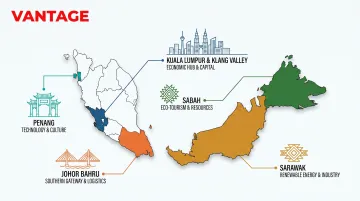
The table above reflects just the starting point. Before deploying any campaign nationally, map each region against four variables: local purchasing behaviour, language preferences, media habits, and cultural anchors. Your brand core stays fixed — what changes is how you show up in each market.
Using Malaysia as Your ASEAN Brand Launchpad
Malaysia is structurally well-suited as a first market for ASEAN expansion. Its trade-to-GDP ratio reached 137% in 2024, making it more open to trade than approximately 90% of countries globally.
Its multilingual population (English, Bahasa Malaysia, Mandarin, Tamil), multicultural composition, and central geographic location make it an effective testing ground for multi-segment brand approaches — ones that can later be adapted for Indonesia, Singapore, Thailand, and the Philippines.
Brands that localize successfully in Malaysia — building genuine cultural fluency and earning community trust — develop a repeatable brand adaptation playbook that reduces the cost and risk of entering neighboring markets. Insights from Malay-speaking Malaysian audiences inform entry into Indonesia. Multicultural brand experience in Malaysia, meanwhile, prepares brands for Singapore's own diverse demographics.
That transfer, however, has a hidden trap. Despite approximately 80% lexical similarity, Bahasa Malaysia and Bahasa Indonesia contain critical vocabulary differences:
- "Percuma" means free (no cost) in Malay but useless/in vain in Indonesian
- "Butuh" means need in Indonesian but is vulgar slang in parts of Malaysia
- "Bisa" translates as can/able in Indonesian, but carries the meaning of venom or poison in Malaysian Malay
SEO keyword strategies, product descriptions, and campaign copy must be entirely separate for each market — the 20% difference contains high-frequency functional vocabulary where mistranslation risks range from confusion to offense.
For Singapore-headquartered businesses, Malaysia is often the most accessible first step into ASEAN. Working with a branding partner experienced across Singapore, Malaysia, Vietnam, and the broader Asia region — like Vantage Branding — ensures brand positioning is built for regional scalability from day one, not reconstructed market by market.
Frequently Asked Questions
What makes brand strategy in Malaysia different from other Southeast Asian markets?
Malaysia brings together Malay, Chinese, Indian, and indigenous communities under one market — each with distinct languages, values, and cultural expectations. That layered diversity demands deliberate localization at every brand touchpoint, a level of complexity you simply don't encounter in more ethnically homogeneous markets across the region.
How important is multilingual branding for businesses in Malaysia?
Multilingual adaptation is critical. It goes beyond translation — tone, imagery, and messaging each need cultural reframing across Bahasa Malaysia, English, Mandarin, and Tamil audiences. Brands that communicate fluently across these languages build measurably stronger trust and reach.
Should brands maintain the same identity in Malaysia and Singapore?
Core brand values and visual identity should remain consistent, but tone, messaging emphasis, and cultural references often need adaptation. Malaysia's multicultural complexity and Malay-Muslim majority audience create different trust signals compared to Singapore's more cosmopolitan consumer base.
How do we adapt our brand for Malaysia's festive seasons without appearing opportunistic?
Authenticity is the key differentiator. Brands should use festive periods to tell stories rooted in shared values (family, generosity, togetherness) rather than push promotional discounts, and this requires understanding the cultural meaning of each occasion, not just its commercial calendar.
How long does it realistically take to build strong brand recognition in Malaysia?
Brand building is a medium-to-long-term investment — meaningful recognition typically develops over 12-24 months of consistent, strategically grounded brand activity. Businesses should set milestone metrics at 3, 6, and 12 months to track progress without expecting overnight results.
Do I need a local or regionally experienced branding agency to succeed in Malaysia?
A strong brand framework travels well, but executing it in Malaysia requires genuine cultural knowledge and on-the-ground market experience. Partnering with an agency that has operated across Malaysia and Southeast Asia gives you a clear advantage — strategy that's sound in principle and credible in practice.