Introduction
The merger is signed. The deal closes. The press release goes out. But for customers checking your website and investors scanning your LinkedIn page, one question goes unanswered: Who are you now?
Malaysian companies face a real paradox post-merger: the business combination is complete on paper, but the brand transition determines whether the market accepts or rejects the new entity. When Celcom and Digi merged in November 2022, the 11-month gap before unveiling the CelcomDigi corporate brand in October 2023 showed just how carefully Malaysian telecoms navigate this moment.
With 97.7% internet penetration across 34.9 million Malaysians, brand confusion spreads fast—and customer churn follows.
What follows is a practical framework for navigating that transition: choosing brand architecture that preserves equity across multicultural audiences, executing digital rollout without losing SEO rankings, and measuring what matters in the first 90 days.
TLDR
- Malaysia's near-universal internet penetration means post-merger brand missteps are immediately visible to virtually the entire population
- Choose brand architecture (merged, endorsed, or house-of-brands) based on a brand equity audit of both entities
- Build digital-first identity systems covering logo, colour, typography, sonic branding, and scalable design assets
- Sequence rollout across owned, paid, and earned channels to avoid fragmentation
- Communicate the rebrand rationale in bilingual, culturally resonant messaging to retain customer trust
Why Post-Merger Branding Decisions Carry Higher Stakes in Malaysia
The Digital Exposure Risk is Quantifiable
Malaysia's digital landscape leaves no room for slow rebrands. As of January 2025, 97.7% of Malaysians are online, with 43.3 million mobile connections representing 121% population penetration. When a merged brand launches inconsistently across channels, the market notices within hours—not weeks.
Social media penetration reached 70.2% in 2025, meaning brand confusion plays out publicly on Facebook, Instagram, LinkedIn, and TikTok simultaneously. A poorly timed rebrand announcement, inconsistent logo usage, or conflicting messaging from customer service teams becomes a viral reputational issue before the marketing team can respond.
Multicultural Brand Resonance is Non-Negotiable
Malaysia's population comprises 58.2% Malay, 22.2% Chinese, 12.3% Other Bumiputera, and 6.5% Indian communities as of Q4 2025. A merged brand must resonate across at least three distinct cultural and linguistic contexts simultaneously—or risk alienating entire customer segments.
Each cultural group responds differently to the same brand signals:
- Visual language and iconography carry distinct meaning across Malay, Chinese, and Indian contexts
- Colour psychology varies — blue signals trust and credibility in Malay culture, while yellow resonates with energy and innovation for Chinese audiences
- Messaging tone that feels authoritative to one segment may read as cold or distant to another
CelcomDigi's decision to retain Celcom's blue and Digi's yellow shows how deliberate colour choices can protect cultural equity on both sides of a merger.
Customer Churn Compounds M&A Failure Rates
83% of M&A deals fail to boost shareholder returns, and 47% of employees leave within Year 1 of an acquisition. Brand confusion accelerates both customer and employee attrition during this vulnerable window.
Malaysian consumers show strong loyalty to established brands. When a merger disrupts familiar brand experiences — changed app interfaces, inconsistent service messaging, or an unfamiliar visual identity — customers question whether the service they trusted still exists.
Competitors actively target these moments of uncertainty with retention offers. That window of doubt is short, but the churn it drives is lasting.
Choosing Your Post-Merger Brand Architecture Strategy
Three Architecture Models for Malaysian Context
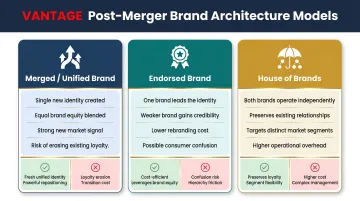
Post-merger brand architecture falls into three primary models, each with distinct trade-offs:
1. Merged/Unified Brand — Create a single new identity absorbing both entities (e.g., CelcomDigi). Best when both brands carry roughly equal equity and the merger aims to signal a new market position. Risks include alienating loyal customers of the "erased" brand.
2. Endorsed Brand — One brand adopts the other's name with an endorsement tag (e.g., "Digi, powered by Celcom"). Appropriate when one brand has markedly stronger equity and the weaker brand benefits from association. Lower execution cost but may confuse the market about which entity leads.
3. House of Brands — Both brands continue independently under a holding entity (e.g., Celcom and Digi as consumer brands under CelcomDigi corporate). Preserves existing customer relationships but requires maintaining two separate brand ecosystems, increasing operational cost.
Conduct a Brand Equity Audit Before Deciding
Harvard Business School identifies three methodologies for brand valuation in M&A scenarios:
- Cost-based valuation: What it would cost to rebuild the brand from scratch if it disappeared today
- Market-based valuation: How the brand compares to equivalent brands sold in recent transactions
- Income-based valuation: Future cash flows and price premiums that can be attributed directly to brand equity
Brand Finance's methodology adds a Brand Strength Index (BSI) scored out of 100, incorporating familiarity, functional credibility, and emotional appeal across 175,000 respondents in 41 sectors. This data reveals which brand carries stronger equity in specific customer segments—critical for architecture decisions.
Key metrics to audit:
- Unaided brand awareness and recall
- Net Promoter Score (NPS) by customer segment
- Branded search volume (monthly Google searches for each brand)
- Social media follower counts and engagement rates
- App store ratings and review sentiment
- Customer lifetime value by brand
Avoid "Equity Erasure"
CelcomDigi's retention of Celcom's blue and Digi's yellow in the new corporate identity demonstrates how visual equity can be deliberately preserved. When brands discard colour palettes, logomarks, or taglines that customers associate with reliability or innovation, they forfeit years of accumulated brand meaning.
Before finalising architecture, map which brand associations are worth keeping:
- Which brand has stronger trust scores in financial services?
- Which is associated with customer service excellence?
- Which has stronger awareness among younger demographics?
The architecture decision should preserve the strongest associations from each entity rather than starting from zero.
The Role of Specialist Brand Strategy Partners
These decisions carry real commercial risk — a poorly chosen architecture can erode customer trust built over years, and reversing course mid-rollout is expensive. That's where a specialist branding partner adds measurable value. Vantage Branding works with organisations across Malaysia and Southeast Asia to stress-test architecture decisions before they reach the digital rollout stage — through stakeholder workshops, brand equity research, and customer response modelling.
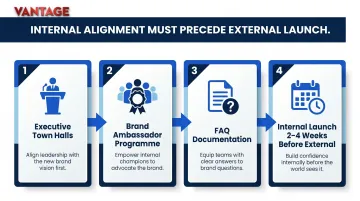
Internal Alignment Must Precede External Launch
The brand architecture decision must be communicated internally before any public announcement. Leadership, sales teams, customer service, and frontline staff all need to understand the new identity and the rationale behind it.
McKinsey research shows that while 80% of C-suite leaders believe their merger messaging is helpful, only 53% of employees agree — a perception gap that directly undermines external rollout credibility.
Internal alignment includes:
- Executive-led town halls explaining the "why" behind the new brand
- Brand ambassador programmes equipping employees to communicate the change
- FAQ documents addressing common concerns
- Internal brand launch before external launch by at least 2-4 weeks
Building a Unified Digital Brand Identity After a Merger
Components of a Comprehensive Digital Identity System
A post-merger digital brand identity extends far beyond a logo. Complete systems include:
- Logo and logomark optimised for digital use across screen sizes (desktop, mobile, smartwatch)
- Colour palette with HEX, RGB, and CMYK values for digital and print consistency
- Typography system with web-safe font pairings and hierarchy rules
- Iconography for UI elements, infographics, and social media
- Motion design principles governing animations, transitions, and video content
- Sonic branding including audio logos, brand music, and sound design
Digital Brand Style Guides Prevent Fragmentation
A digital brand style guide (or design system) is a living document governing how the brand appears across website, mobile app, social media, digital ads, email marketing, and third-party platforms. Without this, post-merger brand expression fragments across teams and channels.
Essential style guide sections:
- Logo usage rules (minimum sizes, clear space, acceptable variations)
- Colour application guidelines (primary, secondary, accent palettes)
- Typography hierarchy (H1-H6, body copy, captions)
- Photography and illustration style (composition, lighting, subject matter)
- Tone of voice guidelines (formal vs. conversational, key messaging)
- Social media templates (Instagram posts, LinkedIn banners, Facebook ads)
- Email signature templates
Domain and Digital Handle Strategy
Post-merger, companies must decide on:
- Domain consolidation: Redirect old domains to the new one using 301 redirects
- Social media handles: Consolidate or maintain separate accounts
- App store identity: Update app names, icons, and descriptions
Google Search Central advises keeping 301 redirects active for at least one year and mapping old URLs to specific new counterparts (not just redirecting all traffic to the homepage). Poor redirect management can cause 35% search visibility loss with six-month recovery timelines.
Sonic Branding Strengthens Digital Recognition
As Branding in Asia notes, "As audio and video consumption continues to rise across Asia-Pacific and globally, the demand for innovative sonic strategies is surging."
CelcomDigi's collaboration with Two AM Music produced a four-note sonic logo with "unique electric tonality" that mimics the natural inflection of the word "CelcomDigi." It shows how a well-crafted audio identity can:
- Reinforces brand name recall through melodic inflection
- Creates consistent experience across video platforms (YouTube, TikTok, LinkedIn)
- Differentiates the brand in audio-first environments (podcasts, smart speakers)
- Adds emotional resonance to brand touchpoints
AI-Assisted Generative Design for On-Brand Assets at Scale
Sonic identity addresses one layer of brand consistency. Visual consistency at scale is where AI tools are changing the equation. Adobe Firefly case studies show enterprises like IBM and Deloitte Digital using AI to produce on-brand assets at volume. Custom Models trained on proprietary brand assets ensure every output matches the established style — making AI a practical brand governance tool.
For post-merger brands, this means:
- Generating hundreds of social media assets in brand style without manual design
- Creating localised campaign visuals for multicultural audiences quickly
- Maintaining brand consistency across 30+ markets with minimal design resource
Sequencing the Digital Brand Rollout Across Channels
Why Phasing Matters: Core-First Sequence
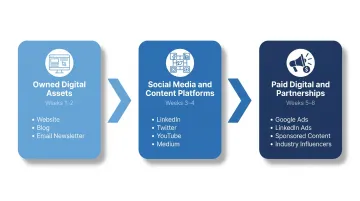
Launching every channel simultaneously risks inconsistency. Follow a "core first" sequence:
Phase 1 (Weeks 1-2): Owned Digital Assets
- Corporate website rebrand
- Mobile app updates (if applicable)
- Email signatures and templates
- LinkedIn company page
- Internal communications platforms
Phase 2 (Weeks 3-4): Social Media and Content Platforms
- Facebook, Instagram, LinkedIn, TikTok profile updates
- YouTube channel rebrand
- Blog and content hub updates
- Google Business Profile updates
Phase 3 (Weeks 5-8): Paid Digital and Partnership Channels
- Programmatic display ads
- Social media advertising
- Search engine marketing (SEM) updates
- Third-party listings and directories
- Partner co-branded materials
Getting owned channels right first means your paid media launches into a coherent brand environment — not a mixed-message one.
Website Rebrand: The Most Critical Digital Touchpoint
The website rebrand must reflect the new brand on launch day while maintaining SEO continuity. Google Search Central guidance includes:
- Use server-side 301 permanent redirects (minimise PageRank signal loss compared to other redirect types)
- Map old URLs to specific new pages (avoid mass homepage redirects)
- Keep redirects active for at least one year
- Submit old and new sitemaps to Search Console
- Change one thing at a time (don't simultaneously change domain, CMS, and layout)
BrightEdge case study data shows poorly executed migrations cause 100% loss of first- and second-place keyword rankings. Successful migrations with proper SEO oversight achieve 60% visibility growth at one month and 80%+ organic traffic growth at two months.
Social Media Channel Strategy
If consolidating two accounts into one:
- Announce the consolidation 2-4 weeks in advance
- Cross-post from both accounts directing followers to the new unified handle
- Export follower lists from both accounts for retargeting campaigns
- Pin a migration announcement post for 30 days
First 30-60 days of content:
- Explain the merger rationale and customer benefits
- Tell the new brand story — who you are now, and why it matters
- Showcase leadership perspectives on the combined entity
- Highlight continuity of service and values
- Celebrate milestones from both legacy brands
Bilingual content for Malaysian audiences: Create content in both Bahasa Malaysia and English, using culturally resonant imagery. Avoid direct translations—adapt messaging tone and examples to each language's cultural context.
Employee Advocacy Amplifies Reach
Your social content sets the direction — but employee voices are what make it believable. Staff sharing the new brand narrative on LinkedIn and personal profiles extends reach far beyond what owned channels can achieve alone. Equip staff with:
- Pre-approved announcement posts (3-5 variations)
- Branded graphics and video assets
- Posting guidelines (what to share, when, and how)
- FAQ talking points for responding to comments
Communicating the Rebrand to Malaysian Customers Without Losing Them
Explain the "Why" Behind the Merger
Malaysian consumers accept brand change when they understand the reason and benefit. CelcomDigi CEO Datuk Idham Nawawi communicated the rebrand as aspiring to be "a new innovation icon for the nation"—positioning the merger as enabling better service, wider coverage, and more innovation for customers, not just a corporate exercise.
Adapt this narrative into digital content formats:
- 90-second explainer video for website homepage and social media
- Blog post detailing merger benefits by customer segment
- FAQ page addressing common concerns (pricing, service continuity, account migration)
- Instagram/TikTok Stories series introducing the new brand
- Email campaign to existing customers outlining next steps
Multichannel Consistency During Transition
That narrative needs to appear everywhere at once. Customers who encounter the old brand on one platform and the new brand on another will question credibility — so a coordinated rollout matters as much as the message itself. Use this transition communication checklist:
- ✅ Email to existing customers (sent 1-2 weeks before launch)
- ✅ In-app notifications (for mobile app users)
- ✅ Updated Google Business Profile and maps listings
- ✅ PR/media announcements coordinated with launch day
- ✅ Customer service scripts updated with new brand messaging
- ✅ Billing statements and invoices updated with new logo
- ✅ Physical signage updated (stores, offices, service centres)
Proactive Digital Communication Reduces Churn
Even with consistent messaging, the weeks after a rebrand are when customers are most likely to disengage — especially those already on the fence. These strategies help retain them:
- Targeted retargeting campaigns for customers who visited the old website or app
- Loyalty programme messaging that reinforces the combined brand's value
- Personalised email sequences tailored to specific segments (enterprise vs. consumer)
- Social listening to identify and respond to concerns in real time
Measuring Post-Merger Brand Performance Digitally
Key Digital Metrics for Brand Health
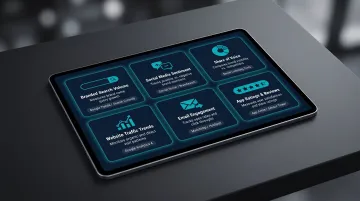
Sprout Social identifies core brand health tracking metrics:
| Metric | What It Measures | How to Track |
|---|---|---|
| Branded search volume | Are people searching for the new brand name? | Google Trends, Google Search Console |
| Social media sentiment | How do audiences feel about the brand? | Sprout Social, Brandwatch, Mention |
| Share of voice | Conversation volume vs. competitors | Social listening tools |
| Website traffic trends | Is traffic maintaining or growing post-rebrand? | Google Analytics 4 |
| Email engagement | Open and click rates under new brand | Email marketing platform (Mailchimp, HubSpot) |
| App ratings and reviews | User sentiment on app stores | App Annie, Sensor Tower |
The First 90 Days Are Critical
The first 90 days post-launch are when customer confusion is highest and brand recall for the new identity is lowest. Set specific targets:
30-Day Targets:
- 40-50% branded search volume compared to legacy brands
- 60%+ positive social sentiment
- Website traffic maintained within 10% of pre-rebrand baseline
60-Day Targets:
- 70-80% branded search volume
- 70%+ positive sentiment
- Website traffic recovered to 100% of baseline or higher
90-Day Targets:
- 90-100% branded search volume
- 75%+ positive sentiment
- Website traffic 110-120% of baseline (new brand driving incremental interest)
Forbes Agency Council data shows most brand transformations take 12-18 months from approval to full launch, and Kantar research shows measurable brand health declines after six months without active marketing support. That means your brand performance plan needs to extend well beyond launch day — with dedicated budget for at least the first 12 months to sustain search visibility, sentiment, and audience recall.
Frequently Asked Questions
How long does a post-merger digital rebrand typically take?
Timelines vary by complexity, but most Malaysian companies take 6-18 months from brand architecture decision to full digital rollout. CelcomDigi's 11-month gap between merger close (November 2022) and brand unveiling (October 2023) illustrates a phased, deliberate approach that balances thoroughness with speed.
Should you keep both brand names or create a new identity after a merger?
The decision depends on the relative brand equity of each entity. Where both brands hold strong customer loyalty in distinct segments, a hybrid approach—maintaining dual consumer brands under one corporate identity—preserves that equity better than erasing either name. Conduct brand equity audits to quantify awareness, NPS, and digital footprint before deciding.
How do you prevent losing SEO rankings during a post-merger website rebrand?
Protect rankings by following these steps in sequence:
- Map 301 redirects from old URLs to specific new pages
- Preserve existing URL structures wherever possible
- Submit both old and new sitemaps to Google Search Console
- Maintain backlink profiles and keep redirects active for at least one year
Change one element at a time — domain, CMS, or design — never all three simultaneously.
What is the biggest digital branding mistake companies make after a merger in Malaysia?
Launching the external brand before achieving internal alignment — resulting in employees, customer service teams, and digital channels communicating different messages simultaneously. Internal brand launch should precede external launch by 2-4 weeks, with staff equipped with approved messaging and brand assets.
How do you communicate a rebrand to a multicultural Malaysian audience effectively?
Create bilingual content (Bahasa Malaysia and English) with culturally resonant imagery and community-specific messaging tailored to Malay, Chinese, and Indian audience segments. Avoid direct translations. Adapt tone, examples, and visual language to each cultural context. Test messaging with representative focus groups before launch.
How soon after a merger should digital rebranding begin?
Brand architecture planning should begin during the merger process itself — before the deal closes — enabling quick execution once it finalises. Delays create a vacuum that competitors and market speculation are quick to fill.