Singapore's business environment makes this particularly high-stakes. The market is trust-driven, multicultural, and highly networked. Professional circles are tightly connected, and reputational signals travel quickly through industry associations, LinkedIn networks, and face-to-face business networks. When two known brands combine, stakeholders—customers, partners, employees, investors—require fast, credible reassurance. Vague or delayed brand communications can be interpreted as instability, creating a vacuum that competitors eagerly fill.
This article covers the foundational decision of brand architecture, the internal-first approach that protects talent and reputation, a phased rollout framework tailored to Singapore's business culture, and the right channels and metrics to ensure your post-merger brand awareness strategy delivers results.
TLDR
- Post-merger brand awareness means managing two existing reputations — not building recognition from zero
- Choose your brand architecture model (unified, endorsed, or dual-brand) before launching external communications
- Brief employees on the new brand before telling customers — internal alignment prevents credibility gaps
- A phased rollout (announcement, identity rollout, consolidation) delivers better results than a single big launch
- LinkedIn, earned media, and in-person events are the go-to channels for post-merger brand awareness in Singapore
Why Post-Merger Brand Awareness Is Different—and Why It Matters More in Singapore
Standard brand awareness builds recognition from scratch. Post-merger brand awareness is different: you're managing the collision of two existing brand reputations, each with its own equity, associations, and customer expectations.
One brand's promise was reliability, the other's was innovation. One served corporate clients, the other targeted SMEs. Now you must reconcile both into a coherent story that preserves value and commands trust.
According to Harvard Business Review, 70% of M&A deals fail based on executive surveys—falling short of the internal projections made to justify the purchase. While operational and financial integration challenges contribute to these failures, brand confusion and stakeholder uncertainty are what accelerate the damage. When customers don't understand what the new entity stands for, they hesitate to renew contracts. When employees don't see a clear future, they leave.
Singapore's Stakes Are Higher
Singapore's business culture places exceptional value on reliability and established reputation. When two known brands combine, stakeholders don't just want information—they require fast, credible reassurance that relationships will continue, service standards won't drop, and the merged organisation is stable. Singapore's professional circles are tightly networked. Employees will be asked by contacts, clients, and industry peers about the merger before official external communications go out. A weak or confused answer damages the brand before the campaign even launches.
The Brand Confusion Window
The period immediately after a merger announcement is the "brand confusion window": customers are uncertain, competitors actively poach accounts, and employees risk disengagement. Research shows that 47% of key employees leave within one year of an M&A transaction, and 75% leave within three years.
Headhunters reach out to top talent on the very day a deal is announced. Close this window proactively with a deliberate awareness strategy, or value destruction becomes inevitable.
Three Primary Audiences
Post-merger brand awareness must serve three distinct audiences simultaneously:
- Internal stakeholders — employees of both merged companies who need clarity, confidence, and a reason to stay
- Existing customers and clients — of both entities, who need reassurance that their relationships and service continuity are secure
- The broader Singapore market and new prospects — who need to understand what the combined entity offers and why it matters
Each audience has different concerns and different trust thresholds. Getting the messaging right for all three simultaneously — without contradicting yourself — is where most post-merger brand efforts break down.
The First Strategic Decision: Choosing Your Post-Merger Brand Architecture
Before any brand awareness campaign launches, leaders must make a foundational brand architecture decision. This determines everything about how the new entity will be communicated. Launching post-merger communications without a resolved architecture creates mixed signals—dual logos on the same documents, inconsistent naming in emails, unclear positioning statements—that confuse the market and signal internal disorganisation.
Three Main Post-Merger Brand Architecture Models
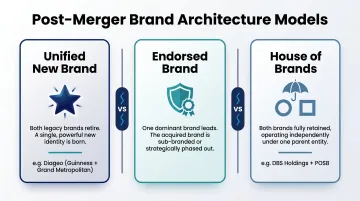
Unified New Brand Both predecessor brands are retired and a single new identity is created. This approach works when both brands carry similar equity, or when the strategic intent is to create something genuinely new rather than inherit either legacy. When Guinness and Grand Metropolitan merged to form Diageo in 1997, the new name signalled a new company — not just two old ones joined together.
Endorsed Brand One company adopts the other's name, with the acquired brand either phased out or retained as a sub-brand with endorsement (for example, "Brought to you by..."). The stronger brand leads when one carries significantly more recognition, or when the acquiring company wants to extend its established reputation into new markets.
House of Brands Both brands are retained separately under a parent holding company structure. It preserves distinct customer bases and mitigates reputational risk, though it increases cost and complexity. DBS's acquisition of POSB in 1998 for SGD 1.6 billion is a textbook Singapore example: POSB was retained as a community-focused brand ("Neighbours first, bankers second"), whilst DBS positioned itself as the pan-Asian growth brand. Combined assets grew more than fivefold, and DBS has since been named "world's best bank" multiple times.
Criteria for Choosing the Right Model
The decision depends on several factors:
- Relative brand equity — which brand carries stronger recognition, trust, and loyalty in your target market
- Customer overlap — whether both brands serve the same audiences or distinct segments
- Strategic rationale — whether the merger aims to consolidate market share, enter new markets, or acquire capabilities
- Market positioning intent — how the merged company intends to compete in Singapore
In Singapore, where many B2B relationships are deeply personal and relationship-driven, erasing a well-loved brand name carries real commercial risk. Customers who've worked with a brand for years may feel betrayed or uncertain if that name disappears overnight.
Brand Equity Auditing
Before choosing a model, conduct a brand equity audit to understand how each brand is perceived across Singapore's communities, sectors, and demographic segments. The audit should cover:
- Surveys of existing customers and key accounts
- Analysis of search volume and social sentiment
- Comparison of brand associations across target segments
- Stakeholder interviews to surface loyalty and trust signals
The Risk of Delaying This Decision
Companies that delay the architecture decision whilst trying to build consensus or appease internal politics create a credibility crisis. External stakeholders see inconsistent branding and assume the merger is chaotic. Internal teams don't know what to tell clients. The longer the delay, the more value leaks away.
Getting the architecture decision right — quickly — is what separates mergers that build momentum from those that stall in confusion. Vantage Branding works with Singapore companies to navigate exactly this: assessing brand equity, aligning leadership teams, and making the architecture call with confidence before communications launch.
Start Inside: Building Internal Brand Awareness Before Going External
Employees of both merging companies are the first—and most powerful—voices shaping how the new brand lands. They need to understand and believe in it before customers hear a word. A merger announcement that surprises or confuses staff creates a credibility gap no external campaign can bridge.
Why Internal Brand Comes First
Organisations that focus on employee experience as a core element of talent management have a 65% chance of achieving superior total returns to shareholders. Employees who feel engaged and informed become advocates. Those who feel uncertain or excluded become flight risks.
In Singapore's tightly networked professional circles, staff will be asked about the merger by contacts, clients, and peers well before official external communications go out. Giving employees consistent, confident talking points is itself part of the brand awareness strategy.
Practical Internal Brand Awareness Tactics for Singapore
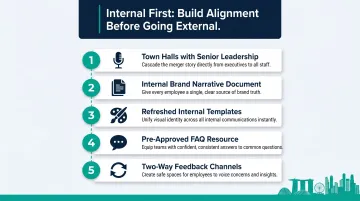
- Town halls with senior leadership: Singapore's professional culture places weight on hierarchy — hearing the merger narrative directly from respected leaders builds trust faster than any email. Schedule briefings before external announcements go out.
- Internal brand narrative document: A concise brief covering merger rationale, new brand positioning, what changes, and what stays the same. Staff need this in writing, not just from a slide deck.
- Refreshed internal templates: Update email signatures, letterheads, and presentation files to reflect the new brand consistently. Mismatched materials signal disorganisation at exactly the wrong moment.
- Pre-approved FAQ resource: Anticipate what clients and contacts will ask — "Will my relationship manager change?" "What new capabilities does this bring?" — and give staff clear, approved answers.
- Two-way feedback channels: McKinsey research shows employees trust their direct supervisors most during M&A. Effective integration demands a steady flow of two-way communication, not just top-down messaging.
A Phased Rollout Strategy for Post-Merger Brand Awareness in Singapore
A phased approach is superior to a single "big launch" because it allows the organisation to manage the volume of change communications, gather early market feedback, and build momentum rather than create a one-off announcement that fades.
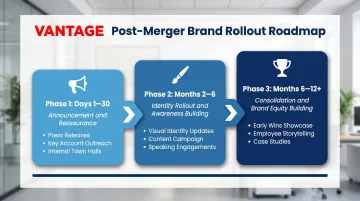
Phase 1—Announcement and Reassurance (Days 1-30)
Goals: Control the narrative, reassure existing customers of both companies that their relationships and service continuity are secure, and establish the basic facts of the merged entity in the Singapore market.
Tactics:
- Coordinated press release distribution to The Business Times, The Straits Times, and industry-specific publications
- Personalised communications to key accounts (phone calls or face-to-face meetings where possible)
- Update all digital touchpoints (website, LinkedIn, Google Business Profile) with consistent merger messaging
- Launch a dedicated merger hub or FAQ page on the company website
- Host internal town halls to align employees before external communications
Singapore M&A activity hit US$51 billion in the first nine months of 2024, up 29% year-on-year. The market is accustomed to deal announcements—stakeholders remember how quickly and clearly you communicated.
Phase 2—Identity Rollout and Awareness Building (Months 2-6)
Goals: Progressively reveal the new or evolved brand identity, build recognition in the Singapore market, and demonstrate the combined entity's capabilities.
Tactics:
- Visual identity updates (logo, brand colours, design system) rolled out across physical and digital touchpoints
- Refreshed brand messaging and positioning integrated into all customer-facing materials
- Coordinated content and media campaign showcasing thought leadership from the merged organisation
- Speaking engagements at Singapore industry events (Enterprise Singapore forums, sector-specific conferences)
- Case studies and white papers demonstrating combined expertise
- LinkedIn content series profiling leadership, sharing integration milestones, and highlighting customer success stories
This is when the market begins to internalise the new brand. Consistency across every touchpoint—website, LinkedIn, email signatures, physical signage, marketing materials—matters here more than at any other stage. Any inconsistency signals confusion and erodes the trust built in Phase 1.
Phase 3—Consolidation and Brand Equity Building (Months 6-12+)
Goals: Move from "awareness" to "preference"—converting recognition of the new brand into genuine stakeholder loyalty and market position.
Tactics:
- Collect and showcase early wins from the merged organisation (new client acquisitions, successful project deliveries, innovation milestones)
- Employee storytelling and testimonials that humanise the merger and demonstrate cultural integration
- Detailed case studies that prove the combined entity delivers superior value
- Community or partnership activities that anchor the new brand in Singapore's business landscape (sponsorships, CSR initiatives, industry collaborations)
- Measurement and optimisation based on brand awareness metrics (covered in a later section)
BCG's post-merger integration framework, drawn from 550+ M&A engagements, captures 9% more value than the average deal through a structured three-phase approach.
A full-scale rebrand takes at least six months, but meaningful shifts in brand recognition and stakeholder trust often require 12-24 months of sustained effort—particularly for B2B companies in Singapore, where trust accumulates through repeated interactions rather than a single campaign.
Channels and Tactics That Work for Post-Merger Brand Awareness in Singapore
LinkedIn: The Primary B2B Channel
LinkedIn is the primary channel for B2B post-merger brand awareness in Singapore. With over 3 million members (roughly 50% of the total population) and 4 out of 5 members driving business decisions within their organisations, the platform offers unmatched reach into Singapore's professional audience.
That depth of access matters for merger communications. 82% of B2B marketers report the greatest success on LinkedIn compared to other social platforms.
Post-Merger LinkedIn Tactics:
- Update the company page immediately with merger announcement and new branding
- Publish thought leadership content from leadership profiling the combined entity's vision and capabilities
- Share integration milestones and success stories to demonstrate momentum
- Engage with industry conversations to reinforce market presence
- Use LinkedIn Ads to target specific professional segments with merger messaging
PR and Earned Media
92% of consumers trust earned media above all other forms of advertising, and 88% most trust recommendations from people they know. Media coverage in outlets such as The Business Times, The Straits Times, and sector-specific trade publications builds credibility for the merged brand and reaches stakeholders who may not follow the company on social media.
Singapore PR Tactics:
- Distribute press releases through newswire services and direct media contacts
- Pitch thought leadership bylines to The Business Times and industry publications
- Arrange media interviews with CEOs and senior leadership to explain merger rationale and vision
- Use case studies and data to pitch newsworthy stories about the merged entity's impact
In-Person and Event-Based Brand Awareness
Earned media builds broad awareness — but in Singapore, the relationship itself often closes the deal. Singaporeans prefer cultivating long-term partnerships over quick transactions, and the success of a deal is largely dependent on the depth of the relationship formed. Face-to-face channels give a merged entity the chance to demonstrate that trust directly.
Event-Based Tactics:
- Host a launch event for the new brand, inviting key clients, partners, and stakeholders
- Sponsor industry conferences and trade shows relevant to the merged entity's sectors
- Participate in Enterprise Singapore events and relevant trade association gatherings
- Organise roundtable discussions or executive briefings on industry topics where the merged entity demonstrates thought leadership
Measuring Whether Your Post-Merger Brand Awareness Is Working
Key Metrics Specific to Post-Merger Brand Awareness
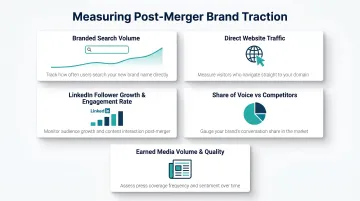
Five metrics give you a reliable picture of post-merger brand traction:
- Branded search volume — Use Google Search Console and Google Trends to track searches for the new merged brand name. Consistent upward movement confirms growing recognition.
- Direct website traffic — Stakeholders who type your URL directly already know who you are. Rising direct traffic is one of the clearest signals of brand recall.
- LinkedIn follower growth and engagement rate — Follower count tells you reach; engagement rate tells you whether that audience actually cares. Both matter for a merged entity rebuilding credibility.
- Share of voice vs. competitors — Measure visibility across search, social, and media relative to key competitors. A rising share of voice means the merged brand is actively claiming market attention.
- Earned media volume and quality — Track mentions and assess whether coverage comes from tier-1 publications or niche outlets, and whether the sentiment is positive or neutral.
Stakeholder Perception Surveys
Reach and impression metrics alone cannot capture whether customers, partners, and prospective clients recognise and trust the new brand. Conduct baseline perception surveys immediately post-merger and repeat them at three-month intervals. Ask targeted questions:
- Are you aware of the recent merger between [Company A] and [Company B]?
- How would you describe the new combined entity in one sentence?
- Do you trust the new entity to deliver the same or better service than before?
- How likely are you to recommend the new entity to a colleague?
The answers surface gaps that no analytics dashboard can catch — and give you a concrete baseline to measure against at each subsequent interval.
Frequently Asked Questions
What is the role of post-merger brand awareness in building brand equity?
Post-merger brand awareness is the foundation of brand equity for the new entity. Without recognition and positive associations in the market, the combined organisation cannot command customer loyalty, pricing power, or market position. The sooner stakeholders trust the new brand, the faster equity accumulates from the combined heritage of both companies.
What is an example of increased post-merger brand awareness?
DBS's acquisition of POSB in 1998 is a Singapore success story. DBS retained POSB as a community-focused brand whilst positioning DBS as the pan-Asian growth brand. Combined assets grew more than five-fold, and DBS has since been named "world's best bank" multiple times by Brand Finance, Euromoney, and Global Finance.
How long does post-merger rebranding and brand awareness building typically take?
The initial brand awareness push typically spans 6-12 months from merger announcement to consolidated brand identity. Meaningful shifts in brand recognition and stakeholder trust can take 12-24 months of sustained effort. This is especially true for B2B companies in Singapore, where trust accumulates through repeated interactions and proven delivery.
Should both company names be retained after a merger in Singapore?
The decision depends on the relative brand equity of each name, the degree of customer overlap, and the strategic positioning of the merged entity. There is no universal answer — a brand architecture audit should guide this decision rather than internal preference or political compromise.
How do you communicate a merger to existing customers without losing them?
Personalised, direct communication to key accounts — before public announcements — is the most effective retention strategy. Focus the message on continuity of service and enhanced capabilities, then assign relationship managers to proactively reach out, answer questions, and reassure clients their needs remain the priority.
What is the most common post-merger brand awareness mistake?
The most common mistake is delaying external brand communications whilst internal decisions are still being resolved. This creates a vacuum that is filled by rumour, competitor narratives, or customer anxiety. In Singapore's interconnected business community, information gaps are especially damaging to brand credibility—stakeholders interpret silence as instability and begin exploring alternatives.