This is the reality facing every company that completes a merger in Vietnam. Before the ink dries on the deal documents, the clock starts ticking on a critical question: how will you tell the combined story before competitors or confusion fill the void?
In a market where 79.8 million internet users and 76.2 million social media users spend their days scrolling, messaging, and shopping on mobile devices, brand narratives spread faster than in almost any other market. The Vietnamese digital ecosystem rewards clarity and punishes ambiguity. A messy merger rollout doesn't just confuse customers—it actively drives them to competitors who offer a clearer value proposition. For sectors like banking, healthcare, and retail, where trust and relationship continuity underpin every transaction, the digital channel isn't just important—it's the primary battleground for post-merger brand perception.
TLDR
- Speed and local cultural fluency determine whether a post-merger brand lands or falls flat in Vietnam
- Brand confusion spreads fast on Vietnam's mobile-first, social-heavy platforms, and lost trust is hard to recover
- A phased approach (audit, align, launch, sustain) consolidates brand equity rather than diluting it
- Digital advertising and data protection compliance must be built in from day one, not retrofitted later
- Vietnam's dominant platforms—Zalo, Facebook, and TikTok—each require channel-specific brand messaging, not a one-size-fits-all rollout
Why Mergers Create a Critical Window for Digital Rebranding in Vietnam
A merger announcement naturally commands attention. Customers, partners, employees, and competitors all sit up and take notice. This creates a rare, brief window when audiences expect change and remain open to a new brand story. That window closes faster than most leadership teams anticipate. When companies miss or mismanage this moment, the consequences compound quickly:
- Brand ambiguity drives customers to seek clearer alternatives
- Fragmented digital footprints—duplicate social pages, conflicting website messaging, mixed SEO signals—become exponentially harder and more expensive to clean up over time
- Customer churn accelerates as confused buyers default to competitors with clearer positioning
Vietnam's M&A landscape is heating up. In the first nine months of 2024 alone, 220+ deals closed with US$3.2 billion in disclosed value, representing 45.9% year-over-year growth.
Yet deal activity doesn't guarantee brand success. In a market where trust and relationship continuity matter deeply—particularly in banking, healthcare, and retail—customers need rapid digital reassurance that the merger makes the combined entity stronger, not just larger.
The Vietnamese digital environment amplifies both opportunity and risk. With more than 2.1 billion messages sent daily on Zalo alone, brand news (and brand confusion) spread within hours. Companies that act decisively during the post-merger window can reshape perception before competitors define the narrative for them.
Understanding Vietnam's Digital Landscape Before You Rebrand
The numbers tell the story: Vietnam is a hyperconnected, mobile-first market where digital brand perception forms and spreads faster than in most other countries.
The scale:
- Internet penetration: 78.8% of the population (79.8 million users)
- Social media users: 76.2 million as of January 2025
- Mobile connections: 127 million active cellular connections—equivalent to 126% of the population
(Source: DataReportal Digital 2025: Vietnam)
The mobile reality:
Vietnamese consumers don't just use mobile devices—they live on them. Mobile accounts for 61.03% of all web traffic in Vietnam, making desktop-first brand strategies a poor fit from the start. Post-merger brand communication must prioritise short-form content, fast-loading mobile pages, and app-based engagement over traditional desktop-heavy assets.
Platforms That Drive Brand Perception in Vietnam
Not all platforms carry equal weight. Where your audience spends time—and how they engage on each channel—shapes whether your rebrand lands or fades into background noise.
Platform hierarchy:
- Facebook: 76.2 million ad reach—the dominant platform for community-building and longer brand narrative content
- TikTok: 40.9 million users aged 18+—the engine for discovery, virality, and reaching younger demographics with authentic storytelling
- YouTube: 62.3 million ad reach—trusted for deeper product education and brand storytelling
- Zalo: 79.6 million monthly active users by end-2025—the primary CRM and direct communication channel for existing customers who expect personalised outreach, not broadcast messaging
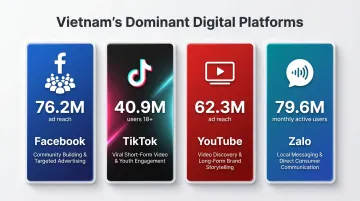
(Source: DataReportal Digital 2025: Vietnam)
E-commerce as brand touchpoint:
Don't treat Shopee, Lazada, and TikTok Shop as mere sales channels. In 2025, the top four e-commerce platforms generated an estimated VND 429.66 trillion (approximately US$16.5 billion) in combined revenue, up 34.75% year-over-year. Shopee alone held 56.04% market share, with TikTok Shop claiming 41.31%—together accounting for close to 8% of Vietnam's entire retail market value.
Any inconsistency in brand names, logos, or product descriptions across these storefronts undermines your rebrand and creates customer service headaches.
The KOL and KOC ecosystem:
Influencer-led content functions as a primary trust-building channel in Vietnam, often outweighing traditional advertising. Key Opinion Leaders (KOLs) and Key Opinion Consumers (KOCs) shape purchase decisions across categories—the numbers reflect this clearly:
- Nano-influencers (1,000–10,000 followers) show the highest median engagement: 16.18% on TikTok and 9.24% on Facebook
- Fashion & Beauty and Food & Beverage together account for 76.3% of influencer marketing spend
- Case example: A creator-led activation for Cetaphil reportedly delivered a 159% year-over-year sales uplift
(Source: AnyMind Group State of Influence APAC 2026)
For post-merger brands, this means briefing KOL partners on the new brand identity before going live—not after. A creator promoting the old brand name or visual identity during a rebrand window actively undermines the transition.
The Gen Z factor:
Vietnam's youngest digitally native cohort sets the pace for engagement trends. Among university students, daily social media usage hits 85.1%, with TikTok leading at 85.6%, Instagram at 84.7%, and Facebook at 79.6% (source: Vector Group).
Gen Z relies heavily on KOCs over traditional advertising for purchase decisions and expects authentic, interactive brand content rather than polished corporate messaging. If your post-merger brand story feels staged, this segment will disengage fast—and their influence extends well beyond their own demographic.
Building a Post-Merger Digital Brand Roadmap
A successful post-merger digital rebrand doesn't happen by accident. It requires a structured, phased approach that balances speed with strategic precision.
Phase 1: Digital Brand Audit
Before changing anything publicly, map what you have.
Conduct a comprehensive audit of both brands' digital estates:
- Website domains and traffic sources
- Social media handles, follower bases, and engagement rates
- SEO rankings and keyword equity for both legacy brand names
- Ad account ownership and historical campaign data
- CRM databases and email lists
- Brand mentions and sentiment across platforms
The goal: identify what has equity worth preserving and what creates confusion or dilutes the new story. That distinction shapes every decision in the phases that follow.
Phase 2: Brand Architecture Decision and Internal Alignment
Determine the brand architecture outcome early:
- Full consolidation to a single brand
- Endorsed brand structure (legacy brands remain visible under a parent brand)
- Hybrid approach (phased transition over time)
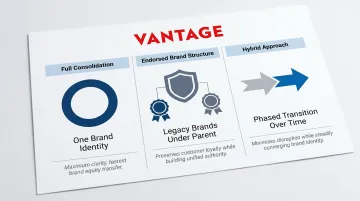
Communicate this decision internally first. Employees are your first digital ambassadors, and inconsistent internal messaging leaks quickly into the digital space — through LinkedIn activity, social content, and review platforms. Hold internal launch sessions before going public so every team member can articulate the new brand story clearly.
For companies navigating complex brand consolidation decisions, an experienced partner like Vantage Branding can help develop insight-led brand identities that hold up across both local Vietnamese channels and regional markets.
Phase 3: Unified Digital Identity Launch
Develop the consolidated brand's visual identity, tone of voice, and messaging framework before updating any digital touchpoint.
Then execute a coordinated launch simultaneously across:
- Website and domain redirects
- Social media profiles (Facebook, TikTok, Zalo, LinkedIn)
- Google Business listings
- App stores (iOS and Android)
- E-commerce storefronts (Shopee, Lazada, TikTok Shop)
Piecemeal rollouts create brand confusion. A customer who sees the new brand on Facebook but finds the old brand on your website will question whether they're dealing with the right company.
Phase 4: Narrative-Led Content Campaign
Once visual consistency is in place, the next job is telling people why the merger happened. Develop a content campaign that frames the change in terms meaningful to Vietnamese customers:
- Better service
- Expanded capability
- Stronger local presence
- Enhanced product range
Distribute across the most relevant channels:
- Video content performs particularly well in Vietnam's media environment — use it to humanise the merger story
- KOL partnerships lend credibility and cultural authenticity that corporate announcements alone cannot achieve
- Zalo direct outreach reassures existing customers with personalised messaging
Phase 5: Monitor, Measure, and Iterate
Set up brand health tracking from day one:
- Share of voice across social platforms
- Sentiment analysis (positive, neutral, negative)
- Organic search visibility for the new brand name
- Customer feedback through social listening tools
- Website traffic and conversion trends
Use this data to identify and respond to misperceptions before they solidify. In Vietnam's social-first media landscape, a narrative that goes uncorrected for even a few weeks can become entrenched.
Key Digital Channels for Post-Merger Brand Communication
Social Media: Where Brand Trust Is Made or Lost First
The consolidation decision:
Should you merge existing brand pages or redirect followers to a single primary page?
Base this decision on engagement data, not follower count. A page with 100,000 inactive followers delivers less value than a page with 30,000 highly engaged followers. Consider:
- Which page has higher engagement rates (likes, comments, shares per post)?
- Which audience aligns more closely with your post-merger target customer?
- What are the algorithmic penalties and audience confusion risks of merging versus redirecting?
Platform-specific strategies:
- Facebook: Best for community-building and longer brand narratives — explain the merger story, answer questions, and highlight expanded capabilities.
- TikTok: Reaches younger demographics through authentic, unscripted content. Behind-the-scenes merger moments and employee reactions perform especially well here.
- Zalo: Direct outreach to existing customers — ideal for reassuring them about service continuity, account transitions, and what changes for them specifically.
SEO and Content: Building Long-Term Brand Authority
SEO implications of post-merger rebrand:
Search engine visibility doesn't transfer automatically when you change brand names or consolidate websites.
Critical SEO considerations:
- Domain migration strategy: If consolidating two websites into one, implement permanent 301 redirects from all old URLs to their new equivalents. (Best-practice guidance from Ahrefs)
- Duplicate content management: Avoid publishing identical content across two legacy websites during transition periods—this confuses search engines and dilutes ranking authority
- Keyword strategy: Capture search traffic for both legacy brand names while building authority for the new combined brand name. Create content that bridges old and new (e.g., "Formerly [Brand A] and [Brand B], now [New Brand]")
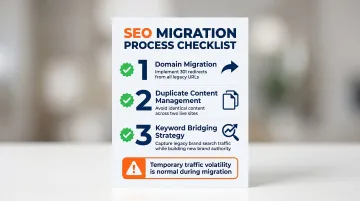
Realistic expectations:
Website migrations often trigger temporary organic traffic declines. Short-term volatility is normal while search engines consolidate signals. Plan for a recovery timeline of weeks to months depending on execution quality and the complexity of the migration.
E-commerce and marketplace presence:
For consumer-facing brands, post-merger brand consistency must extend to Shopee, Lazada, and TikTok Shop storefronts. Mismatched names, logos, or product descriptions across these platforms create customer service headaches — and quietly erode trust in the new brand before it has a chance to establish itself.
Navigating Vietnam's Regulatory Environment for Digital Branding
Vietnam's digital advertising and data protection regulations tightened in 2025–2026, creating compliance obligations that directly affect post-merger brand campaigns.
Decree 342/2025/ND-CP on online advertising (effective February 15, 2026):
This decree introduces explicit rules for online ad formats:
- Maximum 5-second un-skippable window for moving-image/video ads
- Static-image ads must be immediately dismissible with clear close icons
- 24-hour takedown requirement for illegal ads upon authority request
- Reporting and record-keeping obligations for platforms, including cross-border services
Practical implication: All advertising claims made for the new post-merger brand must be accurate, substantiated, and compliant with the Law on Advertising. Marketing materials referencing the heritage or credentials of either legacy brand need legal review before publication to avoid penalties under Decree 38/2021/ND-CP on advertising violations.
Decree 356/2025/ND-CP on personal data protection (effective January 1, 2026):
This decree replaces Decree 13/2023/ND-CP and provides implementing guidance for the Personal Data Protection Law. Key provisions include:
- Data Protection Officer (DPO) or data protection department requirement with specified qualifications
- Data Protection Impact Assessment (DPIA) filing within 60 days of starting processing activities
- 72-hour breach notification requirement
- Cross-border transfer impact assessments within 60 days of first transfer
- Certain exemptions for micro/small/startup entities until 2031 (unless processing sensitive data or large-scale datasets)
(Source: Decree 356/2025 Legal Alert)
The data compliance challenge specific to post-merger situations:
Combining two customer databases from merged entities requires documented consent management and purpose limitation under the new data protection rules. Before launching any post-merger marketing campaigns using the combined list, merged entities must address:
- Consent documentation for each legacy dataset
- Purpose limitation — confirming that new campaign uses fall within the scope originally consented to
- Retargeting and email communications are not transferable across merged lists without this groundwork
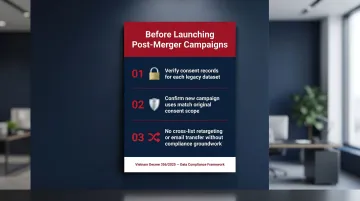
Law No. 116/2025/QH15 (Cybersecurity Law, effective July 1, 2026):
This law replaces the Law on Cybersecurity 2018 and the Law on Cyberinformation Security 2015. Key elements include:
- 24-hour content removal window (6 hours in urgent cases)
- Prohibitions on abusive deepfakes
- Enhanced protections for children
- Stricter obligations for critical information infrastructure operators
(Source: Duane Morris Vietnam)
Relevance to marketing: Faster takedown timelines and stricter content/child-protection measures tighten response requirements for platforms, ad networks, and brands distributing digital content in Vietnam.
Frequently Asked Questions
What is the law on digital transformation in Vietnam?
Vietnam's National Digital Transformation Programme (Decision 749/QD-TTg) targets a digital economy at 20% of GDP by 2025 and 30% by 2030. The Cybersecurity Law (No. 116/2025/QH15, effective July 2026) governs digital platforms and marketing technology, introducing faster content removal timelines and stricter data protections.
How is Gen Z in Vietnam using social media?
Gen Z in Vietnam prefers short-form video platforms like TikTok (85.6% usage among university students) and YouTube Shorts. They rely on Key Opinion Consumers (KOCs) over traditional advertising for purchase decisions and expect authentic, interactive brand content rather than polished corporate messaging.
How do you communicate a merger to customers digitally in Vietnam?
Lead with a benefit-driven narrative—not a corporate announcement—backed by KOL endorsements and consistent messaging across all touchpoints. Use Zalo for direct customer outreach and social video (TikTok, Facebook, YouTube) for broader awareness.
How long does a post-merger digital rebrand typically take?
A basic digital identity consolidation (social handles, website, visual assets) can be executed within 60–90 days. However, a full brand integration—including SEO authority transfer, audience trust rebuilding, and content strategy alignment—typically takes 6–12 months to show measurable results.
Should you retire one legacy brand or create an entirely new merged identity?
It depends on which brand carries more equity—search authority, social following, and customer sentiment—and your strategic intent. In Vietnam's trust-sensitive market, a phased transition or endorsed brand structure is usually safer than an abrupt clean break.
What are the biggest digital branding mistakes companies make post-merger in Vietnam?
The most common pitfalls are:
- Launching without a coordinated multi-channel rollout
- Neglecting SEO migration, which bleeds organic traffic
- Failing to brief KOLs and partners before the public announcement
- Treating data privacy compliance as an afterthought when merging customer databases