Introduction: Why Rebranding in Vietnam Is a Loyalty Gamble Worth Understanding
Vietnam's middle class is projected to double from 13% of the population in 2023 to 26% by 2026, adding over 25 million consumers who increasingly prioritize quality and brand meaning over basic functionality. Vietnamese consumers rank among the least brand-loyal in Asia-Pacific, switching brands and stores freely in an environment where product variety has doubled in ten years while success rates have halved.
That makes rebranding a high-stakes decision. A well-executed transformation can capture a rising middle class willing to pay premiums. The relationship between rebranding and loyalty, however, is far more nuanced than "refresh the logo, boost retention."
Research on major Vietnamese brands shows rebranding reliably lifts brand awareness, perceived quality, and emotional associations. Loyalty itself, though, remains stable even after comprehensive identity overhauls.
Using evidence from Vinamilk, Viettel, and Highland Coffee, this article unpacks how each component of rebranding influences loyalty in Vietnam's market—and what brands must do to convert perception shifts into lasting customer relationships.
TLDR: Key Takeaways
- Rebranding lifts awareness and quality perceptions, but loyalty stays stable short-term across all Vietnamese companies studied
- Perceived quality and brand awareness mediate the path to loyalty more effectively than emotional associations alone
- Symbolic perceptions shift quickly post-rebrand, but behavioral loyalty takes years to follow
- Strategic repositioning outweighs cosmetic updates—visual redesigns without clear strategic direction rarely move loyalty
How Rebranding Affects Brand Loyalty in Vietnam: What the Research Actually Shows
A peer-reviewed study published in Innovative Marketing (2026) examined the impact of rebranding on customer-based brand equity (CBBE) across three major Vietnamese companies—Vinamilk, Viettel, and Highland Coffee—surveying 528 consumers who had used these brands within the past 24 months. Unlike Western-derived generalizations, this research provides Vietnam-specific evidence grounded in local consumer behavior.
The study applied Keller's (1993) CBBE framework, which structures brand equity into four sequential pillars:
- Brand awareness - Recognition and recall
- Perceived quality - Credibility and performance perceptions
- Brand associations - Emotional and symbolic meanings
- Brand loyalty - Repeat purchase behavior and advocacy
The headline finding challenges common assumptions: rebranding significantly improved awareness (beta = 0.276), perceived quality (beta = 0.298), and brand associations (beta = 0.353)—but brand loyalty remained notably stable across all three companies, hovering around 3.0 on a 5-point scale. This suggests loyalty is a long-term construct that doesn't shift immediately after a rebrand, no matter how comprehensive.
The study's structural equation modeling revealed that perceived quality (indirect effect = 0.264) and brand awareness (indirect effect = 0.145) significantly mediate the relationship between rebranding and loyalty—making them the real drivers of behavioral change. Brand association showed the strongest immediate reaction to rebranding, yet it does not significantly mediate loyalty outcomes. Consumers quickly update how they feel about a rebranded company, but those updated feelings require sustained positive experiences before translating into repeat purchase behavior.
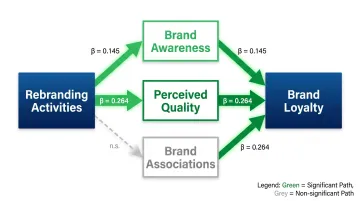
This temporal gap matters. Emotional brand perceptions can shift within weeks of a relaunch, but behavioral loyalty—built through habitual purchasing and accumulated trust—operates on a multi-year timeline that cross-sectional studies cannot capture.
The Three Pillars of Rebranding and Their Different Effects on Loyalty
Every successful rebrand integrates three distinct activities, each targeting a different layer of brand equity:
Repositioning: Strategic Value Redefinition
Repositioning redefines where a brand sits in consumers' minds, adjusting its value proposition, target segment, or competitive differentiation. It's the most impactful activity for long-term loyalty because it addresses what the brand fundamentally stands for, not just how it looks.
Viettel's 2021 repositioning illustrates both the ambition and challenge of strategic shifts. The telco moved from "popularizing telecommunication services" to "pioneering the creation of digital societies," expanding its identity from connectivity provider to digital platform.
The repositioning was bold, but consumer associations lagged. Viettel scored lowest in brand association (1.67/5.0) in the study, suggesting consumers recognized the change but hadn't internalized the new meaning.
Redesigning: Visual Identity Updates
Redesigning updates aesthetic brand elements: logo, color palette, typography, packaging, and digital interfaces. Visual redesigns shape first impressions and signal change. Consumer resistance is typical at first — positive associations solidify over time, not immediately.
Highland Coffee's 2022 redesign simplified its three-color palette to a single red on transparent background, streamlining the oval emblem's coffee bean, mountain, and river elements into minimalist forms. The refresh signaled modernity while preserving brand heritage—but the real impact came from alignment with the broader repositioning strategy.
Relaunching: Communication and Rollout
Relaunching promotes the brand's new identity to reconnect with existing customers and reach new segments. Timing, content strategy, and channel selection all influence how smoothly consumer perceptions shift.
Vietnam's media landscape makes multichannel execution particularly effective. Research on Vietnamese Gen Y consumers found that KOL suitability (brand-influencer fit) is the strongest driver of perceived brand quality (estimate = 0.67). Separately, 92% of Vietnamese consumers trust peer recommendations, compared to only 33% who trust traditional online ads.
Vinamilk's 2023 relaunch applied this directly, collaborating with influencers including Truc Nhan, Miu Le, and Toc Tien across paid social channels.
How the Three Interact—and the Cost of Misalignment
Repositioning sets strategic direction, redesigning makes it visible, and relaunching makes it heard. When these three are misaligned — such as a visual refresh with no clear repositioning rationale — consumers experience confusion that erodes trust.
Brands that execute only one or two pillars tend to fall into the same trap: temporary awareness spikes with no lasting loyalty gains. Common patterns include:
- New logo with no repositioning rationale, leaving consumers uncertain what changed
- Repositioning strategy with no visual refresh, creating a credibility gap
- Communication rollout with no updated identity or positioning to anchor it
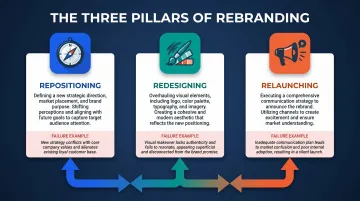
This is a recurring pitfall for Vietnamese brands that treat rebranding as a design project rather than a strategic initiative.
Vietnam Case Studies: Vinamilk, Viettel, and Highland Coffee
Highland Coffee: Community-Driven Resonance (2022)
Highland Coffee's November 2022 rebrand centred on the brand promise "Highlands Coffee Is Ours," inspired by the Vietnamese lyric "This Earth is ours." The repositioning strengthened community connection, resonating with urban professionals aged 26–40 who value lifestyle identity alongside functional quality.
Results: Highland Coffee achieved the highest mean scores among the three brands for brand awareness (3.17/5.0), perceived quality (3.17/5.0), and brand associations (4.42/5.0—nearly three times Viettel's score). Where lifestyle meaning shapes purchase decisions, emotional repositioning produces outsized association scores—a pattern worth noting for any F&B brand targeting Vietnam's growing middle class.
Vinamilk: Modernizing Legacy Equity (July 2023)
Vinamilk's first complete rebrand in 47 years refreshed its image to appeal to the new generation while reinforcing dominance in dairy. The transformation involved 55+ multi-disciplinary individuals across 10 nations, creating a hybrid-serif wordmark, reenergised blue palette optimised for digital, and custom typography. The new mission: "Making food for what the nation cares about."
Vinamilk scored second highest across awareness (3.09) and quality (3.07) metrics, reflecting successful modernisation without alienating existing customers.
By 2025, the rebrand contributed to a Brand Finance BSI score exceeding 90 points and an AAA+ rating (the highest possible level, achieved by fewer than 5% of brands globally), ranking Vinamilk third globally in dairy brand strength.
Viettel: Radical Repositioning Risk (January 2021)
Viettel's 2021 rebrand updated logo, colors, and slogan while repositioning from pure telco operator to broader technology brand. The red-dominant lowercase letters with message bubble icon replaced quotation marks, and the slogan shifted from "Say it your way" to "Your way."
Despite the rebrand's ambition, Viettel ranked lowest across awareness (2.91) and association (1.67) metrics. This reflects the challenge of shifting deeply entrenched perceptions in a dominant mass-market category where functional familiarity, not emotional aspiration, drives loyalty. Radical repositioning in utility categories requires longer timelines and stronger functional proof points before symbolic shifts gain traction.
The Shared Loyalty Finding: Why Similar Scores Matter
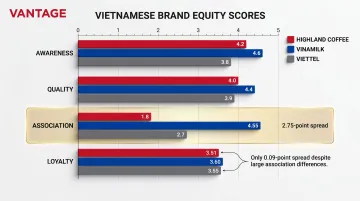
Taken individually, each case study tells a different story. Together, they reveal something more striking: despite dramatic differences in awareness, quality, and association scores, brand loyalty is nearly identical across all three companies.
| Brand | Awareness | Quality | Association | Loyalty |
|---|---|---|---|---|
| Highland Coffee | 3.17 | 3.17 | 4.42 | 3.10 |
| Vinamilk | 3.09 | 3.07 | 3.12 | 3.01 |
| Viettel | 2.91 | 2.94 | 1.67 | 3.04 |
Brand association varies by 2.75 points yet produces only a 0.09-point spread in loyalty. This is the study's most revealing finding: loyalty is a durable construct shaped gradually by consistent experience over time, not suddenly by identity changes—no matter how well-executed.
Why Loyalty Resists Short-Term Brand Changes
Brand loyalty operates on a different timeline than perception. Keller's (1993) CBBE model structures brand building as a sequential pyramid: identity (awareness) must be established before meaning (associations), which must precede response (judgments/feelings), which must precede resonance (loyalty). Brand resonance sits at the pyramid's pinnacle—the final step that cannot be shortcut.
Recent research breaks brand loyalty into behavioral loyalty (repeat purchase) and attitudinal loyalty — itself subdivided into affective (heart), cognitive (head), and habit (hand) loyalty. A rebrand typically disrupts habitual associations first. Until new affective or cognitive bonds form, consumers enter a transitional period: they recognize the change but haven't yet committed to the new brand identity.
This creates a temporal gap. Emotional associations can shift within weeks of a rebrand, but those updated perceptions often take years to translate into behavioral loyalty. Cross-sectional studies capture the perception shift but miss the delayed conversion — which is why all three Vietnamese brands studied show stable loyalty scores despite dramatically different association results.
The takeaway for practitioners is direct: rebranding cannot rescue a loyalty problem in the short term. A rebrand marks the start of a new loyalty-building cycle, not the end of one. Sustained investment in communication, consistent quality delivery, and customer experience is what converts updated associations into durable loyalty — and that work happens after the rebrand launches.
How to Rebrand Without Losing Customer Loyalty in Vietnam
Start With Repositioning Strategy, Not Design
Before any visual changes, define your new brand idea—the authentic, relevant, and differentiating core of what the business stands for. This strategic foundation ensures redesigning and relaunching efforts build consumer trust rather than confusion.
A structured brand strategy process—covering brand essence, organizational purpose, and stakeholder insights—defines the "why" before any design work begins. Agencies like Vantage Branding run this brand discovery phase specifically to ensure strategic clarity drives the rebrand, not the other way around.
Communicate the Rebrand With Transparency and Consistency
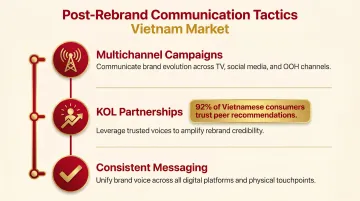
Vietnamese consumers respond strongly to emotional and symbolic brand cues, making how a rebrand is communicated as important as the rebrand itself. Tactics that work in other markets can fall flat here without the right cultural and emotional framing. Post-rebrand communication investment should include:
- Multichannel campaigns explaining the brand's evolution and why it matters
- KOL partnerships prioritizing brand-influencer fit over follower count (92% of Vietnamese consumers trust peer recommendations)
- Consistent messaging across digital and physical touchpoints throughout the transition period
Vinamilk's relaunch shows the scale this requires in practice. The campaign coupled visual rebrand with product innovation, influencer partnerships, and a synchronized rollout across packaging, web, retail, and corporate assets—all moving together to embed the new identity.
Protect Loyalty During the Transition
Identify and retain the brand elements, values, and promises that existing customers already associate with quality and trust. The goal isn't to start from zero but to evolve brand identity while preserving equity foundations that make loyal customers stay.
This is particularly critical in categories like food and beverage or healthcare where familiarity drives purchase decisions. Highland Coffee's redesign preserved its core emblem elements (coffee bean, mountain, river) while modernizing their expression—maintaining continuity with heritage while signaling progress.
Track the Right Metrics Over the Right Timeline
Establish pre-rebrand baselines for:
- Brand awareness (recognition, recall, search traffic)
- Perceived quality scores
- Net Promoter Score (NPS) or loyalty indices
- Repeat purchase frequency
- Brand association strength
- Website engagement metrics
- Brand sentiment (social listening, review analysis)
Track these metrics for at least 12–24 months post-rebrand to capture the delayed loyalty effect. Awareness and association shifts may appear within weeks, but loyalty movement requires sustained measurement over years.
Frequently Asked Questions
Does rebranding always improve customer loyalty?
No. Rebranding reliably improves brand awareness, perceived quality, and associations—but does not directly or immediately improve loyalty. Loyalty is a long-term construct that changes gradually through consistent post-rebrand experience, not from the rebrand event itself.
What is the difference between repositioning, redesigning, and relaunching in a rebrand?
Each component plays a distinct role:
- Repositioning — the strategic shift in how a brand sits in consumers' minds
- Redesigning — the visual and aesthetic update
- Relaunching — the communication and rollout effort
All three must be aligned for a rebrand to build loyalty effectively.
How long does it take for rebranding to affect customer loyalty in Vietnam?
Brand associations may shift quickly after a rebrand, but loyalty—being a behavioral outcome—takes much longer to move. Plan for a minimum 2–3 year timeline, with sustained post-rebrand investment in quality, service, and customer experience before meaningful shifts appear.
Which type of rebranding activity has the biggest impact on loyalty?
For long-term loyalty, repositioning carries the most weight—it redefines the brand's core value proposition. Redesigning and relaunching support the transition but don't independently drive loyalty without that strategic foundation anchoring them.
Why did Highland Coffee outperform Viettel and Vinamilk in brand equity after rebranding?
Highland Coffee's rebrand resonated strongly in community connection and urban lifestyle identity, achieving the highest scores for awareness, quality, and association. The rebrand aligned closely with what its core consumer segment (urban professionals aged 26–40) values emotionally—collectivism, place, and shared experience.
What should Vietnamese brands measure to track loyalty impact after a rebrand?
Monitor these metrics over at least 12–24 months to capture the delayed loyalty effect:
- Brand awareness recall rates
- Perceived quality scores
- Net Promoter Score or loyalty indices
- Repeat purchase frequency
- Brand association strength
- Website engagement and brand sentiment