The challenge isn't just visibility anymore. Vietnamese consumers, particularly Gen Z and Millennials who dominate urban purchasing decisions, demand brands that reflect genuine cultural values, deliver seamless digital experiences, and demonstrate authentic environmental commitment. Brands that refresh superficially—updating a logo without rethinking their narrative—risk irrelevance.
TL;DR
- Five forces shape Vietnam branding in 2026: cultural identity, digital-first experience, ESG credentials, local adaptation, and intensifying competition
- Brands that localize deeply earn stronger engagement; translation alone fails
- In 2026, trust drives growth — brands must earn credibility, not just attention
- Early action on these trends delivers measurable competitive advantage across acquisition, retention, and brand equity
Cultural Identity Is Replacing Generic Brand Messaging
Vietnam's branding environment has shifted decisively from broad visibility campaigns to identity-led narratives. At the 2026 Vietnam National Branding Forum, Deputy Director Hoang Minh Chien stated: "A strong brand cannot rely indefinitely on natural resources or low-cost labour. It must be built on knowledge, technology, and cultural identity." This reflects a structural change in how Vietnamese brands are evaluated — and how consumers respond.
The "Vietnam Story" Concept
Successful brands embed cultural heritage and origin narratives into their identity rather than relying on generic quality claims. Secoin, a Vietnamese cement tile manufacturer established in 1989, exemplifies this approach. The company positions itself as the conservator of Vietnam's traditional cement tiles dating to 1910, exports to 60 countries, and competes through identity rather than scale. As Chairman Dinh Hong Ky put it: "We are not a billion-dollar company, we compete through identity."
This approach isn't limited to heritage brands. The Nation Brand Hexagon framework — covering exports, governance, tourism, investment, people, and culture — shows how cultural positioning creates an emotional foundation that transfers trust to products and services.
Vietnam's national brand value reached $431 billion in 2022, an 11% increase driven partly by stronger cultural positioning.
Practical Implications for Brand Refresh
Companies need brand storytelling that reflects genuine cultural resonance:
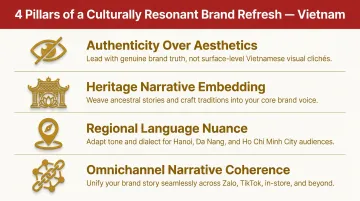
- Drop aesthetics-only thinking — Vietnamese consumers detect and reject inauthentic cultural adaptations
- Embed heritage narratives where they exist; for foreign brands entering Vietnam, connect to values like family, community, and craftsmanship
- Account for regional language nuances between Northern and Southern audiences
- Maintain a coherent narrative across all touchpoints, not just campaign slogans
Brands that get this right earn lasting consumer trust. Those that don't risk being dismissed as outsiders — regardless of budget or reach.
Digital-First Brand Refresh Is Now Non-Negotiable
Vietnam's digital consumer landscape demands that brand identity be built primarily for digital environments. As of late 2025, 85.6 million people use the internet (84.2% penetration), 79 million have social media identities, and median mobile download speeds hit 152.17 Mbps—up 167% year-on-year.
Platform Hierarchy for Brand Refresh
| Platform | Users (2025) | Brand Role |
|---|---|---|
| 79 million | Advertising reach, broad campaigns | |
| Zalo | 78.3 million MAU | Direct customer service, CRM, transactional messaging |
| TikTok | 76.1 million (18+) | Gen Z/Millennial brand discovery, cultural relevance testing |
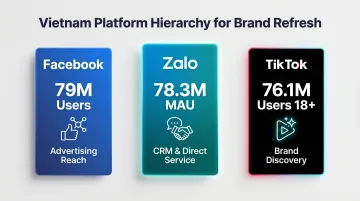
Zalo stands apart from the other platforms on this list. Where Facebook drives reach and TikTok drives discovery, Zalo drives the ongoing customer relationship. MUJI Vietnam lists dedicated Zalo numbers for all 17 stores, enabling real-time, store-level interaction.
Zalo Official Accounts support broadcast messaging, verified badges, and direct 1:1 service — making it the primary CRM channel for brands operating at scale in Vietnam.
Consistent Digital-to-Physical Brand Experience
Getting the platform mix right is only half the challenge. The other half is maintaining coherence when the brand moves from screen to physical space. JINS eyewear ran a pop-up from June to August 2025 focused on brand education, collecting over 2,000 purchase reservations — four times their target. Adaptations included a photo booth using a motorcycle mirror (culturally relevant to Vietnamese urban life) and a dual Japanese-Vietnamese management system to maintain core brand principles while adapting execution.
A brand refresh must account for platform-specific expression: the same brand narrative needs to adapt in tone, format, and visual language across Zalo OA, TikTok, Facebook, and e-commerce platforms without losing coherence.
Sustainability and ESG Are Becoming Brand Differentiators
Sustainability has moved from reputational nice-to-have to structural requirement. Vietnam committed to net-zero emissions by 2050, and Circular 18/2026/TT-BCT now mandates circular economy indicators in the Vietnam National Brand Programme—covering resource efficiency, recycling, and eco-friendly product design.
Green Barriers as Market-Access Requirements
ESG requirements, carbon footprint measurement, and traceability standards are criteria international buyers and retail partners now apply when selecting suppliers. Nearly 60% of Vietnamese businesses exporting to the EU have never heard of the bloc's supply chain due diligence rules. This gap creates competitive advantage for brands that move before competitors do.
EuroCham Vice Chairman Torben Minko stated: "Integration into European value chains is no longer driven by cost competitiveness alone"—sustainability, transparency, and ESG compliance are prerequisites.
Brand Refresh Implication
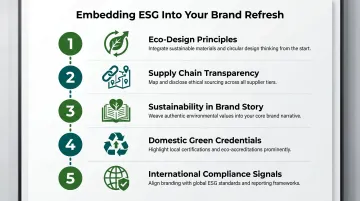
That external pressure has a direct brand implication. Adding an ESG page to a website is not enough—the refresh must embed sustainability language, proof points, and visual identity elements that reflect genuine ESG practices:
- Use eco-design principles in packaging and product materials
- Show supply chain transparency through traceability narratives
- Incorporate sustainability into brand story, not bolt it on
- Speak to domestic consumers who reward green credentials
- Demonstrate compliance to international buyers who require it for market access
Local Adaptation Is Defeating Global Template Strategies
Foreign brands succeeding in Vietnam adapt deeply rather than replicate global formats. MUJI expanded to 17 stores by adjusting its product range, store formats, and brand communication to Vietnamese lifestyle realities: motorbike-centric living, urban density, and local supplier partnerships.
JINS took a different approach. They ran a "not-selling" pop-up to build trust before commerce, sent staff to Japan for brand immersion, and created touchpoints like the motorcycle-mirror photo booth. None of these were cosmetic gestures—each reflected a deliberate decision to compete on local relevance, not global scale.
Risk of Checkbox Expansion
Generic SKU lists and global messaging consistently underperform. Brands treating Vietnam as a checkbox in an "Asia expansion" rollout face:
- Messaging that fails to resonate, driving low consumer engagement
- Product-market misalignment that creates operational drag
- Losing ground to locally grounded competitors who understand the market
Local adaptation includes:
- Regional language nuances (Northern vs. Southern Vietnamese preferences)
- Preferred payment methods (MoMo, ZaloPay, cash-on-delivery remain significant)
- Community-oriented brand values over individualistic messaging
- Store formats suited to Vietnamese urban density and transport modes
Vietnamese Companies Refreshing for Export
The same logic applies in reverse. Vietnamese companies moving into international markets face an equivalent challenge: building a brand identity that travels. Many Vietnamese firms currently lack structured international brand strategies and rely heavily on intermediaries to bridge that gap. The Go Global programme (Decision 626/QD-TTg) targets training 10,000 enterprises and supporting 1,000 companies in internationalization strategies—opening a direct path for Vietnamese businesses to build coherent, credible export identities.
Brand Architecture Is Emerging as a Strategic Response
Vietnam's shifting urban landscape is pushing brands to build brand architecture frameworks. The Ho Chi Minh City mega-region merger with Binh Duong and Ba Ria-Vung Tau creates a 14-million-person entity, effective from September 2025. Brands operating across Hanoi, HCMC, Da Nang, and regional cities increasingly need structured approaches to avoid diluting identity.
What Is Brand Architecture?
Brand architecture is a shared overarching narrative that allows different product lines, geographic presences, or business units to express distinct roles while belonging to one coherent identity. It becomes especially important when:
- A brand serves culturally distinct Northern and Southern Vietnamese markets
- Product lines target different consumer segments (premium vs. mass)
- Geographic expansion requires regional relevance without fragmenting the core brand
Without this structure, brands risk becoming too generic to resonate locally — or too fragmented to hold together nationally.
What's Driving These Brand Refresh Strategies in Vietnam
These trends don't emerge in isolation. Macro forces converge to create urgency:
Economic Growth and Middle-Class Expansion
Vietnam's GDP growth of 8.02% in 2025 outpaces regional averages. The middle class expanded from 13% of the population in 2023 to 26% by 2026, adding 23.2 million people.
Real earnings are projected to grow at 4.8% annually until 2029. Buyers increasingly prioritize quality, authenticity, and aesthetics over price alone.
Technology and Digital Infrastructure
Vietnam's mobile commerce growth, expanding 5G infrastructure, and digitalization of trade promotion create new brand expression channels and raise consumer expectations. The Vietnam National Brand Pavilions on Amazon, Alibaba, and TikTok launched in 2025, giving verified Vietnamese brands dedicated digital storefronts.
Intensifying Competition
International retailers—AEON, Central Retail, MUJI, and JINS—have all committed to aggressive multi-year Vietnam expansion, raising consumer experience benchmarks. Yet Vietnam's top 100 corporate brands declined 14% in combined value to $38.4 billion in 2025, signaling real vulnerability among established players.
Shifting Consumer Expectations
Gen Z and Millennials—representing the majority of urban purchasing decisions—prioritize authenticity and sustainability in brand identity. JINS' pre-order result (2,000 reservations from a non-sales pop-up) shows this cohort responds to brand education and values-driven engagement.
Navigating this complexity requires more than a generic playbook. Agencies like Vantage Branding, which focus on brand strategy and identity across Vietnam and Southeast Asia, bring the cultural and strategic depth that market-specific decisions demand.
Future Signals: What to Watch Beyond 2026
Vietnam's branding environment is moving fast. The next 1–3 years point toward three shifts worth tracking:
OBM Capabilities Growth
Vietnam's Go Global programme (2026–2030) accelerates support for brand internationalisation. As Vietnamese companies shift from OEM to own-brand manufacturing, domestic brand refreshes will increasingly serve as rehearsals for export identities — raising market standards across the board.
Cultural Diplomacy Meets Brand Strategy
Vietnam is embedding national brand messaging directly into diplomatic and tourism promotion. Corporate brands that align with Vietnam's cultural heritage pillars — craftsmanship, innovation, community — gain a halo effect in international markets without building that trust from scratch.
Implementation Roadmap:
- 2026: Inter-agency coordination and refining the national brand identity system
- 2027-2030: Sector-based brand development and digitalized trade promotion
- Beyond 2030: Firmly establish Vietnam's global brand position
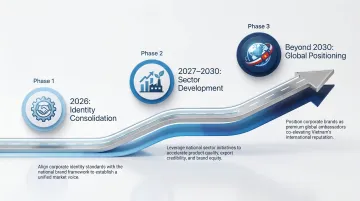
This roadmap has a direct read-through for brand strategy. Each phase — identity consolidation, sector-level development, global positioning — requires groundwork laid well in advance.
Brands that use 2026 to invest in cultural authenticity, digital coherence, and market-specific adaptation will have the trust equity in place when the later phases arrive. Those that wait will be building identity under competitive pressure, not ahead of it.
Frequently Asked Questions
What is a brand refresh and how is it different from a full rebrand?
A brand refresh updates select elements—visual identity, messaging, tone—to stay relevant without abandoning brand equity, while a full rebrand involves a comprehensive overhaul of positioning, name, or identity. In Vietnam's fast-moving market, refreshes are often more strategic than rebuilding from scratch.
Why is 2026 considered a critical year for brand refreshes in Vietnam?
Several forces are aligning in 2026: rising consumer sophistication from GDP growth, new ESG and national brand programme requirements under Circular 18/2026, intensifying competition from foreign retailers like AEON and MUJI, and maturing digital platforms. Together, these make brand positioning decisions unusually high-stakes this year.
How important is cultural localization in a Vietnam brand refresh strategy?
Cultural localization is non-negotiable for brands entering Vietnam. Vietnamese consumers respond to brands that reflect family values, community, and regional identity. Brands that translate content without understanding local culture consistently underperform—genuine resonance is what earns trust and drives engagement.
Which digital platforms should brands prioritize in Vietnam for a refreshed brand identity?
Three platforms deserve priority attention:
- Zalo — direct customer relationships and service touchpoints
- TikTok — Gen Z and Millennial brand discovery
- Facebook — broader advertising reach across demographics
Brand identity must stay coherent across all three while adapting format and tone to suit each platform.
How can foreign brands adapt their global identity for Vietnam without losing consistency?
Develop a brand architecture approach where global brand DNA remains at the core while specific touchpoints—product range, communication tone, platform strategy, local partnerships—adapt to Vietnamese lifestyle realities. MUJI and JINS demonstrate this balance successfully.
How do you measure the success of a brand refresh in the Vietnamese market?
Key metrics to track include:
- Brand awareness shifts in target segments
- Engagement rates across localized digital channels
- Consumer trust survey results
- Sales performance in refreshed markets
- Qualitative feedback from distribution and retail partners
ESG compliance scores and supply chain transparency ratings also matter if international market access is part of your growth plan.