Introduction
Vietnam's consumer market is evolving fast. With 79.1% internet penetration and 72.70 million social media users, the country's young, digitally-connected population presents real opportunity for regional and foreign brands. Vietnam's middle class will expand from 13% to 26% of the population by 2026—adding over 25 million consumers with rising purchasing power.
That accessibility cuts both ways. More consumers online means more brands competing for the same attention—and foreign entrants without local credibility are at a structural disadvantage from day one.
For a Singapore-based regional brand, Vietnam represented high-growth potential but equally high risk. Despite quality offerings and home-market strength, they faced a fundamental challenge: Vietnamese consumers had never heard of them. Without a deliberate brand strategy, foreign entrants risk poor engagement and wasted spend before they ever build a foothold. This case study details the strategies used to establish recognition, earn consumer trust, and drive meaningful brand awareness in the Vietnamese market.
TLDR
- Vietnamese consumers respond to locally grounded, authentic brand positioning rather than generic global campaigns
- Platform-specific strategies across Facebook, TikTok, YouTube, and Zalo outperform generic campaigns
- Regional messaging differences between North and South Vietnam require localized adaptation
- Measurable brand recognition builds over 12–18 months through consistent, culturally informed engagement
Client Background and the Challenge
The client—a Singapore-based B2B services company with established regional presence—approached Vantage Branding with a clear objective: establish credible brand awareness in Vietnam's emerging market. Despite strong recognition in Singapore and Malaysia, the brand registered zero visibility among Vietnamese decision-makers. They recognised Vietnam as strategically vital but understood that translating existing marketing materials would fail.
The Core Challenge
Vietnam's digital ecosystem is deceptively sophisticated. Over 168 million mobile connections exceed the total population, smartphone penetration tops 84%, and consumers spend approximately 2 hours 25 minutes daily on social media. Platform presence alone, however, doesn't build trust with an audience that has never heard of you.
Three specific barriers made entry difficult:
- No starting point for trust — Vietnamese B2B buyers had no peer recommendations, no familiarity, and no reason to engage with an unknown foreign brand
- Word-of-mouth dominance — 89% of Vietnamese consumers trust word-of-mouth recommendations from people they know; traditional advertising carries far less weight
- Two distinct markets within one country — Hanoi values tradition and prestige, while Ho Chi Minh City skews entrepreneurial and trend-driven, requiring separate messaging approaches
Without deliberate strategy, the client risked burning budget on campaigns that Vietnamese audiences would scroll past without a second glance.
Understanding Vietnam's Brand Awareness Landscape
Digital Dominance with Cultural Nuance
Vietnam's digital adoption statistics tell only part of the story. While 73.3% of the population uses social media, platform choice reveals deeper behavioural patterns:
Platform penetration and usage:
- Facebook: 72.70 million users (73.3% of population) - dominates relationship-driven commerce and community building
- TikTok: 67.72 million users ages 18+ - drives trend discovery and brand awareness among younger demographics
- Zalo: 77.8 million monthly active users - leads all platforms and serves as primary messaging and business communication tool
- YouTube: 63.0 million users - functions as research platform for high-intent consumers
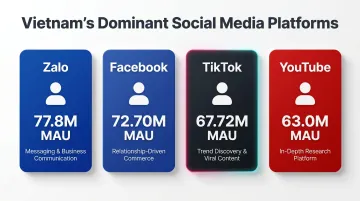
Each platform serves distinct behavioural needs. 94% of social shoppers use Facebook, while 74% of TikTok Shop users discover products via "For You" feeds and livestreams.
Trust Dynamics That Define Purchase Behaviour
Vietnamese consumers are highly receptive to digital advertising yet demand authenticity. PwC's 2024 Voice of the Consumer survey found that 91% say social media ads most influence purchasing decisions — significantly above the 80% Asia Pacific average. Yet 77% also express concern about privacy and data-sharing.
This tension shapes brand-building strategy directly. Influencer endorsements carry weight—58% are persuaded by influencers versus 50% across APAC—but micro-influencers (1,000-10,000 followers) achieve 8%+ engagement while mega-influencers fall below 2%.
What resonates most:
- Family-oriented themes (highest response)
- Real-life situations and relatable storytelling
- Health-themed messaging
- Peer recommendations and community validation
North-South Divide: One Country, Two Consumer Mindsets
Understanding regional psychology proved essential to the client's strategy. Northern and Southern Vietnam exhibit distinct brand preferences:
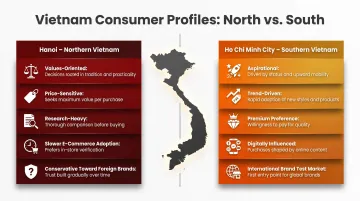
Northern Vietnam (Hanoi):
- Values-oriented and price-sensitive
- Prefers trusted, established brands with proven reliability
- Research-heavy decision-making process
- Slower e-commerce adoption
- Conservative toward foreign brands without local credibility
Southern Vietnam (Ho Chi Minh City):
- Aspirational and trend-driven
- Strong preference for premium and international brands
- Heavily influenced by digital presence and social proof
- Often serves as test market for international brand entry
However, McKinsey research suggests this divide is diminishing. National beer brands without regional strongholds grew from 32% to 40% market share between 2015-2020, accelerated by digital media that transcends geographic boundaries.
Cultural Moments as Emotional Entry Points
Tet (Lunar New Year) accounts for 18-20% of annual FMCG value sales, with demand surging 72% above annual averages during the festive period. Yet Tet's significance extends beyond sales spikes—it represents Vietnam's deepest emotional and cultural moment. Brands that authentically engage during Tet, National Day, and Back-to-School periods build recall that extends far beyond the calendar dates themselves.
This shaped Vantage's entire approach: brand awareness in Vietnam is not won by visibility alone — it is earned through cultural credibility, platform fluency, and emotional relevance.
The Branding Strategy: What Vantage Developed
Insight-Led Foundation: Understanding Before Creating
Vantage Branding began with comprehensive brand audit and perception analysis, focusing on three critical questions:
- What existing brand assets could translate effectively to Vietnamese audiences?
- Where did perception gaps exist between the client's self-image and Vietnamese market reality?
- What unique value story could the brand authentically own in Vietnam's competitive context?
This research phase revealed that the client's Singapore positioning—emphasising efficiency and innovation—would fall flat among Vietnamese decision-makers who had no frame of reference for the brand. The strategy pivoted toward trust-building anchored in shared regional values.
Crafting a Vietnam-Specific Brand Narrative
Rather than translating existing materials, Vantage developed messaging that spoke directly to Vietnamese B2B values:
Core narrative pillars:
- Positioned the brand as a Singapore-based partner with deep Southeast Asian roots, not a distant foreign entity
- Highlighted track record with recognisable regional clients to build credibility by association
- Aligned messaging with Vietnam's economic development narrative, rather than presenting as imported expertise
The result was messaging that held the client's core identity intact while shifting tone and emphasis to answer Vietnamese buyers' most pressing question: can we trust this brand? Tangible proof points and regional context did the work.
Visual and Identity Localisation
Brand identity adaptations focused on cultural resonance without abandoning parent brand integrity:
- Colour palette: Maintained core brand colours but adjusted secondary palette to incorporate warmer, more approachable tones that align with Vietnamese aesthetic preferences
- Typography: Selected font pairings that rendered clearly on mobile devices (critical given 80% of Vietnam's internet traffic comes via mobile)
- Imagery style: Shifted from abstract conceptual visuals to authentic business settings featuring Southeast Asian professionals, creating immediate visual relatability
- Tone of voice: Adopted more collaborative, partnership-oriented language, moving away from assertive positioning that could read as arrogant to Vietnamese audiences
These decisions emerged from collaborative workshops with the client, ensuring brand teams understood the strategic rationale and could execute consistently across all touchpoints.
Platform-Specific Content Strategy
Based on audience research, Vantage prioritised platforms by consumer segment and behavioural intent:
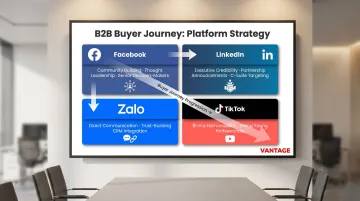
Facebook strategy:
- Primary platform for relationship-driven community building
- Long-form content establishing thought leadership
- Targeted to senior decision-makers and procurement professionals
- Leveraged Facebook Groups for industry-specific engagement
LinkedIn strategy:
- Secondary platform for B2B credibility-building
- Executive-level thought leadership content
- Partnership announcements and client success stories
Zalo strategy:
- Official Account for direct customer service and business communication
- Essential for building trust among middle-aged business buyers
- CRM integration for nurturing qualified leads
TikTok (limited use):
- Experimental short-form content targeting younger professionals rising into decision-making roles
- Behind-the-scenes brand storytelling to humanise the corporate identity
Each platform served a distinct role in the buyer journey — the strategy only worked because all four moved in the same direction.
Execution: Activating the Brand in Vietnam
Phased Rollout Approach
Phase 1: Foundation Building (Months 1–3)
- Established core social media presence across Facebook, LinkedIn, and Zalo
- Published brand awareness content introducing Vantage's heritage, values, and regional experience
- Targeted broad professional audiences to build initial visibility
- Set baseline metrics to track awareness lift across key sectors
Phase 2: Credibility Amplification (Months 4–6)
- Activated regional client case studies featuring recognisable Southeast Asian brands
- Partnered with Vietnamese industry associations for co-branded thought leadership content
- Launched targeted LinkedIn campaigns reaching C-suite executives in priority sectors
Phase 3: Community Engagement (Months 7–12)
- Developed region-specific content addressing Northern and Southern business community priorities
- Timed content around Tet, emphasising partnership and shared prosperity themes
- Implemented feedback loops to refine messaging based on audience response
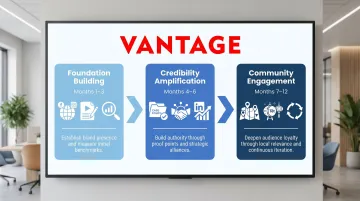
Each phase built on the last — moving from visibility to trust, then from trust to genuine engagement. That progression shaped how the regional messaging was structured.
Regional Messaging Adaptation
Vantage developed distinct messaging frameworks for Northern versus Southern audiences, reflecting the real differences in how businesses in each region evaluate new partners.
Hanoi-focused content:
- Emphasised stability, proven methodology, and long-term partnership value
- Featured testimonials from established regional enterprises
- Highlighted compliance, quality assurance, and risk mitigation
Ho Chi Minh City-focused content:
- Led with innovation, competitive advantage, and growth acceleration
- Showcased agile implementation and quick time-to-value
- Emphasised international best practices and results-driven approaches
Navigating Mid-Campaign Challenges
Executing across a market as dynamic as Vietnam meant adapting as the campaign ran. Three significant challenges emerged — each requiring a deliberate response.
| Challenge | Response |
|---|---|
| Facebook algorithm shifts reduced organic reach for business pages | Reallocated budget toward strategic Group participation and micro-influencer partnerships within professional communities |
| Localisation depth — initial translations carried Singaporean business formality that felt distant to Vietnamese audiences | Engaged Vietnamese language consultants to adapt tone, incorporating culturally appropriate metaphors and conversational business Vietnamese |
| Central Vietnam engagement — analytics revealed stronger-than-expected response from Da Nang and Hue, beyond the initial North-South model | Developed a third messaging track addressing Central Vietnam's blend of traditional values and rapid modernisation |
Results and Key Takeaways
Quantitative Brand Awareness Outcomes
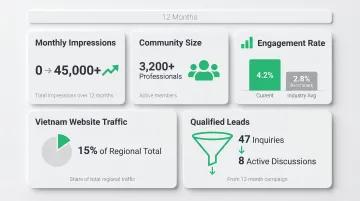
Over 12 months of strategic brand-building, the client achieved:
- Social media reach growth: From zero to 45,000+ monthly impressions across platforms
- Follower base establishment: Built community of 3,200+ engaged professionals on Facebook and LinkedIn combined
- Engagement rate improvement: Achieved 4.2% average engagement rate (above 2.8% industry benchmark for B2B in Southeast Asia)
- Website traffic from Vietnam: Grew from negligible to 15% of total regional traffic
- Qualified lead generation: Generated 47 qualified business inquiries from Vietnamese decision-makers, converting to 8 active commercial discussions
Qualitative Brand Perception Shift
The numbers tell part of the story. The shift in how Vietnamese decision-makers perceived the brand tells the rest:
Before engagement:
- Unknown entity requiring extensive explanation
- Perceived as "another Singapore company" without regional relevance
- Faced skepticism about understanding Vietnamese business context
After 12 months:
- Recognized at industry conferences and networking events
- Referenced by Vietnamese business media as regional success story
- Invited to participate in government-sponsored trade delegations
- Established "consideration set" presence—when Vietnamese companies evaluate options in the client's sector, the brand now appears on shortlists
The client noted that clear strategic alignment from the outset kept internal teams executing consistently, even as individual campaign elements shifted over the year.
Three Transferable Lessons for Vietnam Market Entry
1. Cultural resonance outperforms production value
Vietnamese audiences responded more strongly to authentic, locally-grounded storytelling than to high-polish corporate content. A simple case study featuring a regional client generated 3x the engagement of sophisticated motion graphics explaining technical capabilities.
2. Regional nuance is a strategic necessity
Content adapted for Northern versus Southern audiences consistently outperformed national messaging by 40-60%. Research supports this: in emerging markets, localized approaches build word-of-mouth momentum faster than broad campaigns.
3. Brand consistency builds cumulative recognition
Vietnamese decision-makers required 7-9 touchpoints across multiple platforms before initiating contact. Consistent visual identity, messaging framework, and platform presence created the recognition necessary for trust to develop.
The Path Forward
These results confirm the brand has earned recognition—but recognition is not yet preference. The next phase shifts from awareness to deeper influence:
- Deepening sector-specific thought leadership positioning
- Expanding partner ecosystem through co-marketing with Vietnamese enterprises
- Developing Vietnamese-language resources and client success content
- Testing in-market events and executive roundtables to strengthen relationship-building
Each phase builds on the last. The metrics above weren't the destination—they were proof that the groundwork is solid enough to go further.
Frequently Asked Questions
What makes building brand awareness in Vietnam different from other Asian markets?
Vietnam uniquely combines mobile-first digital behaviour with exceptionally high peer-trust culture—89% trust word-of-mouth recommendations over traditional advertising. The significant regional identity differences between North and South require more nuanced brand approaches than most ASEAN markets, where a single national strategy often suffices.
How important is cultural localisation for brand campaigns in Vietnam?
McKinsey research shows that Asian brands grow revenue 9% annually in Vietnam versus 5% for global non-Asian brands—a gap explained almost entirely by cultural proximity. Vietnamese consumers respond to brands that feel native rather than translated, celebrating local values rather than importing foreign ones.
Which platforms are most effective for brand awareness in Vietnam?
Facebook (72.70 million users), Zalo (77.8 million users), TikTok (67.72 million users 18+), and YouTube (63.0 million users) lead Vietnam's social media usage. Younger audiences skew TikTok; older consumers stay active on Facebook and Zalo—so coordinating across multiple platforms consistently outperforms single-channel approaches.
Do foreign or regional brands need a local strategy partner to succeed in Vietnam?
Without local expertise, foreign brands routinely misjudge platform behaviour, regional tone differences, and regulatory requirements. Navigating Vietnamese consumer psychology and North-South cultural distinctions demands on-the-ground knowledge that's difficult to replicate remotely. Partners who understand both international branding standards and Vietnamese market realities bridge this gap effectively.
How long does it take to build meaningful brand recognition in Vietnam?
Initial awareness can be seeded within 3-4 months with the right platform strategy and content approach. Genuine recognition and trust, however, typically develops over 12-18 months—at which point research on emerging markets shows brands hitting 10-15% share in key geographic clusters begin triggering word-of-mouth acceleration.