Introduction
Your brand isn't connecting anymore. Sales are flat despite strong traffic. Your sales team struggles to explain what makes you different. Prospects seem confused about who you serve or what you do.
You know something needs to change, but the costly question is: do you need a new look, or a new strategy?
Many business leaders waste months and significant budget treating the wrong problem. They invest in logo redesigns when the real issue is a broken value proposition. Or they update messaging while their visual identity actively contradicts their market position.
This article helps you diagnose which path your business needs. You'll learn the key differences between rebranding (changing how you look and sound) and repositioning (changing what you stand for and who you serve), when each strategy applies, and how to avoid treating the wrong problem entirely.
TLDR
- Rebranding changes visual and verbal identity: logo, name, colour palette, tone
- Repositioning shifts strategic stance: target audience, value proposition, market perception
- The two solve different problems and require different investments
- Repositioning typically comes first; rebranding gives the new strategy a visual voice
- Mixing them up leads to wasted spend — and a brand that looks new but says nothing different
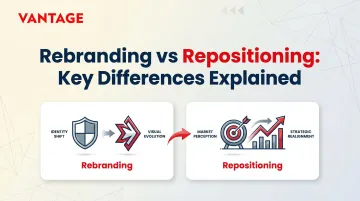
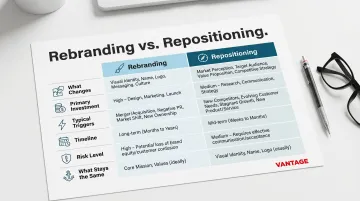
Rebranding vs Repositioning: Quick Comparison
| Dimension | Rebranding | Repositioning |
|---|---|---|
| What Changes | Visual identity (logo, name, typography, colour), verbal identity (tone, tagline) | Strategic stance (target audience, value proposition, messaging framework, competitive positioning) |
| What Stays the Same | Core business model, product/service offering (usually) | Visual identity (often) |
| Primary Investment | Design, production, asset rollout — financial cost is higher | Strategy, research, workshops, internal alignment — time and organisational effort |
| Typical Triggers | Outdated identity, negative brand equity, misleading name, merger/acquisition, market tier misalignment | Declining conversion despite traffic, competitive pressure, new market entry, audience shift, unclear value proposition |
| Timeline | 12-18 months for complex rebrands; faster visual impact | Years to shift market perception; organisational change precedes external visibility |
| Risk Level | High if disconnected from strategy; costly to reverse (Gap's US$100M reversal, Tropicana's US$30M loss) | High if not executed internally; McKinsey reports 70% of transformations fail due to leadership misalignment |
What is Rebranding?
Rebranding is a change to a brand's visual and verbal identity — the name, logo, colour palette, typography, tagline, and tone of voice — intended to reshape how the brand is perceived across every touchpoint.
According to Muzellec and Lambkin's research, corporate rebranding is "the creation of a new name, symbol, design or a combination of them for an established brand with the intention of developing a differentiated position in the mind of stakeholders and competitors."
This is different from a brand refresh. A refresh updates surface elements (modernising fonts, refining colours) without fundamentally changing the brand's identity or meaning. Rebranding, by contrast, signals transformation.
Two Layers of Rebranding:
- Visual rebranding — tangible identity elements: logo, colour system, typography, imagery style
- Strategic rebranding — redefining mission, values, brand architecture, narrative
Effective rebranding requires both layers working together. Visual changes without strategic coherence produce confusion. Strategic shifts without visual expression remain invisible.
Common Triggers:
- The brand name causes confusion or misrepresents the business. Kentucky Fried Chicken became KFC in 1991 to drop "fried" from the name, enabling menu diversification beyond fried products and appealing to health-conscious consumers.
- The identity feels outdated relative to current positioning. The visual language signals a different era, tier, or audience than the company now serves.
- Merger or acquisition. Two entities need a unified identity, or the acquired brand needs distance from its previous owner.
- Negative brand equity. The existing identity carries reputational damage that a fresh start can address.
Real Example: 3M dropped "Minnesota Mining & Manufacturing Company" in 2002, reflecting its evolution from a small-scale mining venture to a diversified technology conglomerate. The name change removed geographic and functional constraints.
When Should You Rebrand?
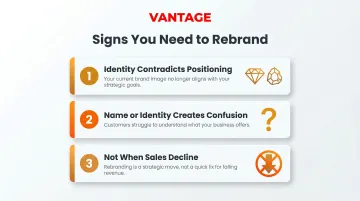
Three clear signals indicate a rebrand may be warranted:
- Identity contradicts positioning. If your company has moved upmarket but still looks like a bootstrap startup, your design language is sending mixed signals. Prospects form judgements within seconds — and if the visuals don't match the pricing, conversion suffers.
- Name or identity creates confusion. When prospects can't immediately understand what you do or who you serve, the brand is failing its most basic function. Needing to constantly explain your identity is a reliable warning sign.
- Not when sales decline. A new logo won't fix broken positioning — an unclear value proposition, the wrong target audience, or misaligned messaging. Rebranding executes the brief. It cannot write it.
An average rebrand costs 10-20% of a company's marketing budget. For a company with S$750,000 in annual marketing spend, that's S$75,000–S$150,000. Complex rebrands take up to 18 months.
Don't invest that time and money solving a problem that doesn't exist.
What is Repositioning?
Repositioning is a change in strategic stance — who the brand is for, what problem it solves, and why it's the right choice over competitors.
Harvard Business School Professor Jill Avery defines brand repositioning as "refining and rewriting the brand's customer value proposition to refocus on either a new consumer target, a new promise of value, a new competitive frame of reference, or new reasons to believe in the brand."
Repositioning changes how a company is perceived in the market without necessarily changing how it looks. It directly affects:
- Messaging and narrative
- Target audience definition
- Pricing logic and tier perception
- Competitive positioning
- Acquisition and retention strategy
What repositioning does not require: A new name or logo.
Real Example: Apple dropped "Computer" from its name in January 2007 when CEO Steve Jobs announced: "The Mac, iPod, Apple TV and iPhone. Only one of those is a computer. So we're changing the name." The repositioning from computer brand to digital lifestyle company was already underway through product strategy. The name change was the final visible signal, not the strategy itself.
Organisational Effort:
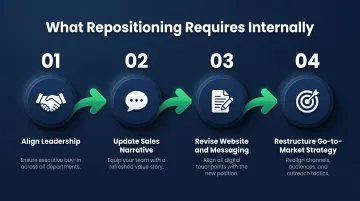
Repositioning is primarily an internal transformation. It requires:
- Aligning leadership on the new strategic direction
- Updating the sales narrative and training teams on the new value proposition
- Revising the website, messaging framework, and ideal customer profile
- Often, restructuring go-to-market strategy
Most leaders underestimate this. McKinsey reports that approximately 70% of large-scale transformations fail — most often because organisations set vague goals, lack a compelling reason for change, allow accountability to slip, or underinvest in building the capabilities required to execute.
When Should You Reposition?
Sales team members give inconsistent explanations. Prospects ask clarifying questions. When no one can describe your offer in one clear sentence, that's a strategic clarity problem — not a visual one.
Conversion rates are falling even though traffic holds steady. Qualified visitors arrive but don't engage. According to MECLABS Institute, a weak value proposition is the primary driver of conversion drop-off — not design. When fewer visitors convert despite consistent traffic quality, the problem is how value is being communicated.
You're targeting a new customer segment or entering a new market. For companies in Asia expanding regionally, positioning must shift before brand identity is updated. Cultural context, competitive dynamics, and buyer priorities differ across markets — repositioning ensures the strategy fits the new context before any visual changes follow.
Rebranding vs Repositioning: Which One Does Your Business Need?
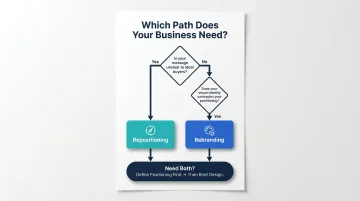
A Simple Diagnostic Framework:
Ask five people who match your ideal buyer profile but don't know your company to review your homepage. Ask two questions:
- "Who is this for?"
- "What problem do they solve?"
If answers are vague or inconsistent: The problem is positioning. Your value proposition, audience definition, or messaging is unclear.
If answers are clear but the visual impression feels mismatched with the price point, market tier, or audience expectations: The problem is design.
Choose Repositioning If:
- The brand name is well established and not misleading
- The core visual identity is sound
- But the message, audience, or value proposition no longer resonates
The work is strategic, not cosmetic. Invest in clarifying who you serve, what you stand for, and why you're the right choice.
Choose Rebranding If:
- The brand's identity actively works against its positioning
- The name causes confusion or limits growth
- The visual identity signals the wrong market tier
- You're preparing for fundraising or acquisition where first impressions carry commercial weight
Choose Both If:
The company has undergone a significant pivot requiring both a new strategic direction and a new visual expression.
Critical: The right sequence matters.
Define and validate the positioning first, then brief the design work. Design started before strategy is confirmed almost always wastes budget.
That sequencing challenge is compounded for companies operating across Asia, where brand perception varies sharply by market and visual identity must work across diverse cultural contexts.
Vantage Branding works with companies in Singapore and across Asia to diagnose which lever to pull — before either investment begins.
Real-World Examples from Global Brands
Example 1: Repositioning Without Rebranding — Apple
Apple dropped "Computer" from its company name in 2007, shifting its positioning from a computer brand to a digital lifestyle brand. The visual identity barely changed — but the market stance shifted entirely.
The repositioning unlocked growth beyond the Mac into iPods, iPhones, and Apple TVs — product categories that redefined the company's revenue model.
Takeaway: Repositioning can be enormously powerful without requiring a visual overhaul.
Example 2: Rebranding to Remove a Growth Constraint — KFC
Kentucky Fried Chicken became KFC in 1991 to remove "fried" from the brand name. This enabled menu expansion into grilled options and new product categories without the name contradicting the offer.
Takeaway: When the name itself limits growth, rebranding creates strategic freedom.
Example 3: Repositioning Followed by Rebranding — Tiger Beer (Singapore)
Tiger Beer, founded in Singapore and now part of Heineken's portfolio, underwent a documented repositioning in 2024. For over a decade, the brand ran "Uncage Your Tiger," championing individual drive and ambition.
Extensive research, however, revealed a tension: while consumers valued that sense of empowerment, the solo-achievement focus felt isolating. Particularly in Asian markets, modern consumers wanted community and shared aspiration — not just personal grit.
In February 2024, Tiger Beer launched "You Never Roar Alone," shifting from individual empowerment to collective courage. The creative execution by LePub Singapore featured a street vendor succeeding through community support, with CGI spectacles in Singapore, Ho Chi Minh City, and Manchester.
The packaging refresh followed: modernised design retaining the tiger emblem with a simplified single-shade background.
Takeaway: The sequence matters. Strategy before design produces coherent outcomes. Design before strategy produces expensive revisions.
For businesses unsure which path to take, the right starting point is a brand diagnostic — one that identifies whether the issue is strategic, visual, or both. Vantage Branding works with companies across Singapore and Asia to diagnose that clearly before committing to either investment.
Frequently Asked Questions
What is the difference between repositioning and rebranding?
Rebranding changes visual and verbal identity (logo, name, colour, tone). Repositioning changes strategic stance — who the brand is for, what it stands for, and how it's perceived in the market.
What does repositioning mean?
Repositioning is a strategic exercise to shift a brand's market perception by shifting its value proposition, target audience, and messaging — without necessarily changing its visual identity.
What are the 4 types of positioning?
The four common types are: by product attribute (what it does), by use or application (when/how it's used), by user (who it's for), and by competitor (what it's better than). Repositioning means deliberately moving from one of these stances to another.
Can a company rebrand and reposition at the same time?
Yes, but it carries risk. Repositioning mid-design brief can force expensive revisions. The safer model: validate the positioning strategy first, then use it to brief the design work.
Is repositioning cheaper than rebranding?
Repositioning costs time and organisational effort (strategy, workshops, messaging alignment); rebranding carries higher financial cost (design, production, asset rollout). The real risk is committing to either without first diagnosing the underlying problem.