Introduction
Vietnam has emerged as one of Asia's most critical manufacturing destinations, attracting $25.58 billion in manufacturing FDI in 2024 alone. Yet most manufacturers competing in Vietnam's industrial zones still rely almost exclusively on price and production capacity to win contracts. This leaves substantial brand value unclaimed.
That's changing. Leading manufacturers in Vietnam—from homegrown champions like Vinamilk to global operations like Samsung and Nike—are proving that branding creates real competitive advantage in manufacturing. Companies that invest in brand strategy are commanding premium pricing and attracting talent competitors can't match.
The three cases below show what that looks like in practice—and what other manufacturers can take from each.
TLDR:
- Vietnam attracted $25.58 billion in manufacturing FDI in 2024, making production efficiency alone insufficient for differentiation
- Vinamilk's 2023 rebrand achieved $3 billion in brand value, ranking it Vietnam's No. 1 food brand and 6th largest dairy brand globally
- Samsung's $23.2 billion Vietnam investment shows how operational scale translates into brand equity when communicated strategically
- Vietnam produces 51% of Nike's footwear and 37% of Adidas's—a quality signal local manufacturers can leverage through stronger brand communications
Why Vietnam's Manufacturing Growth Is Forcing a Branding Reckoning
The China+1 Reality
Vietnam's manufacturing sector attracted $25.58 billion in FDI in 2024, representing 66.9% of total registered foreign investment. The processing and manufacturing sector now accounts for $290.9 billion in exports—71.7% of Vietnam's total export turnover.
Chinese firms led the China+1 migration, accounting for 28.3% of all newly registered FDI projects in 2024. BYD invested nearly $600 million in Phu Tho province alone. Luxshare, Goertek, Foxconn, and BOE all established or expanded Vietnam operations.
Industrial zones are filling fast, and competing manufacturers are chasing the same export contracts. Production efficiency and cost advantage no longer close deals on their own.
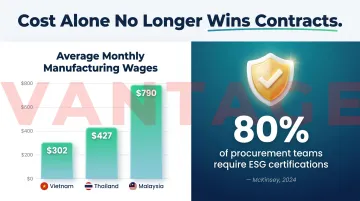
Vietnam's average monthly manufacturing salary of $302 remains lower than Malaysia ($790) and Thailand ($427). Yet McKinsey's 2024 CPO survey found that 80% of procurement teams now require ESG certifications as a prerequisite for supplier selection — a threshold that cost competitiveness alone cannot meet.
The OEM-to-OBM Transition
Vietnam's government recognised this shift. The National Brand Programme grew from 30 enterprises in 2003 to 190 enterprises today, with a target of 1,000 National Brand products by 2030. The Ministry of Industry and Trade frames this explicitly as a shift from OEM (contract manufacturing) to ODM and OBM (own-brand manufacturing) models.
OEM manufacturers capture thin margins and remain vulnerable to demand fluctuations — factory utilisation for many Vietnamese suppliers collapsed from 100% in 2021 to 60–70% in 2023 during global slowdowns. Branded manufacturers control pricing, develop direct customer relationships, and build resilient business value that survives those cycles.
The Dual Audience Challenge
Vietnamese manufacturers face a unique branding challenge: they must build credibility with two distinct audiences simultaneously.
Each audience requires a different brand posture:
- International B2B buyers need confidence in quality, reliability, and certifications. Edelman-LinkedIn research shows 75% of B2B buyers discover new suppliers through thought leadership, and 73% find it more trustworthy than standard marketing.
- Domestic consumers represent a growing second audience as Vietnam's purchasing power rises. Manufacturers entering consumer markets must balance heritage with modernity — and local authenticity with international credibility.
Vinamilk: Rebranding a National Manufacturer for Global Ambition
From State Monopoly to Global Brand
Vinamilk is Vietnam's largest dairy company, generating VND 60,479 billion in revenue in 2023 and exporting to 50 countries. The company ranks as Vietnam's No. 1 food brand and the 6th largest dairy brand globally by Brand Finance.
But scale doesn't guarantee brand strength. As Vinamilk targeted younger domestic consumers and expanded international distribution, its outdated visual identity and brand architecture became liabilities. The logo and packaging designed for a domestic monopoly didn't project the modernity or quality needed to compete with Nestlé and Dutch Lady.
The Strategic Brand Challenge
Vinamilk faced a classic manufacturing brand dilemma: how to modernise without erasing the equity built over decades. Vietnamese consumers trusted Vinamilk as an established, local producer. But that same "established" perception made the brand feel dated to younger buyers and uncompetitive internationally.
The 2023 rebrand tackled this by balancing heritage with aspiration. Key design decisions included:
- Logo: Retained the Vinamilk name in a contemporary handwritten style, with a smile in the "i" and a milk drop in the "a"
- Heritage marker: "Est 1976" references longevity without feeling nostalgic
- Colour palette: Vinamilk's signature green paired with a "sweet milk cream" tone, plus a secondary library of 28 colours drawn from Vietnamese cuisine and cultural heritage
- Pattern system: Visual motifs referencing 1970s stamps, ancient artefacts, and Bronze Drums — grounding the brand in Vietnamese identity across every touchpoint
Cultural Resonance as Strategy
Vinamilk's rebrand demonstrates a critical insight for Vietnamese manufacturers: local identity is not a weakness to hide when competing globally — it's a differentiator to amplify.
Three strategic moves drove this shift:
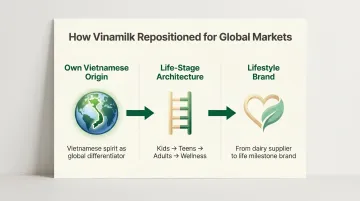
- Owning Vietnamese origin: The brand narrative explicitly positions "Vietnamese spirit" and locally sourced production as strengths — effective in markets where "Made in Vietnam" carries growing credibility and among diaspora communities
- Moving beyond product categories: Brand architecture shifted from milk/yogurt/condensed milk to life-stage segmentation — Kids, Teenagers, Adults, Wellness & Joy
- Becoming a lifestyle brand: That architectural change repositions Vinamilk from a functional dairy supplier to a brand that accompanies consumers through life milestones
Measurable Outcomes
Brand Finance valued Vinamilk at $3 billion in 2023, up from $2.8 billion previously. International revenue grew 5.4% year-over-year, with exports up 12% and overseas subsidiaries up 30% in 2024.
For Vietnamese manufacturers eyeing regional or global expansion, the Vinamilk case is instructive: brand investment at the identity and architecture level translates directly into measurable commercial value — not just perception.
Samsung Vietnam: How Manufacturing Scale Shapes Brand Perception
Vietnam's Largest Foreign Investor
Samsung has invested over $23.2 billion in Vietnam across 6 manufacturing facilities, employing more than 160,000 workers—30% of Samsung's global workforce. The company produces 60% of its 220 million annual phones in Vietnam, with the Thai Nguyen factory alone producing more mobile phones than any other facility globally.
Samsung's Vietnam operations generated $54.4 billion in exports in 2018, accounting for 25% of Vietnam's total export turnover at that time. This makes Samsung Vietnam not just a manufacturer, but a foundational pillar of the national economy.
Manufacturing as Brand Signal
Samsung Vietnam demonstrates a critical principle: for B2B manufacturers, brand credibility is built through visible operational commitments, not marketing campaigns.
The scale, technology investment, and employment footprint communicate quality assurance and manufacturing excellence to governments, partners, and buyers. When Samsung announces a $4 billion chip packaging plant in Thai Nguyen, that investment signals long-term commitment and operational sophistication more clearly than any marketing campaign. Samsung translates production scale into brand equity by making its Vietnam operations highly visible—through government partnerships, media coverage of new investments, and workforce development programs.
Elevating "Made in Vietnam" Credibility
Samsung's supplier development programs grew the Vietnamese supplier base from 4 companies in 2014 to 50 in 2020, achieving a 57% localization rate. Local suppliers were trained to meet global standards; many went on to diversify into automotive and other industries.
The Samsung Tech Programme awarded 360 scholarships worth VND 10 billion and established Samsung Labs at Vietnamese universities. These investments build brand equity for Samsung while strengthening the broader Vietnamese manufacturing ecosystem.
The Lesson for Smaller Manufacturers
Samsung's approach proves that B2B brand credibility comes from demonstrating operational excellence—then making that excellence visible. Operational signals only translate into brand value when communicated consistently.
Manufacturers who invest in the following but never communicate them leave real brand value unclaimed:
- ISO certifications and quality standards
- Automation upgrades and technology investments
- ESG programs and sustainability practices
- Factory audits and third-party verifications
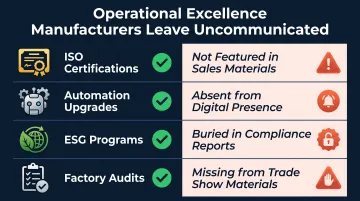
These achievements deserve a place in sales materials, trade show presence, and digital content—not just internal reports.
Adidas, Nike, and the Rise of "Made in Vietnam" as a Quality Signal
Global Production Concentration
Vietnam now produces 51% of Nike's global footwear (FY2025) and 37% of Adidas's footwear (2024), making it the largest single sourcing country for both brands. Nike operates 162 factories in Vietnam employing over 493,000 workers; Adidas produces 27% of its total volume across all categories in Vietnam.
Vietnam exported approximately $27 billion in footwear in 2024, ranking as the 2nd-largest footwear exporter globally.
The Country-of-Origin Halo Effect
When globally recognized brands like Nike and Adidas consistently manufacture in Vietnam and communicate the quality standards applied in those factories, it creates a halo effect benefiting Vietnamese manufacturers across the supply chain.
Fabric suppliers, component makers, and contract manufacturers gain credibility by association. Some Vietnamese contract manufacturers now use their relationships with premium global brands as proof points in B2B marketing — citing production volumes for Nike or certifications earned through Adidas partnerships.
The Branding Opportunity Gap
Despite world-class production capabilities, most Vietnamese textile and footwear manufacturers haven't translated operational excellence into strong brand narratives targeting new clients, talent, or investors.
McKinsey's 2024 survey found that 40% of apparel CPOs plan to increase Vietnam sourcing, yet only 43% of supplier relationships qualify as "strategic partnerships" — the rest remain transactional. Manufacturers treated as interchangeable commodity providers face margin pressure and lose ground when demand slows.
The pattern is consistent: factories with proven track records, ESG certifications, and digital capabilities stay invisible to buyers who could offer better terms. The specific communication gaps include:
- No published case studies demonstrating production scale or quality outcomes
- Absent thought leadership positioning them as specialists rather than vendors
- ESG certifications buried in compliance reports rather than featured in brand materials
- Digital presence that lists capabilities without telling a story that builds trust
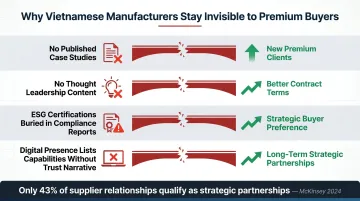
Closing these gaps is where B2B branding in Vietnamese manufacturing delivers measurable commercial return.
Key Branding Lessons from Vietnam's Manufacturing Success Stories
Lesson 1: Brand Strategy Must Precede Visual Identity
Vinamilk, Samsung, and global footwear brands all defined clear brand positioning—what they stand for, who they serve, how they differ—before redesigning logos or packaging.
Manufacturers who skip strategy and jump straight to a visual refresh often create attractive but ineffective brand identities. A new logo without strategic foundation communicates nothing meaningful. Strategic positioning defines the message first. Visual identity gives it form.
Manufacturers investing in brand strategy first achieve more coherent, durable identities that guide every subsequent brand decision, from product naming to trade show messaging.
Lesson 2: Heritage and Modernity Are Not Opposites
Vinamilk's rebrand proves Vietnamese manufacturers don't need to erase local identity to appear global. Authenticity—rooted in Vietnamese craftsmanship, local sourcing, or cultural values—differentiates when positioned correctly.
International buyers increasingly value supply chain transparency and regional expertise. Positioning "Made in Vietnam" as a quality signal, not a cost play, requires manufacturers to communicate operational sophistication, certifications, and technology investments alongside local heritage.
Lesson 3: B2B Manufacturers Need Brand Too
Samsung Vietnam illustrates that manufacturers who never sell directly to consumers benefit enormously from deliberate brand building. Buyers, partners, employees, and regulators all respond to brand signals.
Brand investment influences decisions across every stakeholder group:
- Procurement: Buyers prefer suppliers with established reputations
- Talent acquisition: Skilled workers choose employers with credible brands
- Investor confidence: Financial stakeholders factor brand equity into risk assessments
Lesson 4: Operational Excellence Must Be Communicated
Quality doesn't sell itself in international B2B markets. Edelman-LinkedIn research found that 75% of B2B buyers discover suppliers through thought leadership content—meaning perception shapes shortlists before a sales conversation even begins.
Quality claims must translate into visible, consistent brand communications: case studies showcasing successful projects, certifications highlighted in sales materials, thought leadership demonstrating industry expertise.
Lesson 5: Consistency Across Touchpoints Matters
A common failure mode for manufacturers: investing in a brand refresh but applying it inconsistently across factory signage, sales materials, websites, packaging, and trade show presence.
Brand consistency converts a brand concept into brand perception. Inconsistent messaging, outdated materials, or mismatched visuals erode trust at exactly the moment a prospect is forming a first impression.
How Manufacturers in Vietnam Can Build Brand Equity That Lasts
Start with a Brand Audit
Manufacturers should begin with a brand audit assessing current perception among key stakeholder groups: buyers, distributors, employees, investors. Follow with a gap analysis comparing current perception to desired positioning.
This research-led approach—insight before identity—separates brands that endure from those that simply refresh logos. Working with an experienced branding partner like Vantage Branding, which operates across Vietnam and Asia and brings cross-industry manufacturing branding expertise, can compress timelines and surface positioning opportunities that internal teams often miss.
Align Brand Strategy with Business Strategy
Manufacturers expanding into new export markets, launching proprietary product lines, or targeting premium buyers need a brand built for where the company is going—not where it has been.
Brand architecture decisions become critical for manufacturers with multiple product lines or customer segments. The core question: run each product line under its own identity (house of brands) or consolidate everything under one master brand (branded house)? The right answer depends on three factors:
- Business strategy and growth direction
- Degree of customer overlap across segments
- Competitive positioning in each market
Take the Long-Term View
Manufacturing brand equity builds over years, not months. Treat branding as infrastructure investment—like factory fit-out or quality certification—rather than a one-time marketing exercise.
Consistent application and ongoing brand governance turn an initial brand investment into lasting competitive advantage. The Vietnamese manufacturers featured in these case studies share one trait: they treated brand consistency as a non-negotiable operational standard—not a marketing afterthought.
Frequently Asked Questions
Which famous brands are manufactured in Vietnam?
Vietnam manufactures products for Nike (51% of global footwear), Adidas (37% of footwear), Samsung (60% of phones), Intel (semiconductor components), and Apple suppliers including Foxconn and Luxshare. The country's manufacturing reputation spans electronics, footwear, apparel, and furniture.
Is Vietnam becoming a manufacturing hub?
Vietnam attracted $25.58 billion in manufacturing FDI in 2024, driven by the China+1 strategy, competitive labor costs, and favorable trade agreements including CPTPP and EVFTA. Manufacturing now represents 24.43% of GDP, cementing the country's position as a major global production hub.
Why does branding matter for manufacturing companies in Vietnam?
Branding helps manufacturers differentiate beyond price, attract premium buyers, recruit skilled talent, and build long-term business value. As ESG credentials become a baseline buyer requirement in Vietnam's increasingly competitive sector, brand reputation is now a deciding factor in supplier selection.
What is the difference between OEM and branded manufacturing in Vietnam?
OEM manufacturers produce goods under another company's brand, limiting margin and strategic leverage. Branded manufacturers own their identity, command premium pricing, develop direct customer relationships, and build independent business value. Vietnam's government targets 1,000 National Brand products by 2030 to drive this transition.
How do Vietnamese manufacturers build credibility with international buyers?
Vietnamese manufacturers build credibility through:
- Quality certifications (ISO, ESG standards)
- Consistent brand communications across digital and physical touchpoints
- Factory transparency and showcase visits
- Strategic trade show presence
- Case study content demonstrating past work and partnerships
How long does it take to build a strong manufacturing brand in Vietnam?
Foundational brand strategy and identity typically takes 3–4 months to develop, covering positioning, messaging, and visual identity. Meaningful brand equity—measurable through buyer preference, partner trust, and talent attraction—builds over two to five years of consistent application.