In a market shaped by multicultural consumer expectations, growing digital competition, and a persistent trust gap, brand is no longer a marketing luxury for Malaysian insurers — it is a strategic necessity.
TLDR:
- Malaysia's insurance protection gap averages RM553,000-RM723,000 per family despite recent industry growth
- Only 40-50% of Malaysians have life protection; just 4% of B40 households hold any policy
- Brand trust directly influences purchase decisions in promise-based products like insurance
- Takaful operators must differentiate beyond Shariah compliance as younger consumers demand better experiences
- Insight-led brand strategy — grounding positioning in research and extending it across every touchpoint — separates cosmetic rebrands from those that drive real business results
Why Malaysian Insurance Has a Brand Problem
Despite recording double-digit growth in new business premiums exceeding RM20 billion and total takaful contributions surpassing RM7 billion in the first half of 2024, Malaysia still faces a significant insurance protection gap. Research commissioned by the Life Insurance Association of Malaysia (LIAM) found the average protection gap for Malaysian families ranges from RM553,000 to RM723,000 per family, depending on existing coverage levels.
The numbers tell a troubling story about market penetration. While LIAM reports a headline penetration rate of approximately 56%, Bank Negara Malaysia Assistant Governor Adnan Zaylani Mohamad Zahid revealed that the effective rate — excluding individuals with multiple policies — is approximately 40-50%, meaning only 2 out of 5 Malaysians have life protection. Among B40 (lower-income) households, only 4% have any form of insurance policy.
The Perception Problem Runs Deep
Many Malaysians still associate insurance with complex jargon, aggressive sales tactics, and reluctant claims handling. A 2023 PIDM-Behavioural Insights Team study found that 42% of urban millennials lack life insurance, with younger respondents specifically citing mistrust in the industry and agents as barriers. The 2022 Customer Satisfaction Survey revealed that claims transparency scored lowest among satisfaction pillars at 75 points, with key complaints around slow processes and poor follow-up communication.
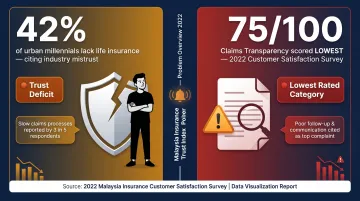
For insurers, this is not a communications problem. It is a brand credibility problem — one that affects acquisition, retention, and the industry's ability to close the protection gap.
The Commoditisation Trap
When products look similar and price competition intensifies, consumers default to the brand they recognise — or delay purchase entirely. In a market where motor takaful products and basic life policies differ little in structure across providers, brand differentiation becomes the primary driver of both conversion and retention.
Without a clear position that communicates distinct value, insurers compete on price alone. Margins erode, and the protection gap widens.
Multicultural Complexity
Malaysia's Malay, Chinese, and Indian consumer segments approach family protection, legacy planning, and risk differently — shaped by distinct financial values and cultural norms. A brand that speaks generically fails to resonate with any of them. Effective brand strategy in this market requires segment-specific messaging anchored in a single, coherent brand identity.
Regulatory Pressure on Brand Credibility
Consumer trust concerns have not gone unnoticed by regulators. Bank Negara Malaysia's drive to improve public confidence in the sector includes stricter standards for agent professionalism and product transparency. Brand consistency and credibility must extend to every customer-facing touchpoint, including the agency force. When agents operate without consistent brand training, the insurer's brand equity becomes fragmented — undermining regulatory efforts and customer trust.
What "Brand" Actually Means for an Insurer
Brand in insurance is not just a logo or tagline. It is the sum of every experience, signal, and perception a customer holds about an insurer: how a claim is handled, how an agent presents themselves, how a website explains a policy, whether a customer feels valued or processed.
Key Components of an Insurance Brand:
- Visual identity: Colours, typography, design language that create recognition and convey professionalism
- Tone of voice: How the brand communicates — plain language versus legalese, empathy versus formality
- Brand values: What the company stands for — trust, transparency, innovation, community
- Brand experience: Every touchpoint — digital platforms, in-branch interactions, agent conversations, claims processes
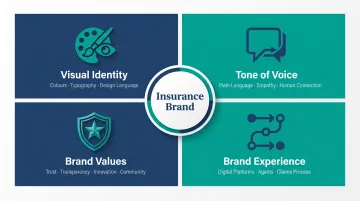
These elements must work together cohesively. A sleek website means nothing if the agent interaction feels outdated. A compassionate tagline rings hollow if claims handling is bureaucratic.
Brand Refresh vs. Rebrand
A brand refresh updates how a brand looks and communicates while retaining its core equity: an updated logo, a modernised colour palette, refreshed messaging that reflects market evolution. A rebrand signals a deeper strategic transformation — repositioning in the market, targeting new audiences, or fundamentally changing what the company stands for.
Insurers need to know which they require before committing budget to either. For Malaysian insurers navigating a rapidly evolving market, that distinction determines whether the work builds on existing customer trust or starts from scratch.
How Brand Builds Trust in a Risk-Averse Market
Unlike buying a product you can evaluate immediately, insurance is a promise about the future. Brand trust is the primary proxy consumers use to assess whether that promise will be kept — making brand investment directly linked to purchase intent and policy renewal rates.
EY's 2024 Global Insurance Outlook notes that trust has shifted from a foundational element to a "competitive liability" for many incumbents, driven by insurers exiting high-risk geographies, denying business disruption claims during COVID-19, and failing to digitise. New entrants take market share by building trust at every touchpoint.
Brand Consistency Across Digital and Physical Touchpoints
As Malaysian insurers invest in mobile apps, online portals, and digital claims handling, the brand experience must be seamless. A McKinsey survey of North American insurance customers found that 6 out of 10 customers switch channels during the pre-purchase phase, and more than 30% are dissatisfied with available digital options.
The stakes are real: customer experience leaders outperformed peers in total shareholder return by 65 percentage points in property and casualty insurance.
Inconsistency between digital interfaces and agent interactions erodes trust faster than any single bad experience. When the mobile app feels modern but the agent's printed materials look dated, customers question the insurer's credibility.
The Agent-Brand Alignment Challenge
In Malaysia, insurance is still heavily distributed through agents. When agents operate as individual "personal brands" without consistent brand training, the insurer's brand equity becomes fragmented. Leading insurers build agent brand guidelines, onboarding processes, and ongoing training that protect brand integrity while empowering agents to build relationships.
Transparency and Plain Language as Brand Tools
Agent consistency addresses one layer of brand trust — but the product itself must also be legible. NAIC research shows that 79% of insurance communications are not readable, which impacts enrolment, claims, and overall experience. The PIDM-BIT study found that choice complexity significantly drives disengagement among Malaysian millennials, with participants 46% more likely to purchase after simplified communication.
Insurers that treat clarity as a brand asset — not a compliance checkbox — build the kind of credibility advertising cannot buy:
- Simplify policy language so customers know what they are covered for
- Use visuals and plain-English summaries to explain complex coverage tiers
- Communicate claims processes upfront, not only when something goes wrong
The Emotional Dimension
Insurance decisions are often triggered by life events — marriage, a new child, a parent's illness. Brands that communicate empathy, not just features, are more likely to be top-of-mind at these critical moments. Insurers that anchor their brand in those human moments — rather than competing purely on price and coverage — are the ones consumers return to when circumstances change.
Brand Differentiation in a Crowded Market: Conventional vs. Takaful
Malaysia is one of the few markets where conventional insurance and Takaful operate side by side at scale, each governed by its own regulatory framework and consumer set. This dual-market reality creates both differentiation challenges and opportunities.
The Takaful Brand Identity Challenge
Many Takaful operators have historically relied on religious compliance as their primary differentiator. As the market matures and younger Muslim consumers expect more from their insurers — in terms of digital experience, service quality, and brand personality — compliance alone is no longer sufficient.
Family takaful held a 40% share of the overall life market in H1 2024, down from 44% in 2023, due to slower growth (0.1%) compared to conventional life insurance (18% growth). While general takaful slightly outperformed conventional non-life insurance (10.5% vs 10.2% growth), the declining family takaful share signals a brand challenge.
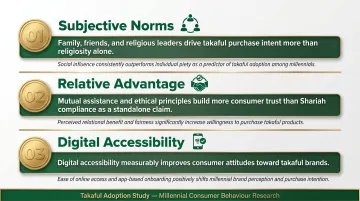
Research on millennials and takaful in Southeast Asia points to three consistent findings:
- Subjective norms — social pressure from family, friends, and religious leaders — are the strongest driver of purchase intention, outweighing religiosity alone
- Relative advantage (ethical superiority, mutual assistance principles) builds trust more than Shariah compliance as a standalone claim
- Digital accessibility measurably improves consumer attitudes toward takaful brands
Digital-Native Disruption
That last point isn't just academic — it's playing out in the market. Newer players like Kaotim, Takaful Malaysia's digital platform, have put it into practice through bold rebranding. Launched in November 2023, Kaotim chose a name drawn from Malaysian slang ("sorted/settled") and built a vibrant visual identity around it. The flagship product, MediKad, delivers on the promise: medical coverage from RM38/month, four-step online enrolment, no medical check-up required.
This approach demonstrates what modern takaful brand positioning looks like: accessible language, simplified processes, digital-first experience, and emotional resonance with a younger audience that values convenience as much as compliance.
Where Both Conventional and Takaful Brands Can Differentiate
Beyond compliance and price, opportunities exist around:
- Owning a niche — healthcare, SME, or family protection — rather than competing across all segments
- Designing digital touchpoints that make onboarding, claims, and self-service genuinely frictionless
- Building community-oriented narratives around mutual assistance, social impact, or financial inclusion
- Committing to ESG in ways that are visible and verifiable — climate risk, sustainable investment, social responsibility
Each of these can form a credible brand platform if backed by genuine operational delivery.
Lessons from Malaysian Insurance Rebrands
The Asian Institute of Insurance: Purpose-Driven Rebranding
In September 2024, the Malaysian Insurance Institute rebranded as the Asian Institute of Insurance (AII), signalling ambition to position Malaysia as a regional hub for insurance professionalism. BNM Governor Abdul Rasheed Ghaffour officiated the launch, emphasising that "a workforce that is not only technically proficient, but also fully committed and uncompromising on ethical standards and professional excellence ensures that the industry's efforts are met with confidence and collaboration, with full trust by customers."
This was not merely a name change but a strategic signal of institutional vision. Insurers can learn from this: aligning brand with institutional ambition requires clarity about where the organisation wants to go, not just where it's been.
Kaotim: Audience-First Branding
When Takaful Malaysia launched Kaotim as a standalone brand, they chose language that mirrors how the target audience thinks and speaks, not how compliance teams write. The brand name is colloquial, the visual identity is vibrant, and the media strategy meets consumers in both physical and digital spaces.
The strategic lesson: brand language must reflect the audience's reality. Simplified doesn't mean simplistic. Accessible doesn't mean unprofessional. Kaotim demonstrates that takaful brands can be modern, relatable, and Shariah-compliant simultaneously.
The Role of Insight-Led Strategy
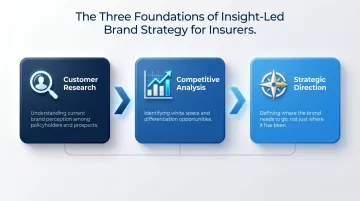
For Malaysian insurers considering a brand evolution, insight-led brand strategy starts with three foundations:
- Customer research — understanding how policyholders and prospects actually perceive the brand today
- Competitive analysis — identifying white space and differentiation opportunities in a crowded market
- Strategic direction — defining where the brand needs to go, not just documenting where it has been
This rigorous foundation is what gives a rebrand staying power. Without it, even the most polished visual identity risks being decorative rather than directional.
Building a Future-Ready Insurance Brand in Malaysia
Three Brand Priorities for the Next Five Years:
Digital brand coherence: Ensuring the brand experience is as strong on mobile as it is in an agent's office, with consistent visual identity, messaging, and service quality across all channels
Inclusive brand positioning: Speaking meaningfully to underserved segments including senior Malaysians and lower-income households as BNM drives greater financial inclusion through initiatives like Perlindungan Tenang, which saw over 780,000 voluntary product purchases by end-2023
Sustainability and social purpose: As ESG expectations grow among investors and regulators — including BNM's 2025 Climate Risk Management policy — brands that embed purpose into their identity rather than treating it as a campaign will earn deeper loyalty
Brand as the Bridge to Innovation
As Malaysian insurers develop micro-takaful, needs-based products for at-risk segments, and climate-responsive coverage, the brand must communicate these innovations in a way that is credible and accessible — not just technically accurate. Without that communicative clarity, even well-designed products struggle to reach the people who need them most.
Brand Investment and Long-Term Relevance
For insurers working to close the protection gap, grow market share, and compete with digital entrants, brand is not an overhead line — it is a strategic asset that compounds over time. Vantage Branding works with organisations across Asia to build brand strategies grounded in market insight and shaped for long-term impact. The question is not whether Malaysian insurers can afford to invest in brand — it is whether they can afford not to.
Frequently Asked Questions
What is branding in insurance?
Branding in insurance is the totality of how an insurer is perceived — encompassing identity, values, communication, and customer experience, not just visual design. It directly influences consumer trust and purchase decisions by shaping whether customers believe the insurer will deliver on its promises.
Why is brand trust especially important in the Malaysian insurance market?
Malaysia's low penetration rates, promise-based products, and multicultural consumer base create unique trust dynamics. Consumers need culturally resonant, consistent brand signals before committing to protection they cannot immediately evaluate.
How does brand differentiation help insurance companies compete in Malaysia?
In a market where products are commoditising, brand creates preference. Strong brands stand out on values, experience, and emotional connection rather than competing solely on price, enabling higher conversion rates and stronger customer loyalty.
How does Takaful branding differ from conventional insurance branding in Malaysia?
Takaful brands must go beyond highlighting Shariah compliance and instead build differentiated identities around service quality, digital experience, and community values. Younger Muslim consumers now expect more from their financial service providers than compliance alone.
What does a successful insurance brand refresh look like?
A successful refresh starts with customer and market research, then aligns visual identity with brand values across every touchpoint — from digital platforms to agent interactions — so consistency builds trust at each encounter.
Can a strong brand help close Malaysia's insurance protection gap?
Yes. When a brand communicates clearly and feels emotionally relevant, it lowers the psychological barriers to buying insurance. Consumers who trust a brand are far more likely to engage — making brand investment a direct lever for reaching underinsured Malaysians.