Introduction: Why Regional Brand Experience Matters in Malaysia
Brands expanding across Malaysia face a challenge that many underestimate: what works in Kuala Lumpur often falls flat in Penang, Johor Bahru, or Sarawak. A single-market approach—built for one city, one culture, one audience—rarely translates consistently across Malaysia's diverse regional landscape.
The stakes are high. Malaysia's population of 34.1 million citizens comprises 70.4% Bumiputera, 22.4% Chinese, 6.6% Indian, and 0.6% other ethnic groups, alongside 137 living languages spoken across the country. That complexity directly shapes how brands are perceived, trusted, and ultimately chosen.
Brand experience in Malaysia spans every touchpoint where a community encounters your brand—digital platforms, retail environments, customer service interactions, and cultural activations. How your brand feels and behaves in Kota Kinabalu will land differently than it does in Petaling Jaya, even when the message is identical.
This article breaks down what regional brand experience services involve in practice, and how brands can stay consistent without ignoring the local realities that determine whether audiences trust them or tune them out.
TLDR
- Regional brand experience aligns strategy, identity, and execution across all customer touchpoints
- Malaysia's ethnic, linguistic, and geographic diversity means Klang Valley strategies won't resonate in Sabah or Sarawak
- Effective regional work requires cultural insight and deliberate localisation, not surface-level translation
- Brands investing in regional experience services gain stronger trust, clearer differentiation, and better market performance
- Agencies with Singapore-Malaysia cross-border experience reduce cultural missteps and maintain brand consistency across markets
What Regional Brand Experience Services Actually Include
Regional brand experience services design, align, and manage every interaction a customer has with your brand—across digital platforms, physical environments, communications, and customer service—in multiple geographic markets within a country.
Core Service Components
The professional services break down into four interconnected areas:
- Brand strategy and positioning — defining what the brand stands for and for whom
- Brand identity design — creating visual and verbal systems
- Brand experience design — bringing the brand to life across touchpoints
- Brand governance — ensuring consistency over time
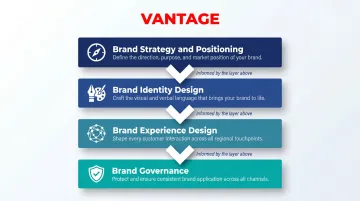
These aren't isolated deliverables. Each layer depends on the one before it — which is why the distinction between branding and brand experience matters in practice.
Branding vs. Brand Experience
Branding defines the foundation—your positioning, identity, and core messaging. Brand experience is how that foundation is expressed and felt at every interaction.
Example: A brand may have a strong logo and colour system, but if its customer service tone feels corporate, its retail environment feels discount-focused, and its digital presence feels premium, the brand experience breaks down. Customers feel confusion, not connection.
Cultural and Regional Insight
In Malaysia, regional brand experience services must account for:
- Language preferences that vary by community and state
- Cultural values shaped by Malay, Chinese, Indian, and indigenous traditions
- Religious considerations including halal requirements and festival calendars
- Consumer behaviour patterns that differ between urban Peninsular markets and East Malaysian communities
This is especially critical for Singapore-based companies entering Malaysia, or Malaysian brands expanding beyond their home state — geographic proximity does not guarantee audience similarity.
Why Malaysia's Market Diversity Demands a Regional Brand Strategy
A Multicultural, Multilingual Population
Malaysia's consumer landscape is defined by its diversity. According to the Department of Statistics Malaysia (DOSM), the country's 70.4% Bumiputera majority includes Malays and indigenous groups such as Iban, Kadazan-Dusun, and Orang Asli. The Chinese community comprises 22.4% and the Indian community 6.6%—each with distinct cultural values, language preferences, and consumption habits.
Urban Peninsular Malaysia (Klang Valley, Penang, Johor Bahru) differs sharply from East Malaysian markets in Sabah and Sarawak. Malaysia's urban population stands at approximately 79.2%, leaving a substantial rural segment concentrated in East Malaysia and northern Peninsular states.
The Language Dimension
While Bahasa Malaysia is the national language, effective brand experience often requires multilingual engagement:
- Mandarin and Hokkien for Chinese-Malaysian audiences
- Tamil for Indian-Malaysian communities
- Indigenous dialects (Iban, Kadazan-Dusun, Bidayuh) for East Malaysian audiences
Brands defaulting to single-language strategies risk alienating significant audience segments.
Religious and Cultural Considerations
These factors must be built into brand experience planning from the start, not layered on as campaign afterthoughts:
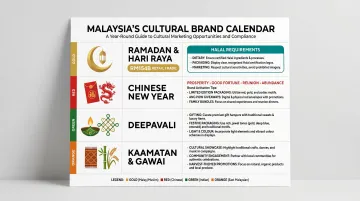
- Halal requirements that shape product development, packaging, and messaging
- Ramadan and Hari Raya dynamics — Malaysia's wholesale and retail trade during this period in 2025 reached approximately RM154 billion
- Chinese New Year and Deepavali seasonal engagement
- Harvest festivals like Kaamatan (Sabah) and Gawai (Sarawak) in East Malaysia
Peninsular vs. East Malaysia Divide
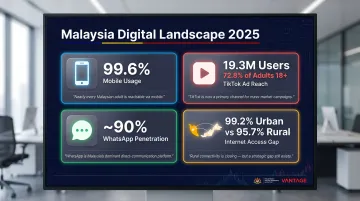
Consumer trust patterns, the role of community and local authority (village leaders, religious institutions), and engagement preferences differ dramatically. Urban digital-first consumption in Klang Valley contrasts with community-driven, in-person engagement in Sabah and Sarawak. This divide extends to infrastructure: while national internet usage reached 98.3% in 2025, urban usage (99.2%) still outpaces rural (95.7%). MCMC's JENDELA Phase 2 allocates 68.9% of its first 1,000 new connectivity sites to Sabah (35.2%) and Sarawak (33.7%)—a clear signal that digital reach in East Malaysia cannot be assumed.
The Cost of Ignoring Regional Differentiation
Cultural missteps generate swift consequences. Prasarana's deodorant ad was pulled from LRT trains in April 2025 after public outcry over racial and religious insensitivity. Gambling platforms exploiting Hari Raya themes in 2021 were placed under investigation after promoting gambling during a sacred Muslim festival.
Both cases show the same failure: brands treating cultural context as decoration rather than foundation. In Malaysia's market, that distinction costs more than a campaign — it costs consumer trust that takes years to rebuild.
Building a Cohesive Brand Experience Across Malaysian Regions
Rooting Experience in Brand Strategy First
Regional adaptation should never mean brand fragmentation. The foundation is **clear, well-defined brand positioning**—what the brand stands for, who it serves, and what it uniquely delivers. Localisation adapts the expression, not the positioning itself.
This requires insight-led research grounded in local behaviour—not assumptions based on proximity to Singapore or homogenised pan-Asia data. Understanding the category, competitor landscape, and target audiences must precede visual or verbal decisions.
Designing Touchpoints for Regional Relevance
Brand experience in Malaysia is shaped across four touchpoint categories:
- Digital — website, social media, e-commerce, apps
- Physical — retail environments, signage, events, packaging
- Human — customer service, sales interactions, brand ambassador behaviour
- Communications — advertising, content, PR
Each must reflect the brand consistently while allowing cultural adaptation.
Visual and verbal identity systems enable this balance. Robust brand guidelines define not just logo placement, but how the brand speaks across different languages and how visual elements adapt across cultural contexts. They also govern tone of voice—shifting between the formal registers suited to corporate audiences and the informal warmth that resonates in everyday Malaysian communication.
Digital Touchpoints: Mobile-First and Platform-Aware
Malaysia's mobile phone usage reached 99.6% of individuals in 2025, making digital touchpoints primary for most brand interactions. Key digital considerations:
- Mobile-first design is non-negotiable
- Platform relevance by region — TikTok's ad reach stood at 19.3 million users (72.8% of adults 18+) in January 2025, making it critical for youth engagement
- WhatsApp's approximately 90% penetration makes it essential for community communication, especially in rural areas
- Multilingual digital content strategies that adapt messaging across Bahasa Malaysia, Mandarin, Tamil, and English
Bringing Brand Experience to Life Through Activation
Experiential activations—pop-up events, product sampling, in-store experiences, and community-based activations—allow consumers to engage tangibly with brands.
During the 2020 Movement Control Order restrictions, BMW Malaysia launched a WebAR showroom that let consumers place a 3D model of the All-New BMW X5 anywhere through their smartphone camera—no app download required. It kept the brand tangible when physical showrooms were closed.
The results are even sharper when activation is built around sensory engagement. Wonda Coffee's contactless sampling campaign (2020) deployed a Virtual Intelligent Brew Master dispenser and automated retail displays, reaching 400 unique consumers per location daily and driving 63% awareness among target listeners within two months.
In East Malaysia particularly, community partnerships matter. Working with local community leaders, indigenous artisans, or regional SMEs creates activations that feel embedded in local culture rather than imposed from outside.
From Brand Strategy to Every Touchpoint: Making It Consistent
Brand Governance in a Regional Context
Brand governance means establishing clear standards, guidelines, and review processes so every brand expression — across regions, agencies, and channels — stays anchored to core strategy.
In markets as geographically and culturally varied as Malaysia, inconsistency erodes brand equity fast. A visual identity that shifts between states, or messaging that reads differently in Bahasa Malaysia versus English, signals a fragmented brand — not a resilient one.
Aligning People Behind the Brand
Employees, distributors, and regional partners shape the brand experience as much as any campaign. For Malaysian brands operating across multiple states, that experience should feel cohesive whether a customer walks into an outlet in Kuala Lumpur or Kuching.
Practical steps to reinforce internal alignment include:
- Shared brand guidelines distributed across all offices and partner teams
- Onboarding that trains staff on brand voice, values, and visual standards
- Regular brand reviews with regional managers to surface inconsistencies early
Measurement Sustains Consistency
Key indicators reveal where brand experience is landing well and where it needs recalibration:
- Brand awareness by region
- Customer satisfaction scores segmented by state or ethnic group
- Net Promoter Scores (NPS) by geography
- Social listening data tracking regional sentiment
Malaysia's leading market research firms—Kantar, Ipsos, and Ken Research—offer brand health tracking services segmented by geography, demographics, and ethnicity. The Malaysian Digital ADEX Reports provide spending benchmarks tracked across digital formats and industry categories.
Signs Your Brand Needs Regional Brand Experience Services
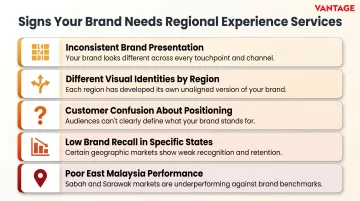
These are clear signals that your brand isn't landing consistently across Malaysia's regions:
- Inconsistent brand presentation across digital and physical channels
- Different visual identities used by different regional teams
- Customer feedback revealing confusion about what the brand stands for
- Low brand recall in specific states or regions
- Poor performance in East Malaysian markets despite strong Peninsular results
Brands That Most Commonly Need This Service
- Singapore-based companies entering Malaysia who underestimate cultural distance
- Malaysian brands scaling from one city to national presence
- Brands in trust-dependent industries — healthcare, financial services, education — where consistent experience directly shapes customer confidence
Vantage Branding works with companies navigating exactly these challenges — particularly those crossing the Singapore–Malaysia corridor, where brand expectations, languages, and cultural cues shift more than most businesses anticipate.
Frequently Asked Questions
What are brand experience services?
Brand experience services cover the strategy, design, and implementation work that shapes how a brand is perceived at every customer touchpoint—from visual identity and communications to in-person and digital interactions.
How is brand experience different from branding?
Branding defines the brand's identity, strategy, and positioning. Brand experience is how that identity is expressed and felt in practice across every interaction a customer has with the business.
Why do companies need a separate brand strategy for Malaysia compared to Singapore?
Malaysia's multicultural, multilingual population and the gap between Peninsular and East Malaysian markets create a very different consumer landscape from Singapore's. Religious and cultural factors—halal requirements, festival calendars, language preferences—add further layers that demand tailored brand approaches.
What should I look for in a regional brand experience agency for Malaysia?
Prioritise agencies that offer:
- Genuine cultural knowledge across Malaysia's diverse regions
- A structured process grounded in insight before strategy
- Experience delivering brand work across multiple industries
- The ability to maintain brand consistency while enabling localisation
How do I know if my brand experience is working in different Malaysian regions?
Key indicators to monitor include:
- Region-specific brand awareness data
- Customer satisfaction and NPS scores segmented by geography
- Social listening for regional sentiment shifts
- Sales performance by state relative to brand investment
How long does it take to develop a regional brand experience strategy?
Scope determines the timeline. A full regional engagement—covering research, strategy, identity, and implementation—typically runs from a few months to a year, depending on brand complexity and the number of markets involved.