Introduction
Malaysia's branding landscape is drawing serious attention from global brand managers across Asia-Pacific. International brands are using it as a regional testing ground, local brands are sharpening their cultural storytelling, and agencies are building frameworks for a market that rewards nuance.
What makes Malaysia distinctive is its multicultural consumer base—Malay, Chinese, Indian, and indigenous communities—each with separate cultural calendars, values, and consumption patterns. A campaign that lands during Ramadan needs a different expression for Chinese New Year or Deepavali.
That complexity isn't a barrier. It's a forcing function for sharper, more culturally grounded brand strategy.
This article unpacks the major branding trends reshaping Malaysia, real-world case studies from brands getting it right, the critical role of cultural intelligence, and what brands—local or global—need to know to build genuine resonance in this market.
TLDR:
- Malaysia's 98% internet penetration and multicultural consumer base make it a strategic testbed for regional brand launches
- Leading brands like Sprite, Patchi, and YSL Beauty are anchoring global platforms in locally meaningful cultural moments
- Cultural intelligence—reading and acting on unspoken values—is now the foundation of brand strategy, not an afterthought
- Local F&B and lifestyle brands are raising the authenticity bar, pushing global entrants to localise with more intent
Why Malaysia Is a Prime Market for Brand Evolution
Malaysia's market data tells the story quickly. As of October 2025, the country counted 35.4 million internet users—98% of the population—and 30.7 million active social media identities (85% penetration). Rapid urbanisation, a digitally engaged youth demographic, and consumers shaped by both local culture and global exposure have made Malaysia one of the most digitally saturated markets in Southeast Asia.
Beyond digital engagement, Malaysia's multicultural makeup creates distinct brand challenges. The market's Malay, Chinese, Indian, and indigenous communities each bring different cultural expectations, consumption patterns, and emotional resonances. A brand strategy that connects during Ramadan/Eid needs to shift fundamentally during Chinese New Year or Deepavali — different cultural narratives entirely, not just translated messaging.
This complexity is precisely why Malaysia is being selected as a regional launchpad by global brands:
- Typo (Cotton On Group) chose Malaysia for its world-first concept store, citing Malaysia as "a growing market for us and the customer here is really engaged with the brand"
- YSL Beauty launched its first-ever global Eid Mubarak campaign in Malaysia, appointing a Malaysian brand ambassador
- Sprite specifically targets Malaysia's mamak stalls in its ASEAN rollout of the 'It's That Fresh' platform
Malaysia's consumer confidence reinforces its strategic importance. The country scored 59 on the Ipsos Global Consumer Confidence Index in May 2025—the highest in Asia—with 69% of Malaysians believing the country is on the right track. The retail market, valued at USD 132.27 billion in 2025, is projected to reach USD 186.15 billion by 2033.
For brand managers, Malaysia is a strategic benchmark: brands that can navigate this market's cultural complexity and earn consumer trust here have a solid foundation to scale across the region.
The Major Branding Trends Reshaping Malaysia's Landscape
Trend 1 — Lifestyle-Led Repositioning
Patchi Malaysia's evolution shows this shift clearly. The luxury chocolatier moved from traditional black-and-gold prestige positioning to a lifestyle-led identity anchored in mint pastel green, cream, and orange tones. The brand refurbished boutiques at Bangsar Shopping Centre, 1 Utama, and Suria KLCC with warmer, more accessible interiors — welcoming a broader audience without sacrificing luxury credentials.
Younger Malaysian consumers in particular gravitate toward brands that integrate into their daily lives, not just their shopping habits.
Trend 2 — Heritage Meets Contemporary Visual Identity
Patchi's phased rollout demonstrates how to update without alienating — softer palettes and fluid lines inspired by heritage logos, with premium roots kept firmly intact. The result is a refreshed identity that existing customers still recognise, while new audiences feel genuinely welcomed.
Trend 3 — Cultural Power as Strategy, Not Afterthought
M&C Saatchi Group Malaysia's launch of their "Cultural Power" framework in May 2025 signals an industry-wide shift: culture is no longer a campaign add-on but the strategic foundation.
The framework uses AI-enhanced analysis and expert-led workshops to uncover cultural truths driving consumer behaviour. Rather than analysing campaigns after the fact, it shapes creative direction from the start. Axiata's 'Getaran Story' and CelcomDigi's '5 Sekawan' are both built on this approach.
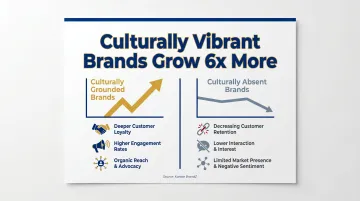
The rationale is backed by data. Kantar BrandZ research shows culturally vibrant brands grow nearly six times more than those that aren't. In an environment where ad-blockers are standard and feeds are oversaturated, culturally resonant creative isn't optional — it's survival.
Trend 4 — Global Platforms, Local Adaptation
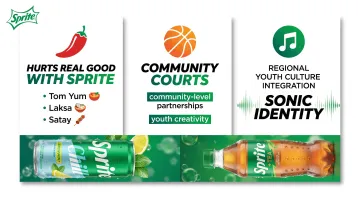
Sprite's ASEAN rollout of 'It's That Fresh' demonstrates how unified global platforms gain traction through locally meaningful execution. The campaign anchors in three regional cultural pillars:
- Spicy food: "Hurts Real Good with Sprite" celebrates pairing with tom yum, laksa, and satay; creator-led content and "Sprite & Spicy" bundles drive activation
- Basketball: Community-level partnerships celebrating youth creativity and the energy of the game
- Music: Integrated into brand DNA to connect with regional youth culture
Product innovation reinforces the brand story. Sprite Chill Lemon Mint delivers intense cooling sensation tailored to Southeast Asian heat. Sprite + Tea responds to a viral social media trend, launching in ASEAN in 2026.
The pattern is consistent across high-performing regional campaigns: a single brand platform adapted through local cultural touchpoints, not retrofitted after the fact.
Trend 5 — Digital Amplifying, Not Replacing, Physical Brand Experiences
Brands featured in Malaysia's branding evolution aren't abandoning physical retail. Instead, digital is positioned as a bridge to deepen real-world engagement.
Patchi Malaysia's leadership framed it clearly: "Digital will not replace retail — it will amplify it." In practice, this means flagship stores drive emotional connection while digital channels handle personalisation, loyalty mechanics, and extended reach beyond foot traffic.
What Leading Brands Are Getting Right in Malaysia — Case Studies
Case Study 1 — Patchi Malaysia
Key moves:
- Phased, boutique-level rollout of global rebrand at Bangsar Shopping Centre, 1 Utama, and Suria KLCC
- Refined interiors to feel "welcoming to a broader audience" without sacrificing luxury
- Festive campaign activations (Chinese New Year, Ramadan, Christmas) to stay culturally embedded
- Shift toward lifestyle emphasis alongside luxury chocolate and gifting
Takeaway: A successful rebrand is not a single event. Patchi's phased, culturally calibrated rollout shows how heritage and contemporary accessibility can coexist — when each step is deliberate.
Case Study 2 — M&C Saatchi Group Malaysia
Key moves:
- Dual rebrand: new visual identity (the "+" motif signifying global creativity meets local insight) and launch of the Cultural Power framework
- Campaign proofs of concept: Axiata's 'Getaran Story' and CelcomDigi's '5 Sekawan' built on cultural diagnostics embedded early in strategy development
What worked: Embedding cultural diagnostics at the strategy stage, not as a post-mortem, produced campaigns that landed from day one rather than needing course corrections after launch.
Case Study 3 — Sprite's 'It's That Fresh' ASEAN Rollout
Key moves:
- Three regional cultural pillars: spicy food, basketball, music
- Introduction of new sonic identity ("Sprite Sound")
- Updated packaging with "Lymon" symbol
- Product innovations like Sprite Chill Lemon Mint tailored to regional preferences
The strategic insight: A strong global platform gains traction when it permits local expression. Sprite went further by letting product innovation — not just messaging — carry that local story.
Case Study 4 — YSL Beauty and Typo
YSL Beauty — Key moves:
- First-ever Eid Mubarak campaign in Malaysia, fronted by local ambassador Meerqeen
- Merged Parisian luxury identity with a Malay Muslim cultural moment
- Positioned the brand as part of Malaysia's cultural calendar, not simply a market entrant
Typo — Key moves:
- Opened a world-first concept store at IOI City Mall Putrajaya as a "creative playground"
- Selected Malaysia specifically to test a new global retail brand experience
- Cited high local consumer engagement as the strategic reason for choosing the market
What both brands understood: Malaysia rewards brands that show up for local cultural moments. Treating Malaysian consumers as a strategic priority — not a secondary market — is what made both activations land.
Cross-Case Insight
Taken together, these four examples point to a consistent pattern: intentional brand evolution, not reactive change. Each brand identified a strategic reason to evolve — a cultural moment, a new audience, a product truth — before making a single visual or messaging decision.
The brands that performed best treated Malaysia as a market with its own logic, not a scaled-down version of a global template.
Cultural Intelligence: The Hidden Engine of Malaysian Brand Success
Cultural intelligence in branding means the ability to read, interpret, and act on the unspoken values, tensions, and shared symbols of a community—and embed that understanding in every touchpoint, from packaging to campaign messaging to store design.
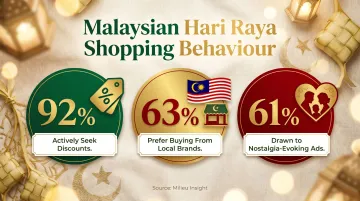
Malaysia's cultural calendar presents real brand opportunities. Ramadan/Eid, Chinese New Year, Deepavali, and national holidays like Merdeka Day are not just seasonal peaks but moments of deep emotional resonance. Research from Milieu Insight on Hari Raya shopping behaviour found:
- 92% of Malaysian Hari Raya shoppers actively seek discounts
- 63% prefer buying from local brands, signalling both price sensitivity and cultural loyalty
- 61% are drawn to ads that evoke nostalgia during festive seasons
Brands that show up authentically during these periods—rather than simply promoting sales—build long-term loyalty.
The risk of cultural missteps is real. In a market as layered as Malaysia, a brand that gets tone, language, or symbolism wrong can face swift backlash. M&C Saatchi's caution that culture must be diagnosed strategically, not assumed intuitively, holds up across the region.
Lemaire's "Objets Senteur" fragrance campaign in China is a recent example, drawing backlash over Qing dynasty braid imagery and illustrating how cultural symbolism can derail even established global brands in Asia.
Local partnerships and brand ambassadors play a critical role. YSL Beauty's appointment of Meerqeen as a Malaysian ambassador for its Eid campaign shows how choosing the right face—one who carries genuine cultural credibility—can make a global brand feel locally rooted. For brands entering or expanding in Malaysia, the ambassador decision is itself a brand strategy call.
Malaysia's Emerging Local Brands to Watch
While global brand moves dominate headlines, Malaysia has a vibrant ecosystem of local brands building genuine resonance in F&B, lifestyle, wellness, and retail.
ZUS Coffee
Founded in 2019, ZUS Coffee set out to make high-quality coffee accessible and affordable for everyday Malaysians. Rather than chasing a premium café image, it built its identity around convenience and value — scaling to hundreds of stores nationwide and expanding into the Philippines, Singapore, and Brunei.
Naelofar
Founded in 2014 by Neelofa, Naelofar anchors in contemporary modest fashion — stylish yet religiously compliant attire for the modern Muslim woman. Digital-first from the start, it has grown into a regional name with presence across selected international markets.
Safi
Founded in 1987, Safi is a leading Halal-certified skincare brand formulated for local skin types and the tropical climate. Backed by the Safi Research Institute — one of the world's largest Halal skincare R&D centres — the brand has expanded across Southeast Asia and the Middle East.
What these brands share:
- Identity anchored in a specific cultural truth: a local flavour, a community story, or a craft tradition
- Social media deployed as a primary storytelling channel, not just a distribution tool
- Direct-to-consumer-first approach, meaning brand identity must work hard online before it works in physical space
The rise of these brands puts real pressure on global players to localise with more precision. Malaysian consumers are proving increasingly brand-literate — and ready to back homegrown alternatives that speak directly to their lives.
How to Update Your Brand for the Malaysian Market
Before changing any visual or messaging element, brands must conduct a cultural audit—understanding how their current identity lands across Malaysia's key communities, what associations have been built, and which to preserve versus evolve.
Those audit findings then drive how the update is sequenced. The most successful rebrands in Malaysia—Patchi being a clear example—use phased rollouts tied to physical touchpoints, digital channels, and cultural moments. This pacing lets consumer feedback shape implementation without derailing the core strategy.
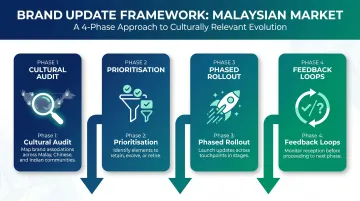
A practical phased approach typically covers:
- Cultural audit: Map current brand associations across Malay, Chinese, and Indian communities
- Prioritisation: Identify which elements to retain, evolve, or retire
- Phased rollout: Launch updates across touchpoints in stages, not all at once
- Feedback loops: Monitor reception at each phase before proceeding
For brands managing identity across Malaysia's three major communities, regional expertise matters. Vantage Branding works with businesses across Singapore, Malaysia, and broader Asia—helping brands develop strategies grounded in cultural insight rather than assumption.
Frequently Asked Questions
What are Malaysia's emerging local brands?
Malaysia's emerging local brand scene is growing particularly in F&B, wellness, and lifestyle categories, with brands building identity around specific cultural stories and direct-to-consumer digital-first strategies. Examples include ZUS Coffee (accessible premium coffee), Naelofar (contemporary modest fashion), and Safi (Halal-certified skincare).
How do you update your brand?
A brand update starts with a strategic audit: assess what your current identity communicates, identify what needs to change, and establish why before touching visuals or messaging. In a market like Malaysia, updates should also be tested across the cultural communities you serve, not just one segment. The process works best when it's phased, audience-tested, and grounded in strategy rather than aesthetic preference.
What makes Malaysia's consumer market different from other Southeast Asian markets?
Malaysia's consumer base spans Malay, Chinese, Indian, and indigenous communities — each with distinct cultural expectations, languages, and values. Combined with 98% internet penetration and a packed cultural calendar, this means brands must operate with a level of nuance that markets built around a single dominant culture simply don't require.
Why are global brands choosing Malaysia for regional brand refresh rollouts?
Malaysia's combination of urbanisation, a digitally connected middle class, major retail infrastructure (malls like Suria KLCC, 1 Utama), and a culturally diverse consumer base makes it an ideal testbed for brand strategies that need to prove relevance across varied audiences before scaling regionally.
How important are festive occasions in Malaysian brand marketing?
Festive seasons—particularly Ramadan/Eid, Chinese New Year, and Deepavali—are among the highest-stakes branding moments in Malaysia. Brands that show up with culturally resonant, emotionally genuine campaigns during these periods build deeper loyalty than those that treat them as purely transactional sales windows.