These heritage brands face a tension. Retail rents rose 1.9% across Singapore in 2025, while consumer habits shift toward digital-first experiences and generational transitions challenge operational continuity. Yet these businesses hold irreplaceable cultural value in Singapore's multi-ethnic identity — they are community anchors, not just commercial enterprises.
This article explores what heritage brand positioning means, why Singapore's diversity creates unique branding opportunities, and the strategies brands can use to preserve legacy while driving modern growth.
TLDR:
- Heritage brand positioning strategically places history and cultural roots at the centre of market perception
- Singapore's Chinese, Malay, Indian, and Eurasian communities create a unique multicultural branding environment
- Success requires balancing preservation of core values with intentional innovation
- The SG Heritage Business Scheme offers formal recognition and transformation support
- Digital storytelling bridges the gap between heritage awareness (87%) and purchasing (46%)
What Is Singapore's Cultural Heritage?
Singapore's cultural heritage is not monolithic. It is shaped by the interweaving of Chinese, Malay, Indian, and Eurasian communities, each bringing distinct traditions, languages, food cultures, and craft practices that have evolved over more than a century. This multicultural fabric reflects the CMIO (Chinese-Malay-Indian-Others) framework that has defined Singapore's national identity since independence.
That multicultural depth creates a branding environment unlike most other markets. Heritage brands in Singapore carry both a business story and a community story — serving as touchstones for specific ethnic communities and, collectively, for the nation's shared identity.
A traditional Indian textile shop, a Peranakan restaurant, or a Chinese medical hall sells products, yes. More than that, each one maintains cultural practices and transmits community knowledge across generations.
The National Heritage Board's SG Heritage Business Scheme, launched in October 2025, formalises this recognition. The scheme's criteria reflect how deeply Singapore's government views these businesses as cultural infrastructure:
- At least 30 years of operational history
- Located in the same site or area throughout
- Strong community ties and heritage preservation
- Minimum 30% local equity
42 businesses were designated in 2025 from more than 80 applicants, validating that these are not just commercial enterprises but essential elements of Singapore's living heritage.
What Is Heritage Brand Positioning?
Heritage brand positioning is the strategic act of placing a brand's long history, cultural roots, and enduring values at the centre of how it is perceived in the market. It is a deliberate claim — trust accumulated over decades, made visible and relevant today.
The Heritage Brand vs. Old Brand Distinction
Age alone does not create heritage positioning. A 2007 study published in the Journal of Brand Management defines a heritage brand as "one with a positioning and value proposition based on its heritage." What matters is the active maintenance of a "brand covenant" — the core promise or character that customers have returned to across decades and that remains recognisable across generations.
The study identifies five dimensions that constitute brand heritage:
- Track record — proof of consistent performance over time
- Longevity — survival through different eras and leadership
- Core values — principles that remain constant and integral to identity
- Use of symbols — visual cues providing a sense of continuity
- History important to identity — organisational mindset that history is essential

Two Failure Modes to Avoid
Heritage brands must navigate between two extremes:
Over-preservation treats the brand like a museum exhibit — admired but untouched. Customers respect the history, but relevance erodes as the brand fails to meet contemporary needs or communicate through modern channels.
Opportunistic reinvention pours established trust into whatever trend sells this quarter. This confuses loyal customers who no longer recognise the brand they trusted, while failing to convince new audiences because the brand lacks authentic differentiation.
Continuity of Character, Not Stasis of Form
The brands that sustain heritage positioning over decades are those that allow form to evolve while keeping character constant. Materials, visual identity, service formats, and communication channels change — the foundational promise does not.
For Singapore brands specifically, heritage positioning often carries multicultural weight. A brand's Chinese, Malay, or Indian heritage can be an authentic differentiator in a market that values cultural authenticity, provided it is expressed with specificity and pride rather than as a generic "local brand" claim.
The Three Pillars of a Strong Heritage Brand Strategy for Singapore Businesses
Preserve: Documenting and Protecting Your Brand's Core
The first pillar is active preservation — deliberately identifying, documenting, and protecting the specific practices, stories, recipes, craftsmanship methods, or founding values that constitute the brand's irreplaceable core.
Heritage brands that succeed treat documentation and knowledge transfer as strategic priorities — not as administrative tasks, but as survival work:
- Training younger staff in traditional methods
- Creating brand archives with founding stories and artifacts
- Explicitly naming the elements that must not change even as the brand evolves
- Recording intangible knowledge before key practitioners retire
Example: Spring Court Restaurant, one of Singapore's oldest restaurants serving local Chinese cuisine, displays images and precious items throughout the restaurant — on walls and menus — that honour its legacy and celebrate traditions. This visible preservation turns brand history into customer experience.
Government support exists for this work. The NHB's Organisation Transformation Grant provides up to $40,000 for transformative projects that contribute to business sustainability, including heritage documentation efforts.
Engage: Building Community Ties That Outlast Transactions
The strongest heritage brands in Singapore do not merely sell to their communities — they are woven into community life. They support cultural events, participate in neighbourhood activities, and serve as gathering spaces or reference points for specific ethnic or local communities.
The SG Heritage Business Scheme explicitly recognises community ties as a designation criterion, reflecting how deeply heritage brands function as cultural anchors rather than commercial fixtures.
Example: Toko Aljunied, founded in the 1930s and known for batik and sarong kebaya offerings, demonstrates deep community engagement:
- Active involvement with the Arab Association of Singapore
- Participation in the Kawan Kebaya community network
- Contributions to educational funds
- Support for UNESCO's nomination of Kebaya to the Representative List of Intangible Cultural Heritage
Other SG Heritage Business Scheme designees show the same commitment across different communities:
- Halijah Travels offers subsidised pilgrimage tours for underserved members of the Muslim community
- Nasi Padang Sabar Menanti hosts heritage tours for students and makes annual donations to local mosques
- Rumah Makan Minang supported frontline workers during the COVID-19 pandemic
This level of engagement creates reciprocal loyalty. Communities defend heritage brands during economic challenges, advocate for their recognition, and transmit their cultural importance to the next generation.
Innovate: Embracing Change Within the Brand Covenant
The third pillar is intentional, brand-faithful innovation — finding new formats, channels, customer segments, or product extensions that extend reach without diluting core identity.
Many heritage brands hesitate here unnecessarily. As long as the foundational promise stays clear, expansion into adjacent areas or adoption of new platforms is simply the brand story continuing into a new chapter.
Examples of heritage brand innovation:
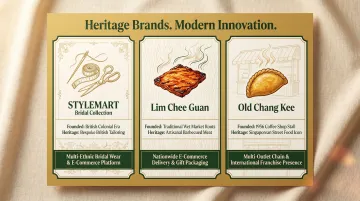
STYLEMART Bridal Collection evolved from tailoring for British clients in the 1950s into a brand for multi-ethnic bridal and heritage wear. Owner Ms Kavita Thulasidas has expanded into e-commerce and explores new consumer segments — an example of heritage brand extension retaining cultural authenticity.
Lim Chee Guan, recognized under the SG Heritage Business Scheme, operates e-commerce delivery across Singapore via its own website, making traditional bak kwa accessible to customers who may not visit the physical New Bridge Road outlet.
Old Chang Kee began in 1956 at a small stall in a coffee shop near Rex Cinema along Mackenzie Road. It now has multiple outlets across Singapore and international expansion, while maintaining the curry puff recipe and preparation methods that built its reputation.
Innovation in Singapore's heritage context often means bridging ethnic or generational audiences — a brand beloved by one community finding authentic ways to welcome new communities, or a founding generation's craft being reinterpreted by the next generation in formats that resonate with younger consumers.
How to Modernize a Heritage Brand Without Losing Its Identity
Modernising a heritage brand starts with a clear-eyed brand audit: separating what is essential from what is merely familiar.
Essential elements (the covenant):
- Founding values and principles
- Cultural specificity and authentic heritage
- Core promise to customers
- Traditional methods or practices that define quality
Incidental elements (open to evolution):
- Dated visual styles and logo execution
- Outdated service formats
- Communication language that no longer resonates
- Physical touchpoints that don't serve current customers
Vantage Branding's brand strategy process guides heritage businesses through this distinction. Through research, stakeholder interviews, and collaborative workshops, the founding covenant is identified and protected — while incidental elements are updated to serve today's audiences.
Visual Identity Refresh
Visual identity refresh is a common and often necessary modernisation step. This means updating typography, colour systems, or logo execution to work across digital platforms, while retaining design cues that signal continuity.
Key principles:
- Evolve logos rather than replace them entirely
- Maintain heritage marks or cultural motifs that loyal customers recognise
- Update typography for digital readability while preserving institutional character
- Introduce contemporary colour palettes that complement (not replace) heritage colours
The goal is to appear contemporary without abandoning the visual equity built over decades.
The Generational Succession Challenge
Visual identity is one dimension of modernisation. Leadership transition is another — and often the harder one. When ownership passes to a new generation, the brand's continuity depends on how well that handover is managed.
New leaders should be empowered to reinterpret the brand's promise in their own voice without feeling obligated to mimic the founder's style. Imitation often comes across as inauthentic. Instead:
- Identify the founder's core values, not just their methods
- Give the next generation permission to honour those values through contemporary expression
- Document the founding vision before leadership transitions
- Create brand guidelines that articulate "what must never change" vs. "what can evolve"
Third-generation owner Ernest Ting of Swee Choon Tim Sum Restaurant captures this balance: "We are now the custodians of something larger than ourselves — a living legacy that continues to connect people through food." The restaurant now has six branches, showing that expansion and modernisation can coexist with heritage preservation.
Recalibrating Your Audience
Modernisation means recalibrating who the brand speaks to and how. A heritage brand that has always served one generation now needs to earn permission from the next.
Younger audiences tend to value:
- Transparency about sourcing and production methods
- Social purpose and community contribution
- Craft authenticity — the "why" behind traditional practices
Heritage brands need to communicate their history through these lenses. Instead of "we've been here 80 years," show what those years mean: why your grandfather chose those ingredients, what your traditional method produces that no faster process can. That specificity is what makes heritage feel relevant — not just old.
Leveraging Digital Channels and Storytelling for Heritage Brands
One of the most persistent challenges for heritage brands in Singapore is translating physical, sensory experiences into compelling digital narratives. The smell of a traditional bakery or the ritual of a tea ceremony must be conveyed to audiences who may never have encountered the brand in person.
The key is specificity. Not "we have been around for 80 years" but the story of:
- A specific recipe and why it requires three days to prepare
- A founding family decision that shaped the business philosophy
- A craft technique passed down across generations with detailed process documentation
Social Media as Cultural Education
Social media and content platforms create real opportunities for heritage brands to become cultural educators:
- Behind-the-scenes content showing traditional methods
- Founder or third-generation owner interviews explaining heritage practices
- Community stories that illustrate the brand's role in cultural preservation
- Educational content about traditional crafts, ingredients, or techniques
This content performs strongly with both local audiences who feel pride of recognition and international visitors seeking authentic cultural experiences.
But cultural education alone does not drive revenue. The more pressing question is whether digital storytelling actually moves consumers from awareness to purchase.
Bridging the Awareness-Purchase Gap
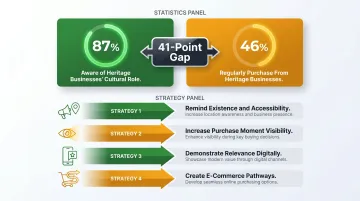
Digital visibility is not optional for heritage brands facing economic pressure. NHB's 2024 Heritage Awareness Survey found that 87% of Singaporeans agreed heritage businesses play an important role in promoting appreciation of Singapore's history, heritage and culture. Yet the 2023 Heritage Business Feasibility Study revealed only 46% regularly purchase from heritage businesses.
This 41-percentage-point gap represents lost revenue. Consumers recognize importance but don't convert that awareness into purchasing behavior. Consistent digital presence and storytelling directly address this gap by:
- Reminding audiences that heritage businesses still exist and are accessible
- Making heritage offerings visible when customers are making purchase decisions
- Demonstrating relevance through contemporary communication channels
- Creating convenient purchasing pathways through e-commerce or online booking
Heritage brands that remain invisible digitally cede market share to competitors who communicate more actively, regardless of weaker heritage credentials.
Government Support and Recognition: The SG Heritage Business Scheme
The SG Heritage Business Scheme introduced by the National Heritage Board in October 2025 offers both brand positioning value and practical business support.
What the Designation Offers
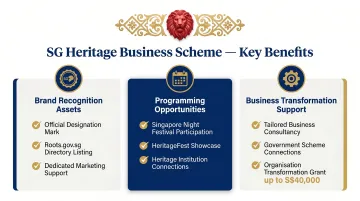
Brand recognition assets:
- SG Heritage Business designation mark (plaque and digital assets)
- Featured listing on Roots.gov.sg heritage directory
- Increased visibility and marketing support
Programming opportunities:
- Inclusion in Singapore Night Festival
- Participation in Singapore HeritageFest
- Connection to programmes at heritage institutions like the Indian Heritage Centre
Business transformation support:
- Tailored consultancy to identify new business opportunities
- Connection to relevant government support schemes
- Access to the Organisation Transformation Grant (up to S$40,000)
Eligibility and Application
The pilot phase is limited to businesses in Singapore's Central Area (Chinatown, Kampong Gelam, Little India, Civic District, Bras Basah.Bugis, and Orchard). Criteria include:
- Registered and operating in Singapore for at least 30 years
- Located in the same site or area for 30+ years
- At least 30% local equity held by Singaporeans or PRs
- Offer traditional trades, goods, or services
- Demonstrate strong community ties or impact
- Committed to maintaining heritage
Integration with SG Culture Pass
Heritage businesses can develop programmes for the SG Culture Pass, which provides S$100 in credits to every Singapore Citizen aged 18+ (valid until 31 December 2028). This creates opportunities to:
- Attract new customers who might not otherwise visit
- Develop heritage tours or cultural experiences
- Generate revenue while fulfilling educational missions
Strategic Use of Recognition
These programming opportunities extend the value of the Culture Pass well beyond a one-time visit — and the same principle applies to the designation itself. The SG Heritage Business mark carries real weight when woven into your brand story across every customer touchpoint: your website, packaging, in-store experience, and media outreach. A plaque at the entrance is a starting point, not a strategy.
Use recognition to:
- Validate authenticity in marketing communications
- Build consumer confidence in quality and legitimacy
- Attract media coverage and editorial features
- Strengthen community partnerships and sponsorship opportunities
Frequently Asked Questions
What is heritage brand positioning?
Heritage brand positioning uses a brand's history, cultural roots, and long-established values as its primary claim to trust and market differentiation. Unlike simply being an old brand, it requires actively maintaining a core promise across generations — not coasting on it.
What is Singapore's cultural heritage?
Singapore's cultural heritage is the interweaving traditions, practices, and community stories of its Chinese, Malay, Indian, and Eurasian populations. This multicultural legacy is expressed through food, craft, language, ritual, and business, formally preserved through institutions like the National Heritage Board.
How can heritage brands in Singapore stay relevant to younger generations?
Relevance comes from reinterpreting your core promise in formats younger audiences engage with — digital storytelling, transparent narratives, and authentic cultural pride. The foundational values stay intact; the expression evolves.
What is the SG Heritage Business Scheme and who can apply?
The NHB scheme launched in October 2025 recognises and supports businesses with at least 30 years of Singapore history, strong community ties, and a demonstrated commitment to heritage preservation. Participants receive brand recognition support, programming opportunities, and access to transformation grants.
How do you modernize a heritage brand without losing its identity?
Start by separating what is essential — founding values, cultural specificity, core promise — from what is incidental, such as visual style or communication format. Update the incidentals freely. Preserve and strengthen the essentials at every touchpoint.
For Singapore's heritage brands, the competitive pressure is real — but so is the advantage. A brand rooted in decades of community trust and cultural specificity holds something no new market entrant can manufacture overnight. The brands that thrive will be those that treat that legacy as a strategic asset, not a limitation.
Moving forward means knowing which parts of your heritage to protect and which to reframe. Tell that story with specificity — on every platform where your next generation of customers will first encounter you.