Introduction
Singapore's D2C market is no longer just about cutting out the middleman — it's about who tells the most compelling brand story. Many D2C brands in Singapore get the distribution model right, launching sleek websites and mastering fulfilment logistics. But most fail at branding — and that gap is where success is won or lost.
Singapore offers exceptional conditions for D2C brands: mobile penetration sits at 165%, digital infrastructure ranks among the most advanced in Asia, and consumers are research-driven and discerning. The city-state's multicultural audience — spanning Chinese, Malay, Indian, and expat communities — responds to authenticity, not generic marketing.
Yet precisely because Singapore shoppers are digitally sophisticated, they're quick to spot brands that lack substance beneath the polish.
What follows is a practical look at how D2C brands can build real equity in Singapore — from shaping a distinctive identity to earning the trust of one of Asia's most discerning consumer markets.
TLDR
- D2C brands control the entire customer relationship — pricing, data, and narrative — by selling directly without intermediaries
- Singapore's 95.8% internet penetration and 88.2% social media adoption make it one of Southeast Asia's most attractive D2C markets
- Strong D2C branding rests on three pillars: clear differentiation, culturally relevant identity, and authentic storytelling that builds community
- Most D2C brands in Singapore over-invest in performance ads and underinvest in brand equity, which becomes costly as CAC rises
- Brands that invest in identity and narrative early outlast margin pressures better than those chasing short-term conversions
What Is a Direct-to-Consumer Brand?
A D2C brand manufactures or sources its own products and sells directly to end consumers — bypassing wholesalers, distributors, and third-party retail platforms. "Direct" refers not just to the sales channel but to the entire relationship: the brand owns the customer interaction from first touchpoint to repeat purchase.
D2C vs. B2C
In B2C, a retailer or marketplace sits between the brand and the consumer. A local skincare brand selling through a department store or Shopee is B2C — the retailer controls pricing display, product placement, and customer data. In D2C, the brand is the retailer. It controls inventory, pricing, and messaging — and owns the customer relationship directly.
D2C as a Model, Not Just a Channel
D2C is a business model, not merely a distribution tactic. A D2C brand can eventually open physical stores or list on marketplaces as secondary channels — what defines it is brand ownership — the relationship, data, and storytelling all stay in the brand's hands.
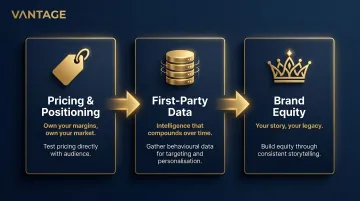
That ownership creates real strategic leverage. Without intermediaries in the way, D2C brands can:
- Test pricing and product positioning directly with their audience
- Gather first-party behavioural data to refine targeting and personalisation
- Build brand equity through consistent, unmediated storytelling
Why Singapore Is a Hotspot for D2C Brands
Structural Advantages
Singapore offers D2C brands a rare combination of infrastructure, digital adoption, and policy support:
- Near-universal smartphone penetration and reliable digital payments
- E-commerce platform GMV reached $5.9 billion in 2025, up 21% year-on-year
- 3rd globally in the 2024 UN e-Government Survey, reflecting mature digital infrastructure
- Established last-mile logistics networks that keep fulfilment costs predictable
Enterprise Singapore's Productivity Solutions Grant (PSG) provides up to 50% funding (capped at $30,000) for SMEs adopting e-commerce solutions, lowering barriers to entry for D2C brands building their own storefronts.
Consumer Behaviour Profile
Singapore shoppers are digitally native and research-intensive. They compare prices, scrutinise reviews, and expect specificity. This creates ideal conditions for D2C brands that offer authenticity, niche positioning, and direct engagement — and hostile conditions for generic mass-market messaging.
Key behaviours include:
- High responsiveness to personalised product offerings
- Scepticism toward corporate or impersonal brand voices
- Cross-channel research before purchase (social media, reviews, brand website)
- Willingness to pay premiums for brands that align with personal values
The Competitive Landscape Challenge
Singapore's small geographic size limits total addressable market volume. D2C brands must prioritise customer lifetime value and community building over pure acquisition.
The demographic mix — 74.1% Chinese, 15.1% Malay, 8.7% Indian, plus a significant expat population — means there is no single "Singapore consumer." Brands that adapt their positioning to specific cultural segments consistently find stronger loyalty and repeat purchase rates than those treating the market as homogeneous.
Core D2C Branding Strategies for Singapore
Define Your Brand Position Before You Scale
Brand positioning is the strategic foundation every D2C brand must establish before spending on marketing. Positioning answers: who is this brand for, what does it stand for, and why should a Singapore consumer choose it over alternatives?
How to Conduct a Positioning Exercise:
- Identify the target segment with precision — not "health-conscious millennials" but specific psychographic and behavioural traits (e.g., "urban professionals aged 28-38 who prioritise mental wellness, value transparency, and prefer minimalist aesthetics")
- Map the competitive landscape — identify direct competitors, substitute solutions, and positioning gaps
- Find credible differentiation — in Singapore's crowded market, "quality" and "affordable" are not differentiators; values, purpose, and specificity are
Pressure-Test Against Singapore's Multicultural Audience:
A position that resonates with the Chinese majority may need nuanced adaptation for Malay or Indian communities, or the expat segment. For example, wellness messaging emphasising individual achievement may land well with expatriates but require reframing around family and community for traditional Malay audiences. Brands that assume cultural uniformity often miss significant pockets of loyal customers.
This is where a structured positioning process pays off. Vantage Branding works with D2C brands to map these audience layers and define positioning that holds across Singapore's diverse consumer base.
Own the Customer Relationship Across Every Brand Touchpoint
D2C brands win by owning the customer relationship — not just the transaction. Every email, packaging insert, social post, unboxing experience, and after-sale interaction is a brand moment. Consistency across these moments builds trust and drives repeat purchase.
Brand Touchpoint Mapping:
Audit every place a customer encounters the brand and ensure the experience, tone, and visual identity align. For D2C brands in Singapore, touchpoints often include:
- Instagram/TikTok discovery
- Branded website
- WhatsApp customer service (used by 97.1% of internet users)
- Physical packaging delivered to the door
- Post-purchase email sequences
Owning the customer relationship also means owning the data that comes with it. D2C brands can access browsing patterns, purchase history, and direct feedback — behavioural signals that inform not just marketing but brand evolution. Brands that use this data to refine their communication and product messaging build stronger equity than those that ignore it.
Invest in Brand Equity, Not Just Customer Acquisition
Many D2C brands in Singapore face pressure to drive short-term sales through performance marketing — paid social, search ads. But research shows CAC rises steeply once early-adopter segments saturate. In the US, Shopify data indicates retail CAC averaged $226.38 in 2024, up 7% year-over-year. While Singapore-specific benchmarks are scarce, directional signals show Singapore's Facebook CPM averaged $21.50 over 2025-2026 — approximately 8.5% higher than the global average.
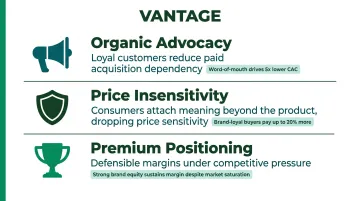
Brand equity — the intangible value consumers assign to a brand — acts as a buffer against rising acquisition costs. Brands that invest in it early benefit in three specific ways:
- Loyal customers advocate organically, reducing paid acquisition dependency
- Price sensitivity drops as consumers attach meaning to the brand beyond the product
- Premium positioning becomes defensible, protecting margins under competitive pressure
Brands that survive margin compression build equity before the squeeze arrives.
Building a Distinctive D2C Brand Identity in Singapore
For D2C brands, identity carries more weight than in traditional retail. There is no physical store environment to fill in the gaps — the brand communicates entirely through owned assets: logo, colour palette, typography, photography style, tone of voice, and packaging.
Create a Visual Identity That Travels Across Digital and Physical Channels
D2C brands in Singapore typically operate across Instagram, a website, packaging, and TikTok — the visual identity must work across all without losing coherence.
A scalable visual system covers:
- Primary logo with clear usage rules
- Defined colour palette (primary, secondary, accent)
- Consistent photographic style (lighting, model type, backgrounds)
- Typographic hierarchy
A common pitfall is designing for one channel first — usually Instagram — then struggling to apply the same identity to packaging or website headers. A well-designed identity is channel-agnostic, with guidelines a small team can follow without a designer present for every execution.
For example, 75CL — a wine, spirits, and gifts retailer — worked with Vantage Branding to reimagine their brand by placing occasions and emotions at the heart of messaging rather than product features. The visual identity extended across delivery vans with vibrant yellow and orange design, retail store interiors, and luxury gift packaging — demonstrating channel-agnostic coherence.
Develop a Brand Voice That Reflects Singapore's Cultural Context
Brand voice is the personality expressed through words — and getting it right for a Singaporean audience requires cultural sensitivity. Singapore's communication culture blends directness, pragmatism, and warmth. Brands that feel too formal come across as stiff; brands that appropriate local slang inauthentically can alienate consumers.
To build a practical brand voice guide:
- Identify 3-4 voice attributes (e.g., "warm but expert," "frank but encouraging")
- Write example sentences in-voice and out-of-voice for each attribute
- Apply consistently across website copy, social captions, email, and packaging

Voice should adapt in register — more formal in email, conversational on social — without losing character.
Both visual identity and brand voice need to work together as a system. When they do, the result is a brand that consumers recognise and trust — whether they encounter it on TikTok, in their inbox, or on a delivery box at their door.
The Role of Brand Storytelling and Community in D2C Success
Craft a Brand Narrative That Connects Locally
D2C brands have a storytelling advantage traditional retail brands lack: they speak directly to consumers without the filter of a retailer. The brand narrative should answer three questions:
- Why does this brand exist?
- Who is it for?
- What does the world look like when this brand succeeds?
Brands with clear answers attract customers who share those values — and those customers become advocates.
Localising the Brand Narrative for Singapore:
Ground the story in locally relevant tensions:
- Balancing wellness with fast-paced work culture
- Desire for sustainable products without premium pricing
- Pride in supporting homegrown brands
Two Singapore-born brands show what this looks like in practice:
Love, Bonito — founded to address the lack of clothing options designed for Asian women's proportions, climate, and culture — built a "women-first" lifestyle platform invested in women's wellbeing and confidence. Starting from blogshop origins, the brand crossed $88 million in revenue in 2023 and is projected to exceed $100 million in 2025.
Skin Inc. — founded by Sabrina Tan in 2008 — positioned as "one size fits one" customised skincare, using AI and data to deliver personalised solutions. That specific positioning drove expansion into Sephora, Nordstrom, and Selfridges, with tens of millions in annual revenue.
Build Community as a Brand Asset
The most resilient D2C brands build communities — not just customer lists. Community creates organic advocacy, user-generated content, and product co-creation opportunities that reduce marketing costs over time.
Global Benchmark: Glossier
Glossier launched in 2014 after building an audience through the Into The Gloss blog, which had 2-3 million unique monthly visitors. Products were developed based on blog comments — Boy Brow and Milky Jelly Cleanser came from reader requests. Glossier's UGC flywheel (stickers in every order encouraged customers to photograph and share) and "Generation Glossier" ambassador program (focusing on micro/nano-influencers with 10K-100K followers) drove results: 70% of online sales came from peer referrals, and 80% of customers were referred by a friend.
Community-Building Tactics for Singapore D2C Brands:
- Micro-influencer partnerships with Singapore-based creators who share genuine alignment with brand values
- Branded hashtag campaigns
- Customer review programs
- Exclusive member communities via WhatsApp or Telegram (Telegram is used by 65.3% of internet users in Singapore)

Leverage Social Proof and Transparency to Build Trust
Singapore consumers are among the most research-intensive shoppers in the region. Nielsen's 2021 Trust in Advertising study found that 88% of global respondents trust recommendations from people they know more than any other channel. Trust in advertising in Asia-Pacific is higher than in North America — up to 20% higher than in North America and Europe.
For D2C brands operating here, this means surfacing social proof — reviews, before/after content, founder transparency — at the exact points in the purchase journey where doubt is highest. A brand claim rarely closes the sale. A peer recommendation often does.
Common D2C Branding Pitfalls to Avoid in Singapore
Product-First, Brand-Second Trap
Many Singapore D2C founders build a great product and launch without a defined brand position or identity, assuming the product will speak for itself. In a market where copycats surface within months and marketplace algorithms flatten differentiation, a strong brand sustains pricing power and loyalty.
Inconsistent Brand Identity Across Channels
The gap between a polished website and generic social media presence — or between premium packaging and poor email communication — is fatal. For Singapore consumers who are digitally sophisticated and cross-channel by nature, inconsistency signals amateurism and erodes trust quickly.
This typically happens when there are no defined brand standards — or when different teams produce materials independently. The result is fragmentation across:
- Colour schemes and logo usage
- Typography and visual tone
- Messaging and brand voice
Each inconsistency makes it harder for customers to recognise, remember, and connect with the brand.
Conflating Marketing Spend with Brand Building
Many D2C brands interpret brand awareness as a function of ad spend — the more they spend, the more "known" they are. But awareness without brand meaning (clear position, consistent identity, resonant story) is expensive and fragile. When ad spend drops, so does visibility. A brand built on paid reach alone has no foundation to stand on once the budget runs out.
Frequently Asked Questions
What is considered a direct-to-consumer brand?
A D2C brand manufactures or sources its own products and sells directly to end consumers without intermediaries such as wholesalers, retailers, or third-party marketplaces, giving it full control over pricing, customer data, and brand experience.
What are the DTC brands in Singapore?
Notable Singapore-born D2C brands include Love, Bonito (fashion), Skin Inc. (skincare), and From Yours (wellness). Singapore's D2C ecosystem spans niche lifestyle brands and venture-backed consumer startups across categories.
Which ecommerce platform is best in Singapore?
Shopify is the most common starting point for Singapore D2C brands, given its ease of use and built-in D2C tools. WooCommerce and custom storefronts work better for brands needing deeper control. Most brands treat Shopee or Lazada as secondary channels, keeping their own storefront as the primary brand home.
What makes D2C branding different from traditional retail branding?
In traditional retail, the physical environment does much of the heavy lifting — shelf placement, packaging context, and store atmosphere all signal quality and build trust. D2C brands must achieve all of that through owned digital assets alone, which makes brand identity, voice, and storytelling far more consequential.
How do D2C brands build customer loyalty in Singapore?
Singapore D2C brands build loyalty through consistent brand experience across touchpoints, community engagement via social and messaging platforms (especially WhatsApp and Telegram), and personalised post-purchase communication that reinforces brand values rather than just pushing the next offer.