
Introduction
Singapore is home to 358,300 enterprises — 296,700 of them SMEs — competing in one of the world's most sophisticated markets. SMEs make up 99% of all businesses and employ 71% of the workforce.
With 95.8% of the population online and 88.2% actively using social media, being "good" is no longer enough to be chosen.
Most brands compete on price because they haven't defined what makes them worth more. Without clear positioning, businesses default to generic claims — "quality," "trusted," "innovative" — that every competitor can say. In a market this crowded and discerning, vague positioning becomes an instant liability.
This article explains what brand positioning is, why it works differently in Singapore's unique landscape, and walks you through a practical framework to find and own a distinct space in the market.
TLDR:
- Brand positioning defines the strategic space you occupy in a customer's mind — not just visuals, but the answer to "why choose you?"
- Singapore's density, multicultural complexity, and 95.8% internet penetration demand sharper differentiation than most markets
- A 4-part framework covers: target audience, competitive frame, point of difference, and reason to believe
- Avoid generic differentiators — specificity wins in a market where consumers compare options within seconds
- Review positioning every 2-3 years or when facing new competition, expansion, or product launches
What Is Brand Positioning?
Brand positioning is the strategic place a brand occupies in a customer's mind. Your logo, tagline, and colour palette express it — but positioning is the underlying answer to "why choose you over everyone else?" That answer guides every decision: messaging, identity, sales pitches, and customer experience design.
Strong positioning answers four core questions:
- Who are we for? (target audience)
- What category do we compete in? (competitive frame)
- What makes us different? (point of difference)
- Why should customers believe us? (reason to believe)
Without clear answers, brands fall back on empty descriptors. Words like "quality," "trusted," and "innovative" appear on half the websites in any given industry — they signal nothing to a buyer already tuned out by identical claims.
Positioning vs. Identity: Strategy Before Design
Brand positioning is the intellectual strategy. Brand identity is how that strategy gets expressed visually and verbally.
Starting with a logo before defining positioning leads to subjective design decisions driven by personal preference rather than strategic intent. A positioning statement acts as the filtering device that aligns every visual choice — from typography to tone of voice — around a single coherent message.
Without that filter, feedback cycles become circular. Everyone has an opinion on the logo; nobody can agree because there's no strategic benchmark to measure against.
Why Singapore Demands a Different Positioning Approach
Extreme Competitive Density
Singapore had 358,300 registered enterprises in 2024, according to Singapore Department of Statistics. That's one business for every 17 residents. Over 81% earn S$1 million or less annually, making differentiation critical for survival.
Customers can compare options within seconds across digital platforms. Vague positioning pushes you straight into price-based competition, where margins shrink and loyalty disappears.
Multicultural Complexity
Singapore's citizen population breaks down as:
- Chinese: 75.5%
- Malay: 15.1%
- Indian: 7.6%
- Others: 1.8%
Add 1.91 million non-residents (31.2% of total population), and you're addressing at least four major ethnic communities plus a substantial expatriate base. A single, undifferentiated brand message will land flat with most of them.
Positioning must account for which audience segments you're prioritising without alienating others—especially for brands spanning multiple verticals.
Digital Sophistication
DataReportal's Digital 2025: Singapore report reveals:
- 95.8% internet penetration (5.61 million users)
- 88.2% social media penetration (5.16 million users)
- Average daily internet time: 6 hours 33 minutes
- Median mobile download speed: 127.75 Mbps
Singaporean consumers are globally informed and highly tech-savvy. They immediately spot the difference between authentic local relevance and a generic campaign imported from overseas markets.
That means your brand needs consistent, credible messaging across every digital touchpoint — from your website to your LinkedIn presence to your Google search snippet.
Regional Gateway Status
Singapore ranked #1 globally as the most competitive economy in the 2024 IMD World Competitiveness Ranking. More than 4,000 global companies maintain regional headquarters here.
Brands that achieve clear positioning locally are better equipped to expand into ASEAN markets. Being Singaporean alone isn't a differentiator in Vietnam or Malaysia. You need a specific, transferable position — one built on clear values and a defined audience, not just geography.
The 4-Part Brand Positioning Framework for Singapore
This framework breaks brand positioning into four components — target audience, competitive frame, point of difference, and reason to believe — each one sharpening the next.
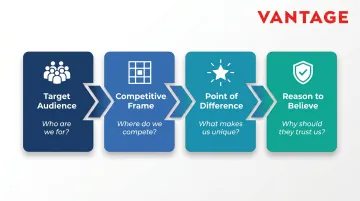
Target Audience: Who Are You Trying to Win?
Narrowing your audience means deciding who you speak to most powerfully — not who you're willing to sell to. A healthcare brand serving all ages, for instance, will use completely different tone, channels, and messaging when targeting working adults seeking preventive care versus seniors needing post-acute rehabilitation.
B2B Context: In Singapore's financial, marine, and technology sectors, audience definition must identify three distinct roles:
- User — wants ease of use; messaging should emphasise speed and simplicity
- Decision-maker — wants ROI; messaging should lead with outcomes and payback
- Gatekeeper — wants minimal disruption; messaging should address integration and risk
Competitive Frame: What Category Are You Competing In?
Customers don't evaluate brands in isolation — they compare. The competitive frame defines the category customers use to understand your brand, which often differs from how you'd describe your own industry.
A boutique hotel may compete with serviced apartments. An F&B brand may compete with gifting products. Identifying the right frame helps you spot positioning gaps.
How to Map the Competitive Landscape:
- List 3–5 key competitors
- Identify what they claim
- Note which audiences they target
- Find where they all say the same thing
The gap in that pattern is where positioning opportunity lives.
Point of Difference: What Makes You Meaningfully Different?
A strong point of difference must be relevant to your target audience, genuinely distinctive from what competitors claim, and credible enough to prove. All three matter — miss one and the positioning collapses.
Don't confuse features with differentiation. "We have a mobile app" is a feature. "We give SME logistics teams same-day operational visibility without ERP migration" is a point of difference.
Where Singapore Brands Find Defensible Differentiation:
- Specialized audience (serving a niche others ignore)
- Proprietary methodology (a unique process)
- Superior customer experience (measurably better service)
- Local market understanding (cultural nuance competitors miss)
- Technical capability (expertise others lack)
- Proven track record (results competitors can't show)
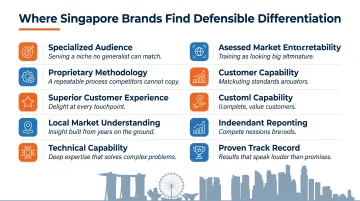
The best point of difference is the most valuable to customers and hardest for competitors to replicate.
Reason to Believe: Why Should Customers Trust You?
Every positioning claim needs visible proof. Without it, you're making empty promises.
What Proof Looks Like:
- Years of experience in the category
- Client portfolio with recognisable names
- Certifications or accreditations
- Published case studies with measurable outcomes
- Customer testimonials
- Proprietary frameworks or methodologies
For newer businesses, founder expertise, pilot results, or a clearly articulated methodology can each stand in as credible proof — especially when paired with a specific client outcome, however early-stage.
Key Brand Positioning Strategies for Singapore Market Success
Cultural Positioning Strategy
Effective brands in Singapore don't just acknowledge multiculturalism—they strategically build it into positioning.
This might mean positioning around a shared Singaporean value (efficiency, meritocracy, community) rather than ethnic-specific appeals. The goal is relevance across audience segments without dilution.
Balance global polish with local relatability: Singaporeans respect international standards but distrust brands that don't understand local context. Position as globally informed but locally rooted.
Premium vs. Value Positioning
Singapore consumers span a wide spectrum. UOB's 2025 ASEAN Consumer Sentiment Study found 53% actively hunt for discounts—the highest in ASEAN. Yet approximately 50% plan luxury purchases within 12 months, according to YouGov 2023 research.
Choose and commit to a positioning tier. Trying to appeal to both premium and value buyers simultaneously dilutes brand perception.
Premium Positioning Requirements: Every touchpoint must match the claim—pricing, environment, packaging, communication, service speed, and customer experience. A single inconsistency undermines the whole position.
Insight-Led Positioning
The strongest positions are built on genuine audience research, not internal assumptions.
Agencies like Vantage Branding approach this through cross-industry research spanning healthcare, government, technology, F&B, marine, and other sectors — surfacing customer truths that internal teams, close to their own product, often can't see.
Research-driven positioning reveals:
- What customers actually value (vs. what you assume)
- Which competitors they genuinely compare you to
- The language they use to describe problems
- The proof points they find most credible
Positioning for Regional Expansion
For Singapore brands looking to grow into ASEAN markets, develop a core positioning that is locally rooted but regionally transferable.
The brand story must be specific enough to be credible in Singapore, yet flexible enough to adapt—not dilute—for Vietnam, Malaysia, or Indonesia.
Singapore's role as a regional hub means strong positioning here often becomes your ASEAN positioning template. Get it right locally first.
How to Write Your Brand Positioning Statement
A positioning statement is an internal strategic tool—not a public tagline. It guides every brand decision your team makes, from campaign messaging to product naming.
Standard Template: "For [target audience], [Brand Name] is the [competitive frame] that [point of difference], because [reason to believe]."
Singapore B2B Example (Healthcare IT): "For mid-sized private hospitals in Singapore, MedTech Solutions is the clinical workflow platform that reduces documentation time by 40% without disrupting existing EMR systems, because we've successfully integrated with 15 different hospital IT environments across Southeast Asia."
Weak vs. Strong Positioning Statements
Weak (Generic): "For businesses in Singapore, ABC Consulting is a trusted partner that provides quality solutions to help clients succeed."
Why it fails: Nothing here is ownable. Words like "trusted" and "quality" describe every competitor too — and the audience, benefit, and proof are all absent.
Strong (Specific): "For Singapore SME manufacturers preparing for regional expansion, ABC Consulting is the regulatory compliance partner that delivers market-ready documentation in half the industry standard time, because we've guided 40+ manufacturers through ASEAN market entry since 2015."
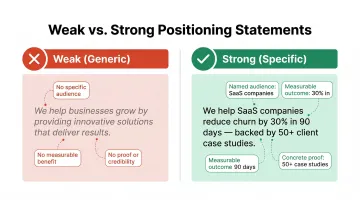
Why it works: Names a specific audience, a measurable benefit, and concrete proof.
Test Your Positioning Statement Internally
Share it with your sales team, marketing staff, and anyone else who speaks to customers.
Good sign: They can all use it to make independent decisions consistently.
Warning sign: It creates confusion or gets interpreted differently by different people.
A strong positioning statement should function like a compass — when your team faces a brand decision, it points them in the same direction without needing to ask.
Common Brand Positioning Mistakes to Avoid
Mistake 1: Trying to Appeal to Everyone
Broad positioning dilutes your message and pushes buyers to compare you on price alone.
Kantar research found only 40% of brand leaders believe their positioning is sharp enough, while 1 in 5 admit it's "nowhere near" clear.
Strong positioning requires the courage to prioritise a core audience even while serving others.
Mistake 2: Using Generic Differentiators
Words like "quality," "trusted," and "innovative" are meaningless because every competitor can say them.
Test your differentiator: If your closest competitor can claim the same thing, it's not a point of difference.
Replace generic claims with specifics:
- Not "quality"—what kind of quality, proven how, for whom?
- Not "trusted"—trusted by which customers, based on what evidence?
- Not "innovative"—innovative in what specific way, with what measurable outcome?
Mistake 3: Treating Positioning as a One-Time Exercise
Getting the specifics right is only half the battle. Sharp positioning also needs to stay relevant as your market shifts. Review positioning when:
- Entering a new market
- Facing stronger competition
- Launching new product lines
- Preparing for regional expansion
- Noticing customers can no longer explain why they choose you

Know which type of change you need:
- Full repositioning — your strategic territory has shifted; the core message must change
- Brand refresh — your position is still valid, but how you express it needs updating
Most brands need a positioning review every 2-3 years. Major business triggers require sooner review.
Frequently Asked Questions
What are some examples of brand positioning?
Premium airline positioning: Singapore Airlines positions on service excellence through the iconic Singapore Girl, delivering consistent quality rather than competing on price. Local F&B heritage positioning: Traditional brands position on authenticity and cultural legacy. B2B tech niche positioning: A cybersecurity firm positions as the only provider specialising in maritime port security across ASEAN.
What is the brand positioning of Singapore Airlines?
Singapore Airlines has built its position around premium service excellence — the tagline "A Great Way to Fly" and the Singapore Girl icon have anchored the brand since the early 1970s. What makes it distinctive is the dual strategy: premium differentiation delivered alongside operational cost efficiency through a young fleet and fuel savings.
What is brand positioning in marketing?
Brand positioning in marketing is the strategic process of defining how a brand should be perceived relative to competitors in the customer's mind. That defined position then shapes all marketing messages, creative decisions, channel strategies, and customer touchpoints to create consistent brand perception.
How do you create a brand positioning statement?
Use the four-part formula: For [target audience], [Brand Name] is the [competitive frame] that [point of difference], because [reason to believe]. This internal strategic tool—not a public slogan—aligns messaging across sales, marketing, and brand identity by answering who you serve, what category you compete in, what makes you different, and why customers should believe you.
How often should you review your brand positioning strategy?
Review positioning every 2-3 years, or sooner after major triggers — entering a new market, facing stronger competition, or preparing for regional expansion. Know the difference: full repositioning changes your core strategic stance, while a brand refresh updates how you express the same position.
What makes brand positioning in Singapore different from other markets?
Singapore's mix of four major ethnic groups, 31.2% non-resident population, 95.8% internet penetration, and status as Asia's #1 regional HQ destination demands sharper, more culturally aware positioning than most markets. Consumers here are globally exposed and digitally sophisticated — they compare options instantly and see through generic positioning.