Introduction
Singapore may be a small city-state, but building a brand that resonates here is anything but simple. Success in this market doesn't come from applying generic "Asian values" or broad Asia-Pacific strategies. It requires understanding the specific, deeply held values that shape how Singaporean consumers evaluate brands, decide which ones to trust, and determine where their loyalty belongs.
Many businesses — both local and international — enter Singapore with strategies built for a generic regional audience, only to find their messaging falls flat with how Singaporeans actually think and buy.
The 2019 E-Pay brownface controversy is a sharp example. When a government-backed e-payment campaign cast a single Chinese actor to portray multiple ethnicities, the backlash was immediate. The ad was pulled, apologies were issued, and the incident became a landmark case in why cultural specificity matters.
This article breaks down what regional brand values are, identifies the core values defining Singapore's consumer landscape, and explains how brands can authentically embed them into strategy — rather than simply claiming them.
TLDR
- Regional brand values reflect what consumers inside a market expect from brands daily — distinct from how a country is perceived globally
- Singapore's 6.04 million population is Chinese (75.6%), Malay (15.1%), Indian (7.6%), and others — and multiculturalism shapes every brand expectation
- Trust, quality, innovation, pragmatism, and sustainability form the core value pillars Singaporean consumers use to evaluate brands
- Singaporean consumers check 3-5 sources before purchasing and demand 20+ reviews at 4.0+ ratings before converting
What Are Regional Brand Values (And How They Differ From National Brand Values)?
Regional brand values refer to the beliefs, expectations, and cultural priorities that consumers in a specific geographic market use (consciously or not) to judge whether a brand feels credible, relevant, and trustworthy. These are not the same as a country's macro reputation on the world stage.
National brand values reflect how a country is perceived globally. Singapore consistently ranks in the top tier for governance (3rd globally on Transparency International's 2025 Corruption Perceptions Index with a score of 84/100), safety, and economic competitiveness. Regional brand values, by contrast, are what consumers inside that market expect from the brands they engage with daily — and the two don't always align perfectly.
Why Singapore Deserves Its Own Framework
Singapore is frequently lumped into a broad "Asian market" or "Asia-Pacific" category, which overlooks the distinct priorities of its consumer culture. Marketing leaders operating in Singapore have made this distinction clear. Ruth Yam, Director of Marketing at Starbucks Singapore, stated that localization "is not an on-trend gimmick" but rather "an important pillar as it helps the brand to connect more intimately with its customers and community." Faye Wee, Marketing Director at Asia Pacific Breweries, echoed this: "There's no one-size-fits-all when it comes to localisation. It's all about being relevant and meaningful to your audience."
The average Singaporean checks 3 to 5 information sources before making a purchase, according to a 2026 consumer behaviour guide. Brands with fewer than 20 reviews or ratings below 4.0 face significant conversion challenges. This research intensity distinguishes Singapore from markets where brand awareness alone drives conversion.
That research intensity is just one part of the picture. What Singapore's consumers actually evaluate — and how they weigh each factor — sets the market apart.
What Makes Singapore's Market Particularly Demanding
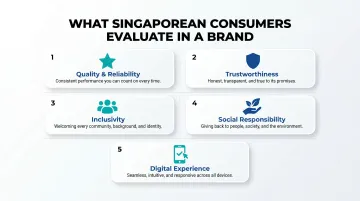
Singaporean consumers are pragmatic, digitally informed, and quick to identify messaging that feels imported without local grounding. They evaluate brands against several criteria at once:
- Quality and reliability — premium pricing is accepted, but only when backed by clear evidence
- Trustworthiness — transparency and consistency matter more than polish
- Inclusivity — brands that reflect Singapore's multicultural reality are rewarded
- Social responsibility — consumers notice whether a brand's values hold up off-campaign
- Digital experience — with ~97% smartphone penetration and ~7 hours of daily screen time, frictionless mobile-first interactions are expected, not optional
They are value-conscious rather than simply price-sensitive. Singaporeans will pay a premium, but research extensively to confirm they're not "losing out" — a behaviour rooted in the culturally specific kiasu (fear of missing out) mindset, with Grab, Shopee, and PayNow shaping the ecosystem they navigate daily.
For brands entering or repositioning in this market, the challenge is not simply knowing these values exist — it's translating them into brand decisions that feel genuinely local rather than retrofitted.
How Singapore's Multicultural Identity Shapes Brand Values
Singapore's population of 6.04 million comprises Chinese (75.6%), Malay (15.1%), Indian (7.6%), and Others (1.7%), alongside a significant expat population. This diversity is not cosmetic; it is foundational to how Singaporeans expect brands to behave, communicate, and present themselves.
Practical Branding Implications
Brands in Singapore that visibly acknowledge and respect cultural diversity — through inclusive imagery, multilingual communication, and campaign timing aligned with multiple cultural calendars — signal cultural fluency. Those that ignore this or default to a monocultural lens risk appearing out of touch or exclusionary.
The 2019 E-Pay brownface controversy illustrates the stakes. An advertisement for Singapore's unified e-payment initiative featured actor Dennis Chew, who is ethnically Chinese, portraying characters of multiple races, including darkening his skin to portray an Indian man. The public response was immediate.
Critics called the ad "lazy," "racist," and "tone-deaf." NETS, Havas, and Mediacorp issued public apologies, the advertisement was pulled from all platforms, and police issued stern warnings.
Successful campaigns take the opposite approach — rooting creative work in Singapore's specific cultural mix rather than a generic regional template:
- Tiger Beer released 20 limited-edition "district bottles" featuring landmarks tied to specific Singapore neighbourhoods
- UNIQLO Singapore partnered with local artists "MindFlyer" and "Pew Pew Patches," combining Sanrio characters with local food icons like teh tarik and kueh tutu
Harmony and Respect as Core Brand Values
Singaporean culture places strong emphasis on communal cohesion. Brands that project stability, mutual respect, and sensitivity tend to earn trust; those that adopt provocative or divisive positioning rarely do. Singapore's officially adopted Shared Values — nation before community, family as the basic unit of society, consensus over conflict, and racial and religious harmony — define the cultural ground rules that brand strategy here must work within.
The Core Brand Values That Resonate With Singapore Consumers
Five value pillars have emerged from Singapore's unique history, social norms, and economic priorities. These are not abstract ideals but active expectations that Singaporean consumers bring to their brand relationships.
Trust and Credibility
Trust is the most important brand value in Singapore. The 2023 Edelman Trust Barometer gave Singapore a Trust Index score of 66 (classified "Trust" bracket), with government trust at 76% and business trust at 62%. Singapore's culture of low corruption, strong governance, and high institutional confidence means consumers transfer these expectations into their brand relationships.
Key behavioral findings:
- 43% of Singaporeans believe government-business partnerships are most likely to achieve constructive action on societal issues
- All four institutions (Business, Government, Media, NGOs) are viewed as both competent and ethical
- Trust in traditional media stands at 64%; search engines at 60%; social media is distrusted (41%)
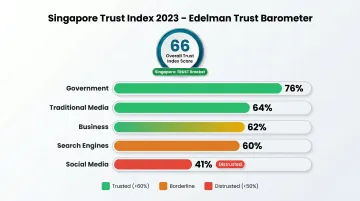
Consumers carry these institutional trust standards into commercial contexts. They scrutinise brand claims with unusual rigour, demand transparency, and penalise perceived breaches of trust quickly in a small, highly networked market.
Quality and Reliability
Singaporean consumers prioritize demonstrable quality over novelty or price. Singapore's limited domestic market and high cost of living have produced consumers who are selective and value-focused — they expect brands to deliver on their promises consistently.
Singapore Airlines tops YouGov's 2025 Recommend Rankings in Singapore with a score of 86.2, reflecting decades of brand consistency:
| Rank | Brand | Recommend Score |
|---|---|---|
| 1 | Singapore Airlines | 86.2 |
| 2 | Louis Vuitton | 84.6 |
| 3 | Apple | 84.3 |
| 4 | Uniqlo | 81.7 |
| 5 | Nike | 80.7 |
SIA's accolades include 33 consecutive Business Traveller Asia-Pacific Best Airline awards, Fortune's "World's Most Admired Companies" 2024 ranking (29th globally), and 35-time Condé Nast Traveler Readers' Choice Best Airline. The brand's strategy centres on the "Singapore Girl" icon (introduced in 1972), consistent in-flight service innovation, and technology investment through its Krislab digital innovation lab.
Charles & Keith provides another example. Founded in 1996 as a single ladies' footwear store, the brand now operates over 600 stores globally through an affordable luxury positioning, vertical integration, and introducing 20–30 new designs weekly. They were the first retail company in Singapore to launch e-commerce (2004) and pioneered sensory branding with standardised in-store scent and curated soundscapes.
Innovation and Forward-Thinking
Singapore's national identity is built on adaptation and progress, and consumers expect the brands they choose to reflect the same orientation. This doesn't mean being flashy — it means being purposeful about how a brand evolves, invests in digital experience, and solves problems in ways that feel ahead of the curve.
With 97% smartphone penetration and a super-app ecosystem, brands must prioritise mobile UX, integrate with local payment platforms (PayNow, SGQR), and maintain presence on local digital touchpoints.
Security, however, cannot be an afterthought. A 2025 Global Digital Shopping Index found that 61% of Singaporean shoppers are concerned about data security when storing payment credentials, and 73% of SMBs worry their payment technology is becoming outdated. Innovation must be paired with visible security assurance.
Pragmatism and Value Clarity
Brands must make their value proposition clear, specific, and defensible. Vague positioning or aspirational messaging without substance tends to underperform. Consumers want to understand clearly what a brand does, what it stands for, and why it's the right choice — not just feel inspired by it.
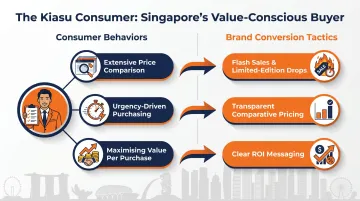
The culturally specific "kiasu" mindset drives extensive price comparison, urgency-driven purchasing, and getting maximum value from every purchase. Singaporean consumers are "value-conscious, not price-sensitive."
With GDP per capita exceeding $80,000, consumers will pay premiums for quality — but they research extensively to confirm that value first. The same individual may purchase luxury handbags and budget airline tickets in the same week.
Flash sales, early-bird pricing, and limited-edition drops trigger kiasu responses that accelerate conversions. Brands that provide transparent pricing, comparative value evidence, and clear ROI messaging outperform purely aspirational branding.
Sustainability and Social Responsibility
Sustainability has moved from a differentiator to a baseline expectation — especially among younger consumers. 58% of Singaporeans prefer sustainable brands, according to YouGov's 2022 Profiles data, with Gen Z at 66%.
However, 54% of the general population is not willing to pay a premium for eco-friendly products, indicating a significant awareness-to-action gap. Among those who have purchased sustainable fashion, top barriers for non-buyers include:
- 68% do not know where to find sustainable fashion
- 56% cite price concerns
- 18% are skeptical of sustainability claims
A November 2023 Competition and Consumer Commission of Singapore study found that 51% of products listed across 100 e-commerce websites made vague or unsubstantiated environmental claims. Vague green claims compound that skepticism further.
Singapore's Green Plan 2030 shapes consumer expectations through targets including planting 1 million more trees, reducing waste to landfill per capita by 30% by 2030, and deploying at least 2 GWp of solar energy by 2030. Brands must frame sustainability as value-additive — durability, long-term savings, health benefits — not as a moral premium.
How to Embed Singapore's Regional Brand Values Into Your Brand Strategy
Start With Brand Value Definition Before Localisation
Before a brand can authentically reflect Singapore's regional values, it must first have clearly defined its own brand values, purpose, and positioning. Trying to localise without this foundation results in inconsistent, reactive decisions. Clear internal brand values give every localisation decision a consistent reference point.
Ask:
- What does your brand stand for beyond what it sells?
- What principles guide decision-making?
- How do your values differentiate you from competitors?
- Are these values documented and shared across the organisation?
Conduct Genuine Consumer Research, Not Assumption
Understanding what Singaporean consumers value requires research — surveys, focus groups, social listening, and cultural insight — not assumptions based on regional stereotypes.
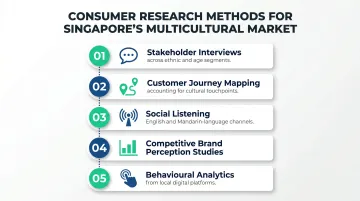
Effective research methods for Singapore's multicultural market include:
- Stakeholder interviews across ethnic and age segments
- Customer journey mapping that accounts for cultural touchpoints
- Social listening across platforms including English-language and Mandarin-language channels (approximately 30% of Chinese Singaporeans prefer Mandarin content, particularly on Xiaohongshu)
- Competitive brand perception studies
- Behavioural analytics from local digital platforms
Translate Values Into Every Brand Touchpoint
Brand values must be embedded into visual identity, tone of voice, customer experience, and messaging — not just stated on a website.
How trust can be expressed across key touchpoints:
- Use clean, consistent visual systems that signal credibility at a glance
- Write in clear, direct language — no jargon, no unsubstantiated claims
- Back service promises with transparent policies and responsive support
- Provide proof through certifications, customer reviews, and case studies
Build Long-Term Consistency Rather Than Campaign-by-Campaign Adaptation
Singapore consumers reward consistent, long-term brand behaviour over reactive campaign pivots. Singapore Airlines' decades-long brand consistency — maintaining the "Singapore Girl" icon since 1972 while continuously investing in service innovation — shows what sustained brand discipline looks like in practice.
Why consistency matters in Singapore:
- Small market means word-of-mouth spreads quickly
- Frequent pivots signal instability, eroding trust
- Consumers research extensively and notice inconsistencies
- Track record becomes a differentiator over time
For brands working through this process, a local branding partner can shorten the learning curve considerably. Vantage Branding works with organisations across healthcare, government, and F&B in Singapore to develop strategies grounded in local market insight — not generic regional frameworks.
Common Mistakes Brands Make When Approaching Singapore's Brand Values
Treating Singapore as Part of a Generic Asian Market
This is the most common and costly error. Strategies designed for a broad "Asia-Pacific" audience frequently miss the cultural specificity and consumer sophistication of Singapore.
What this looks like in practice:
- Imagery that doesn't reflect Singapore's specific demographic mix
- Messaging that resonates in China or India but reads as tone-deaf locally
- Assuming English-only communication is sufficient (30% of Chinese Singaporeans prefer Mandarin content)
- Applying pricing strategies from lower-income markets to Singapore's high-GDP context
As noted earlier, the E-Pay brownface ad demonstrated how production shortcuts — using a single actor to represent all ethnic groups rather than casting authentically — generate severe reputational damage.
Projecting Values Rather Than Proving Them
Claiming to stand for trust or quality is not the same as demonstrating it through every interaction. Singaporean consumers are research-driven and skeptical of brands that make big claims without visible, consistent evidence.
What "proof-based branding" looks like:
- Third-party certifications and accreditations
- Customer testimonials and verified reviews (minimum 20+ reviews at 4.0+ ratings)
- Transparent communication about policies, pricing, and practices
- Documented track record and case studies
- Tangible service commitments backed by guarantees
Prioritising Novelty Over Longevity
Brands that change direction frequently or rebrand superficially signal instability — and in Singapore's trust-first market, that instability is noticed. Innovation has its place, but consistency is itself a form of brand value.
Brands that commit to a clear identity build equity over time. Those that chase trends or pivot campaign-by-campaign erode it. Singaporean consumers check 3–5 sources before purchasing — they notice when a brand's positioning shifts without clear rationale.
The contrast is straightforward:
- Commit: Sustain a defined identity across touchpoints, even as executions evolve
- Chase: Rebrand reactively, shift messaging seasonally, or adopt trends without strategic fit
Frequently Asked Questions
What is the difference between regional brands and national brands?
National brands reflect how a country is perceived globally — for example, Singapore's reputation for governance, safety, and competitiveness. Regional brands are companies operating within a specific geographic market and building identity with local consumers. The two inform but do not replace each other.
What are the 5 core values of Singapore?
Singapore's officially adopted national values are meritocracy, multiracialism, pragmatism, self-reliance, and integrity. Together, they shape what consumers expect from brands: competence, cultural respect, clear value, informed decision-making, and transparent conduct.
What are the 5 pillars of brand loyalty?
The common pillars of brand loyalty are trust, quality, emotional connection, consistency, and perceived value. In Singapore's market, consumers research extensively and demand proof over claims — brands that deliver reliably earn lasting loyalty.
How do Singapore's multicultural demographics influence brand values?
Singapore's Chinese, Malay, Indian, and Eurasian communities make inclusivity, cultural sensitivity, and multilingual communication baseline expectations for credible brands. Monocultural representation carries real risk, as the 2019 E-Pay brownface controversy demonstrated.
Why is trust such an important brand value in Singapore?
Singapore's low-corruption culture (ranked 3rd globally on the 2025 Corruption Perceptions Index), strong institutional governance, and well-informed consumer base set a high bar for brand trust. Any perceived breach tends to be penalised quickly in a small, highly networked market.
How can a brand authentically reflect Singapore's values without appearing tokenistic?
Authentic alignment means embedding values into strategy, operations, and every customer touchpoint — not just campaign creative. Brands that conduct genuine consumer research and behave consistently over time earn credibility; those that rely on surface-level cultural references rarely do.