Introduction
Imagine a family-owned business celebrating its 60th anniversary. Three generations of loyal customers still swear by the brand—but their average age is 58. The founder's grandchildren now run the company, and they're well aware of a troubling reality: younger consumers scroll past their ads, uninterested in a brand that feels like their parents' choice, not theirs.
Every established brand faces this reckoning sooner or later: accumulated heritage is simultaneously your greatest competitive asset and, if mismanaged, the anchor that drags you toward irrelevance. The trust and credibility that took decades to build can become a liability the moment your story stops evolving.
The core fear is understandable: modernizing risks erasing the authenticity that took generations to earn. That fear causes many heritage brands to stagnate, choosing preservation over relevance. The brands that navigate this successfully don't abandon their past. They use it as the foundation for a more compelling future story.
This article covers what separates heritage storytelling from generic brand narrative, why the tension between tradition and modernity is a strategic advantage, and how to evolve your brand story in a way that preserves what matters most.
TLDR
- Heritage brands hold an irreplaceable competitive edge—trust and provenance—that no new entrant can manufacture
- Modernization means reframing the past as the foundation for a compelling future, not erasing it
- Effective heritage storytelling bridges founding values to present-day audience aspirations through a clear, structured narrative
- Modernizing delivery mechanisms (visuals, channels, language) differs from changing the core story—conflating the two is the most common mistake
- A phased, research-led approach is what separates brands that evolve successfully from those that lose their identity in the process
What Is a Heritage Brand (And Why Storytelling Is Its Engine)
Brand heritage is the accumulated provenance, values, reputation, craftsmanship, and emotional equity a brand builds across its lifetime. This accumulation isn't automatic—it must be actively stewarded through consistent narrative.
The Critical Distinction:
- Heritage brand: One that deliberately positions its history as a living, central part of its identity
- Brand with heritage: One that has a long history but doesn't leverage it as a strategic asset
According to research by Urde et al., brand heritage is "a dimension of a brand's identity found in its track record, longevity, core values, use of symbols, and particularly in an organizational belief that its history is important." The choice between these two postures is strategic, not default.
Why Storytelling Activates Heritage Equity:
An unnarrated history sits in an archive. A well-crafted brand story draws that history into the present — giving customers a reason to care, to choose, and to stay loyal.
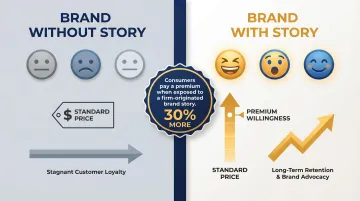
That connection has measurable commercial weight. A 2012 study by Lundqvist et al. found that consumers exposed to a firm-originated brand story rated the brand more positively and were willing to pay a premium. Story doesn't just frame features — it's what gives them meaning.
The Heritage Storytelling Paradox: Asset or Anchor?
The Provenance Advantage
The same history that makes a heritage brand trustworthy can make it feel static. Brand provenance—the legitimate source of a brand's authority and authenticity—functions as a competitive moat that new brands cannot replicate, no matter their marketing budget.
But provenance only works when it's told as a living story, not a museum exhibit.
Three things provenance delivers that no new brand can buy:
- Decades of demonstrated consistency that builds instinctive trust
- Cultural familiarity that reduces audience skepticism
- A narrative foundation that can anchor change without losing credibility
The Nostalgia Trap
When a brand's story is told exclusively in the past tense—celebrating what it was rather than what it stands for now—it becomes an artefact rather than a living brand.
The generational nuance matters:
- 68% of Gen Z responds positively to throwback marketing for eras they never experienced — nostalgia borrowed from a past they discovered, not lived
- **61% of Millennials say nostalgia improves brand perception** and drives buying intent — rooted in personal memory and emotional connection
The trap isn't nostalgia itself—it's when nostalgia becomes the only narrative mode. Heritage brands must connect the past to present-day human truths.
When Stories Stop Evolving, Equity Erodes
Audiences change, cultural references shift, and a narrative that once felt aspirational begins to feel out of touch.
The pattern is consistent across categories:
| Brand | Strategic Failure | Business Impact |
|---|---|---|
| Kodak | Failed to translate "Kodak moment" heritage into the digital era | Revenue dropped from $13.3B in 2003 to $6B in 2011 |
| Sears | Lost historical positioning as America's dominant retailer | Store base shrank from 3,500 in 2005 to under 700 in 2018 |
| Burberry | Successfully bridged eras by leveraging 1856 heritage while embracing digital experiences | Maintained premium luxury positioning across generations |
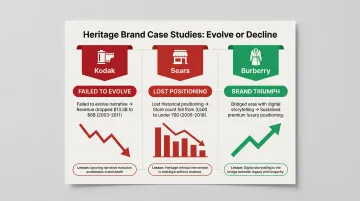
Heritage brands that fail to modernize their narrative face severe revenue contractions. Those that integrate historical provenance with modern experiences sustain premium positioning.
The Asia-Specific Context
In markets like Singapore and Southeast Asia, heritage carries particular cultural weight. Multi-generational family trust, institutional credibility, and community legacy are powerful narrative currencies.
According to the 2025 Edelman Trust Barometer, family-owned businesses are the most trusted business type globally, at 68%. Locally, Singapore's 2024 Edelman data shows Government leading institutional trust at 77%, with Business following at 63% — both figures reflecting how deeply credibility shapes audience relationships here.
In this environment, heritage storytelling carries more weight — and more risk. Tiger Balm illustrates the opportunity: by keeping founder Aw Chu Kin's family story central to its brand narrative, it has sustained trust and recognition across generations throughout the region.
From Product-Centric to Story-Centric Thinking
The brands that successfully modernize shift their frame entirely. Rather than asking "What do we make?" they ask "What do we stand for — and how has that stayed true across decades?"
That shift — from product logic to story logic — is where heritage becomes a strategic asset rather than a liability.