Introduction
Singapore businesses expanding into Malaysia, Vietnam, Indonesia, or other Southeast Asian markets face a real tension: a brand that resonates domestically can feel tone-deaf the moment it crosses a border. A polished, English-forward identity built for Singapore's professional market may seem overly formal in Vietnam's digital-first landscape or culturally distant in Indonesia's collectivist society.
Standard "visual refresh" projects that modernize logos and color palettes won't bridge this gap. The solution is a strategic recalibration — one that addresses cultural values, linguistic nuances, and market-specific trust signals without fragmenting your core identity.
This article covers what a regional brand refresh entails, how it differs from domestic rebranding, and how to execute it across multiple markets while keeping your brand coherent.
TLDR:
- Regional brand refreshes adapt identity, messaging, and positioning across multiple SEA markets simultaneously—not just modernize domestically
- 82% of Singapore SMEs plan overseas expansion in 2026, yet only 39% feel prepared for regional competition
- Cultural distance is measurable — Indonesia's collectivism (Hofstede: 5) versus Singapore's individualism (43) requires distinct narrative approaches
- Enterprise Development Grant (EDG) co-funds up to 50% of qualifying regional brand development projects
What Makes a Brand Refresh "Regional" — and Why It Matters
Defining the Regional Brand Refresh
A regional brand refresh is a strategic update to brand identity, messaging, visual systems, and market positioning — designed to resonate across multiple Southeast Asian markets simultaneously.
Unlike a domestic refresh that modernises brand elements for one market, a regional refresh must resolve cultural, linguistic, and perceptual differences across diverse audiences without fragmenting the brand's core identity or diluting its equity.
The Critical Distinction
The fundamental difference lies in scope and complexity:
A domestic refresh solves for one market's evolving aesthetic preferences, competitive shifts, or changing customer expectations — the cultural context stays constant.
A regional refresh must address:
- Cultural value systems that vary dramatically across markets (collectivism vs. individualism, power distance, uncertainty avoidance)
- Linguistic requirements beyond simple translation—idiomatic localization and market-appropriate tone
- Trust signals and credibility markers that differ by market (what builds trust in Singapore may not work in Indonesia)
- Platform ecosystems that fragment across borders (Facebook dominates Vietnam; TikTok leads in Indonesia; Xiaohongshu serves Chinese Malaysians)
Singapore's Unique Regional Positioning
Singapore's multicultural population, English-language business environment, and geographic proximity to major SEA economies make it an ideal base for building brands that scale across the region.
The city-state's position as a regional hub provides real advantages: exposure to diverse cultural perspectives, talent familiar with neighbouring markets, and established trade corridors. These advantages translate into brand success only when backed by deliberate regional strategy — which is precisely what the rest of this guide addresses.
Why Singapore Businesses Need a Regional Brand Strategy Now
The $5 Trillion Regional Growth Opportunity
Southeast Asia's private consumption is projected to grow 8% annually to $5 trillion by 2035, according to Bain & Company and NielsenIQ research from November 2025. For the first time in a decade, SEA attracts more Foreign Direct Investment than China. The region's digital economy alone reached $263 billion in 2024, growing 15% year-on-year.
Yet competitive intensity is rising. Local brands hold more than 50% of market value in Indonesia, Thailand, and Vietnam. Singapore businesses entering these markets face entrenched local competitors who understand their home markets intimately. Without differentiated, locally resonant brand positioning, even superior products struggle to gain traction.
Expansion Intent Meets Readiness Gap
82% of Singapore SMEs plan overseas expansion in 2026, according to a DBS survey from February 2026. Yet only 39% of regional executives feel prepared to address intensifying competition and shifting consumer behaviour. This readiness gap represents the space where regional brand strategy makes the difference between successful market entry and costly misalignment.
Divergent Consumer Expectations Across Markets
Trust in business varies dramatically across SEA markets. The 2025 Edelman Trust Barometer reveals Indonesia leads at 81% trust in business, while Singapore trails at 67%. These differences signal fundamentally different expectations about how brands should communicate, what constitutes credibility, and which trust signals matter most.
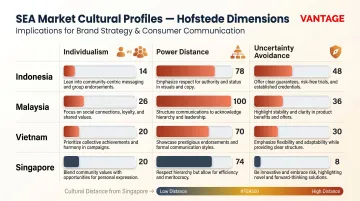
Cultural differences run deeper still, and Hofstede scores make the gaps concrete:
| Market | Key Dimension | Score | Brand Implication |
|---|---|---|---|
| Indonesia | Individualism | 5 (very low) | Centre messaging on family and collective benefit, not personal achievement |
| Malaysia | Power Distance | 100 (global max) | Respect hierarchical structures in all brand communications |
| Indonesia vs. Singapore | Uncertainty Avoidance | 48 vs. 8 | Indonesian audiences expect clearer, more structured reassurances than Singaporean brands typically offer |
Digital Acceleration Makes Regional Alignment Critical
Southeast Asia's 460 million social media users spend 2.5–3.5 hours daily on platforms, yet platform dominance fragments sharply by market. Facebook leads in Vietnam; TikTok dominates Indonesian urban youth; Xiaohongshu serves Chinese Malaysians. A Singapore brand's content reaches regional audiences whether or not it was designed to. When brand identity has not been calibrated for those markets, unintentional reach becomes a liability rather than an advantage.
Video commerce alone accounts for 20% of SEA e-commerce GMV, up from under 5% in 2022. Brand identity systems must now function in short-form video contexts, not just static applications.
Signs Your Brand Is Holding You Back in SEA Markets
Visual and Messaging Misalignment
Your brand visuals and messaging were built for Singapore's market context — professional, clean, English-forward — but feel misaligned when tested against regional markets. Vietnam's vibrant digital-first aesthetic, Malaysia's bilingual consumer base, and Indonesia's community-oriented visual norms each demand different brand expressions.
If your communications feel overly formal or culturally distant in neighboring markets, you're experiencing this gap.
Low Recognition Despite Strong Product
You receive low brand recognition or weak conversion when entering a new SEA market despite a strong product or service offering. This perception gap signals that your brand identity doesn't communicate trust or relevance to local buyers. Your offering isn't the issue — local buyers simply don't yet see your brand as one they can trust.
No Coherent Regional Positioning
Your brand has no coherent answer to the question: "What does this brand stand for across all the markets it serves?" That gap points to missing regional brand positioning — a unifying identity that still allows for local expression. The result: inconsistent brand experiences that erode credibility the moment you cross a border.
Common signals to watch for:
- Your tagline or value proposition requires heavy rewriting for each new market
- Sales teams in different countries describe your brand differently
- Local partners struggle to explain what your brand stands for
Core Strategies for a Regional Brand Refresh
Regional Cultural Mapping Comes First
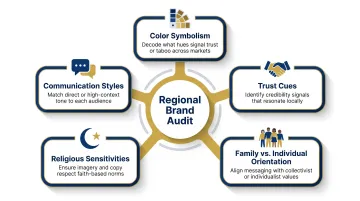
Before any visual or messaging work begins, Singapore businesses must audit how their brand values, visual language, and tone land in each target market. This cultural mapping process includes understanding:
- Color symbolism: Red signifies luck and prosperity in Chinese cultures but can carry different associations in other contexts
- Trust cues: What builds credibility varies—institutional authority in one market, community endorsement in another
- Family vs. individual orientation: Indonesia's extreme collectivism (Individualism score: 5) versus Singapore's moderate individualism (43) demands different narrative framing
- Religious sensitivities: Particularly critical for markets like Indonesia and Malaysia with significant Muslim populations
- Communication styles: Direct vs. indirect, hierarchical vs. egalitarian, formal vs. informal
These dimensions have direct commercial consequences: get them wrong and your messaging alienates the audience you're trying to reach.
Establish Your Regional Brand Architecture
Choose Your Structural Approach
Two structural models dominate regional brand strategy for Singapore SMEs:
| Approach | Best When | Trade-off |
|---|---|---|
| Unified brand with localized expressions | Expanding into culturally adjacent markets | Requires disciplined guidelines to prevent drift |
| House-of-brands or separate market brands | Cultural distance is extreme, or acquired brands carry strong local equity | Higher management cost, diluted cross-market recognition |
For most SMEs, a unified brand with controlled local flexibility is the more cost-effective path. The decision should be anchored in market research, not assumed.
Define Localized Expressions
Localized expressions translate core brand identity into culturally appropriate formats:
- Market-specific taglines translated idiomatically (not literally)
- Culturally appropriate imagery and talent representation reflecting local diversity
- Platform-specific content formats matching how audiences consume media in each market
- Core elements remain locked: logo, primary color palette, fundamental brand values
Adapt Your Brand Voice and Messaging for SEA Audiences
Tone Shifts by Market
Brand tone must shift systematically across markets while maintaining recognizable consistency. Singapore's B2B and professional audiences respond to precision and credibility. Vietnamese consumers, particularly younger demographics, respond to aspiration and digital-native energy. Malaysian audiences often expect bilingual accessibility and community-oriented messaging.
The data backs this up: 76% of online shoppers prefer to buy products with information in their native language, and 40% will never purchase from websites in other languages. Academic research analyzing SEA advertising from 2019–2024 found that campaigns integrating local languages, regional influencers, and visual storytelling consistently outperform standardized global content.
Localization Is Not Translation
The brand's story must be re-anchored in local cultural context. Love, Bonito, a Singapore fashion brand, demonstrates this effectively. Nearly 50% of the brand's revenue now comes from outside Singapore. The core identity — "made for you" — stayed constant, but messaging was adapted to address Asian women's proportions, climate preferences, and local cultural contexts. The Singapore origin became a credibility marker, not a limitation.
Refresh Your Visual Identity for Regional Relevance
Audit Visual Identity for Regional Readiness
Check logo legibility across digital and physical formats common in target markets. Assess whether the color palette carries unintended cultural meanings. Evaluate whether photography and illustration styles reflect the diversity of the target audience rather than defaulting to Singaporean visual context.
Critical questions include:
- Does your visual system work in vertical video formats (TikTok, Instagram Stories)?
- Are typography choices legible in target languages?
- Do color combinations respect cultural associations in each market?
- Does imagery represent the ethnic and demographic diversity of your audience?
Build a Scalable Brand System
A flexible design framework with defined rules for how the brand adapts visually across markets enables regional teams or local partners to execute consistently without fragmenting the brand's identity. This system should specify:
- Tier 1 (locked): Logo, core palette, brand mark, primary brand statement
- Tier 2 (adaptable): Imagery guidelines, supporting color use, tagline translations, content formats
- Tier 3 (market-created within guidelines): Social content, local campaign visuals, market-specific applications

The Regional Brand Refresh Roadmap: From Singapore to SEA
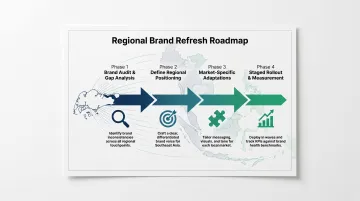
Phase 1: Brand Audit and Regional Gap Analysis
Conduct a structured audit across three dimensions:
Internal Alignment: Do your team and leadership have a clear, consistent understanding of what the brand stands for? Internal misalignment amplifies when expanding across markets.
Market Perception: How does your brand land with existing regional customers or prospects? Interview customers in at least one target market to understand perception gaps between Singapore and neighboring markets.
Competitive Benchmarking: How does your brand compare to key players already active in target SEA markets? Map not just direct competitors but any brand competing for the same customer attention and trust.
The audit output is a prioritized gap list — the foundation every subsequent phase builds on.
Phase 2: Define Regional Brand Positioning
Develop a single, regionally relevant brand positioning statement that captures your unique value in terms transcending Singapore's local context. This positioning should speak to shared aspirations or pain points across your target SEA audiences.
Core outputs include:
- Updated brand values that resonate across markets
- Refined brand promise relevant beyond Singapore
- Tone-of-voice guide accounting for market variation
- Brand architecture decision (unified vs. endorsed vs. house-of-brands)
Every localization decision in Phases 3 and 4 should trace back to this positioning.
Phase 3: Develop Market-Specific Adaptations
Create a tiered asset library following the Tier 1/2/3 framework outlined above. This prevents over-localization while preserving cultural relevance across markets.
Key deliverables at this stage:
- Locked universal assets (logo, core color palette, brand voice principles)
- Market-adapted materials (campaign themes, imagery, key messages)
- Market-specific assets (language versions, local partnerships, regional event collateral)
Agencies with on-the-ground presence in target markets — such as those actively working across Singapore, Malaysia, and Vietnam — can significantly compress the research phase here by drawing on direct client experience rather than secondary cultural studies.
Phase 4: Staged Market Rollout and Measurement
Launch in priority markets first rather than attempting simultaneous regional rollout. Start with the market where your brand has the most existing traction or clearest cultural alignment. Measure, refine, then expand.
Key Performance Indicators to track within the first 90 days:
- Brand search volume by market
- Inbound inquiry quality and conversion rates
- Net Promoter Score (NPS) by market
- Social media engagement and sentiment by platform and market
- Sales cycle length compared to Singapore baseline
Done well, each market entry sharpens your team's ability to execute the next one faster.
Funding and Planning Support for Your Regional Brand Refresh
Enterprise Development Grant (EDG) Coverage
The Enterprise Development Grant (EDG) through Enterprise Singapore provides co-funding of up to 50% of eligible project costs for qualifying SMEs. Sustainability-related projects receive enhanced support up to 70%.
Regional brand development aligns with EDG objectives under two qualifying areas:
- Strategic Brand and Marketing Development — brand strategy development, brand financial value assessment, and marketing resource optimisation plans
- Market Access — pilot projects and test bedding in new geographical markets, plus standards adoption for international competitiveness
Eligibility requirements:
- Registered and operating in Singapore
- At least 30% local equity held by Singaporean citizens or Permanent Residents
- Financial readiness to complete the project
- Project not yet commenced at application point
Important exclusions: EDG does not cover production of collaterals (brochures, videos, websites), PR campaigns, advertising/media buys, social media influencer engagement, SEO/SEM, or social media platform management.
A new grant called EDGE launches in 2H2026. Current EDG remains accessible until then, so SMEs should plan applications with that timeline in mind.
Work with Regionally-Experienced Partners
Regional brand refresh requires insight into multiple market contexts simultaneously, not just familiarity with the Singapore market. Work with a branding agency that has direct experience across SEA markets. Vantage Branding works across Singapore, Malaysia, and Vietnam, bringing on-the-ground market knowledge to each stage of the regional brand process.
Investment Ranges and Phased Approach
Full regional brand projects for multi-market SEA expansion typically range from S$80,000 to S$150,000 before EDG co-funding. Each additional language adds 8–12% to creative labour costs. With EDG co-funding of up to 50%, net outlay for qualifying SMEs could fall between S$40,000 and S$75,000.
Phased implementation — starting with strategy and positioning before rolling out visual updates — keeps costs manageable for SMEs managing multi-market expansion and ensures the strategic foundation is solid before execution begins.
Frequently Asked Questions
What is the difference between a regional brand refresh and a standard brand refresh?
A standard refresh modernizes brand elements for a single market's evolving preferences. A regional refresh is designed to make the brand credible and resonant across multiple SEA markets simultaneously—requiring cultural mapping, flexible brand architecture, and multilingual messaging strategy that maintains core identity while allowing controlled local adaptation.
Which Southeast Asian markets typically require the most adaptation from Singapore brands?
Indonesia and Vietnam require the most adaptation—driven by distinct languages, cultural norms (collectivism, different trust hierarchies), and dominant platforms (TikTok/WhatsApp versus Facebook). Malaysia shares greater linguistic and cultural proximity with Singapore, but still benefits from Bahasa Malaysia localization and ethnic segment consideration.
How long does a regional brand refresh typically take for a Singapore business?
A focused regional brand refresh covering strategy, visual updates, and core asset development typically takes 3 to 6 months, with additional time for market-by-market rollout. The added complexity of cultural research and multi-market coordination places it between a domestic visual refresh and a full rebrand in scope and effort.
Can Singapore SMEs use the EDG grant to fund a regional brand refresh?
Yes, the Enterprise Development Grant (EDG) through Enterprise Singapore can apply to qualifying branding and market development projects, including those with regional scope. Verify current eligibility and funding coverage directly with Enterprise Singapore or a certified consultant, as program details are subject to change.
How do you maintain a consistent brand identity while adapting for different SEA markets?
Use a tiered asset model: lock core elements (logo, palette, primary positioning) while allowing controlled flexibility in secondary assets like imagery, tone, and translated messaging. Brand guidelines define what each market can and cannot adapt, with a scalable design system helping regional teams execute consistently.
What are the most common mistakes Singapore businesses make in a regional brand refresh?
Common pitfalls include treating translation as localization and applying Singapore-centric visual norms to culturally distinct markets. Others skip the brand audit phase, launch across all markets at once without testing in a priority market first, or underestimate cultural distance by assuming geographic proximity equals similarity.