Introduction
Vietnam has the assets most destinations can only wish for: UNESCO World Heritage sites, 3,260 km of coastline, a culinary tradition that ranks 16th globally for "food the world loves," and 54 ethnic groups with living cultural traditions. Yet in 2024, the country attracted just 17.5 million international visitors—half the arrivals Thailand welcomed that same year.
The shortfall comes down to how Vietnam tells its story. Industry experts and official assessments from the Vietnam National Administration of Tourism (VNAT) have flagged the same core weakness: Vietnam's national tourism brand remains "confused," lacking the concentration and differentiation needed to compete with regional rivals like Thailand's "Amazing Thailand" or Singapore's "Passion Made Possible."
The stakes are substantial. Vietnam targets 25 million international arrivals by 2026 and 45–50 million by 2030, with tourism revenue projected at approximately $43 billion in 2026 alone.
Reaching those numbers requires more than promotional campaigns. A distinctive, consistent brand identity amplifies every marketing dollar, builds traveller confidence before arrival, and makes every hotel, tour operator, and restaurant more competitive by association.
TLDR:
- Vietnam's tourism brand suffers from fragmentation, lacking the clear positioning that competitors like Thailand have established
- The country targets 25 million visitors by 2026 and 45-50 million by 2030, requiring stronger brand clarity
- A unified brand architecture grounded in cultural authenticity gives Vietnam a credible path to closing the gap with regional leaders
- Digital channels and influencer marketing are already driving measurable arrival spikes from key markets
- Sustainability positioning offers a genuine differentiator for attracting high-value travellers
What Is Tourism Branding and Why Does It Matter for Vietnam?
Tourism branding is the strategic process of shaping how a destination is perceived internationally. Rather than a slogan or a single campaign, it's a deliberate construction of identity, values, imagery, and emotional promise — shaping how potential visitors think about a place before they ever book a ticket.
For Vietnam, strong destination branding is especially high-stakes. When dozens of countries compete for the same long-haul European, North American, and regional Asian travellers, a fragmented or generic brand makes it difficult for any single promotion to gain traction.
Official assessments from VNAT and Nhan Dan confirm that Vietnam's positioning is "not very effective," citing a "lack of concentration" and failure to communicate "outstanding and different values" compared to Thailand, Singapore, or Malaysia.
Why this matters economically:
- A strong national tourism brand creates a multiplier effect, amplifying every marketing dollar spent
- It builds traveller trust and emotional connection before arrival, increasing conversion rates
- It makes individual businesses—hotels, tour operators, restaurants—more competitive through positive association
- It enables premium pricing by shifting perception from "cheap destination" to "high-value experience"
Without this foundation, Vietnam's promotional efforts remain scattered. Provincial tourism boards build independent destination images, government bodies pursue disconnected campaigns, and private enterprises create their own messaging—preventing a coherent story from reaching international audiences at the scale needed to compete.
Vietnam's Current Brand Identity: Strengths and Gaps
Genuine Brand Assets
Vietnam's raw material for destination branding is exceptional. The country holds eight UNESCO World Heritage Sites, from Ha Long Bay's limestone karsts to Hoi An's ancient merchant quarter and Hue's imperial citadel. International recognition validates this potential: Vietnam won World's Leading Heritage Destination 2025 at the World Travel Awards, and Hanoi earned Leading Cultural Destination honours.
Beyond monuments, Vietnam's culinary diversity is a defensible competitive advantage. Brand Finance's Global Soft Power Index 2025 ranked Vietnam 16th globally for "food the world loves"—ahead of many established tourism powerhouses. The country's 54 ethnic groups maintain living traditions, offering authentic cultural experiences that high-value travellers increasingly seek.
The Positioning Paradox
Ironically, this richness creates Vietnam's central brand challenge. With so many genuine assets—heritage sites, beaches, cuisine, culture, adventure opportunities—the country has struggled to identify one leading product around which to anchor the national brand.
Marketing expert Philip Kotler suggested Vietnam become "the world's kitchen," emphasising culinary positioning. Industry leaders have proposed alternative anchors: heritage destination, adventure travel hub, or warm local hospitality.
The debate remains unresolved. Vietnam's official tagline "Timeless Charm" is considered "too general" and "lacking specificity"—a description that could apply equally to Cambodia, Laos, or Thailand. The campaign theme "Live Fully in Vietnam" offers more energy but still doesn't answer the fundamental question: what makes Vietnam distinctly different from its competitors?
Structural Fragmentation
Without a clear national brand strategy, government bodies, localities, and private tourism enterprises each build their own destination images independently:
- Da Nang markets itself as a beach resort hub
- Hanoi emphasises cultural heritage
- Ho Chi Minh City positions around urban energy and history
- Ha Giang and Sapa promote adventure trekking
Each message is valid. Together, they don't add up to a coherent national story.
The opportunity cost is measurable: Vietnam's brand value is improving—the country ranked 52nd in the Global Soft Power Index 2025, with particularly strong future growth potential (15th globally). But without a unified brand strategy, this value growth remains fragmented and harder to sustain against competitors with decades of consistent brand investment.
Key Strategies for Vietnam Tourism Branding Development
1. Define a Unified Brand Positioning
The foundation of effective tourism branding is selecting a primary brand position and committing to it consistently across all markets and channels.
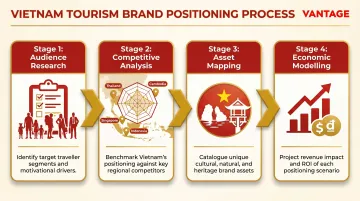
The positioning selection process should include:
- Audience research across priority source markets to understand decision drivers and perception gaps
- Competitive analysis mapping how Thailand, Singapore, Indonesia, and Cambodia are positioned
- Asset mapping to identify which Vietnamese strengths are most defensible and hardest for competitors to replicate
- Economic modelling to project which positioning drives highest-value visitor segments
The resulting position must be specific enough to differentiate Vietnam from regional neighbours while broad enough to encompass regional diversity. For example, "Southeast Asia's living cultural treasury" could anchor messaging around heritage, cuisine, traditions, and authentic experiences — territories where Vietnam genuinely leads — while allowing provinces to adapt the narrative to local assets.
Critical success factors:
- Senior government commitment to sustain the positioning for 5-10 years minimum
- Alignment with Vietnam's broader nation brand and economic development strategy
- Cultural authenticity that Vietnamese citizens and tourism workers can credibly deliver
- Flexibility for market-specific adaptation without fragmenting the core message
2. Create a Consistent National Brand Architecture
Once positioning is defined, Vietnam needs a master brand framework that all stakeholders can adapt without fragmenting the core identity.
A comprehensive brand architecture includes:
- Visual identity system (logo, colour palette, typography, photography style)
- Verbal identity (tone of voice, messaging framework, tagline usage guidelines)
- Core narrative (the story Vietnam tells about itself, consistent across channels)
- Application guidelines showing how provincial and private operators use the national brand
Destinations that built global recognition — Singapore's "Passion Made Possible," Japan's "Cool Japan," South Korea's Hallyu wave — did so through disciplined brand architecture sustained over years, not campaigns. Translating strategic positioning into executable visual and verbal systems is where experienced regional branding partners, including Singapore-based agencies like Vantage Branding that work across Asian destination markets, add measurable value.
Implementation requirements:
- VNAT ownership with mandate to enforce consistency
- Provincial tourism boards trained on brand application
- Private sector incentives (co-marketing funding, certification programs) to encourage adoption
- Regular brand health tracking to measure consistency and impact
3. Anchor the Brand in Cultural Authenticity
Vietnam's most defensible brand territory lies in its living culture (food traditions, festivals, craft practices, and the warmth of its people) rather than purely scenic assets that competitors can also claim.
Cultural experiences are what high-value travellers increasingly seek. The Ministry of Culture, Sports and Tourism's national brand for cultural tourism explicitly positions Vietnam on distinctive cultural values with emphasis on heritage and culinary assets, targeting 20-25% of total tourism revenue from cultural tourism by 2030 (approximately $130 billion).
How to operationalise cultural authenticity:
- Develop signature experiences that showcase regional cuisine, craft traditions, and festivals
- Train tourism workers as cultural ambassadors who can tell authentic local stories
- Support community-based tourism initiatives that generate income for ethnic minority villages
- Protect and promote intangible cultural heritage (traditional music, dance, craft techniques)
- Ensure marketing imagery features real Vietnamese people and places, not generic stock photos
Sustaining this authenticity requires ongoing investment in the cultural assets the brand promises to deliver. When brand image and visitor experience align, the positioning becomes self-reinforcing.
4. Pursue Strategic Market Segmentation
Vietnam's brand message should not be identical in every source market. Effective destination branding tailors emphasis and product mix to different audience segments.
Market-specific adaptation examples:
- Europe: Emphasise heritage depth, culinary sophistication, and multi-week itineraries combining culture and nature
- Northeast Asia (Korea, Japan): Highlight beach resorts, golf, wellness, and convenient regional access
- ASEAN: Position around adventure travel, affordability, and weekend city breaks
- North America: Focus on authenticity, transformation, and unique experiences unavailable elsewhere
South Korea demonstrates this principle in action. As Vietnam's #1 source market, Korean arrivals grew from 3.6 million (2023) to 4.6 million (2024), with VNAT attributing growth to positive spillover from Key Opinion Leaders, high social media visibility, and cultural affinity. This success came from targeted messaging emphasising destinations like Da Nang, Nha Trang, and Phu Quoc that resonate specifically with Korean preferences.
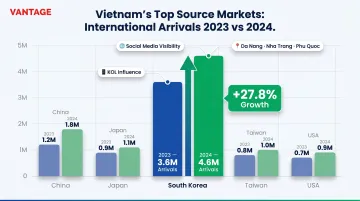
The Korean example shows that market-specific emphasis strengthens rather than dilutes the core brand — each audience simply connects with a different facet of the same positioning.
5. Align Brand Promise with On-the-Ground Experience
Tourism branding fails when visitor experience doesn't match the image projected. Vietnam must align service quality, infrastructure investment, and storytelling capability so expectations match reality.
Priority alignment areas:
- Train hospitality workers to deliver the warmth and cultural insight the brand promises
- Invest in transport connectivity, signage, and tourist facilities that support premium positioning
- Maintain beaches, heritage sites, and natural areas to justify premium pricing
- Develop curated experiences (cooking classes, craft workshops, heritage tours) that deliver on cultural positioning
- Build booking platforms, mobile apps, and virtual tours that reflect modern destination standards
When brand promise aligns with reality, visitors become brand ambassadors. Word-of-mouth reinforcement from satisfied travellers (social media posts, online reviews, personal recommendations) sustains brand reach far beyond what paid advertising alone can achieve.
6. Participate Consistently in Global Trade and Media Platforms
Vietnam's presence at international tourism fairs — ITB Berlin, World Travel Market London, Paris World Travel Fair — is an effective channel for B2B brand-building and partnership development. Vietnam maintained an official pavilion at WTM London 2025, showcasing destinations to global tour operators and travel media.
The key is consistency: showing up every year with coherent messaging. Trade fair participation builds cumulative awareness among the industry professionals who package and sell Vietnam to end consumers. Each consistent appearance reinforces positioning, demonstrates commitment, and signals that Vietnam is a reliable, professional destination partner.
Digital Marketing and Influencer-Led Promotion
Vietnam's tourism brand-building has shifted from traditional promotional materials toward a multi-channel digital ecosystem. VNAT and provincial tourism boards now integrate social media, content marketing, virtual reality, and AI-powered personalisation to reach travellers at the point when travel decisions are actually made.
The Power of Social Media Influencer Marketing
South Korea provides the clearest case study in influencer-driven brand amplification. Vietnamese authorities credit the surge in Korean tourists partly to "positive spillover effects" from Key Opinion Leaders and high visibility across social media platforms. Da Nang, Nha Trang, and Phu Quoc became "default destinations" for Korean travellers largely through organic social media promotion by Korean celebrities and influencers visiting Vietnam.
The ROI is tangible: targeted influencer visits produced arrival spikes in specific provinces with no proportional increase in advertising spend. The content created—social posts, vlogs, reviews—continues generating awareness long after the initial visit.
Short-Form Video Platforms
Vietnam's visual diversity is inherently suited to short-form video. Street food markets, lantern-lit ancient towns, karst landscapes, and dramatic coastal sunsets perform well on TikTok, Instagram Reels, and YouTube Shorts alike. NPR reported in April 2026 on TikTok driving American expat interest in Vietnam and Thailand, with social media videos influencing relocation and travel decisions.
Strategic short-form video approach:
- Encourage user-generated content by creating photogenic moments at tourist sites
- Partner with micro-influencers (10K–100K followers) for authentic destination storytelling
- Develop official content series showcasing regional cuisine, festivals, and local characters
- Track hashtag performance and trending topics to identify emerging interest areas
The most cost-effective content comes from visitors themselves — which means destination design and on-the-ground experience directly shape digital reach.
Emerging Technologies: VR and AI
VNAT launched the "Live Fully in Vietnam" campaign in December 2021 featuring 360-degree virtual tours of Ha Long Bay, Da Nang, Nha Trang, Phu Quoc, and Hoi An. These immersive experiences extend Vietnam's brand reach to audiences who haven't yet visited, offering emotional connection before booking.
AI-driven personalisation lets tourism boards serve different messages to different audience segments — adventure seekers, culinary travellers, families — without diluting the core brand identity. Each audience gets a tailored entry point into the same destination story.
Shift to Outcome-Based Metrics
Digital channels enable precise measurement that traditional promotion never could. Vietnam's tourism brand investments must shift from activity-based metrics (brochures distributed, fairs attended) to outcome-based tracking:
- Brand awareness scores by source market (aided and unaided recall)
- Social share of voice versus Thailand, Singapore, Cambodia
- Visitor intent surveys measuring consideration and preference
- Conversion attribution connecting digital touchpoints to bookings
- Sentiment analysis of social media mentions and online reviews
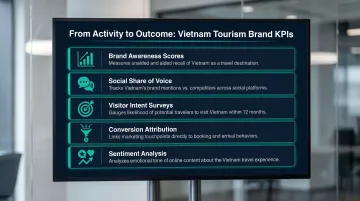
Without this measurement layer, even well-funded campaigns risk repeating spend on channels that generate visibility but not arrivals.
Lessons from Leading Global Destination Brands
Japan's "Cool Japan" Strategy
Officially launched in 2013 with a Cool Japan Fund capitalised at approximately $500 million over 20 years, Japan's government-led brand strategy built a globally recognisable identity around anime, manga, video games, washoku (cuisine), fashion, and omotenashi (hospitality).
The results are measurable: Japan recorded a record 36.9 million foreign tourists in 2024, surpassing the 2019 pre-pandemic record by 16%. Cool Japan succeeded because it was culturally anchored, government-backed, consistently funded, and sustained over decades—not a three-year campaign.
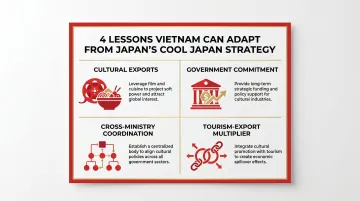
Lessons Vietnam can adapt:
- Ground positioning in authentic cultural exports (Vietnamese cinema, cuisine, design)
- Secure long-term government commitment and funding
- Coordinate across ministries (tourism, culture, foreign affairs, trade)
- Create economic multiplier by linking tourism brand to export promotion
South Korea's K-Culture Phenomenon
South Korea turned entertainment into a tourism marketing channel. The deliberate export of K-dramas and K-pop created massive demand for in-destination experiences. Government analysis from April 2026 found that foreign tourists attending BTS concerts in Seoul stayed 2.6 days longer than average visitors and spent $770 more per trip.
As South Korean government officials concluded: "Large-scale 'hallyu' performances have a clear effect in attracting visitors to regions." Cultural content, in other words, is a direct pipeline to tourism spending.
Lessons for Vietnam:
- Invest in Vietnamese film, music, and cultural content that can travel internationally
- Support cultural exports that create emotional connection before physical visits
- Partner with Vietnamese celebrities and artists as tourism ambassadors
- Measure the tourism multiplier effect of cultural investments
Singapore's Sentosa Island Model
Sentosa's transformation from military outpost to integrated resort destination took decades of coordinated branding, product development, and quality control. The result: Singapore now ranks among Asia's highest per-visitor-spend leisure destinations, with Sentosa's integrated resort model serving as a global benchmark for deliberate destination reinvention.
Lessons for Vietnam:
- Commit to long-term product development alongside brand building—not one without the other
- Align all destination stakeholders around a single, consistent positioning
- Use quality control as a brand tool; visitor experience must match what marketing promises
- Target high-yield visitor segments rather than optimising purely for volume
Sustainable Tourism as a Brand Differentiator
Booking.com's 2024 Sustainable Travel Report found that 83% of travellers say sustainable travel matters to them, and 75% plan to travel more sustainably in the next 12 months. Sustainability has become a baseline brand expectation — and a genuine competitive lever for destinations that act on it.
Vietnam can leverage its natural and community-based tourism credentials as a genuine brand differentiator rather than a marketing add-on.
Sustainable positioning opportunities:
- VNAT's community tourism initiative across remote, mountainous, and island regions distributes income while delivering authentic experiences — Nam Dam Cultural Village in Ha Giang generates VND 45 million per household annually.
- A GEF-funded ecotourism certification programme builds the policy framework and international credibility needed to attract responsible travellers.
- Vietnam's 2030 tourism plan targets full elimination of single-use plastics across all tourist destinations and coastal services — a concrete, verifiable commitment few regional competitors can match.

Positioning Vietnam as a responsible, experience-rich destination attracts higher-spending, longer-staying travellers while protecting the natural and cultural assets the tourism brand is built upon. Destinations that make sustainability a visible brand commitment consistently outperform those that treat it as a footnote.
Frequently Asked Questions
What is tourism branding?
Tourism branding is the strategic process of shaping and communicating a destination's distinct identity, values, and promise to attract visitors. Where general advertising drives short-term promotion, destination branding builds lasting perception and emotional connection that shapes traveller choice for years.
What are the current tourism trends in Vietnam?
Key trends include rapid growth in cultural and heritage tourism, rising demand for sustainable and community-based experiences, surge in social-media-driven travel decisions (especially from TikTok and Instagram), and increasing arrivals from Northeast Asian markets led by South Korea. Check the latest VNAT statistics for current monthly figures.
What is the tagline of Vietnam Tourism?
Vietnam's official tourism tagline is "Timeless Charm," with "Live Fully in Vietnam" serving as an active campaign theme launched in 2021. Industry debate continues about whether these taglines are specific and differentiated enough compared to regional competitors like Thailand's "Amazing Thailand."
How does Vietnam's tourism brand compare to other Southeast Asian destinations?
Vietnam ranks 52nd in Brand Finance's Global Soft Power Index 2025, but lags behind Thailand and Singapore in brand clarity due to inconsistent messaging and lower promotional investment. Thailand attracted roughly double Vietnam's arrivals in 2024.
What role does culture play in Vietnam's tourism brand?
Culture—encompassing cuisine, UNESCO heritage sites, living traditions, and the warmth of local people—is Vietnam's most authentic and defensible brand territory. It anchors a distinctive global tourism identity built on experiences competitors cannot easily replicate.
How can Vietnam attract more high-value international tourists through branding?
Attracting high-value tourists means shifting from volume-focused messaging to premium positioning — curating signature experiences in heritage, culinary, and luxury eco-tourism for specific high-spend markets. Service quality, infrastructure, and environmental standards must then match the brand promise delivered internationally.