Tourism destinations face a uniquely complex branding challenge. They are not products a single company controls, yet they must compete in a global market for visitor attention, loyalty, and spending. Unlike a hotel chain or airline, a destination's brand is co-created across hundreds of stakeholders—government bodies, businesses, residents, and visitors themselves—making consistency and strategic alignment far harder to achieve.
This post draws on brand equity case study research and real-world destination examples to unpack what destination brand equity is, why it matters, and how tourism boards and DMOs can build it strategically.
TLDR
- Strong brand equity cuts visitor switching, drives repeat visitation, and fuels word-of-mouth advocacy
- Destination brands succeed only when governments, businesses, residents, and visitors align behind one shared identity
- Effective brand equity rests on four pillars: awareness, perceived quality, brand associations, and loyalty—all demanding active management
- Winning destinations treat brand strategy as an ongoing discipline, not a one-off marketing campaign
What Makes Destination Brand Equity Different from Product Branding
Destination brand equity applies Aaker's consumer-based brand equity (CBBE) framework to the tourism context: the differential effect that a destination's name and identity has on a traveller's response, perceptions, and decision-making.
Konecnik and Gartner (2007) established the foundational four-dimension model—awareness, image, quality, and loyalty—confirming that product-based frameworks transfer to destinations, though with critical distinctions.
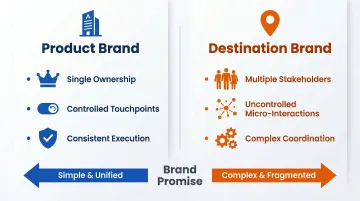
The core distinction is ownership and control. A product brand is owned and controlled by a single company, while a destination brand is co-created across hundreds of businesses, government bodies, residents, and travellers. This makes consistency far harder to achieve and maintain. When Apple launches a product, the company controls every touchpoint. When Singapore positions itself as a destination, that promise must be delivered through immigration queues, taxi drivers, restaurant meals, hotel experiences, and thousands of other micro-interactions no single authority fully controls.
When the Experience Is the Product
Unlike a tangible product, a destination's brand promise is delivered through thousands of micro-interactions. The brand is not the marketing campaign—it's the lived experience. A delayed immigration process, an unfriendly service interaction, or a disappointing meal can undermine years of brand building, regardless of how sophisticated the destination's marketing materials appear.
Authenticity as a Non-Negotiable Foundation
Shi et al. (2022) found that brand authenticity is a direct antecedent of destination brand equity—not a supplementary attribute. It drives revisit intention and satisfaction more reliably than polished campaigns alone. Travellers are drawn to destinations with believable, rooted cultural identities rather than manufactured appeal.
Brand Equity Is Slow to Build, Fast to Destroy
Destination brand equity accumulates across years of consistent messaging, physical improvements, and visitor experience. A single crisis can erase it quickly. Egypt lost approximately 33% of tourist arrivals (14.7 million to 9.8 million) and 30% of tourism revenue ($12.5 billion to $8.7 billion) in a single year following the 2011 revolution, with monument revenues collapsing 95% by 2014.
Sri Lanka saw arrivals fall by up to 70% in the weeks after the 2019 Easter Sunday bombings. For DMOs, this asymmetry means crisis resilience planning deserves as much investment as brand-building campaigns.
The Four Pillars of Destination Brand Equity
These four CBBE dimensions provide the diagnostic framework DMOs can use to assess where their brand currently stands.
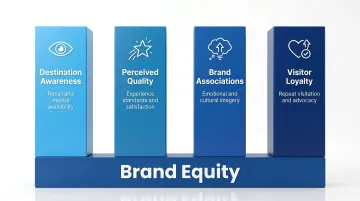
Pillar 1: Destination Awareness
Destination awareness goes beyond name recognition. It encompasses top-of-mind recall when a traveller is planning a trip, and the ability of the destination to be recalled spontaneously within its category—"best beaches in Southeast Asia," "top city-break destinations in Europe."
Research shows destinations with higher awareness earn disproportionately more consideration even when quality differences are marginal. Awareness creates the mental availability that precedes preference. If your destination doesn't come to mind during the planning phase, it won't make the shortlist.
Key awareness drivers:
- Consistent long-term marketing across source markets
- Media coverage and editorial features
- Word-of-mouth and social media visibility
- Major events and cultural moments that put the destination in global conversation
Pillar 2: Perceived Quality and Experience
Perceived quality is the traveller's subjective judgment about the overall excellence of the destination experience—infrastructure quality, safety, value for money, hospitality standards, and service levels.
Perceived quality acts as both a driver of satisfaction and a mediator between initial visits and repeat visitation.
Research by Karunanayaka et al. (2025) found that perceived quality does not have a significant direct effect on revisit intention. However, it has a strong, significant positive effect on tourist satisfaction (beta = 0.540), and satisfaction is the **primary driver of revisit intention** (beta = 0.738).
The implication: quality is a necessary input that must produce satisfaction before it converts to loyalty.
Pillar 3: Brand Associations and Image
Brand associations are the network of meanings, emotions, and imagery travellers connect with a destination—what comes to mind when someone hears "Singapore" or "Bali." Strong, distinctive associations create the basis for preference in a crowded market.
Research shows that emotional and symbolic associations tend to shift more readily following a rebrand, but take longer to convert into loyalty. A longitudinal study by Pike (2008) tracked five destinations over four years and found no measurable change in brand equity despite active marketing campaigns.
Loyalty shift lags association shift further still. DMOs should budget for multi-year brand programmes before expecting measurable shifts in perception.
Common association categories:
- Cultural attributes (heritage, arts, cuisine)
- Natural features (beaches, mountains, climate)
- Functional benefits (safety, convenience, value)
- Emotional benefits (relaxation, adventure, discovery)
- Symbolic meanings (status, sophistication, authenticity)
Pillar 4: Visitor Loyalty and Advocacy
Destination loyalty operates in two dimensions: repeat visitation (behavioural loyalty) and active recommendation (attitudinal loyalty / word-of-mouth).
Research consistently shows that stronger brand equity directly reduces visitor switching to competing destinations. Studies across multiple contexts confirm that higher brand equity correlates with higher revisit intention and recommendation intention.
The repeat visitor economics debate:
Contrary to common assumptions, repeat visitors don't necessarily spend more per trip. Macao data (ITRC, 2017) shows first-time visitors spend 14% more on average than repeat visitors. UK data (Visit Britain, 2015) shows similar patterns: first-time tourists average £623 per visit versus £578 for repeat tourists.
However, repeat visitors cost less to acquire and generate word-of-mouth that attracts new visitors. The economic argument for loyalty is therefore about acquisition cost efficiency and advocacy value, not per-trip spending.
In tourism, advocacy—travellers recommending a destination to their networks—is the highest-ROI loyalty output, consistently outperforming paid advertising in both reach and conversion.
Case Study Insights: What Top Tourism Destinations Get Right
Five patterns emerge consistently from destinations that build durable brand equity — each with direct implications for brand strategy.
Lesson 1: Consistency Across Touchpoints Reduces Brand Erosion
Just as banking research shows that strong brand equity reduces customer switching, destination research confirms that when a destination delivers consistent quality across all touchpoints—digital presence, on-arrival experience, accommodation standards—it builds the loyalty that keeps visitors returning and resisting competitors' appeal.
The challenge is scale. A hotel chain can enforce service standards across 50 properties. A destination must influence thousands of independent operators, each with different incentives and capabilities.
Lesson 2: Rebranding Must Lead with Repositioning, Not Redesign
Studies on rebranding in consumer markets show that brand association is the most responsive dimension to identity changes, while loyalty is the most resistant. Destinations that rebrand purely with new logos or slogans without genuine strategic repositioning of their value proposition typically fail to generate lasting equity gains.
South Korea's "Imagine Your Korea" campaign (launched July 2014) provides a positive example. The Korea Tourism Organization repositioned the country around the theme that tourists "will discover more than they could imagine." This strategic repositioning preceded the visual identity, and arrivals grew from 14 million (2014) to 17.5 million by 2019.

When repositioning comes first, the visual identity has something real to express — which is why the equity gains hold.
Lesson 3: Segmentation Protects Brand Coherence
Top-performing destination brands identify their primary visitor segments and build brand equity around the associations most resonant with those segments—rather than attempting mass appeal.
Singapore's "Passion Made Possible" brand (launched August 2017) demonstrates sophisticated segmentation. STB developed seven "Passion Tribes" across 15 global markets:
- Foodie (culinary enthusiasts)
- Collector (shoppers and curators)
- Explorer (outdoor and interest-based explorers)
- Action Seeker (thrill-seekers and sporting event fans)
- Culture Shaper (arts and culture enthusiasts)
- Socialiser (music and entertainment seekers)
- Progressor (business travellers seeking collaboration/innovation)
This segmented brand architecture allows Singapore to hold multiple sub-audiences without diluting the overall brand. The "Passion Made Possible" umbrella unifies diverse experiences under a coherent positioning. Precise segmentation also determines which digital channels and voices will resonate — which leads directly to how modern destinations reach those audiences.
Lesson 4: Digital Advocacy Is the New Awareness Driver
User-generated content, influencer partnerships, and social media reviews now function as the primary brand awareness channels for destinations. Research by Nguyen et al. (2022) found that more than one-third of Asia-Pacific travellers rely on user-generated content for destination decisions. Separately, 92% of consumers trust UGC over traditional advertising, according to a 2021 Stackla consumer content report.
This shift fundamentally changes the brand equity equation. Traditional advertising builds awareness; UGC builds trust and consideration simultaneously. Destinations that manage digital advocacy effectively see measurably lower switching behaviour.
Lesson 5: Investment in Brand Tracking Pays Compound Returns
Destinations that systematically measure their brand equity—awareness scores, sentiment tracking, Net Promoter Score among visitors—over time are able to detect early erosion and intervene before it becomes a crisis. Catching a decline in perceived quality six months early is far cheaper than recovering from a reputational crisis.
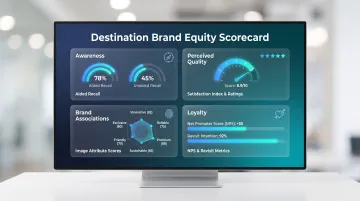
Measurement should cover all four pillars: awareness (aided and unaided recall), perceived quality (satisfaction scores), brand associations (image attributes), and loyalty (revisit intention, Net Promoter Score).
The Stakeholder Challenge: Why Destination Branding Is Harder Than It Looks
The Multi-Stakeholder Reality
A destination's brand equity is co-delivered by tourism boards, airlines, hotels, attractions, restaurants, transport providers, retail businesses, and even residents. No product brand faces this level of stakeholder complexity.
Research by Sartori (2012) on internal stakeholders in South Tyrol, Italy found:
- 80.1% of stakeholders were satisfied with the regional branding strategy
- 68.5% of dissatisfied stakeholders wanted changes to brand values — feeling the brand didn't reflect actual performance
- Small and micro-enterprises showed the largest knowledge gaps, directly undermining commitment to the brand mission
Successful destination branding requires active internal stakeholder mobilisation. When information gaps emerge, misalignment follows — and that misalignment is exactly what makes the government-private coordination problem so persistent.
The Government-Private Sector Coordination Gap
Many destination brands underperform not because their strategy is wrong, but because implementation breaks down when private operators pursue competing or inconsistent brand narratives. This challenge requires governance structures, not just marketing guidelines. Tourism boards need mechanisms to align hundreds of independent operators behind a shared positioning—through incentives, co-marketing programmes, training, and certification.
The Resident Community Dimension
Sustainable destination brand equity requires authentic buy-in from local communities. Over-tourism and commodification erode the very cultural authenticity that many destinations' brand equity is built on.
Barcelona illustrates how quickly this can unravel. The city has 1.7 million residents but hosted 15.5 million overnight tourists in 2024. Long-term rental prices rose 68% over the past decade. Major anti-tourism protests erupted in July 2024 with thousands chanting "tourists go home." The Barcelona Tourism Consortium formally raised concern over the city's "overtourism image" — linking reputational damage directly to the brand.

Resident engagement is a strategic brand equity issue, not just a social one. If residents reject the destination positioning, the authenticity that drives brand equity disappears.
How Strong Destination Brand Equity Drives Tourism ROI
The Loyalty-Revenue Link
Research on brand equity in service industries consistently shows that brand equity negatively impacts switching behaviour—visitors with strong destination loyalty are significantly less likely to choose a competing destination for their next trip.
While repeat visitors may spend slightly less per trip than first-timers (as discussed in Pillar 4), they deliver superior lifetime value through:
- Lower acquisition costs (no need for expensive awareness campaigns)
- Higher conversion rates (already predisposed to return)
- Advocacy value (organic word-of-mouth that attracts new visitors)
The Word-of-Mouth Multiplier
Destinations with high brand equity generate organic advocacy, which acts as a high-credibility, low-cost marketing channel. As noted earlier, 92% of consumers trust word-of-mouth and UGC more than traditional brand advertising.
The result is self-reinforcing. Strong brand equity drives visitor satisfaction; satisfied visitors advocate; advocacy builds awareness among new segments — all at minimal marginal cost.
Premium Pricing and Resilience
Strong brand equity enables premium pricing across the board:
- Higher room rates as visitors perceive greater destination value
- Higher spend per visit driven by stronger intent and engagement
- Longer average stays among loyal, emotionally connected travellers
It also provides resilience when conditions deteriorate. Egypt saw a 33% arrival decline following political instability; Sri Lanka lost 70% of arrivals after the Easter bombings. Both cases reflect what happens when brand equity cannot absorb a crisis shock. Destinations with deep loyalty and emotional resonance return to pre-crisis volumes significantly faster — because the underlying preference never fully eroded.
Building Your Destination Brand with a Strategic Foundation
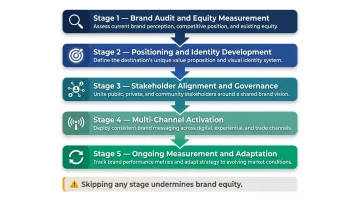
Destination brand equity is built through insight-led strategy, not campaign-by-campaign activity. The starting point must be a rigorous audit of current brand perceptions, competitive positioning, and stakeholder alignment before any visual or messaging work begins.
The Core Strategic Sequence
1. Brand Audit and Equity Measurement
- Assess current awareness, perceived quality, associations, and loyalty
- Benchmark against competing destinations
- Identify gaps between current perceptions and desired positioning
2. Positioning and Identity Development
- Define unique value proposition and target segments
- Develop distinctive brand associations and messaging
- Create visual identity that expresses positioning
3. Stakeholder Alignment and Brand Governance
- Engage government, private sector, and resident communities
- Establish governance structures for brand consistency
- Develop implementation guidelines and training
4. Multi-Channel Activation
- Roll out brand across digital, physical, and experiential touchpoints
- Launch campaigns that reinforce positioning
- Activate stakeholders as brand ambassadors
5. Ongoing Measurement and Adaptation
- Track brand equity metrics continuously
- Detect erosion early and intervene
- Adapt strategy based on market feedback
Skipping any stage—particularly the research and stakeholder alignment phases—leads to superficial rebrands that fail to build genuine equity.
Work with a Destination Branding Partner
Executing this sequence well requires more than a framework. It requires a partner who understands destination complexity across government stakeholders, tourism boards, and visitor experience teams.
Vantage Branding is a Singapore-based branding agency with experience across destination, government, and tourism sector clients in Singapore and Asia. Past work includes identity development for Sentosa's "Wings of Time" light and sound show—translating a unique visitor experience into a cohesive brand that communicates clearly across channels and audiences.
The agency's destination branding work spans:
- Brand discovery and stakeholder workshops
- Positioning strategy and identity design
- Multi-channel activation across digital and physical touchpoints
Contact Vantage Branding:
- Phone: +65 6698 9257
- Email: hello@vantagebranding.com.sg
Frequently Asked Questions
What is destination brand equity and why does it matter for tourism boards?
Destination brand equity is the added value a destination's name and identity creates in travellers' minds—the differential effect on perceptions, preferences, and decision-making. It directly influences visitor consideration, loyalty, and spending, which is why it shapes everything from budget priorities to long-term competitiveness.
How is branding a tourism destination different from branding a product or company?
Destinations are co-created by governments, businesses, residents, and visitors—no single authority controls the full experience. Brand equity is built through consistent delivery across thousands of touchpoints, not just marketing, and depends on genuine stakeholder alignment.
What are the four key dimensions of destination brand equity?
The four pillars are: (1) destination awareness—recall and recognition when travellers plan trips, (2) perceived quality—judgments about experience standards and value, (3) brand associations—emotional and cultural imagery connected to the destination, and (4) visitor loyalty—repeat visitation and active recommendation to others.
How do you measure destination brand equity effectively?
Effective measurement covers all four equity pillars and typically combines:
- Visitor surveys tracking awareness and brand associations
- Net Promoter Score monitoring for loyalty
- Repeat visitation data analysis
- Social listening and sentiment analysis
- Benchmarking against competing destinations over time
What are the most common mistakes destinations make with their branding?
The most common pitfalls include:
- Rebranding visually before completing strategic repositioning
- Failing to align private-sector stakeholders and residents with the brand
- Neglecting authentic community engagement
- Not measuring brand equity systematically, allowing erosion to go undetected
How long does it take to build strong destination brand equity?
Meaningful brand equity develops over 3–7 years of consistent strategic execution. Awareness and perception gains can appear within 12–18 months of a well-implemented campaign, but loyalty takes the longest to shift. Destination branding researcher Steven Pike found no measurable equity change over four years in one studied destination—confirming that multi-year horizons are the norm, not the exception.