Introduction
Many businesses expanding across the Causeway face a common challenge: a brand that resonates powerfully in Singapore can feel distant, overly premium, or culturally tone-deaf in Malaysia — and vice versa. Despite their proximity and shared history, Singapore and Malaysia require fundamentally different branding strategies.
Singapore's median household income reached S$12,446 per month in 2025, supporting a market where consumers expect polished, globally benchmarked brand experiences. Malaysia's median household income sits at RM7,017 monthly, with a significant urban-rural divide (RM8,139 vs RM4,588).
That 4.2x income gap creates vastly different consumer expectations around brand positioning, pricing cues, and value communication.
Economics are only part of the story. Three structural differences shape how brands must show up in each market:
- Language: Singapore ranks #3 globally for English proficiency, enabling English-first branding; Malaysia's multicultural makeup (Bumiputera 68.8%, Chinese 23.2%, Indian 7.0%) demands strategies across Bahasa Malaysia, English, and Mandarin
- Demographics: A unified city-state versus a geographically diverse nation with distinct urban and rural consumer segments
- Platforms: LinkedIn reaches 82% of Singapore's population, while Facebook dominates Malaysia with 23.1 million users
TL;DR
- Singapore branding prioritises premium positioning, English-first communication, and globally benchmarked visual systems
- Malaysian branding requires multilingual content, cultural sensitivity across three major communities, and value-driven messaging
- The two markets diverge across language strategy, visual identity, digital channels, and cultural calendar integration
- Expanding across both markets typically calls for brand adaptation, not a full rebuild
Singapore vs Malaysia Branding: Quick Comparison
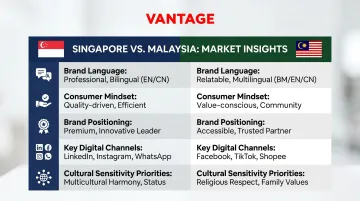
| Dimension | Singapore | Malaysia |
|---|---|---|
| Primary Brand Language | English (82% penetration; #3 globally) | Multilingual (Bahasa Malaysia, English, Mandarin, Tamil) |
| Consumer Mindset | Premium-oriented; benchmarks against global standards | Value-driven; price-to-quality balance across income tiers |
| Brand Positioning | Credibility and consistency against global benchmarks | Cultural fluency, community trust, and price accessibility |
| Key Digital Channels | LinkedIn (82%), Instagram (53.8%), TikTok (72.4% adults) | Facebook (64.4%), TikTok (72.8% adults), WhatsApp (#1) |
| Cultural Sensitivity Priorities | Consistency across touchpoints; international credibility | Halal compliance, festive calendar rotation, race-aware imagery |
Branding in Singapore: The Premium, Global-First Market
Singapore operates as one of Asia's most affluent consumer markets, with GDP per capita reaching $90,674 in 2024. The population is highly educated — 64.4% hold post-secondary qualifications — creating an audience that evaluates brands against international benchmarks.
Brand expectations are unforgiving here. Singaporean consumers form first impressions quickly and judge inconsistency harshly. A 2026 Edelman Trust Barometer study revealed a 28-point trust advantage for domestic companies over foreign-headquartered ones — the highest gap in Asia-Pacific.
Even established international brands must invest heavily in local credibility signals: awards, heritage narratives, and consistent execution across every customer interaction.
Visual Identity Expectations
Those credibility signals begin with how a brand looks. Singapore's design culture reflects what the DesignSingapore Council describes as "creative while pragmatic, multicultural while modern, Asian and future-thinking." The market rewards minimalism, clean typography, and restrained colour palettes. Brands that appear inconsistent or visually "budget" lose credibility fast in B2B, healthcare, finance, and professional services.
Visual identity serves a functional role, not just an aesthetic one. In a 2025 study on design value, 77% of respondents reported using Media Design — visual identities and brand aesthetics — as core business tools. Brand guidelines aren't optional; they're infrastructure.
Digital Brand Landscape
Singapore's digital ecosystem is unique globally. LinkedIn penetration reaches 82% of the population — 4.80 million members, up 14.3% year-on-year. No other market approaches this level of professional platform saturation, making LinkedIn the primary channel for B2B credibility-building.
The remaining platforms each serve distinct audiences:
- Instagram — 53.8% reach (3.15M users), 54.1% female skew; primary channel for lifestyle and consumer brands
- TikTok — 72.4% adult reach (3.63M users aged 18+); growing for awareness and entertainment-led content
- WhatsApp — ranked #1 favourite platform by users at 30.4%; critical for direct customer communications
Brand voice across these platforms leans authoritative, confident, and concise. Thought leadership content performs well — Singaporeans prioritise reliability and reputation over impulse appeal.
When Singapore Branding Matters Most
Full brand systems deliver the highest ROI for:
- B2B tech and professional services — where LinkedIn presence and brand consistency directly influence enterprise sales cycles
- Financial services and investment firms — where visual polish signals operational credibility
- Healthcare providers — where brand trust correlates directly with patient acquisition and retention
- Premium F&B and lifestyle brands — where aspirational positioning justifies higher price points
Branding in Malaysia: The Value-Driven, Multicultural Market
Malaysia's brand environment demands more than visual polish — it demands cultural precision. With three major ethnic communities (Bumiputera 68.8%, Chinese 23.2%, Indian 7.0%) and a 1.77x urban-rural income gap, brands must feel accessible and community-aware across genuinely different audience segments.
Value-Driven Consumer Mindset
Malaysian consumers prioritise value for money, but that doesn't mean they trade down on quality. The national median household income of RM7,017 hides sharp regional variation: KL households earn RM10,805 monthly, while rural areas average RM4,588. Brands must signal value across multiple tiers without appearing cheap.
Even in urban KL and Selangor, where premium brands find their strongest footing, affordability cues still matter. Brand communication needs to weave in:
- Pricing transparency that builds rather than undermines trust
- Relatable messaging that connects across income levels
- Practical benefit framing alongside aspirational positioning
Multilingual Content Reality
Malaysia's linguistic complexity shapes every brand decision. While Malaysia ranks #26 globally for English proficiency (score: 566, "High Proficiency"), brands cannot rely on English alone. Bahasa Malaysia serves as the national language, Mandarin reaches the 23.2% Chinese community, and Tamil serves the 7% Indian population.
This creates practical challenges:
- Logo lockups must accommodate three languages without compromising visual hierarchy
- Typography systems must support Latin, Simplified Chinese, and Tamil scripts
- Campaign layouts require flexible structures that work across language lengths
- Brand guidelines must specify language usage rules, not just colour and fonts
Most successful Malaysian brands publish core content in at least Bahasa Malaysia and English, with Mandarin added for consumer-facing campaigns.
Cultural Sensitivity Requirements
JAKIM Halal certification is more than regulatory compliance: it is brand equity. A 2024 survey of 19,697 consumers found that 69% prioritised Halal certification for food purchases, 64% for beverages, and 55% for personal care products. For the Muslim-majority population (63.5%), Halal compliance is a foundational trust signal.
Beyond Halal, brands must navigate Malaysia's festive calendar with care. Major campaigns rotate through Hari Raya (April-May), Chinese New Year (January-February), and Deepavali (October-November). Each festival carries specific colour codes that brands must get right.
Colour carries specific cultural meaning in Malaysia:
- Green signals Islam and dominates Hari Raya branding
- Red and gold represent fortune and prosperity during Chinese New Year (never use black or white prominently during CNY)
- Yellow/orange mark Deepavali celebrations (bright yellow is also reserved for Malaysian royalty)
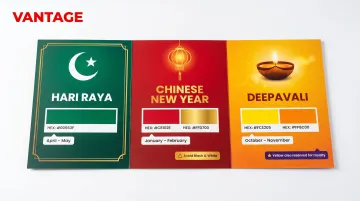
Successful brands pivot visual identity through these seasonal touchpoints rather than maintaining year-round consistency.
Digital Channels That Matter
Facebook dominates Malaysian digital life with 23.1M users (64.4% penetration), making it the primary brand awareness channel. TikTok reaches 72.8% of adults (19.3M users aged 18+), driving high engagement for short-form video content in local languages. LinkedIn penetration sits at just 25.4% (9.10M members) — far below Singapore's 82% — meaning professional brand-building requires different tactics.
WhatsApp ranks as Malaysia's #1 social platform, functioning as both personal communication tool and business CRM channel. Many Malaysian brands use WhatsApp Business for customer service, order management, and community relationship-building.
Brand tone across these platforms favours warmth, conversation, and relatability over the authoritative precision preferred in Singapore.
When Malaysian Branding Delivers ROI
These channel and cultural dynamics translate into measurable returns for the right business types. Full brand investment pays off most clearly in:
- F&B and retail, where emotional connection and cultural resonance directly drive purchase decisions
- SME consumer goods, where community trust and word-of-mouth outweigh global credibility signals
- Lifestyle and wellness, where the festive calendar creates predictable, built-in engagement peaks
- Regional franchise expansion, where localisation determines whether a brand lands beyond Kuala Lumpur
Key Dimensions Where Branding Differs
Brand Tone and Messaging
Singapore brand voices prioritise credibility, precision, and authority. Copy tends toward the declarative: "We deliver X," "Our platform enables Y." This mirrors a consumer culture that values directness and benchmarks brands against international standards.
Malaysian brand voices favour warmth, community, and relatability. The same message needs recalibration: "Together, we'll achieve X," "Join our community of Y." The shift isn't cosmetic — it's a move from transactional positioning to relational brand identity.
Visual Identity and Colour
Singapore's design culture draws from global minimalism with occasional Asian influences. Colour choices follow international design trends more than cultural symbolism. Brands can maintain consistent visual systems year-round without cultural friction.
Malaysia requires deliberate colour strategy. Green carries Islamic associations beyond branding — it's a cultural identifier. During Chinese New Year, red-and-gold dominate every retail environment, making off-palette campaigns invisible. Brands must either rotate colour schemes seasonally or choose palettes that work across cultural contexts.
Language Strategy Complexity
Singapore operates effectively in English. Brands occasionally deploy Singlish inflections for local relatability ("Can lah," "Shiok"), but core communications default to standard English. A single copywriter can manage the entire brand voice.
Malaysia demands structured multilingual production:
- Core messaging in Bahasa Malaysia (national reach) and English (urban/professional)
- Mandarin versions for Chinese community engagement
- Festival-specific content in relevant languages
- Typography that accommodates multiple scripts without visual hierarchy collapse
- Brand guidelines specifying which languages appear where, in what order
In practice, a campaign requiring one asset in Singapore needs three to five versions in Malaysia — each with its own copy, typography, and cultural timing.
Price-to-Value Signalling
Singapore's GDP per capita ($90,674) is approximately 7.6 times Malaysia's ($11,874). This gap fundamentally shapes what "premium" means in each market.
In Singapore, premium aesthetics justify higher price points. Clean design, sophisticated typography, and minimalist execution signal quality — and consumers read "expensive-looking" as "trustworthy."
In Malaysia, overly premium branding without value cues creates barrier perception. Brands must balance aspiration with accessibility — signal quality without appearing exclusive. This means more explicit value communication: benefit statements, testimonials, clear pricing context.
Digital Platform-Brand Fit
LinkedIn and Instagram dominate Singapore's brand ecosystem. Both reward high-production, consistent visual systems. A well-executed brand guidelines document translates directly into platform success. Content that looks professional, maintains visual consistency, and demonstrates authority performs well.
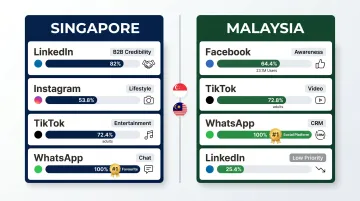
Facebook and TikTok drive Malaysian brand awareness. Both prioritise personality, entertainment, and culturally timed content over visual consistency. A campaign that violates brand guidelines but nails festive timing will outperform a perfectly on-brand but culturally tone-deaf post.
One Brand or Two? How to Approach Cross-Market Branding
Most businesses expanding between Singapore and Malaysia face a brand architecture decision: unified brand with market adaptations, or separate identities?
The practical answer for most brands: unified architecture with deliberate market-specific adaptations.
This approach maintains core brand equity — logo, primary colour palette, foundational positioning — while flexing tone, language, channel strategy, and cultural cues per market.
When Adaptation Is Enough
Brand adaptation works when:
- Core positioning translates across both markets (B2B services, tech platforms, professional brands)
- The business serves similar audience segments in both countries (urban professionals, enterprise clients)
- Product/service pricing sits in comparable tiers relative to each market's income distribution
- Cultural sensitivity requirements can be addressed through content and campaign execution, not identity redesign
Adaptation typically involves:
- Tone recalibration (authoritative to relational)
- Language expansion (English-only to multilingual)
- Channel strategy shifts (LinkedIn to Facebook/WhatsApp)
- Seasonal campaign integration (festive calendar rotation)
- Value messaging addition (clearer benefit articulation)
When Deeper Rethinking Is Needed
A more fundamental brand architecture review becomes necessary when:
- Positioning is fundamentally mismatched (hyper-premium Singapore brand entering tier-2 Malaysian cities)
- Cultural requirements conflict with core brand identity (Halal compliance requiring ingredient/process changes that affect brand story)
- Price-to-value perception creates insurmountable barrier (Singapore pricing appearing exploitative in Malaysian context)
- Target audience shifts entirely (B2B in Singapore to B2C in Malaysia)
Getting this decision right requires more than a checklist — it requires on-the-ground familiarity with how audiences in each market actually respond to brand signals. Vantage Branding has navigated these decisions for clients expanding across Singapore and Malaysia, including ThoughtFull, a mental wellness platform now operating across four markets in Asia. That kind of cross-market experience reduces the risk of cultural misreads and keeps brand coherence intact through localisation.
Conclusion
Neither market is "better" for branding — they demand different strategies. Singapore rewards consistency, polish, and globally benchmarked positioning. Success requires flawless execution across every touchpoint, authoritative brand voice, and premium visual systems that signal credibility.
Malaysia rewards cultural fluency, multilingual accessibility, and relational warmth. Success requires seasonal brand pivoting, value-forward communication, and platform strategies built around community engagement rather than corporate authority.
Before expanding across the Causeway, audit your brand against the target market:
- Tone: Does your brand voice feel too corporate for Malaysia, or too casual for Singapore?
- Visual system: Can your identity accommodate three languages, or rotate through festive colour palettes?
- Language strategy: Do you have infrastructure for multilingual content production and brand guidelines?
- Channel fit: Are you investing in LinkedIn for Malaysia or Facebook for Singapore — both likely wrong?
- Value communication: Does your brand signal trustworthy premium in Singapore, or inaccessible elitism in Malaysia?
Most brands need adaptation, not reinvention. That adaptation goes deeper than translation: it means understanding what earns trust in one culture may signal detachment in the other. If you're navigating that gap, Vantage Branding works with businesses entering or expanding across both markets — and the differences are always more nuanced than they first appear.
Frequently Asked Questions
What brand is famous in Singapore?
Well-known Singapore-origin brands include Singapore Airlines (ranked #2 globally in 2025 Skytrax awards), BreadTalk (bakery chain operating across 16 countries), Charles & Keith (affordable luxury fashion), and Tiger Beer. Each has built a consistent visual identity and clear value proposition that travels across markets.
How do cultural differences between Singapore and Malaysia affect brand messaging?
Singapore's relatively homogeneous English-speaking business culture permits a single, authoritative brand voice. Malaysia's tri-community composition requires culturally sensitive messaging that acknowledges Malay, Chinese, and Indian values, plus seasonal touchpoints like Hari Raya, Chinese New Year, and Deepavali — effectively requiring three parallel brand narratives within one system.
Should I create separate brand identities for Singapore and Malaysia?
Most businesses don't need fully separate identities. A unified brand with adapted tone, language, channel strategy, and cultural sensitivity typically suffices. Deeper repositioning becomes necessary only when core positioning fundamentally mismatches the new market's income tier or cultural expectations — such as ultra-premium Singapore brands entering budget-conscious Malaysian markets.
What are the key language considerations when branding in Malaysia?
Malaysian brands typically need Bahasa Malaysia, English, and Mandarin across communications. This drives complexity in typography systems (Latin, Chinese, and Tamil scripts), logo placement hierarchies, and campaign layouts — all of which must hold visual coherence across very different text lengths.
How does consumer purchasing power affect brand positioning differently in Singapore vs Malaysia?
Singapore's median household income of S$12,446 monthly supports premium positioning, where sophisticated aesthetics justify higher prices. Malaysia's RM7,017 median — with a 1.77x urban-rural gap — means brands must signal value clearly, balancing aspiration with accessibility through direct benefit communication and cultural relatability.
Can a Singapore brand enter Malaysia without adapting its branding?
Some premium Singapore brands transfer unchanged into urban Malaysian markets (Kuala Lumpur, Penang, Johor Bahru), particularly in B2B and professional services. However, most need tone adjustment, multilingual content, cultural sensitivity integration, and value-forward messaging to avoid appearing distant or inaccessible to broader Malaysian audiences beyond the top income tier.