Introduction
Vietnam's cities — particularly Ho Chi Minh City and Hanoi — present a visual landscape unlike anywhere else in Southeast Asia. Walk through District 1 and you'll encounter French colonial facades standing beside tropical vernacular shophouses and bold concrete modernist towers. That architectural collision shapes how consumers read brands, how investors assess credibility, and what "quality" looks like in this market.
What follows examines Vietnam's modernist architectural movement and what it means for brand strategy — whether you're building a presence here, investing, or expanding from abroad.
TLDR:
- Vietnam's modernist architecture blends international design with biophilic elements into a distinctive, globally recognized visual language
- Physical spaces function as brand trust signals — consumers read architectural quality as proof of values and commitment
- Generic global identities often create an aesthetic credibility gap when they clash with local design sensibilities
- Ho Chi Minh City's 2025 mega-region merger creates urgent place branding needs that mirror corporate brand architecture problems
- Market entry success depends on adapting brand identity to Vietnam's climate-responsive, culturally grounded design philosophy
Vietnam's Modernist Architecture: From Colonial Influence to Contemporary Expression
Vietnam's architectural identity shifted dramatically following the political changes of the 20th century. After independence, the country moved deliberately away from colonial-era French buildings toward modernism as a form of cultural self-expression and differentiation.
The modernist movement took root during the 1950s–1970s, when Vietnamese architects adopted international structural languages — concrete, glass, and steel — building on industrial infrastructure inherited from French colonial administration.
Ngo Viet Thu, the first Asian to win the Grand Prix de Rome in 1955, designed the Independence Palace in Saigon (completed 1966). The project set a precedent for large-scale public architecture that created modern urban identity rooted in traditional values.
Development concentrated from 1949 to 1975, then paused until Vietnam reopened economically following the Doi Moi reforms in 1986. The result was a compressed, clearly defined architectural period followed by decades of stasis — and then a sharp return to growth.
That renewed growth has been fueled by significant foreign capital. In 2024 alone:
- Foreign investment in real estate reached $3.72 billion — 18.8% of total FDI inflows
- Ho Chi Minh City, where rapid urbanization created demand for new visual vocabulary, grew at 2.65% annually
- Newly registered FDI hit $10.23 billion across 904 projects
Regional architectural variation adds commercial complexity. Vietnam's built environment spans:
- Highland stilt houses ("nha san") — wooden structures elevated on stilts in mountainous areas by the Tay, H'mong, and Thai peoples
- Three-Gian Houses ("nha ba gian") — symmetrical structures common in northern rural lowlands
- Urban tube houses ("nha ong") — narrow-fronted, extremely deep structures on tight urban plots that define city centers
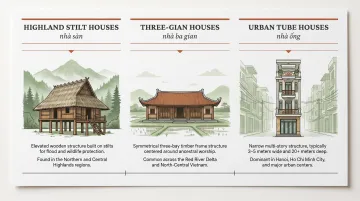
This diversity makes Vietnam's architectural landscape deeply layered — and commercially significant for brands entering or communicating in this market.
The Design Language of Vietnamese Modernism: What Makes It Distinct
Biophilic Design as Cultural Signature
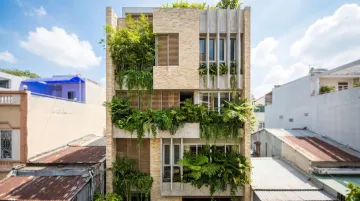
Biophilic design — the deliberate integration of natural light, vegetation, water, and ventilation into contemporary structures — defines leading Vietnamese architecture. Vo Trong Nghia Architects (VTN) exemplifies this approach. Founded in 2006, VTN has received approximately 150 international awards, including Dezeen Architect of the Year (2019) and the Prince Claus Award from the Netherlands (2016).
VTN's philosophy centers on reconnecting city dwellers with nature, using bamboo as a sustainable alternative to timber, and reducing air conditioning reliance through green facades. House for Trees (built for $155,000) and Farming Kindergarten show how these principles scale from compact urban homes to public education buildings.
Tropical Space, founded by Tran Thi Ngu Ngon, winner of the 2025 Diversity in Architecture Award, applies similar thinking to residential and industrial projects. The firm has 14 published projects on ArchDaily and three Architizer A+ Awards — built on a consistent focus on climate-responsive design for Vietnam's tropical conditions.
Climate-Responsive vs. International Aesthetics
Vietnamese modernism navigates a productive tension: tropical climate demands on one side, international aesthetics on the other. The resolution isn't compromise — buildings are designed to breathe, shade, and respond to their environment rather than override it.
The Bloom Architects exemplifies this approach. Their Tile House in Bao Loc features an inverted trapezoid roof designed as a "funnel" to trap wind and distribute it throughout the house. Slots between red-clay wall tiles facilitate natural ventilation, while the roof collects rainwater into an underground tank for automatic irrigation.
Material Palette: Hybrid Authenticity
Vietnamese modernist design combines:
- Exposed concrete
- Bamboo
- Local brick and terracotta
- Glass and steel
This material mix is neither nostalgic nor generic. It reads as distinctly Vietnamese to a local audience and distinctly considered to an international one — a rare combination that gives the work genuine cross-market legibility.
Minimalist-Yet-Human Quality
KIENTRUC O, led by Dam Vu, uses the traditional Vietnamese "Tam" module based on human body proportions. The firm's name — "O" representing a "perfectly incomplete circle" — symbolizes a search for the essential and universal. Their approach draws on archetypes from communal houses ("Dinh") and Hue royal architecture.
MAS Architecture in Hanoi focuses on "regional architecture" responding to local socio-economic changes. Up House in Soc Son integrates crop-drying space into modern residential structure, addressing shrinking agricultural land in suburban Hanoi.
Global Recognition
At least 10 Vietnamese firms have won Architizer A+ Awards, with H&P Architects holding six and MIA Design Studio holding four. That concentration of wins — across firms of different sizes and focus areas — confirms Vietnamese architectural language has become a recognisable and valued aesthetic on the global stage.
Architecture as Brand Signal: How Vietnam's Built Environment Speaks
In Vietnam, the physical space a brand occupies functions as a powerful trust signal. Consumers and investors read built environments as proxies for brand values: quality, credibility, ambition, and cultural awareness.
Physical Retail as Strategic Investment
Despite e-commerce growth, physical retail remains essential in Vietnam. International brands "prioritize physical presence and flagship stores to build brand awareness upon entering the market" — they are not abandoning physical stores for online-only strategies.
The numbers reflect this: retail space occupancy hit 93.5% in Ho Chi Minh City and 85% in Hanoi in Q4 2024. Leasing demand from international brands currently outstrips the supply of modern, high-quality retail space. In an undersupplied market, brands that invest in architecturally distinctive spaces stand out simply by existing — the bar for differentiation is that low.
The Quality Gap as Brand Opportunity
Vietnam lags behind regional competitors like Thailand, Singapore, and Malaysia in retail scale, quality, and customer experience. A shortage of well-planned retail space keeps the market firmly in landlords' favor.
For brands, this gap is a strategic opening. Physical stores serve as trust-building anchors — particularly important for international brands entering a new market. The commercial and hospitality brands succeeding in Vietnam have increasingly invested in architecturally distinctive spaces, not just for functional reasons, but because the space itself is a branding asset.
The Aesthetic Credibility Gap
Foreign brands often face what can be called an aesthetic credibility gap when entering Vietnam. Visual identities developed for Western or generic global markets can feel disconnected from local design sensibility — and Vietnamese consumers notice.
McDonald's operated just 17 stores in Vietnam against 36,000+ globally; Burger King managed 13 against 16,000+. Both struggled against Vietnam's deeply embedded local food culture — a clear case of cultural misalignment undermining brand dominance.
Cultural Identity as Design Strategy
Vietnamese architecture firms consciously embed the cultural identity of the region into built work. Inrestudio, led by Kosuke Nishijima, focuses on "architecture specific to local contexts with global perspectives." Their MORICO Cafe project renovated an old brick row house, directly critiquing the trend of glass-walled shops that sever interiors from street life. Instead, they restored the traditional relationship between shop and sidewalk.
Brand strategy faces the same challenge: a visual identity that ignores its physical context will always feel imported, no matter how polished. When the built environment and the brand speak the same design language, the result is coherence that customers sense before they can articulate it.
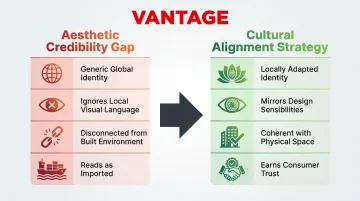
Shared Structural Logic
Architecture and branding share the same underlying discipline: both translate values into form. In Vietnam's market — where physical space is undersupplied, culturally specific, and closely read by consumers — brands that treat their built environment as a strategic asset build trust faster than those that treat it as a lease decision.
Place Branding Through Architecture: Lessons from Ho Chi Minh City's Skyline
Landmark Place Branding: Empire City as Case Study
Major mixed-use developments in Ho Chi Minh City are designed not just as buildings, but as brand identities for urban locations. Empire City in Thu Thiem, designed by Buro Ole Scheeren, exemplifies landmark place branding.
Project specifications:
- Total GFA: 362,900 sqm across three towers
- Empire 88 Tower: 333 meters (88 floors)
- Design concept: "Nature Bursts into the Sky" — featuring the "Sky Forest" (cantilevered platforms with vertical gardens) and "Cloud Space" (public arena at summit)
- Mountain-shaped podium inspired by Vietnam's terraced rice fields
Positioned as a focal point for "Vietnam's New Generation" and the city's "vibrant startup culture," Empire City uses architectural ambition to shift the meaning of place. The Thu Thiem peninsula occupies 647 hectares across the Saigon River from HCMC's historic center, planned to become the city's largest economic, commercial, and financial hub.
The Mega-Region Branding Challenge
From July 1, 2025, Ho Chi Minh City officially merged with Binh Duong and Ba Ria - Vung Tau provinces. The new entity encompasses:
- Approximately 14 million people (from 10 million)
- Approximately 6,772 sqkm area (from 2,095 sqkm)
- GDP contribution rising from 15.5% to approximately 24% of national GDP
- Home to 278,000 enterprises, 220,000 household businesses, and more than 2,000 startups (approximately 50% of the national total)
- Attracted over $4 billion in FDI in the first seven months of 2025 (16.7% of national total)
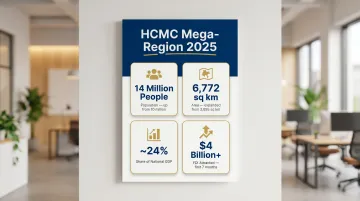
These numbers tell one story. The harder challenge is narrative: a mega-region combining finance, industry, logistics, culture, and coastal economy needs a coherent brand story, not just a new map.
Brand Architecture at City Scale
Dr. Giannina Warren, Associate Professor and Senior Program Manager at RMIT Vietnam, is an international thought leader in place branding who spearheaded the world's first MA in Place Branding. Her work highlights a consistent risk: as cities grow larger, they become harder to explain and harder to remember — unless brand architecture is deliberately applied.
At the city level, that means building a shared overarching story. Individual districts and economic zones can each express a distinct role, but they need to belong to one coherent identity. The parallel to commercial branding is direct: managing sub-brand and master brand relationships in complex markets follows the same logic.
The Cost of Fragmented Communication
Ignoring place branding carries measurable risk:
- Fragmented communication causes investors to perceive operational risk
- Residents feel disconnected
- International audiences lose confidence
The same principle applies to businesses operating in Vietnam. A brand that looks inconsistent across physical and digital touchpoints doesn't read as diverse — it reads as disorganized.
What Businesses Entering Vietnam Can Learn from Its Architectural DNA
Design Principles as Brand Strategy
The principles guiding Vietnam's best modernist architecture — contextual sensitivity, material authenticity, human scale, and environmental responsiveness — apply directly to brand strategy. Brands that enter Vietnam without adapting their identity to local visual and cultural context risk the same outcome as a building that ignores its climate: structural failure over time.
The Brand Landscape Audit
Before entering Vietnam, businesses should conduct a "brand landscape audit" — understanding not just consumer demographics and preferences, but the visual and spatial language that already commands trust and attention in the market.
This includes understanding:
- How competitors present themselves architecturally and visually
- Which design elements signal quality and credibility in your sector
- What material palettes, color schemes, and typographic choices resonate locally
- How culturally resonant brands balance international sophistication with local authenticity
Market Entry Context
The scale of opportunity is significant. Newly registered FDI hit $10.23 billion across 904 projects in 2024, up 6.4% in number and 2.4 times in value year-over-year.
New retail space coming online through 2027:
- Hanoi: 140,700 sqm by end of 2025; a further 174,100 sqm in 2026–2027
- Ho Chi Minh City: 165,429 sqm across 12 projects between 2025–2027
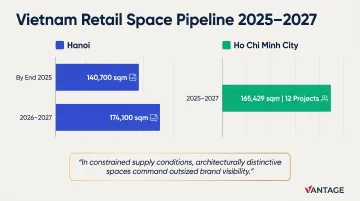
In a constrained supply environment, brands that invest in architecturally distinctive spaces stand out.
Working with Regional Expertise
For companies seeking to build a Vietnam-ready brand identity that is globally coherent but locally resonant, working with a branding partner who understands the cultural and design nuances of the Southeast Asian market is essential.
Vantage Branding is a Singapore-based agency specialising in brand strategy, visual identity, and brand architecture for businesses operating across Vietnam and Asia. With experience spanning government, investment, healthcare, retail, and technology sectors, the agency helps international brands translate their global identity into something that resonates locally — so that every visual and physical touchpoint speaks the language of the market they serve.
Frequently Asked Questions
What is modernist architecture in Vietnam?
Vietnamese modernism emerged in the mid-to-late 20th century as a post-colonial design movement embracing concrete, glass, and international structural forms. It increasingly incorporates biophilic and climate-responsive elements unique to the region, creating a distinctive hybrid aesthetic.
How does architecture influence brand identity in Vietnam?
In Vietnam, physical space and visual design language function as trust signals. Consumers and investors read architectural quality and cultural sensitivity as indicators of a brand's values, credibility, and long-term commitment to the market.
What is biophilic design and why is it important in Vietnamese architecture?
Biophilic design integrates natural elements — light, greenery, water, and ventilation — into built spaces. Vietnam's leading architecture firms have adopted it as a defining characteristic, reflecting both climatic necessity and a cultural philosophy of harmony with nature.
What is place branding and how is it used in Vietnamese cities?
Place branding is the strategic practice of shaping how a location — a district, city, or development — is perceived by residents, investors, and visitors. Ho Chi Minh City's major urban projects like Empire City show how architects and planners use built form and narrative together to reshape the meaning of place.
What should foreign brands know about Vietnam's visual design landscape before entering the market?
Vietnam's design sensibility values contextual authenticity, material honesty, and cultural specificity. Foreign brands that import generic global identities without adaptation appear disconnected; those that tailor their aesthetic to local expectations earn trust and relevance faster.
How does brand architecture apply to cities and businesses in Vietnam?
Brand architecture is the structural logic governing how a brand's sub-identities relate to the master brand. The principle applies equally to cities coordinating diverse districts and to businesses running multiple product lines or market presences across Vietnam.