Introduction
When two companies merge, the deal brings together two brands, two cultures, and two sets of customer expectations—all converging at once. The financial complexity is just one layer. How employees, customers, and investors perceive and respond to the change often determines whether the deal succeeds or fails.
The stakes are sobering. According to KPMG's analysis of over 3,000 M&A deals, 57.2% of acquirers ultimately destroyed shareholder value, with Total Shareholder Return dropping an average of 7.4% in the two years following a deal. Harvard Business Review cites studies indicating that 70% of mergers and acquisitions wind up as failures.
Most M&A failures are not purely financial. Misaligned brand identity, confused customers, and disengaged employees are the real culprits. This article offers a practical framework for navigating M&A brand decisions: from audit to architecture to launch, so the brand drives value rather than undermines it.
TLDR:
- 57% of M&A deals destroy shareholder value, often due to brand misalignment and customer confusion
- Brand strategy should begin before the deal closes to prevent uncertainty and attrition
- Brand integration approach should match the degree of customer and product overlap
- Brand audits, stakeholder input, and visual consistency are non-negotiable steps
- Naming and brand architecture decisions signal strategic intent before any content launches
Why Branding Determines M&A Success
Behind every successful merger is a story that employees, customers, and investors can believe in—not just a balance sheet they can read. Without that narrative, even the most financially sound acquisition can unravel through customer attrition and talent loss. Brand strategy is what turns a financial transaction into a shared direction.
The data backs this up:
- Prophet research found that brands prioritising customer demand and brand strategy outperformed the S&P 500 by 12% over the last decade on profitable growth
- McKinsey found that organisations prioritising employee experience during M&A have a 65% chance of achieving superior total returns to shareholders
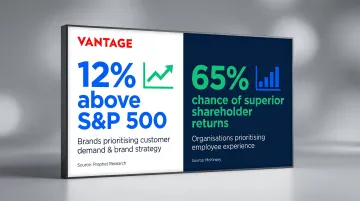
Both findings point to the same conclusion: brand and people decisions made early in the deal process directly affect financial outcomes. Internal alignment must happen before any external launch.
The Two Most Common Branding Mistakes in M&A
1. Treating branding as cosmetic
A new logo without a new strategy creates confusion, not clarity. Bain & Company documented how First Union Bank lost 20% of its customer base within the first year after acquiring CoreStates Financial—prioritising cost-cutting over customer experience led to mass defection. In another case, a major US bank's Net Promoter Score plummeted from 11.5 to zero as customers felt overlooked during integration.
2. Delaying brand decisions until after the deal closes
When brand decisions are postponed, internal uncertainty spreads. Employees don't know how to position themselves externally, customers receive inconsistent messages, and the vacuum of clarity erodes confidence. The moment a deal is announced, stakeholders begin forming perceptions—delaying brand strategy means ceding control of that narrative.
Both mistakes are avoidable. When Westpac acquired St. George Bank, they set a measurable goal from day one: zero customer loss. Relationship managers made personal visits to wealth management clients, while marketing campaigns reassured retail customers they'd gain access to a larger ATM network. The customer base held steady—and churn rates actually dropped.
Four M&A Brand Integration Scenarios: Which One Fits Your Deal?
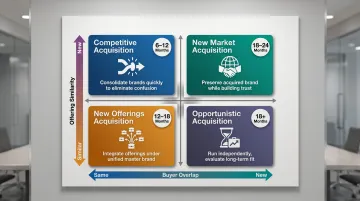
The right branding approach depends on two key questions: Are the buyers the same or different? Are the offerings similar or new? Where your deal sits on this matrix determines the timeline, messaging strategy, and brand architecture model.
Competitive Acquisition: High Overlap in Buyers and Offerings
Both companies serve the same customers with similar products. Speed matters here:
- Rapid brand consolidation (6–12 months) is typically appropriate
- Reassurance messaging for customers and employees becomes the priority
- Prevent customer attrition by clearly communicating continuity of service
- Absorb the acquired brand under the acquirer's master brand quickly to reduce market confusion
New Market Acquisition: Same Offering, New Buyers
The acquirer enters a new geographic or demographic market with its existing offering. Trust — not speed — determines success here.
This scenario is particularly common in cross-border M&A. Reuters reported that cross-border deals involving Asia-Pacific companies rose 25% year-on-year to $286 billion as of September 2024. In these deals, local brand equity is rarely worth discarding quickly.
Edelman Trust Barometer data shows domestic companies enjoy a trust premium across Asia-Pacific: +29 points in Japan, +28 in Singapore, +28 in South Korea, and +18 in Malaysia.
Recommended approach:
- Plan for an 18–24 month transition with a relationship-first approach
- Build the acquiring brand's awareness and credibility before consolidating
- Retain the acquired brand's local equity while gradually introducing the acquirer's credentials
- Weigh carefully whether to preserve trusted local brand names before retiring them
New Offerings Acquisition: Same Buyers, Expanded Portfolio
The acquisition adds new capabilities for an existing customer base. The goal is to show customers what they gain — not just what changed.
- Use a "one plus one equals three" messaging strategy
- Let the acquiring brand act as an endorser rather than immediately absorbing the acquired brand
- Plan a 12–18 month horizon to allow customers to understand the expanded value proposition
- Communicate how the combination creates benefits previously unavailable from either brand alone
Opportunistic Acquisition: New Buyers and New Offerings
Strategic alignment is longer-term, and customers on both sides need time to see where this is going. Patience here is a strategy, not a delay.
- Retain the acquired brand independently for 18+ months
- Communicate intent — whether preservation or eventual integration — transparently from the start
- Avoid rumour by stating clearly how the brands will relate over time
- Focus on portfolio management rather than immediate consolidation
A Step-by-Step M&A Brand Strategy Framework
Step 1 — Conduct a Dual Brand Audit
Before any strategic decisions, assess both brands systematically. A brand audit evaluates:
- Messaging consistency and clarity
- Visual identity assets and brand equity
- Customer perception and market positioning
- Cultural attributes and organisational values
- Competitive differentiation and white space opportunities
The audit must happen before any naming or design work begins. A specialist brand consultancy brings structured methodology to this stage, surfacing evidence-based insight rather than internal assumptions — and providing a factual foundation for every strategic decision that follows.
Step 2 — Engage Stakeholders Early and Across Both Entities
Involving leadership, employees, and key customers from both sides of the deal is critical. Top-down brand decisions made without cross-stakeholder input create significant risks, particularly for employee retention post-acquisition.
Willis Towers Watson research found that only 19% of acquiring companies select more than 20% of salaried employees for retention agreements, yet 72% set aside fixed retention payments. McKinsey data shows that "praise and commendation from an immediate manager" ranks as the most effective retention lever — above performance bonuses or base pay increases.
In practice, this means:
- Including voices from both sides in naming and narrative decisions
- Avoiding management teams drawn entirely from the acquiring entity
- Using brand workshops as early signals of cultural equity
- Communicating that both organisations' identities are valued, not absorbed
Step 3 — Build a Brand Purpose, Not Just a Brand Story
Distinguish between a narrative (what happened) and a purpose (why it matters to the audience). The combined brand must articulate a new value proposition that answers "what does this mean for me?" from the customer and employee perspective, not just financial rationale.
A brand story might be: "Company A acquired Company B to expand our geographic footprint." A brand purpose might be: "Together, we now deliver faster response times and localised expertise across three new markets, ensuring you receive the same quality of service wherever you operate."
Purpose-driven branding focuses on audience benefit, not corporate structure.
Step 4 — Establish a Unified Visual Brand Identity
Develop a new visual system that presents the combined entity coherently:
- Review existing visual assets from both brands
- Identify common ground and areas of alignment
- Audit the competitive landscape for white space and differentiation opportunities
- Create a consistent visual identity across all touchpoints from day one of announcement
Visual identity must be consistent across digital platforms, physical locations, marketing materials, and employee communications. A fragmented visual presence signals that the integration itself is unfinished — and stakeholders notice.
Step 5 — Plan Implementation Timing
Two primary options:
"Flip the switch" approach:
- Announce deal and new brand simultaneously
- Requires significant preparation before announcement
- Signals decisiveness and control
- Best for competitive acquisitions with high overlap
Phased rollout approach:
- Announce deal with interim brand positioning
- Roll out new brand in stages over 12–24 months
- Allows for stakeholder adjustment and feedback
- Best for new market or opportunistic acquisitions
At minimum, preview the name, narrative, and core visual identity at the time of deal announcement. Arriving without these signals indecision, not deliberation.
Step 6 — Define Governance and a Migration Roadmap
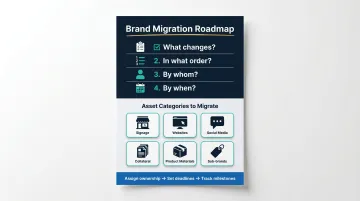
A brand migration plan should answer:
- What needs to change?
- In what order?
- By whom?
- By when?
Assets to include in the roadmap:
- Signage (office, retail, facility)
- Websites and digital properties
- Collateral (brochures, presentations, proposals)
- Social media profiles and content
- Product materials and packaging
- Sub-brands and endorsed brands
Without clear ownership, brand migration stalls — deadlines slip, assets go unupdated, and the integration looks messier than it is. Assign accountability by asset type, set realistic deadlines, and track progress against milestones.
Naming Strategy and Brand Architecture: The Decisions That Signal Everything
Naming is one of the highest-stakes brand decisions in any M&A—and the choice sends a clear signal to every audience before a single piece of content is published. It's a strategic communication act, not just a creative exercise.
The Three Core Naming Options
1. Retain one legacy name
Signals continuity and market confidence, typically used when a dominant acquirer absorbs a smaller firm.
The acquired brand is retired, and the acquirer's brand becomes the master brand. This works well in B2B contexts where relationships are managed by people, or when the acquired brand has low equity or significant overlap with the acquirer.
2. Create an entirely new name
Signals transformation and ambition, used when neither brand alone carries the right associations.
Example: Accenture was created when Andersen Consulting separated from Arthur Andersen. The renaming, rebranding, and repositioning was accomplished in 147 days, launching on January 1, 2001. The name evokes "accent on the future."
Example: Stellantis was formed in 2021 through the merger of PSA Group and Fiat Chrysler Automobiles. Neither legacy corporate name was used. "Stellantis is rooted in the Latin verb 'stello' meaning 'to brighten with stars.'"
3. Combine both names
Signals a merger of equals and preserves dual brand equity.
Example: ExxonMobil was formed on November 30, 1999, when Exxon and Mobil merged, combining both legacy names.
Example: PricewaterhouseCoopers was created in 1998 when Price Waterhouse and Coopers & Lybrand merged, combining both firm names.
Once the naming decision is made, the next question becomes structural: how should the new or combined entity organise all the brands under its roof? That's where brand architecture comes in.
Understanding Brand Architecture in M&A
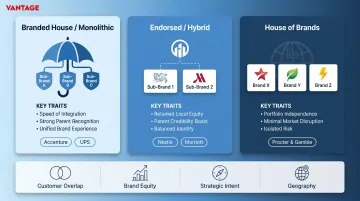
Brand architecture is the strategic system that organises how a parent brand, sub-brands, and acquired entities relate to each other. David Aaker's Brand Relationship Spectrum, published in 2000, defines the foundational framework most practitioners still rely on today.
The three main models each handle acquisitions differently:
Monolithic (Branded House)
- One master brand covers all products and services
- Acquired brand folds under the parent umbrella — transition speed depends on the acquired brand's equity
- Works best when the acquirer has strong market recognition
- Examples: Accenture, UPS
Endorsed (Hybrid)
- Parent brand endorses the acquired brand, which keeps partial identity
- Lets the acquired brand retain local equity while drawing on parent credibility
- Strategy varies by brand strength and market context
- Examples: Nestlé endorsing products; Marriott for some brands, but not Ritz-Carlton
House of Brands
- Portfolio of independent brands; the parent is invisible to customers
- Most accommodating model for acquisitions — new brands slot into the existing portfolio without disruption
- Example: Procter & Gamble
Choosing between these isn't purely a branding question — it's a business strategy decision shaped by four factors.
How to Choose the Right Architecture Model
- Customer segment overlap: High overlap favours consolidation; low overlap favours independence
- Acquired brand equity: Strong equity justifies retention; weak equity justifies absorption under the master brand
- Strategic intent: Long-term integration favours a Branded House; portfolio management favours a House of Brands
- Geography: In Asia-Pacific markets, where brand trust is deeply relationship-driven, retaining a locally recognised acquired brand often outweighs the efficiency of consolidation
Communicating Brand Change: Internal First, Then External
The Inside-Out Principle
Employees must understand and believe in the new brand before it is announced to the market. Prophet explicitly states that internal alignment must happen "before launching externally" to avoid undermining M&A results.
An internal brand communication plan should include:
- Core messages that explain the strategic rationale and new brand positioning
- FAQs that address common employee concerns — job security, reporting lines, benefits
- Talking points for leaders to ensure consistent communication across departments
- Training materials that prepare staff to represent the brand with confidence
In the Westpac/St. George merger, frontline staff were empowered with tools and authority to resolve customer issues during transition—demonstrating that employee preparedness before external-facing changes directly supports customer retention outcomes.
External Communication Strategy
Once internal alignment is secured, the external rollout should follow a multi-channel approach timed to the deal announcement:
- Press release with clear messaging about the brand positioning
- Updated website reflecting the new brand identity
- Social media announcements across all platforms
- Direct customer outreach (email, phone calls, account manager visits)
Messaging should address customer concerns directly:
- Will service quality change?
- Will pricing change?
- Who is their new point of contact?
- What benefits does the combination create for them?
Ongoing Communication Post-Launch
Prosci research shows that projects with excellent change management are up to 7 times more likely to achieve change success. Initiatives with dedicated change management resources are six times more likely to meet their goals.
Build a 90-day post-launch communication calendar and treat brand messaging as an ongoing commitment. Key actions to sustain momentum:
- Monitor brand sentiment across customer and employee touchpoints to catch confusion early
- Celebrate milestones and share success stories as proof points of the new brand
- Reinforce the brand narrative consistently across all internal and external channels
Frequently Asked Questions
When should branding begin during an M&A process?
Branding should begin before the deal closes, so a clear brand narrative and visual identity are ready to deploy at the moment of announcement, preventing a vacuum of uncertainty for employees and customers alike.
How long does M&A rebranding typically take?
Timelines vary by acquisition type: competitive acquisitions may consolidate in 6–12 months, while new market or opportunistic acquisitions may run 18–24 months or longer, depending on brand equity and integration complexity.
Should we keep the acquired company's brand name or replace it?
This depends on the acquired brand's equity, market recognition, and strategic direction—strong regional brands in new markets are often retained, while brands with low equity or significant overlap are typically absorbed.
What is brand architecture and why does it matter in M&A?
Brand architecture is the system that governs how parent and acquired brands relate. The wrong architecture creates customer confusion; the right one gives each brand a distinct role that supports the overall business strategy.
How do we protect customer loyalty during a post-acquisition rebrand?
Transparent communication is essential—address customer concerns directly, maintain service continuity, and make the brand transition feel like an upgrade rather than an upheaval.
What is the biggest branding mistake companies make during M&A?
Two mistakes stand out: treating branding as a cosmetic exercise (swapping logos without a unified strategy), and delaying brand decisions until after the deal closes. Both leave employees and customers without a clear narrative at the moment they need one most.