This scenario plays out frequently in Singapore's active M&A market, where operational priorities—systems integration, headcount restructuring, financial reporting consolidation—routinely overshadow digital branding. The result is a trust gap. Stakeholders encountering mixed signals across digital channels question the merged entity's competence before it has a chance to prove its value.
This article lays out a practical post-merger digital branding framework for Singapore businesses. It covers brand architecture decisions, digital channel integration, stakeholder communication sequencing, and Singapore-specific considerations—including PDPA compliance and EDG funding pathways—that determine whether your merged entity earns trust or loses it.
TLDR:
- Approximately 70% of M&A deals fail to deliver expected value, with brand and cultural misalignment as key contributors
- The first 100 days post-announcement are critical for stakeholder trust formation
- Domain migrations take an average of 523 days to recover organic traffic; 17% never recover
- Singapore's PDPA requires fresh consent for marketing to merged customer databases
- EDG co-funds brand strategy development at up to 50% for eligible SMEs
What's Really at Stake When Brands Merge in Singapore
Singapore's M&A landscape is unforgiving. As the leading Southeast Asian market for M&A by both volume and value, businesses here operate in a competitive, relationship-driven, and heavily digitised environment. Brand inconsistency during a merger becomes immediately visible—and costly.
Customers evaluate the merged entity in real time across websites, LinkedIn, Google Search, and review platforms. Partners assess operational stability through digital signals. Talent weighs employment security based on how coherently the organisation presents itself online.
The Trust Window: Your 100-Day Deadline
Research identifies the first 100 days following a merger announcement as the critical period for stakeholder trust. Missteps during this window have enduring consequences.
Deloitte's workforce data shows employees who trust their organisation are:
- 2.3x more likely to report working for a highly efficient organisation
- 1.8x more motivated to work harder
- 50% less likely to look for a new job during transition
Delayed or incoherent digital branding during this trust window directly impacts client retention, talent stability, and competitive positioning. In Singapore's B2B market—where institutional clients maintain high trust thresholds and credibility carries outsized weight—digital brand signals carry real commercial weight.
Why Most Mergers Fail
Approximately 70% of M&A deals fail to achieve expected value, according to research cited in Harvard Business Review. Bain & Company's 2023 M&A Practitioners' Survey found nearly 50% of respondents attributed past deal failures to cultural fit issues or difficulty integrating management teams. Separately, Deloitte reports cultural clashes represent approximately 30% of M&A integration failures.
Those cultural failures don't stay internal—they surface in the brand. Branding is the visible manifestation of whether two organisations have successfully integrated their cultures, value propositions, and operational identities.
Real Singapore Examples
Two Singapore agency mergers show how different the timelines can look in practice:
| McCann + MullenLowe Singapore | Happy Marketer → Merkle Singapore | |
|---|---|---|
| Trigger | Omnicom acquisition of IPG | Dentsu acquisition |
| Announcement | December 9, 2025 | February 2019 |
| Model | Absorption — MullenLowe identity retired | Phased — interim endorsed brand used |
| New Brand Live | January 1, 2026 | March 24, 2022 |
| Transition Duration | ~3 weeks | ~3 years |
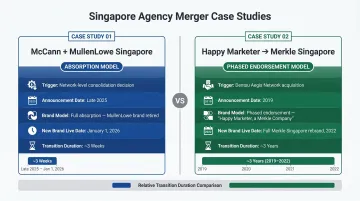
Both approaches worked within their contexts. The point isn't which model is correct — it's that neither was accidental. Post-merger digital branding is a sequenced, multi-phase discipline requiring Day 1 communication, interim brand management, and long-term integration planning.
The 3 Post-Merger Brand Architecture Approaches
Before executing any digital rebrand, leadership must decide on the brand architecture model. This decision determines everything that follows: domain strategy, social media consolidation, stakeholder messaging, and SEO migration approach.
1. Absorption ("Stronger Horse")
The acquired entity's brand is retired. All digital assets, customers, and communications consolidate under the acquirer's brand.
When It Works:
- The acquirer has significantly stronger brand equity
- Customer bases overlap substantially
- Cost efficiency and operational clarity are priorities
- Speed to market matters
Digital Tasks:
- Domain migration with 301 redirects from retired domain
- Social media account consolidation or retirement
- Google Business Profile updates and directory listing changes
- Email signature and marketing automation updates
- Website content migration and URL mapping
Primary Risk: Alienating the acquired company's loyal customer base if the transition is too abrupt. Customers who valued the acquired brand's identity, culture, or positioning may view the absorption as a loss rather than an upgrade.
Singapore Example: McCann absorbing MullenLowe Singapore (2025).
2. Endorsement/Sub-brand
The acquired brand retains market presence but is endorsed by the parent brand — for example, "Company A, a Company B company."
When It Works:
- The acquired brand has distinct customer equity worth preserving
- Customer bases serve different segments or geographies
- Regulated sectors (healthcare, financial services) where brand continuity signals stability
- Transitional period before full absorption
Digital Tasks:
- Maintain separate websites with clear parent brand endorsement
- Update social media bios and LinkedIn company pages with endorsement language
- Coordinate content calendars to align messaging while preserving brand voice
- Manage dual Google Business Profiles with consistent NAP (Name, Address, Phone) data
- Set a clear timeline for eventual consolidation
Primary Risk: Operational complexity. Running dual digital properties dilutes resources, confuses SEO authority, and requires ongoing coordination to prevent messaging conflicts.
Singapore Example: Happy Marketer's interim phase as "Happy Marketer, a Merkle Company" (2019–2022).
3. New Brand Creation
Both legacy brands are retired in favour of an entirely new identity.
When It Works:
- Merger of equals where neither brand should dominate
- Reputational reset required
- Entry into a new market category that neither legacy brand fully represents
- The combined entity's positioning requires a fresh start
Digital Tasks:
- New domain acquisition and dual-domain migration strategy
- Complete website rebuild reflecting new positioning
- New social media accounts with follower migration campaigns
- Comprehensive SEO strategy to build authority from zero
- Stakeholder re-introduction and market education campaigns
Primary Risk: Losing existing brand equity from both organisations. Customers must learn and trust a new entity. Of the three models, this one demands the greatest investment, the longest timeline, and the most intensive stakeholder communication effort.
Less Common in Singapore: No verified local example exists in recent Singapore agency mergers, though the model appears in global corporate contexts — for example, Verizon, formed from the merger of GTE and Bell Atlantic.
Decision Framework
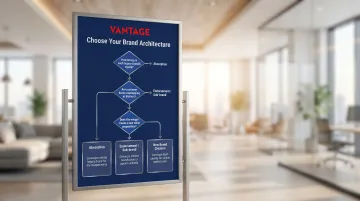
Ask three questions:
How strong is each legacy brand's equity? If one brand clearly outperforms the other in awareness, reputation, and customer loyalty, absorption makes sense. Where both carry comparable equity, endorsement or new brand creation is worth considering.
Are the customer bases overlapping or distinct? Overlapping bases favour absorption. Distinct bases (different industries, geographies, or buyer personas) favour endorsement or sub-branding, temporarily.
What does the combined entity's future positioning require? If the merger creates a fundamentally new value proposition that neither legacy brand represents, new brand creation may be the only authentic choice.
Key Digital Branding Strategies After a Merger in Singapore
Audit Before You Act
The first step is a comprehensive digital brand audit. Without this inventory, consolidation efforts will be incomplete and create ongoing inconsistencies.
What to Audit:
Owned Digital Assets:
- Primary and secondary websites
- Domain names and subdomains
- Social media profiles (LinkedIn, Facebook, Instagram, YouTube)
- Google Business Profile listings
- Email marketing platforms and subscriber lists
- Paid advertising accounts (Google Ads, LinkedIn Ads)
- CRM systems and customer databases
- Brand assets used by channel partners or resellers
What to Assess:
- Whether both organisations communicate the same value propositions — or contradict each other
- Whether logo usage, colour palettes, typography, and imagery are consistent across channels
- Which domains hold organic authority, what content ranks, and what backlinks exist
- Whether the two digital properties attract the same users or distinct audience segments
Vantage Branding structures this audit phase around stakeholder interviews and brand workshops — ensuring every digital touchpoint is mapped before any consolidation work begins.
Consolidate Digital Touchpoints Systematically
Rushing all channels simultaneously increases error risk and reduces transition quality. A phased approach lets teams address high-visibility touchpoints first, then work inward to complex integrations.
Recommended Sequencing:
Phase 1 (Days 1-30): High-Visibility Touchpoints
- LinkedIn company page and executive profiles
- Primary website homepage with interim messaging
- Email signatures across leadership and customer-facing teams
- Google Business Profile
Phase 2 (Days 31-90): Secondary Channels
- Social media accounts (Facebook, Instagram, YouTube)
- Blog and content repositories
- Third-party directories (industry associations, review platforms)
- Partner portals and reseller brand assets
Phase 3 (Days 91-180): Deep Integration
- Full website content migration and URL mapping
- Marketing automation and CRM consolidation
- Paid advertising account restructuring
- Historical content archives and knowledge bases
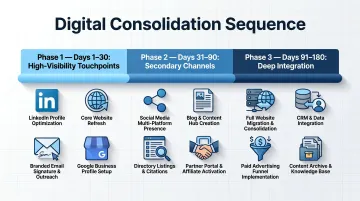
Domain migration sits within Phase 3 but warrants its own treatment — it carries the highest technical risk of any step in a post-merger rebrand.
Domain Migration Strategy
Domain migration is the highest-risk digital task in a post-merger rebrand. A Search Engine Journal study of 892 migrations found the average domain migration takes 523 days to recover pre-migration organic traffic levels. Worse, 17% of migrations never recover.
Google's Official Guidance:
- Use permanent (301 or 308) server-side redirects — these do not cause PageRank loss
- Avoid redirect chains; keep hops to 2 or fewer
- Do not redirect all old URLs to the new homepage; map each page to its most relevant equivalent
- Keep redirects active for at least one year (indefinitely for users)
- Use Google Search Console's Change of Address tool for domain-level moves
- Do not change domains and CMS simultaneously — isolate variables
- Update high-volume external backlinks manually by contacting site owners
Launch the new domain 24-48 hours before implementing redirects. This gives Google time to discover and begin indexing the new site structure before the old domain starts redirecting traffic away.
Rebuild the Brand Narrative for Digital Channels
The merged entity needs a unified brand narrative that answers:
- What does the combined organisation stand for?
- Who does it serve?
- Why is this merger better for clients?
This narrative must adapt to different digital formats:
- Homepage headline: 8-12 words capturing the new positioning
- LinkedIn company description: 2-3 sentences explaining the combined value proposition
- Executive thought leadership: LinkedIn articles and bylines that position merged entity leadership as industry experts
- Email communications: Client-facing messages that address continuity, capability expansion, and commitment
Rollout Sequence:
- Align internally first: Leadership, employees, and frontline teams must understand and articulate the narrative before it goes external
- Then address existing clients: Website, LinkedIn, and direct email communications to current clients
- Then go to market broadly: Press releases, blog posts, social media, and industry publications
Releasing the external narrative before internal stakeholders are aligned creates credibility gaps. Employees who learn about the new brand positioning from external media rather than internal communications lose trust in leadership.
Manage Stakeholder Communication Across Digital Channels
Different stakeholder groups require different messages delivered through different channels.
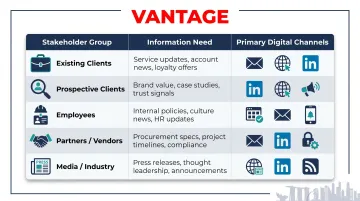
Stakeholder Groups and Channels:
| Stakeholder | Information Need | Primary Digital Channels |
|---|---|---|
| Existing clients | Service continuity, account management changes, expanded capabilities | Email, website, LinkedIn |
| Prospective clients | New value proposition, combined expertise, why engage now | Website, LinkedIn, paid search |
| Employees | Job security, cultural integration, day-to-day changes | Internal comms, intranet, leadership emails |
| Partners/vendors | Contractual continuity, payment processes, contact changes | Email, partner portals, phone calls |
| Media/industry | Strategic rationale, market positioning, leadership vision | Press releases, LinkedIn thought leadership |
Create a Digital Communication Timeline:
- Merger announcement (Day 1): Simultaneous email to all stakeholders, website announcement banner, LinkedIn posts from leadership
- Interim brand period (Days 1-90): Regular updates on integration milestones, FAQ updates on website, employee spotlights on social media
- Full brand launch (Days 90-180): New website launch, rebrand announcement campaign, case studies showcasing combined capabilities
When stakeholders encounter conflicting messages across channels, they question whether the merger itself is under control. Consistent, timed communications — even simple ones — signal that leadership has a plan.
Singapore-Specific Considerations for Post-Merger Digital Rebranding
PDPA Compliance and Merged Customer Databases
When two entities merge, their customer databases merge. But marketing consent does not automatically transfer.
The PDPC Advisory Guidelines on Key Concepts provide a Business Asset Transaction exception allowing personal data transfer for deal purposes. However, deemed consent by notification does not apply to direct marketing messages.
Practical Implication: You may legally acquire customer data through the merger, but you cannot immediately market to those customers under the merged brand without fresh opt-in consent.
What This Means for Digital Marketing:
- Email marketing to merged lists requires re-permissioning campaigns
- Retargeting audiences from acquired entity may need fresh consent
- CRM-linked digital campaigns must audit consent records before launch
- LinkedIn matched audiences and Facebook Custom Audiences may require consent updates
Recommended Approach: Plan a "consent acquisition" campaign alongside—not after—the brand migration. Frame it as a value exchange: "We've merged to serve you better. Opt in to receive updates on expanded capabilities, new services, and exclusive insights."
Multicultural and Multilingual Audience Dynamics
Singapore's market is multicultural, multilingual, and sector-specific. Digital content that served one organisation's audience may not resonate with the other's. A post-merger content strategy needs to audit both legacy brand audiences before adapting messaging, imagery, and channel priorities.
Three areas to audit before consolidating content:
- Does one entity serve primarily English-speaking corporate clients while the other serves Mandarin-speaking SMEs? Language channel priorities will differ.
- Visual identity, tone, and messaging that worked for a B2C consumer brand may feel misaligned for a B2B institutional audience.
- Healthcare and financial services clients expect regulatory credentials prominently displayed; technology clients expect innovation signals.
Enterprise Development Grant (EDG) Funding
The Enterprise Development Grant co-funds brand strategy development at up to 50% of eligible costs for local SMEs.
Eligible Activities:
- Brand diagnosis and gap analysis
- Primary and secondary market research
- Brand strategy development
- Assessment of brand financial value
- Strategic marketing resource optimisation
NOT Covered:
- Production of collaterals (brochures, videos, websites)
- Campaign implementation (advertising, SEO/SEM, media buys)
- Consultant retainer fees
Implication for Post-Merger Branding: EDG can co-fund the strategic planning phase—brand architecture decisions, stakeholder research, positioning development—but not execution (website builds, campaign rollouts). Separate the strategy phase (EDG-eligible) from implementation (not eligible) and apply before starting the project.
Important: A new grant called EDGE is scheduled to launch in 2H2026, replacing EDG. Businesses currently in M&A processes have a narrowing window to apply under known terms.
For organisations navigating both the strategic and administrative sides of an EDG application — alongside an active merger — working with a branding partner familiar with government processes can reduce friction and protect the timeline.
Common Post-Merger Digital Branding Mistakes to Avoid
Mistake 1: Cosmetic-Only Rebranding
Changing logos and colour schemes without revisiting positioning, messaging, or audience strategy is the most common post-merger branding failure.
The digital presence looks new but still fails to communicate the combined value clearly. Stakeholders see a visual refresh but no substantive answer to "Why should I care about this merger?"
Start with strategy before touching visual identity — define your positioning, narrative, and audience segmentation first. From there, your brand architecture decision (whether to absorb, endorse, or build a new brand entirely) should follow the business rationale, not design preferences.
Mistake 2: Moving Too Slowly on Digital Consolidation
Running two separate websites, social media accounts, or email domains for extended periods after a merger signals internal disorganisation.
Appropriate timeline:
- Interim communication: Within 30 days of merger announcement
- Primary digital assets consolidated: Within 90 days
- Full brand rollout: Within 6-12 months depending on complexity
Prolonged dual-brand operations dilute SEO authority, confuse customers, and waste resources managing parallel systems.
Mistake 3: Neglecting the Acquired Entity's Digital Community
The acquired brand's followers, review profiles, and content assets represent real audience equity. Abruptly shutting down accounts or redirecting without acknowledgment alienates loyal customers.
A respectful handover goes a long way. When winding down the acquired brand's digital presence:
- Post farewell messages on acquired brand's social accounts explaining the transition
- Provide clear forwarding instructions to the new accounts
- Preserve review history where possible (Google Business Profile, industry directories)
- Invite followers to the new entity with value-driven messaging
- Archive valuable content rather than deleting it
Frequently Asked Questions
What are the 4 types of M&A?
The four main types are horizontal, vertical, conglomerate, and market-extension mergers. Horizontal mergers occur between competitors in the same industry. Vertical mergers join companies at different supply chain levels. Conglomerate mergers involve unrelated businesses. Market-extension mergers combine companies selling similar products in different markets. Each type influences post-merger branding complexity differently.
What is the reason for merger and acquisition?
Primary motivations include market expansion, cost synergies, access to new capabilities or talent, and competitive consolidation. The strategic rationale should directly shape the post-merger brand narrative. For example, an acquisition driven by capability expansion requires digital branding that communicates those expanded capabilities clearly to existing and prospective clients.
Should we keep the acquired company's brand or replace it after a merger in Singapore?
The decision depends on relative brand equity, customer base overlap, and strategic positioning goals. Regulated industries like healthcare and financial services generally benefit from brand continuity, while tech or consumer sectors may favour faster consolidation. Assess each legacy brand's market recognition and customer loyalty before retiring established local names.
How long does post-merger rebranding typically take in Singapore?
Interim communications should deploy within 30 days of merger announcement. Primary digital assets (website, LinkedIn) should consolidate within 60-90 days. Full brand launch typically occurs within 6-12 months depending on brand architecture complexity and merged entity size. Domain migrations require ongoing monitoring for 12-18 months to ensure SEO recovery.
When should a company start planning its post-merger digital branding strategy?
Ideally during the due diligence phase, before the merger is finalised. This allows brand architecture decisions, domain strategy, and stakeholder communication plans to be ready at announcement. Branding decisions made after closing result in costly delays and confusion during the first 100 days, when stakeholder trust is most fragile.
Does Singapore's PDPA affect how we use customer data for digital marketing after a merger?
Yes. PDPA requirements mean organisations must review whether existing consent covers data use by the new merged entity. Re-permissioning campaigns may be required for digital marketing lists, as deemed consent provisions do not apply to direct marketing messages. Seek legal advice specific to your merger structure and consent records.