Introduction
When a Singapore acquisition closes, leadership teams typically spend months on financial due diligence, legal integration, and operational alignment. The brand decision—the most visible signal to customers, employees, and the market—frequently becomes an afterthought, despite directly affecting deal success.
The tension is real: rebrand too quickly and you risk erasing brand equity built over years. Move too slowly and customers are left confused about who they're doing business with. According to a Forbes Agency Council article, 70% to 90% of mergers and acquisitions fail, often because leaders focus only on financial synergies while ignoring brand equity and cultural alignment.
This guide covers why post-acquisition rebranding is uniquely complex, how to choose the right brand architecture, the step-by-step process to execute it well, and Singapore-specific considerations leaders must not overlook.
TLDR:
- Post-acquisition rebranding reconciles two brands, customer bases, and cultures simultaneously
- Brand architecture choice (absorption, endorsed, hybrid) must precede design work
- 47% of key employees leave within one year of M&A—internal alignment matters
- Singapore requires ACRA name updates (S$15, 3-15 days) and IPOS trademark filings (S$280-S$410 per class)
- EDG grants offset up to 50% of branding consultancy costs for eligible SMEs
Why Post-Acquisition Rebranding Is Different From a Standard Rebrand
A typical rebrand involves one company updating its identity. Post-acquisition rebranding means reconciling two distinct brands, two customer bases, and two organisational cultures at once—compounding the strategic complexity at every level.
The Dual-Audience Challenge
The acquiring company must reassure its own stakeholders that the deal adds value. At the same time, it must manage the acquired company's customers — people who may feel deep loyalty to the brand they've known and trusted. Both audiences require distinct messaging, yet both must believe the combined entity is stronger.
Brand Equity at Risk
The acquired company often carries significant market recognition and customer goodwill. Research shows that 95% of executives describe cultural fit as critical to integration success, yet organisational issues account for 50% of merger failure factors based on ten years of McKinsey M&A survey data.
When cultural mismatches are severe, companies can see annual net income drops of S$600 million or more within three years of closing. Absorbing a brand without proper assessment doesn't just damage goodwill — it erodes the financial value the acquisition was meant to create.
The Culture Collision
Employees of the acquired company use the brand as a proxy for identity and belonging. When the brand changes, anxiety, disengagement, and talent attrition follow.
The attrition data is striking:
- 47% of key employees leave within one year of an M&A transaction, rising to 75% within three years
- 44% of early leavers cite "the new or changing culture" as their primary reason — ahead of competitor recruitment or role dissatisfaction
Case Study: Happy Marketer to Merkle Singapore
When dentsu acquired Happy Marketer in February 2019, the rebrand wasn't finalised until March 2022—a deliberate, phased three-year approach.
The agency initially operated as "Happy Marketer, a Merkle Company" (endorsed brand model), spending three years building operational maturity, integrating 34 employees with 700 new colleagues, and preserving team chemistry before completing the full transition to Merkle Singapore. During this period the team grew to over 80 staff, demonstrating successful talent retention through gradual integration.
Choosing Your Brand Architecture: The First Strategic Decision
Brand architecture defines the structural relationship between acquiring and acquired brands. This decision shapes every rebranding choice that follows — and must be made before any design work begins.
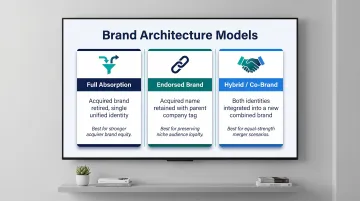
The Three Main Brand Architecture Models
Full Absorption retires the acquired brand entirely, replacing it with the acquirer's identity. This works best when the acquirer has stronger equity and broader market recognition — and when customers already associate with the acquirer's category.
Example: Grab's acquisition of Uber's Southeast Asia operations in March 2018 involved complete brand absorption—Uber's platform was discontinued within two weeks, and all drivers and customers migrated to Grab.
Endorsed Brand keeps the acquired company's name but links it visibly to the parent — "CompanyX, a [Acquirer] company." This preserves the acquired brand's equity while signalling backing from a larger entity, making it useful when the acquired brand has loyal customers in a niche market.
Hybrid or Co-Brand integrates both identities into a new combined brand. This approach is most common in mergers between relative equals, or when both brands serve distinct but complementary audiences the combined entity wants to retain.
Making the Evidence-Based Decision
A brand equity audit of both entities drives the right architecture choice — covering market awareness, customer loyalty, competitive positioning, and strategic fit with the combined company's direction.
Vantage Branding's brand strategy process starts with exactly this audit, helping leadership make evidence-based decisions rather than ones driven by internal politics or seniority. The audit involves:
- Customer perception research across both brand bases
- Stakeholder interviews with leadership and frontline teams
- Competitive landscape analysis
- Brand value assessment and equity measurement
Practical Decision Framework:
- Where the acquired brand has higher recall in its specific market, an endorsed approach protects that equity
- Full absorption is the stronger play when the goal is unified market presence and simplified communications
- If both brands serve complementary audiences worth retaining, hybrid branding maintains equity on both sides
The right model is rarely obvious from the outside — it emerges from the audit data. Rushing this decision risks either erasing valuable equity or carrying dead weight into the new brand.
Step-by-Step Rebranding Process After an Acquisition
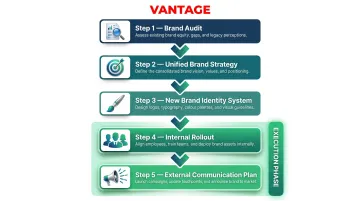
Step 1 — Conduct a Brand Audit of Both Entities
Before any visual or naming decisions, assess brand equity comprehensively:
- Customer perception research to understand what each brand's customers value most
- Stakeholder interviews with employees, partners, and key accounts
- Competitive landscape analysis to identify positioning gaps and opportunities
- Brand association mapping to determine which attributes can transfer to the new identity
The audit identifies whether the acquired brand's customer associations can be carried forward or whether they conflict with the acquirer's positioning.
Step 2 — Define the Unified Brand Strategy
Those audit findings directly shape the combined company's brand strategy. With a clear picture of both brands' equity and gaps, define:
- Where the combined entity sits in the competitive landscape
- The core values that guide decision-making across both legacy teams
- The value proposition customers will actually experience
- A brand narrative that explains why this acquisition makes the combined entity stronger — from the customer's perspective, not just leadership's
The brand story must answer "what does this mean for me?" from the customer's perspective—not just from leadership's view.
Step 3 — Develop the New Brand Identity System
Translate brand strategy into visual and verbal identity:
- Name (if changing)
- Logo, typography, colour palette
- Tone of voice and messaging hierarchy
- Visual guidelines for consistency
Ensure the identity system is built for consistency across all touchpoints: digital, physical, internal communications, and collateral.
Step 4 — Execute the Internal Rollout First
Brief and align employees of both companies before any public announcement. Internal teams—especially those from the acquired company—must understand and feel included in the new brand narrative before they're expected to represent it.
The numbers reveal how often this step is skipped: only 22% of employees strongly agree that leadership has clear direction, and only 15% strongly agree leadership makes them enthusiastic about the future. Post-acquisition is the moment to close that gap.
Internal rollout components should include:
- Leadership briefings explaining strategic rationale
- Employee workshops introducing the new brand
- Internal communications materials (email templates, intranet content, FAQ documents)
- Brand ambassador training for customer-facing teams
Step 5 — Execute the External Communication Plan
Roll out the rebrand to external audiences in a structured sequence:
- Key account clients first — direct outreach via account managers, not mass email
- Partners and vendors with personalised notifications explaining what's changing and what stays the same
- Broad market announcement via press release, website update, and social media
A phased external rollout prevents the abrupt "why did everything change overnight?" reaction that erodes customer trust.
Singapore-Specific Considerations
Legal and Regulatory Updates
When a company rebrands post-acquisition in Singapore, legal obligations include:
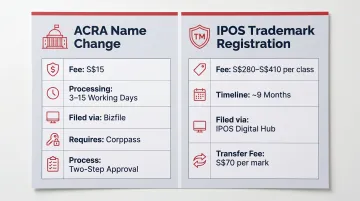
ACRA Company Name Change:
- File via Bizfile using the "Application for New Business Entity Name for Name Change" eService
- Fee: S$15 (non-refundable)
- Processing time: Up to 3 working days (or up to 15 working days if sent to referral authorities)
- Requires Corppass login
- Two-step process: (1) Apply for and receive approval; (2) Update entity information using transaction number
IPOS Trademark Registration:
- New trademark application via Form TM4 through IPOS Digital Hub
- Fees: S$280 per class (pre-approved items) or S$410 per class (non-pre-approved)
- Examination timeline: Approximately 9 months if no objections
- Transfer of ownership (if acquiring existing trademarks): Form CM8, S$70 per trade mark number
Multicultural Sensitivity in Naming and Messaging
Singapore's population is ethnically and linguistically diverse. Brand names or taglines that read well in English may carry unintended connotations in Mandarin, Malay, or Tamil.
Post-acquisition name changes carry real linguistic risk. Any new name should be tested across Singapore's primary language communities before launch. This means:
- Phonetic testing for unintended meanings in different languages
- Visual testing of bilingual or multilingual brand applications
- Cultural sensitivity review to ensure symbols and colours align with intended associations
Funding Support: Enterprise Development Grant (EDG)
Singapore SMEs undergoing post-acquisition brand integration may be eligible for the Enterprise Development Grant (EDG), which offsets up to 50% of qualifying branding consultancy costs (70% for sustainability-related projects).
Eligibility criteria:
- Registered and operating in Singapore
- Minimum 30% local shareholding
- Financially viable to start and complete the project
Qualifying costs include:
- Third-party branding consultancy fees (brand strategy, brand identity, brand discovery)
- Software and equipment
- Internal manpower costs
Not covered: Brand execution, production, marketing campaigns, website development
Application process:
- Submit via Enterprise Singapore's Business Grants Portal
- Approval typically takes 8–12 weeks
- Projects cannot commence before grant approval is received
Common Mistakes to Avoid When Rebranding After an Acquisition
Rebranding Too Quickly
Rushing the rebrand to signal integration speed often backfires. It skips the brand equity audit, erases the acquired brand's goodwill before customers are ready for the change, and signals to employees that their identity was disposable.
79% of acquirers retained at least 80% of employees during retention periods, but only 50% maintained that retention level one year post-merger—indicating a sharp drop once cultural integration takes effect.
Employee attrition can double compared to traditional averages during M&A transactions involving slow, unclear, or one-directional communications.
Neglecting the Acquired Company's Employees
The rebrand can feel like erasure to the team whose company was acquired. Failing to involve them—or at minimum, communicating with empathy and transparency—leads to disengagement and attrition, undermining the very capabilities the acquirer paid to bring in-house.
Disengaged employees don't wait for a better offer—they leave at the first opportunity. Retention depends on making acquired staff feel their work and identity still have a place in what comes next.
Treating the Rebrand as a Design Project Rather Than a Strategy Project
Ordering a new logo without first defining the unified brand positioning results in a visual that looks different but communicates nothing new. The identity should be the output of strategy—not a shortcut around it.
As Wolff Olins notes, M&A branding should be treated as "the birth of something new"—not an exercise in shared DNA or cosmetic logo changes. Before any external rollout, the brand needs to earn conviction internally, with investors and employees, first.
Frequently Asked Questions
Can I rebrand an existing product?
Yes, a product can be rebranded independently of the parent company. The decision should be driven by whether the current name limits market potential, and it should align with the broader brand architecture of the combined company post-acquisition.
How to rebrand without losing customers?
Proactive, empathetic communication is the key. Notify key customers before the public announcement, explain what is changing and why it benefits them, and ensure the quality and relationships they relied on remain unchanged despite the brand update.
How long does post-acquisition rebranding typically take in Singapore?
Timelines vary by complexity, but a considered post-acquisition rebrand in Singapore typically takes between 4 to 9 months from strategy to launch. Some companies opt for multi-year phased approaches to protect client and culture continuity, as seen in Happy Marketer's three-year transition to Merkle Singapore.
Should the acquired company keep its brand name after an acquisition?
This depends on the acquired brand's equity. If it has strong market recognition and customer loyalty in its segment, an endorsed model (retaining the name with a parent company link) often preserves more value than full absorption. A brand equity audit should inform this decision.
Do I need to update legal registrations when rebranding after an acquisition in Singapore?
Yes. If the company name changes, register the new name with ACRA (S$15, 3-15 days processing), and file trademarks for any new brand name or logo with IPOS (S$280–S$410 per class) to protect intellectual property.