Many Singapore businesses pour resources into logos, colour palettes, and taglines, then wonder why customers don't stick around. The missing piece isn't visual—it's foundational. Without a credible, deliverable brand promise, your business is indistinguishable from every competitor making the same hollow claims about "excellence" and "customer care."
This article explains what a brand promise actually is, why Singapore's unique market makes it non-negotiable, the frameworks that make it work, and a step-by-step process for building one that your business can consistently keep.
TLDR:
- A brand promise is an operational commitment, not a marketing tagline—it defines what customers can expect every time they interact with your business
- Singapore consumers trust business at 63% but switch brands readily, making credibility and consistency critical differentiators
- The 3 C's (Company, Customer, Competitors) validate your promise; the 5 P's (Product, Price, Place, Promotion, People) ensure you can actually deliver it
- Development takes four to eight weeks and requires research, internal alignment, and stress-testing against real operational capacity
What Is a Brand Promise?
A brand promise is the specific, verifiable commitment your brand makes to customers about what they will experience every time they interact with you. It's not aspirational copy or a feel-good statement—it's an operational contract with the market.
The difference matters:
- Brand mission is broad and society-facing (e.g., "To inspire and nurture the human spirit")
- Brand purpose explains why you exist beyond profit
- Brand promise is practical and customer-facing—it defines what customers will get, every time
Singapore Airlines demonstrates this distinction clearly. Their mission statement speaks to "air transportation services of the highest quality." Their brand promise, by contrast, is built on three operational pillars: Service Excellence, Product Innovation, and Network Connectivity.
These aren't marketing phrases—they're the design criteria behind crew training programmes (15 weeks, three times the industry average), a fleet averaging 7.25 years old (among the world's youngest), and KrisFlyer's 8.8 million members. The promise shows up at every touchpoint, from booking to landing.

A brand promise must be specific enough to be measurable and consistent enough to build trust. Generic statements like "we deliver excellence" fail both tests. A promise like "we respond to every client query within four business hours" passes.
Why Brand Promises Matter Specifically in Singapore
Singapore consumers operate from a higher trust baseline than the global average—63% trust business, compared to approximately 44% globally. But that trust is actively conditional, not passive loyalty. 44% would switch brands due to rising costs, and nearly half are more likely to experiment with new brands than they were five years ago.
This creates a high-stakes dynamic: there's more trust to lose, and the margin for inconsistency is razor-thin. Singapore consumers don't just buy products—they research them. 63.1% use social media to research brands before purchasing, and they're evaluating reliability, demonstrated value, and proof of claims across LinkedIn, Instagram, TikTok, and WhatsApp.
Multicultural expectations raise the bar further
Singapore's population includes Chinese (74.3%), Malay (13.5%), Indian (9.0%), and other ethnic groups, with English spoken most frequently at home (48.3%). A brand promise that feels culturally tone-deaf or exclusive to one segment erodes credibility fast. One that reflects shared values—reliability, transparency, respect—builds loyalty across all segments.
Business outcomes are measurable
Strong brand promises deliver tangible returns:
- Trusted companies outperform peers by up to 400% in market value
- 88% of customers who trust a brand will repurchase
- Enterprise Singapore's Enterprise Development Grant (EDG) funds "Strategic Brand and Marketing Development" at up to 50% of eligible costs — making brand investment financially supported, not just strategically sound
Those returns extend beyond Singapore. Businesses expanding into Malaysia, Vietnam, and broader Asia need a promise that's locally grounded yet universally credible. Investors and partners consistently scrutinise brand coherence — it signals organisational maturity, not just market presence.
The Foundations: What the 3 C's and 5 P's Mean for Brand Promise Development
The 3 C's and 5 P's are the research and delivery frameworks that separate credible brand promises from forgettable marketing copy. Used together, they ensure your promise is grounded in what your business can actually do — and what your market actually needs.
The 3 C's: Research Triangle
The 3 C's—Company, Customer, Competitors—validate your promise before you write it. A promise built without all three inputs is either internally irrelevant, customer-disconnected, or competitively invisible.
Company: What can your brand genuinely and consistently deliver? Anchor the promise in real operational capability. If your fulfilment process takes three days, don't promise next-day delivery. The promise must survive scrutiny from your own operations team before it reaches a customer.
Customer: What do Singapore consumers in your segment actually value? Research-driven buyers expect specificity. Your promise must address a real need, solve a concrete pain point, or deliver a verifiable benefit — generic value propositions consistently underperform in this market.
Competitors: What promises are already claimed in your category, and where is the white space? In Singapore's dense competitive landscape, differentiation is non-negotiable. If five competitors already promise "quality service," you need a more specific, defensible position.
The 5 P's: Delivery Framework
The 5 P's—Product, Price, Place, Promotion, People—determine whether your business can actually keep the promise. The 3 C's inform what the promise should say; the 5 P's determine whether you can deliver it.
- Product: Does your offering consistently meet the standard your promise sets?
- Price: Does your pricing model support the value proposition you're promising?
- Place: Can your distribution or service delivery channels reliably fulfil the promise?
- Promotion: Are your marketing channels and messaging aligned with the promise?
- People: Can your team—sales, service, delivery—consistently deliver the promise at every customer touchpoint?
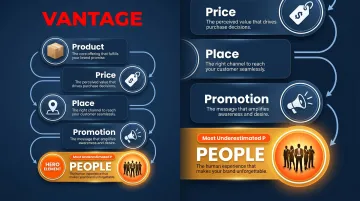
People is the most underestimated P in Singapore. Service quality and professionalism define how respected brands are perceived here. A promise printed on a website means little if the team behind it hasn't internalised it.
This is where many businesses need external support. Vantage Branding works with organisations to build the internal alignment that turns a brand promise into consistent, day-to-day behaviour — not just positioning language.
How to Develop Your Brand Promise: A Step-by-Step Process
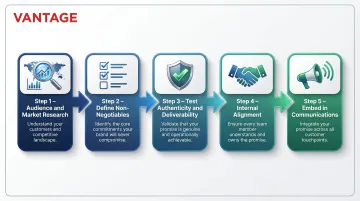
Step 1: Conduct audience and market research
Gather qualitative and quantitative data on what your target customers in Singapore genuinely value, what gaps competitors leave unfilled, and what your business uniquely delivers. Too many brands write promises from the inside out — an approach that rarely resonates.
Research should cover three areas:
- Customer interviews to surface what people actually expect and value
- Competitor brand audits to identify gaps in the market
- Market opportunity analysis to find where your strengths align with unmet needs
Step 2: Define your brand's non-negotiables
Identify the one or two things your brand must always deliver, regardless of channel, format, or audience segment. Distil this into a clear, specific, testable statement. Not "we deliver quality" — but "we respond to every client query within four business hours." Instead of "we care about our customers," say "we guarantee same-day dispatch for orders placed before 2pm."
Step 3: Test for authenticity and deliverability
Before committing, stress-test the promise against your operations, team capabilities, and supply chain. A promise that cannot survive operational scrutiny will erode trust faster than having no promise at all.
Three questions to answer honestly:
- Can we deliver this today, with current resources?
- Can we sustain it next quarter under pressure?
- Can we scale it without compromising consistency as we grow?
Once you can answer yes to all three, the promise is ready — but only if your teams can execute it.
Step 4: Align internally before communicating externally
Train teams across every customer-facing function — sales, service, delivery — so the promise is experienced consistently. Brand promises fail when marketing writes them but operations doesn't execute them. Internal alignment is not optional.
Vantage Branding's Brand Implementation Workshops help Singapore businesses embed brand strategy across teams, turning the promise from a marketing statement into an operational standard.
Step 5: Embed the promise into all brand communications
The promise should shape website copy, social media tone, sales proposals, and customer service scripts — not live in isolation as a tagline. Consistency across channels is what transforms a statement into a brand truth. When done well, customers don't notice the promise — they just experience it, repeatedly.
Adapting Your Brand Promise for Singapore's Multicultural Market
Singapore's diversity is a competitive advantage, not a complication. Brands that reflect multicultural values in their promise naturally build broader trust and emotional resonance across Chinese, Malay, Indian, and expat consumer segments.
Language and cultural sensitivity
English is the default business language—spoken most frequently at home by 48.3% of residents—but language alone isn't enough. The tone, imagery, and values embedded in your brand promise need to feel inclusive.
Avoid promises that read as imported rather than locally grounded. What resonates in New York or London can feel tone-deaf here if it skips the values Singaporeans actually respond to: pragmatism, reliability, and genuine respect for diversity.
Digital channel consistency
Singapore has one of the highest smartphone and internet penetration rates in the world—95.8% internet penetration and 88.2% social media penetration. The brand promise must translate authentically across digital channels. For B2B brands, that means LinkedIn. For consumer brands, Instagram and TikTok. For service follow-up, WhatsApp. Each platform requires the same promise, delivered in platform-appropriate ways.
Proof is non-negotiable
Back your promise with visible, specific evidence. Audiences here are sceptical of claims they can't verify—so give them something concrete:
- Published case studies with measurable outcomes
- Industry certifications relevant to your sector
- Client testimonials and retention figures
- Response time data if you promise 24/7 support
- Service guarantees with defined delivery standards

If you promise quality, show the proof. If you promise speed, publish the numbers.
Common Brand Promise Mistakes Singapore Businesses Make
Mistake 1: Being too broad
Promises like "we deliver excellence" or "we care about our customers" mean nothing because they are unverifiable and indistinguishable from every competitor. Specificity is the defining quality of a credible brand promise in a discerning market like Singapore. A promise must be concrete enough that a customer knows whether you kept it.
Mistake 2: Treating Singapore as part of a generic "Asian market"
Brands that import a regional promise without adapting it to Singapore's distinct legal, cultural, and consumer environment risk appearing disconnected. Singapore's unique identity—governance, rule of law, multicultural society—requires a promise that reflects these realities, not one designed for the lowest common denominator across Asia.
Mistake 3: Failing to deliver consistently
Research shows that two-thirds of customers perceive a gap between what brands promise and what they actually do. That gap—between stated promise and lived experience—is where trust breaks down.
Treat promise delivery as an operational metric, not just a marketing exercise. Build internal review cycles to track consistency over time and address failures before they compound.
Frequently Asked Questions
What does a brand promise do?
A brand promise sets a clear expectation for customers, guides internal decision-making across the business, and builds trust over time by creating a consistent, verifiable experience at every touchpoint.
What are the 3 C's of brand development?
The 3 C's—Company, Customer, and Competitors—form the research foundation for any brand promise, ensuring it is credible to deliver, relevant to customers, and distinct from competitors.
What are the 5 P's of positioning?
The 5 P's—Product, Price, Place, Promotion, and People—are the delivery mechanisms that must align with the brand promise, ensuring it is not just communicated but consistently experienced across all brand interactions.
What is the difference between a brand promise and a brand mission?
A brand mission is aspirational and society-facing, while a brand promise is practical and customer-facing. The promise specifies what customers can expect to experience, not what the company hopes to achieve in the world.
How do you know if your brand promise is working?
A brand promise is working when retention improves, referrals increase, and customers can accurately describe what the brand stands for. NPS scores, testimonials, and repeat purchase rates are the most reliable indicators to track.
How long does it take to develop a brand promise?
A well-researched brand promise typically takes four to eight weeks, covering market research, internal alignment, and stakeholder review. Rushing it is one of the most common reasons brands end up with promises they cannot keep.