Introduction
Mergers and acquisitions in Singapore have become routine. Southeast Asia recorded US$84.5 billion across 849 deals in 2024, with Singapore leading the region in both deal value and volume.
High-profile transactions like DBS's acquisition of Citi's Taiwan consumer banking business and OCBC's increased stake in Great Eastern show that even Singapore's most valuable brands face critical post-merger brand decisions.
Most companies focus heavily on financial due diligence while underestimating how much brand equity is at stake. Research shows that nearly 50% of M&A deals fail due to cultural fit or management integration issues, not spreadsheet errors. An improperly managed brand transition erodes customer trust, confuses stakeholders, and destroys value that took years to build.
This guide covers the essentials: what post-merger brand evaluation actually means, the key dimensions you must assess, a practical framework tailored for Singapore companies, and the most common mistakes that destroy brand value.
TLDR
- Post-merger brand evaluation audits and aligns brand values, equity, and identity across both merging entities
- Brand value is a material intangible asset—intangibles now represent approximately 92% of S&P 500 market capitalisation
- Cover brand equity, stakeholder perception, brand architecture options, and cultural alignment in every evaluation
- Starting brand evaluation during due diligence—not after the deal closes—reduces post-close disruption and brand equity erosion
What Is Post-Merger Brand Evaluation?
Post-merger brand evaluation is the systematic process of assessing the brand assets, equity, and strategic positioning of two merging entities to determine how the combined organisation should present itself to the market.
Done well, it shapes customer retention, employee engagement, and enterprise value — not just the logo on the door.
Brand value in this context encompasses four components:
- Brand equity: Customer perception, loyalty, trust, and associations
- Brand identity: Visual and verbal brand systems (logos, colours, tone, messaging)
- Brand architecture: How brand entities relate to each other (parent brands, sub-brands, endorsed brands)
- Financial brand value: The quantifiable economic value attributable to the brand as an intangible asset
Brand value and brand equity are related but distinct. Brand value is the financial quantification (using methodologies like royalty relief, applied by firms such as Brand Finance), while brand equity is the perceptual and emotional strength a brand holds with its audiences. Both are affected by a merger and both require evaluation.
Singapore's brand landscape is sophisticated and competitive. Brand Finance's Singapore 100 report values the top 100 Singapore brands at US$78.4 billion collectively, with DBS leading at US$17.2 billion. This signals how much is at stake when brands change hands or merge.
Why Brand Value Is at Stake in Every M&A Deal
Brand value is frequently one of the largest intangible assets on the balance sheet. Intangible assets now constitute approximately 92% of S&P 500 market capitalisation, up from just 17% in 1975. In mergers, this value can either compound or collapse depending on how the brand transition is managed.
Three common brand value risks in a merger:
- Customers who don't understand what's happening to "their" brand will leave for a competitor they do recognise
- Employees who no longer see their values reflected in the merged entity disengage — or resign
- Investors and partners read unclear brand direction as a sign of operational instability
Each of these risks played out in a high-profile Singapore case. Vistara — a joint venture between Tata Sons and SIA established in 2013 — was fully retired when it merged into Air India in November 2024.
SIA now holds a 25.1% stake in the combined entity, yet carries reputational exposure from Air India's losses exceeding US$2.4 billion and faces operational challenges it cannot directly control as a minority shareholder.
Key Dimensions of Brand Value to Assess After a Merger
Brand Equity Audit
Evaluate how each brand is perceived by its target audience—including awareness, preference, trust, and advocacy. Identify which brand holds stronger equity in which customer segments or markets. This involves primary research: surveys, interviews, focus groups, and perception studies across key stakeholder groups.
Financial Brand Valuation
Brand value can be quantified using the royalty relief method. This approach calculates what a company would pay in royalties if it licensed the brand from a third party, then discounts future royalty savings to net present value.
The process involves:
- Calculating a Brand Strength Index (BSI) score from 0-100
- Determining a royalty rate range for the sector
- Applying the BSI to calculate a brand-specific royalty rate
- Forecasting brand-specific revenues
- Applying the royalty rate to forecasted revenues
- Discounting post-tax brand revenues to obtain NPV
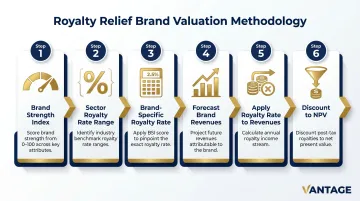
This methodology, compliant with ISO 10668, is used by Brand Finance and other valuation firms to generate defensible brand valuations for M&A purposes.
Brand Architecture Assessment
Brand architecture defines how brands in a portfolio relate to each other. Four primary models exist:
| Model | Definition | Singapore Example |
|---|---|---|
| Branded House (Monolithic) | Single master brand spans all offerings | DBS post-Citi Taiwan acquisition |
| Sub-brands | Master brand combined with distinct sub-brand names | SIA Group (Singapore Airlines, Scoot) |
| Endorsed Brands | Independent brands visibly linked to a parent | OCBC-Great Eastern relationship |
| House of Brands | Stand-alone brands with minimal corporate connection | Grab ecosystem (GrabFood, GrabPay) |
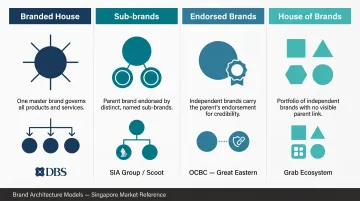
The choice of architecture determines which brands survive, which are retired, and how they are positioned relative to each other. That structural decision is inseparable from the cultural one: brand architecture only holds if the values behind it are genuinely aligned.
Cultural and Values Alignment
Brand values reflect the internal culture and operating principles of an organisation — they are not simply marketing language. In a merger, misaligned values between the two entities create internal friction that shows up as inconsistent customer experience. Employees who don't believe in the new brand will not authentically represent it to customers.
Stakeholder Perception Mapping
Understand how key stakeholders perceive each brand — and what trust each brand carries into the combined entity. The audiences that matter most typically include:
- Customers — existing loyalty, brand preference, and switching risk
- Employees — cultural alignment, morale, and retention risk
- Investors — confidence in the combined entity's brand strategy
- Regulators — reputational standing and compliance associations
- Partners — relationship equity and co-branding implications
Stakeholder mapping identifies which of these groups hold the strongest perceptions — positive or negative — and where integration decisions will face the most resistance.
A Step-by-Step Framework for Post-Merger Brand Evaluation in Singapore
Step 1 — Pre-Merger Brand Audit
Before the deal closes, conduct a comprehensive audit covering:
- Brand equity data from customer research
- Brand identity assets (logos, visual systems, messaging frameworks)
- Trademark registrations in Singapore and target markets (the Intellectual Property Office of Singapore (IPOS) is the statutory body for trademark registration)
- Current brand architecture and portfolio structure
IPOS recorded 55,109 trademark filings in FY2023/24, reflecting Singapore's active IP landscape. Conducting a trademark audit early prevents legal complications later.
Step 2 — Stakeholder Research
Conduct primary research with key audiences from both organisations:
- Customers (surveys, interviews)
- Employees (focus groups, culture assessments)
- Partners and suppliers (perception interviews)
This data is the foundation for all strategic brand decisions. Without it, you're making brand architecture choices based on executive preference rather than market reality.
Step 3 — Brand Value Scoring and Gap Analysis
Use research findings to score each brand across key dimensions:
- Equity strength by segment
- Identity consistency and recognition
- Cultural alignment and internal credibility
- Market relevance and future potential
Map out where each brand leads and where it falls short — by dimension and by audience. That gap map drives the architecture decision in Step 4.
Step 4 — Brand Architecture and Positioning Decision
The gap analysis points toward one of three paths: consolidating under a single brand, creating a new unified identity, or maintaining a portfolio structure. Each has trade-offs in cost, market continuity, and internal alignment.
Define the positioning before finalising the architecture. The strongest brand structures are built around a clear market position — not the other way around. For Singapore-based organisations working through this decision, Vantage Branding supports teams through stakeholder research and architecture workshops tailored to local and regional markets.
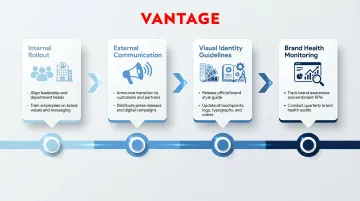
Step 5 — Brand Transition Roadmap
Develop a phased transition plan:
- Internal rollout first: Employees and leadership before external audiences
- External communication: Customers, partners, media with clear timelines
- Visual identity guidelines: Comprehensive standards for consistent application
- Milestones for monitoring brand health: KPIs, customer satisfaction surveys, social media engagement tracking
Singapore-Specific Factors That Shape Post-Merger Brand Value
Multicultural Audience Dynamics
Singapore's diverse population—75.6% Chinese, 15.1% Malay, 7.6% Indian, and 1.7% Others—means brand names, visual identities, and messaging carry different cultural resonances. A brand strongly associated with one community may not transfer its equity seamlessly to another after a merger.
Regulatory and Compliance Considerations
Singapore's regulatory environment—particularly in sectors like financial services (MAS-regulated), healthcare, and government-linked industries—places constraints on how brands can be represented and communicated. MAS requires capital markets services licensees to notify MAS within 14 days of a name change. Post-merger brand changes in regulated sectors require additional compliance steps.
Regional Brand Ambitions
Many Singapore companies operate across Southeast Asia, so compliance is only one dimension of the brand evaluation. A post-merger assessment must also account for how target audiences in each market perceive each brand—not just locally. Key regional considerations include:
- Malaysia and Indonesia: High brand-awareness overlap with Singapore, but distinct cultural and language sensitivities apply
- Vietnam: A high-growth market where brand heritage and trust signals carry extra weight
- Cross-border mergers: Brand equity built in one country may not translate to the other, requiring separate evaluation frameworks
Common Mistakes That Erode Post-Merger Brand Value
Moving Too Fast Without Research
The most common mistake is making brand decisions—especially retiring a beloved brand—based on internal preference rather than stakeholder research. Customers and employees often have stronger loyalties to one brand than leadership realises. Ignoring this leads to churn and disengagement.
DBS executed a full brand absorption of Citi's Taiwan consumer banking business over a single weekend in August 2023, doubling its customer base to over 1.1 million and transferring close to 3,000 employees. This rapid branded-house approach prioritised speed but accepted the risk of customer disruption across millions of accounts.
Treating Brand as an Afterthought
Many companies focus on operational and financial integration first and treat brand as a cosmetic last step. Bain's 2023 research found that 70% of M&A deals result in failure, often due to cultural and brand integration issues. By the time brand strategy is addressed, the market has already formed opinions about the merged entity — and reversing those perceptions costs significantly more than getting it right from the start.
Underestimating Internal Culture
Brand values that exist only on paper will not survive a merger. A combined brand must be credible to employees before it can be credible to customers. Internal integration is where most post-merger brand efforts fall short:
- Employee workshops that align teams around shared values and behaviours
- Communication guidelines that ensure consistent messaging across both legacy organisations
- Leadership buy-in that models the new brand culture visibly and consistently
- Feedback channels that give employees a voice in the transition
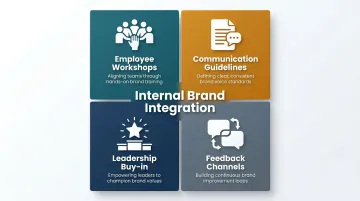
Without these foundations, external brand promises will not hold.
Frequently Asked Questions
What is brand equity and how does it relate to brand values and brand image?
Brand equity is the perceived value and strength a brand holds with its audience, built through awareness, trust, and loyalty. Brand values are the principles a company stands for; brand image is how those principles are perceived externally. All three are interconnected and all shift meaningfully in a merger.
What is a post-merger acquisition?
Post-merger acquisition refers to the period after two companies combine, during which the new entity must integrate operations, culture, and brand. It covers all the decisions and transitions that follow the deal closing.
Should a merged company keep both brand names or create a new one?
This depends on the relative equity of each brand, the target market, and strategic intent. Keeping both may suit a house-of-brands architecture, while a single new brand signals true transformation. Research and stakeholder data should drive this decision, not internal politics.
When should a company begin the brand evaluation process in a merger?
Start during due diligence—ideally before the deal closes—so that brand risks and opportunities are factored into deal valuation and integration planning, rather than being addressed reactively after the merger is public.
What is brand architecture and which model is best for post-merger situations in Singapore?
Brand architecture is the strategic framework governing how brands in a portfolio relate to each other. There is no universally "best" model; the right choice depends on brand equity data, audience research, and your specific business strategy.
How long does a post-merger brand evaluation typically take?
Timelines vary by company size and complexity, but a thorough brand evaluation—including stakeholder research, gap analysis, and architecture decision—typically takes between 6 to 16 weeks, with brand transition rollout extending further depending on scope.