Singapore's compact, competitive market makes this oversight particularly costly. With 358,300 enterprises in 2024 and SMEs comprising 99% of all businesses, you're not just competing for attention — you're fighting for survival. First impressions in this market are near-impossible to undo, and a weak brand at launch means you'll spend months (and budgets) trying to fix positioning that should have been right from day one.
This article walks Singapore businesses through a practical, brand-led approach to go-to-market strategy — from building the brand foundation to selecting channels and measuring impact — with Singapore's unique market context woven throughout.
TLDR:
- A GTM strategy without brand foundation is a launch plan without differentiation
- Singapore's 99% SME density and high brand credibility expectations make first impressions critical
- Brand positioning, visual identity, and messaging must be finalised before launch assets are created
- Government grants (EDG up to 50%, MRA up to 70%) subsidise brand strategy development
- Channel selection should reinforce brand positioning, not just reach audiences
What Is a Go-to-Market Branding Strategy (and Why Singapore Businesses Need One)
A go-to-market branding strategy is more than a launch checklist. It's the deliberate alignment of how a brand is positioned, communicated, and experienced at the moment of market entry or product launch.
The distinction matters:
- General GTM strategy: Focuses on channels, timelines, and tactical execution
- Brand-led GTM strategy: Brand identity and positioning actively shape every launch decision
In Singapore's context, this distinction becomes critical. The market is compact and highly competitive. According to the 2025 Edelman Trust Barometer, trust is now ranked as a purchase consideration equal to quality and price globally, with 80% of people trusting brands they currently use. For Singapore consumers, brand credibility and reputation are non-negotiable before any purchasing decision.
Why Singapore businesses can't afford to get this wrong:
Singapore operates as both a multicultural local market and a regional business hub. Brands must balance local resonance with broader appeal from day one.
A brand built intentionally before launch avoids costly repositioning later. This is especially true when testing positioning in Singapore before expanding to ASEAN markets like Malaysia, Vietnam, or Indonesia.
The 2019 NETS e-pay brownface controversy demonstrates what's at stake. The ad resulted in an IMDA "stern reminder" and sustained public backlash, showing that culturally misaligned messaging in Singapore triggers regulatory and reputational risk that no amount of paid media can fix.
In a market where nearly every business is an SME competing for the same attention, brand differentiation is what determines who gets remembered and who gets ignored.
Step 1: Build Your Brand Foundation Before You Go to Market
The brand foundation is the internal architecture behind all external GTM activity. Without it, your messaging becomes inconsistent and forgettable.
What the brand foundation includes:
- Brand Purpose — Why your business exists beyond profit, guiding every strategic decision
- Target Audience — Who you are specifically built for. Generic positioning ("we serve everyone") fails in Singapore's segmented market; specificity builds credibility
- Brand Personality — The tone, values, and character shaping every touchpoint, from website copy to how your sales team speaks
The Brand Positioning Statement: Your Internal Alignment Tool
Use this framework to clarify positioning before launch:
For [target customer] who [need], [brand name] is a [category] that [key benefit]. Unlike [competitor], we [primary differentiator].
This isn't marketing copy — it's an internal alignment tool. Every team member and agency partner should communicate the same value proposition consistently across channels.
Visual Identity Essentials
Once your positioning is locked, visual identity translates it into something customers can see and recognise. Before you launch, finalise these elements:
- Logo — Your primary brand mark
- Colour palette — Strategic colours that communicate brand personality
- Typography — Fonts that define your verbal visual language
- Imagery style — Visual content standards that ensure consistent storytelling
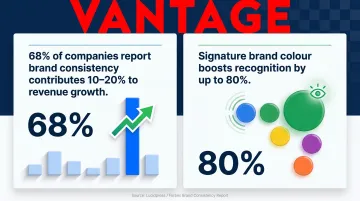
In Singapore's visually cluttered market — from MRT advertising to Instagram feeds — a distinct and consistent visual identity is a competitive advantage. Research shows that 68% of companies report brand consistency contributes 10-20% to revenue growth, while a signature brand colour boosts recognition by up to 80%.
Brand Story: Why It Matters in Singapore
Singaporean consumers respond to authentic narratives, especially ones that reflect local culture, lived experience, or clear purpose.
POSB Bank is a textbook example. Established in 1877 and positioned as "The People's Bank," its tagline "Neighbours First, Bankers Second" created loyalty that outlasted generations. The results speak for themselves:
- Nearly 70% of customers who opened passbook accounts as children still hold them as adults
- The PAssion POSB Debit Card reached over 2 million cardholders
- During the 1998 DBS-POSB merger (valued at S$1.6 billion), the POSB brand name was deliberately retained to prevent customer and staff attrition
That last point illustrates something worth noting: a strong brand story has quantifiable commercial value, not just sentimental appeal.
SMEs unsure where to begin can work with a specialist branding agency. Vantage Branding works with Singapore businesses on brand strategy and identity development, with services potentially eligible for up to 50% funding through the Enterprise Development Grant.
Step 2: Define Your Brand Positioning and Messaging for Singapore's Unique Market
Positioning determines where your brand lives in the customer's mind relative to alternatives. In Singapore, where consumers are pragmatic and research-driven, a clear and differentiated position is what converts awareness into action.
The goal is to own a space — a specific benefit, emotion, or audience niche — rather than trying to appeal to everyone.
Messaging for Singapore's Multicultural Market
English is the business language, but messaging should be tested across cultural contexts (Chinese, Malay, Indian communities) to ensure it lands without unintended friction.
Develop audience-specific messaging:
- Headline message — The single most important thing you want the market to know
- 3-4 supporting proof points — Evidence that substantiates the headline
- Objection handlers — Prepared responses to the most common hesitations
Example (B2B SaaS context):
Headline: "Enterprise workflow automation built for Singapore's regulated industries"
Proof points:
- MAS-compliant data residency and security architecture
- 40% faster implementation than global platforms due to local support
- Case studies from Singapore financial services and healthcare sectors
- Integration with CPF, IRAS, and ACRA systems
Objection handler: "Unlike offshore solutions that require months of compliance work, our platform is pre-configured for Singapore regulatory requirements."
Why Trust Signals Drive Purchase Decisions in Singapore
Research shows that 81% of consumers need to trust a brand before buying. In Singapore, trust signals routinely outperform purely promotional messaging — especially in regulated and high-consideration categories.
What builds trust:
- Earn third-party validation through awards, media coverage, and industry endorsements
- Signal longevity with client tenure data, heritage references, and track record specifics
- Publish social proof — testimonials, case studies, and recognisable client logos — where buyers research
Trust-building also shapes how you position for scale. Singapore brands that establish credibility locally find it far easier to earn it across the region.
Balancing Local and Regional Positioning
Singapore brands need to position for regional credibility (ASEAN or Asia-Pacific markets) from day one, even when launching locally.
Charles & Keith demonstrates this approach well. Founded in 1996 as a single ladies' footwear store in Singapore's Amara Shopping Centre, the brand used "affordable luxury" positioning to expand systematically: Indonesia (1998), the Philippines (2001), the Middle East (2004), and China (post-2011). Singapore's cosmopolitan population served as a testing ground — the brand refined its aesthetic here before exporting it to each new market.

The lesson: Positioning language and brand identity should be designed to scale — avoiding hyper-local references that won't travel — without losing the authentic Singapore origin story that differentiates you.
Step 3: Build a Brand-Led Channel Strategy for Your GTM Launch
Your channels should be chosen not just based on where your audience is, but on which channels best reinforce the brand experience you're trying to create.
Channel choice is itself a brand signal. A premium B2B brand that opens on TikTok communicates something very different from one that leads with LinkedIn and industry media — and that difference shapes first impressions before a prospect reads a single word of your content.
Map Channels to Brand Goals
Focus on 3-4 channels where brand impact is highest, not spreading budget across everything.
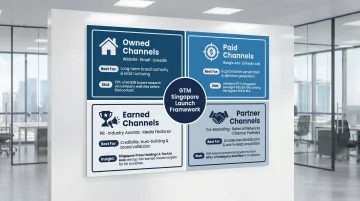
Channel categories for Singapore GTM launches:
| Channel Type | Best For | Singapore Context |
|---|---|---|
| Owned (website, email, LinkedIn content) | Controlled messaging, long-term asset building | Essential foundation for all launches |
| Paid (Google Ads, LinkedIn Ads, targeted social) | Intent capture, targeted reach | LinkedIn reaches 86.7% of Singapore population |
| Earned (business media, industry awards, PR) | Credibility signals, third-party validation | CNA and Straits Times carry 74% and 73% trust respectively |
| Partner (co-marketing, referral networks, trade associations) | Trust transfer, warm introductions | Critical in Singapore's tight professional networks |
LinkedIn in Singapore: DataReportal reports LinkedIn's advertising audience reached 5.10 million members by late 2025, equivalent to 86.7% of the total population. For B2B GTM launches, LinkedIn isn't a niche channel in Singapore — it's a mass professional platform.
The Traditional vs. Digital Balance
Singapore businesses — especially in B2B, healthcare, and government sectors — still respond to credibility signals from traditional channels.
Traditional channels that still matter:
- Trade publications
- Industry awards
- Conference presence and speaking slots
- Print media in trusted outlets
Reuters Institute data shows overall trust in news in Singapore stands at 47%, but the most trusted news brands are CNA (74%) and The Straits Times (73%). Earned media placement in these outlets carries disproportionate brand credibility relative to general social media presence.
A practical starting point: use digital channels to build reach and capture intent early, then layer in traditional earned media to reinforce credibility as you move deeper into the sales cycle.
Consistency as a Channel Strategy Discipline
Every channel should deliver the same brand voice, visual identity, and core message. Inconsistency across channels is one of the most common GTM branding mistakes.
Done well, brand consistency across channels looks like:
- Same logo, colour palette, and typography across LinkedIn, website, and trade event booth
- Same headline positioning message across all channels (adapted for format, not fundamentally changed)
- Same brand personality in email nurture sequences, social posts, and sales presentations
The gaps show up more often than most brands expect. Common consistency failures include:
- Professional, corporate tone on LinkedIn but casual, playful tone on Instagram (without strategic reason)
- Different value propositions on the website vs. paid ad landing pages
- Mismatched visual styles between digital and physical collateral
Singapore-Specific Branding Considerations That Shape GTM Success
Government Grants Subsidise Brand Strategy Development
Enterprise Development Grant (EDG): Covers up to 50% of eligible costs for Strategic Brand and Marketing Development projects. This includes brand diagnosis, competitive analysis, research, brand strategy development, and brand financial valuation.
Not covered: Production of collaterals (brochures, videos, websites), implementation of marketing campaigns, retainer fees, advertising and media buys.
Market Readiness Assistance (MRA) Grant: Now covers up to 70% of eligible costs for overseas market expansion (enhanced from 50%, effective 1 April 2026). Capped at S$100,000 per company per new market across three pillars: overseas market promotion (S$20,000), overseas business development (S$50,000), and overseas market set-up (S$30,000).
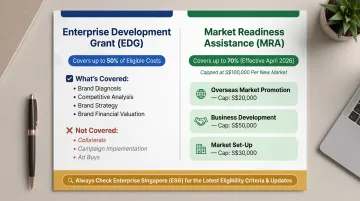
Check Enterprise Singapore's official website for current eligibility and funding percentages.
Singapore as a Regional GTM Testing Ground
The market's small size means brands can validate their positioning, messaging, and channel effectiveness quickly before committing to ASEAN markets. Brands that get this right in Singapore typically avoid costly repositioning exercises when they expand — a rework at the regional level can run two to three times the original brand development cost.
Professional Networks Accelerate B2B Traction
Singapore's business community is tightly connected, and brand reputation moves fast. A strong first impression at launch — backed by deliberate relationship-building — often generates early pipeline more efficiently than paid channels. For B2B brands especially, a structured referral or advocate programme tends to shorten sales cycles and lower customer acquisition costs in the first 12 months.
Measuring Brand Impact After Your GTM Launch
Brand performance measurement in a GTM context means tracking signals that connect brand activity to business outcomes. That means going past follower counts and impressions — and focusing on awareness, sentiment, and conversion data that show whether your positioning is actually landing with the right audience in Singapore.
Key Brand Indicators to Track Post-Launch
Brand Awareness:
- Aided and unaided recall surveys
- Share of voice in target media channels
- Search volume for branded terms
Brand Sentiment:
- Social listening and media monitoring
- Customer feedback and review sentiment
- Net Promoter Score (NPS)
Brand Conversion:
- Percentage of brand-aware prospects who convert to leads
- Lead quality scores by awareness source
- Customer acquisition cost by channel
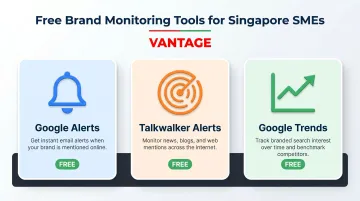
Free/affordable tools Singapore SMEs can use:
- Google Alerts: Tracks web mentions of your brand keywords at no cost
- Talkwalker Alerts: Monitors news, blogs, and web mentions for free
- Google Trends: Tracks search interest over time and benchmarks against competitors
Post-Launch Brand Review Cadence
Weekly performance checks (first month):
- Channel traffic and engagement
- Lead quality and conversion rates
- Messaging resonance signals
30-day brand audit:
- What's landing vs. what's misaligned
- Where customers are dropping off
- Channel performance vs. brand goals
90-day strategic review:
- Is positioning generating intended market perception?
- What messaging resonates with which audience segments?
- Where should we double down or pivot?
Brands that build a structured review cadence typically outperform those that treat launch day as the finish line. The data from your first 90 days tells you exactly where to invest next — treat it as your clearest strategic input, not a report card.
Frequently Asked Questions
What is the difference between a GTM strategy and a branding strategy?
A GTM strategy is a launch execution plan covering channels, timelines, and tactics. A branding strategy defines who you are, what you stand for, and how you're perceived. The most effective launches integrate both from the start.
How long does it take to develop a go-to-market branding strategy in Singapore?
Typically 8–12 weeks total: 2–4 weeks for brand foundation and positioning, 2 weeks for messaging and channel planning, and 4–6 weeks for asset creation and launch preparation.
What branding elements should be finalised before a GTM launch?
These four elements must be locked before any launch assets are created:
- Brand positioning statement
- Visual identity (logo, colours, typography)
- Brand voice and messaging hierarchy
- Core brand story
How does Singapore's multicultural audience affect a GTM branding approach?
Test messaging across cultural contexts before launch. Imagery, language, and tone should be inclusive — generic messaging rarely resonates with Singapore's diverse community groups.
Can Singapore SMEs access government grants for GTM branding activities?
Yes. The Enterprise Development Grant (EDG) covers up to 50% of brand strategy work, while the Market Readiness Assistance (MRA) grant covers up to 70% of overseas expansion costs. Check Enterprise Singapore's official website for current eligibility.
Should a Singapore brand prioritise digital or traditional channels in its GTM launch?
The most effective GTM launches blend both — digital for reach and targeting efficiency, traditional for credibility signals (especially in B2B, healthcare, and government sectors). Channel choice should be led by where your target audience places their trust.