Introduction: Why Branding Is the Make-or-Break Factor for SEA Expansion
Southeast Asia stands out as one of the world's fastest-growing consumer markets. The region's digital economy reached $263 billion in GMV in 2024, marking a 15% year-on-year increase. Private consumption across the SEA-6 markets is projected to grow 8% annually, reaching nearly $5 trillion by 2035.
Yet most brands fail when they enter this market. The reason is almost always the same: they treat Southeast Asia as one unified market, when in reality it spans vastly different cultures, languages, and consumer behaviours across Indonesia, Vietnam, Thailand, Malaysia, Singapore, and the Philippines.
The core challenge is holding together a consistent global brand identity while adapting deeply enough to earn genuine local trust. What follows are the strategies that make both possible.
TLDR:
- SEA's $263B digital economy rewards brands that invest in equity early
- 1,370+ languages and fragmented platforms mean one message won't reach everyone
- Strong SEA brands keep a consistent core while flexing messaging market by market
- Singapore's regulatory stability makes it the go-to first-market anchor in SEA
- Treating localisation as translation—not strategy—is the fastest route to churn
Why Southeast Asia Is a High-Stakes Branding Opportunity
Southeast Asia presents a rare combination of scale, growth, and digital maturity that few regions can match.
Unprecedented Digital and Economic Growth
The region's digital economy reached $263 billion in GMV in 2024, with revenues growing 14% to $89 billion and profits increasing 2.5x in just two years. More telling: private consumption across Indonesia, Malaysia, the Philippines, Singapore, Thailand, and Vietnam is projected to grow 8% annually, reaching nearly $5 trillion by 2035—potentially surpassing North America.
Young, Digital-Native Consumers with High Brand Awareness
More than one-third of SEA's 670 million inhabitants are aged 15-34, with internet penetration averaging 79.44% across the region. Filipinos spend nearly 11 hours online daily—60% more than the global average. These consumers are digitally fluent, brand-conscious, and increasingly discerning.
Awareness doesn't equal loyalty, though. 25% of SEA consumers are actively switching brands to find better value, and 42% seek the same products at lower prices. Gen Z consumers in particular prefer brands that distinguish them over traditional household names.
That makes first impressions and brand positioning decisive from day one. Consumers who leave rarely come back — and the switching data shows they have no shortage of alternatives to choose from.
SEA Rewards Early Brand-Building Over Product Differentiation Alone
In Europe or North America, established distribution and product heritage give incumbent brands a durable edge. SEA works differently. The market is growing fast, consumer preferences are still forming, and brands that build equity early capture ground that latecomers struggle to recover.
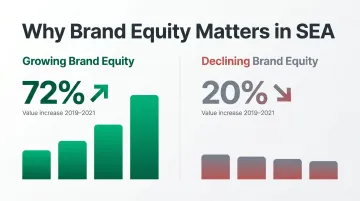
Kantar's research shows that brands with growing equity increased their value by 72% between 2019 and 2021, compared to just 20% for brands with declining equity. In a region where consumers are brand-aware but not yet locked into long-term loyalty, a meaningful and differentiated brand is the most durable competitive advantage a business can build.
The Core Branding Challenge: Navigating a Deeply Diverse Region
The single biggest mistake brands make in SEA is underestimating how different each market truly is.
Extreme Linguistic and Cultural Diversity
Southeast Asia has approximately 1,370 living indigenous languages, according to Ethnologue. Indonesia alone accounts for over 700 languages, the Philippines 100+, Myanmar 100+, and Malaysia 100+. A single brand narrative almost never travels unchanged across markets when the underlying languages, cultural references, and value systems are this diverse.
Religious and social contexts vary just as sharply. Islamic values shape brand expectations in Indonesia and Malaysia — modesty, family orientation, and halal compliance influence everything from imagery to tone.
Elsewhere, Vietnam's collectivist culture prioritises community endorsement over individual achievement. Thailand's Buddhist-influenced consumer mindset responds to entirely different emotional triggers than the predominantly Catholic Philippines.
Platform Behaviour Diverges Sharply Across Markets
Brand voice must adapt to how consumers actually engage with content:
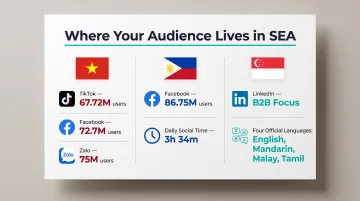
- Vietnam: TikTok reaches 86.3% of adults 18+ (67.72 million users), while Facebook maintains 72.7 million users. Zalo, a local super app, has 75 million active users. Commerce is increasingly video-native.
- Philippines: Facebook dominates with 86.75 million users (73.4% social penetration). Filipinos spend 3 hours 34 minutes daily on social media—among the highest globally.
- Singapore: Four official languages (English, Mandarin, Malay, Tamil) create a unique multicultural environment. LinkedIn carries disproportionate weight for B2B brands.
Brands that develop a single social content strategy and distribute it across markets struggle to generate meaningful engagement.
The Cost of Ignoring Cultural Nuances
Microsoft famously recalled 200,000 copies of Windows 95 at a cost of millions after displaying an incorrect border for Kashmir in its mapping software. It's a broader Asian example, but the principle applies directly to SEA: cultural and geopolitical insensitivity in brand execution causes real financial and reputational damage.
In SEA, common missteps include:
- Colour symbolism — white signifies mourning in parts of SEA; red represents luck and festivity
- Imagery choices — visuals that feel neutral in one market can offend in another
- Influencer fit — the wrong archetype can undermine credibility rather than build it
- Religious tone — failing to respect local sensitivities can alienate entire demographic segments overnight
Brand Proximity: The Key Success Metric
Kantar's Meaningful Different Framework measures brand equity through three dimensions: Meaningful (meeting functional needs and creating emotional connection), Different (standing apart), and Salient (coming easily to mind). Brands with high Demand Power generate 9x the volume share of low-power brands.
In SEA, local relevance is what separates outperforming brands from the rest — not price. Brands perceived as locally meaningful and differentiated are twice as likely to remain in BrandZ rankings over 20 years.
The competitive pressure is real: local and regional manufacturers now command over 50% of FMCG market value through aggressive distribution and faster localised innovation. Foreign brands cannot assume relevance — they have to build it.
Building a "Glocal" Brand Framework for SEA
The most successful SEA expansions follow a "glocal" approach: maintain a consistent global brand core while creating flexible adaptive layers tailored to each market.
What "Glocal" Means in Practice
A glocal branding framework preserves your brand's essential identity—purpose, values, visual identity system—while creating flexible elements (messaging, tone, campaign creative, local proof points) that can be adapted per market.
Nike's SEA Strategy demonstrates this approach. The brand launched its first-ever regional app specifically for Southeast Asia and India in 2021, covering Singapore, Thailand, the Philippines, Malaysia, Vietnam, and Indonesia. The SEA and India region accounts for 30% of Nike's total global app downloads, making it Nike's fastest-growing digital platform globally. The app maintains Nike's core brand identity while delivering localized sport and style guidance, community engagement, and culturally relevant content.
McDonald's Malaysia offers another example. The brand runs an annual "Prosperity Burger" campaign around Lunar New Year—a product created specifically for the Malaysian market with no US equivalent. The 2026 campaign, "The Blessing," positions prosperity not as material wealth but as family togetherness, resonating with Malaysian cultural values while maintaining McDonald's global brand architecture.
Defining Your Brand Core vs. Adaptive Elements
Before entering any SEA market, establish clear boundaries:
Non-Negotiable Brand Core:
- Logo and primary visual identity system
- Brand purpose and core values
- Brand promise (what you commit to deliver)
- Primary colour palette
- Key brand assets (sonic identity, signature design elements)
Adaptive Layer (Market-Specific):
- Taglines and messaging hierarchy
- Campaign visuals and creative executions
- Cultural references and storytelling structure
- Influencer and spokesperson choices
- Social content formats and platform strategy
- Product naming conventions
- Customer proof points and testimonials
The distinction matters because it determines where you invest in consistency (building long-term equity) versus where you invest in relevance (driving immediate connection).
Conducting Brand Research Before Market Entry
Never carry assumptions from your home market into SEA. Brand strategy should be preceded by research across three areas:
- Consumer perception: How do target consumers in this market view your category, competitors, and brand attributes — and which emotional or functional benefits matter most to them?
- Competitive landscape: Who are the established local and regional players, what positioning do they own, and where are the genuine gaps?
- Cultural sensitivity: Which visual, verbal, or symbolic elements could cause unintended offence, and what local conventions must you respect?
Skipping this research is one of the most common causes of brand failure in the region. Vantage Branding's work across Singapore, Malaysia, and Vietnam emphasises this insight-led approach, using brand discovery workshops, stakeholder interviews, and market analysis to inform strategy before creative execution begins.
Brand Architecture Decisions for Multi-Market SEA
Your brand architecture choice affects both investment efficiency and consumer trust:
- Monolithic/Branded House: A single master brand covers all offerings (e.g., Apple, FedEx). This maximises brand equity concentration but requires the core brand to flex across diverse markets.
- Endorsed Brand: Sub-brands maintain their own identity while being endorsed by a parent brand (e.g., Marriott portfolio). This allows local adaptation while leveraging parent brand credibility.
- House of Brands: A portfolio of independent brands, each with a distinct identity (e.g., P&G's Tide, Pampers, Gillette). This allows maximum local customisation but requires higher brand-building investment per market.
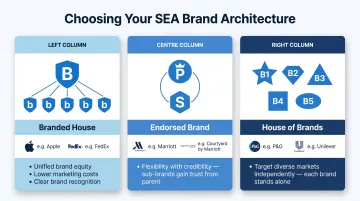
The right choice depends on your category, competitive context, and resource availability. For companies entering SEA from Singapore or expanding regionally for the first time, working with a branding partner who understands both global standards and local market dynamics reduces the cost of missteps significantly.
Key Branding Strategies for Expanding into SEA Markets
Market-Specific Brand Positioning
Rather than applying a single value proposition across every market, identify what resonates most in each. The priorities differ significantly:
- Singapore: Trust and reliability carry the most weight in a risk-averse, highly regulated environment
- Vietnam and Indonesia: Value and social proof matter more in price-sensitive, high-growth markets
- Thailand: Status and differentiation drive purchase decisions in more aspirational consumer segments
Craft your positioning accordingly. This doesn't mean creating entirely different brands—it means emphasizing different facets of your core brand promise based on what each market values most.
Social-First Brand Storytelling
Video commerce now accounts for 20% of total e-commerce GMV in SEA, up from less than 5% in 2022. With social commerce accelerating across the region, brand narratives must be built for short-form, platform-native formats (TikTok, Instagram Reels, Facebook Stories) that can be localized at volume.
This is fundamentally different from adapting global campaign assets. It requires:
- Building modular brand stories that work in 15-60 second formats
- Creating visual language systems optimized for vertical video
- Developing content frameworks that local teams can execute without heavy headquarters oversight
- Designing for sound-off viewing (captions, strong visual storytelling)
In Vietnam, where over 70% of users report purchasing after seeing influencer promotions, authenticity and peer endorsement consistently outperform polished production values. That same logic extends to how trust is built across the region more broadly.
Trust-Building as a Branding Imperative
In SEA markets where brand recognition is limited, trust signals carry outsized weight:
- Co-brand with established local players to borrow credibility quickly
- Seek third-party validation from respected regional publications and industry voices
- Participate visibly in local causes and cultural moments, not just commercial ones
- Communicate your brand values clearly — audiences want to know what you stand for
Local brands now command over 50% of FMCG market value in SEA — winning on trust and local relevance, not just price. Foreign brands must build these same signals deliberately.
Brand Localization Beyond Translation
Effective localization adapts:
Visual Identity Elements:
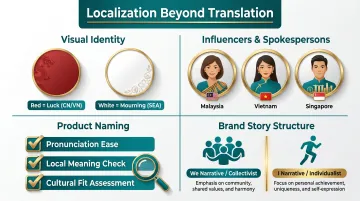
- Red signals luck and festivity in Singapore and Malaysia; gold represents prosperity; white can indicate mourning in some contexts; blue is broadly trusted across the region
- Using culturally relevant colours increases ad recall by up to 40%, while culturally incorrect colours can reduce conversions by 20-35%
Spokespersons and Influencer Archetypes:
- Malaysia and Indonesia respond to family-oriented, modest influencer personas
- Vietnam values community leaders and peer recommendations
- Singapore's multicultural environment requires diverse representation
Product Naming Conventions:
- Avoid names that sound negative or inappropriate in local languages
- Consider meaning, pronunciation, and cultural associations
- Test names with native speakers before launch
Brand Story Structure:
- Collectivist cultures respond better to "we" narratives than "I" narratives
- Some markets value origin stories and heritage; others prioritize innovation and future vision
- Emotional triggers differ: aspiration vs. belonging vs. security
Navigating these decisions — what to standardize, what to adapt — is where brand strategy does its heaviest lifting. For companies entering SEA from Singapore or expanding across Malaysia and Vietnam, Vantage Branding combines market research with brand strategy frameworks to make those calls with confidence.
Common Branding Mistakes to Avoid in SEA
Mistake 1: Assuming Cultural Similarity Equals Consumer Similarity
English fluency in Singapore does not mean Singaporean consumers share the same brand expectations as UK or US audiences. ASEAN economic integration does not mean consumers in Thailand think like consumers in Indonesia.
Each market has distinct historical context, regulatory environment, media consumption patterns, and purchase decision hierarchies. Treat each market as a unique branding challenge requiring dedicated research and strategy.
Mistake 2: Treating Localisation as a Translation Exercise
Brands that simply translate their global tagline or campaign assets without rethinking the underlying emotional hook for each market often generate low engagement and can unintentionally offend.
Translation converts words; localisation converts meaning, context, and emotional resonance. A tagline that works in English may sound awkward, presumptuous, or meaningless when directly translated into Bahasa Indonesia or Vietnamese. Worse, it may inadvertently reference something culturally inappropriate.
Invest in native-speaking brand strategists and cultural consultants who can identify these risks before launch.
Mistake 3: Prioritising Short-Term Performance Marketing Over Brand Equity
In SEA, where consumer trust in foreign brands must be earned, brands that skip brand-building in favour of aggressive paid acquisition often face high churn and weak loyalty once campaigns stop.
Kantar's data shows that brands with growing equity increased their value by 72% between 2019 and 2021, versus only 20% for declining-equity brands. Research by Les Binet and Peter Field demonstrates that brand building has the greatest impact on future sales, and that brand and performance marketing enhance each other when balanced correctly.
The pattern holds across categories:
- Airbnb saw a 20% traffic increase after shifting to brand building with its "Made Possible by Hosts" campaign in 2021
- Heinz experienced declining performance after pulling back on brand equity in favour of short-term sales activations
In a high-growth, competitive region like SEA, sustainable success means building equity that compounds — not renting attention through paid media.
Using Singapore as a Brand Anchor for Regional SEA Expansion
Why Singapore Is the Ideal First Market
Singapore ranked #1 globally in the World Bank's Business Ready (B-READY) 2025 report, confirming its position as the world's most business-ready economy. The assessment evaluates regulatory framework, public services, and operational efficiency across 101 economies.
Singapore offers:
- An English-language environment that lowers linguistic barriers for initial market testing
- A globally trusted regulatory framework that signals credibility to investors, partners, and consumers
- Four official languages (English, Mandarin, Malay, Tamil) and a diverse ethnic mix — making it a natural testing ground for brand messaging across key SEA demographic groups
- A "regional credibility premium" that established Singapore brands carry into neighbouring markets, accelerating trust-building from day one
The Phased Expansion Model
These attributes make Singapore the logical starting point — and they directly inform how the phased expansion model works in practice.
Phase 1: Validate in Singapore
- Test brand positioning and messaging
- Refine visual identity and customer experience
- Build operational systems and partnerships
- Establish regional credibility
Phase 2: Expand to Malaysia and Vietnam
- Roll out with proven brand assets
- Apply localized frameworks developed in Singapore
- Adapt messaging for cultural and linguistic differences
- Leverage Singapore credibility to accelerate trust
Phase 3: Scale to Indonesia and Thailand
- Enter higher-complexity markets with battle-tested brand
- Invest in deeper local adaptation
- Build market-specific partnerships and distribution
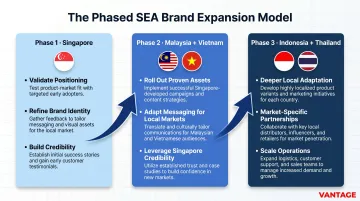
The sequence matters: each market builds on the last. By the time a brand reaches Indonesia or Thailand — the region's most complex consumer environments — it carries proven assets, refined positioning, and a credibility trail that starts in Singapore.
Frequently Asked Questions
What is the global branding strategy?
A global branding strategy is how a company builds a consistent brand identity across international markets while adapting its messaging and creative execution to stay relevant in each one. The core brand stays intact; what changes is how it speaks to local audiences.
What is an example of a global brand?
Nike and McDonald's are strong examples. Nike maintains consistent brand identity worldwide while adapting campaigns to local cultures—such as its SEA-specific app that localizes content for Singapore, Thailand, Malaysia, Vietnam, and the Philippines. McDonald's keeps its core brand architecture intact while creating market-specific products like Malaysia's Prosperity Burger for Lunar New Year.
How do you localize a brand for Southeast Asia?
Start with market-specific consumer research, then build outward from there:
- Adapt messaging tone and visual identity to local cultural sensitivities
- Choose brand ambassadors or partnerships that carry local credibility
- Create platform-native content for each market's dominant channels (TikTok in Vietnam, Facebook in the Philippines)
What makes branding in Southeast Asia different from other regions?
SEA packs extraordinary diversity into a compact geography: 1,370+ living languages, multiple dominant religions, and consumer behaviours that shift sharply from one market to the next. Add a young, digitally active population with rising brand awareness, and brand relevance and trust become decisive in ways they simply aren't in more homogeneous regions.
Why is Singapore a good starting point for SEA brand expansion?
Singapore offers a stable, English-language, pro-business environment (ranked #1 globally in the World Bank's B-READY 2025 report) that allows brands to test positioning, build credibility, and refine operational systems before scaling into higher-complexity SEA markets like Indonesia or Vietnam. Its multicultural population also serves as a testing ground for regional messaging.