Introduction
Southeast Asia is one of the most dynamic and complex brand-building environments in the world. The region encompasses 10 nations, over 680 million consumers, and a digital economy on track to surpass $300 billion in 2025—a 7.5x increase from just a decade ago. This explosive growth rewards brands that commit to genuine regional strategy built for the region's actual diversity.
Yet many brands enter SEA with a critical blind spot. They apply a generic global playbook and expect it to work across Indonesia, Vietnam, Thailand, Malaysia, and the Philippines. When campaigns underperform and brand recognition stalls, the core mistake is treating SEA as a single, homogeneous market — not a collection of distinct cultures, languages, and consumer behaviours.
This guide lays out the strategic principles needed to grow a brand with sustained relevance and recognition across Southeast Asia. You'll learn how to balance regional consistency with local cultural relevance, why digital and social commerce are non-negotiable growth channels, and how a phased expansion approach prevents costly missteps.
TLDR: Key Takeaways
- SEA encompasses 10 nations with distinct cultural, linguistic, and consumer differences—a tailored approach for each market is essential
- Strong brand foundation (positioning, identity, voice) must come before market expansion to prevent fragmentation and wasted spend
- Cultural storytelling and local relevance drive brand trust faster than translated global campaigns
- Social commerce and mobile-first channels are where brand awareness is built and won—video commerce now accounts for 25% of total e-commerce in SEA
- Phased scaling (pilot, refine, expand) outperforms simultaneous multi-market launches
Why Southeast Asia Demands Its Own Brand Strategy
Southeast Asia isn't one market—it's 10 nations at varying stages of economic development, each with distinct languages, religions, consumer behaviours, and digital ecosystems. Brands entering with a copy-paste global approach routinely underperform because they misread the regional complexity.
The opportunity is substantial. SEA's digital economy reached $263 billion in 2024, growing 15% year-on-year. By 2025, the region's gross merchandise value (GMV) is projected to exceed $300 billion—1.5 times the initial forecast. This growth is powered by 200 million new users who've come online in the past decade, with 3 in 5 people now shopping digitally.
The SEA middle class is also growing fast. By 2030, Asia could account for two-thirds of the global middle class, with 700 million new members added between 2025 and 2030. Vietnam alone is expected to add 36 million people to its middle class by that year.
These consumers aren't looking for the cheapest option. They seek brands that reflect their specific cultural values and aspirations, meaning brand differentiation outweighs price discounting.
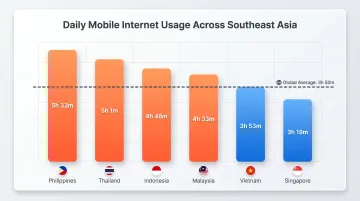
Daily mobile internet usage also varies dramatically across the region, reinforcing how mobile-first these markets truly are:
- Philippines: 5 hours 33 minutes
- Thailand: 5 hours 1 minute
- Indonesia: 4 hours 46 minutes
- Malaysia: 4 hours 33 minutes
- Vietnam: 3 hours 53 minutes
- Singapore: 3 hours 19 minutes
Four of the six major SEA markets exceed the global average of 3 hours 50 minutes. This mobile dominance shapes how brands must show up: social-first, visual, fast-loading, and interactive.
Brands that win in SEA balance regional consistency—so they're recognisable across markets—with local cultural relevance, so they feel native to each one. That tension sits at the core of every strategic decision explored in the sections ahead.
Build a Strong Brand Foundation Before You Expand
Brand strategy—not advertising or marketing campaigns—is the essential first step before any SEA market entry. Without a clearly defined positioning, value proposition, and brand architecture, messaging fragments across markets and confuses consumers. The result: inconsistent experiences, difficulty building trust, and wasted spend on campaigns that don't ladder up to a coherent brand story.
What a Robust Brand Foundation Comprises
Core strategic elements:
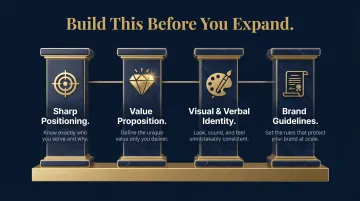
- Sharp positioning statement that differentiates the brand from local and global competitors
- Value proposition that can be adapted contextually without losing core meaning
- Consistent visual and verbal identity system (logo, colour palette, typography, tone)
- Brand guidelines that allow local flexibility without sacrificing core identity
Why this matters in SEA: when a brand lacks this foundation, local teams or partners improvise. Each market develops its own interpretation of what the brand stands for. By the time you've entered three markets, you effectively have three different brands—none building on the equity of the others.
Singapore's infrastructure, IP protection framework, and strategic geography make it the natural hub for developing centralised brand strategy before deploying across the wider region. Brands that do this work upfront—partnering with a Singapore-based agency like Vantage Branding, whose clients span healthcare, government, and finance across the region—avoid costly fragmentation and build recognition faster.
Real-World Consequences of Skipping This Step
Skipping the foundation phase creates compounding problems across markets:
- Your logo appears in different colour variations, messaging emphasises different benefits, and customers in Malaysia wouldn't recognise your brand in Indonesia
- One market positions you as premium, another as value-driven — expectations clash when customers encounter the brand across borders
- Marketing budgets are duplicated without building cumulative equity; each market effectively starts from zero
Getting the foundation right before you expand is what separates brands that scale cleanly from those that spend years untangling inconsistencies they created in year one.
Navigate Cultural Diversity Without Losing Brand Consistency
One Brand, Many Voices
A brand entering SEA should maintain a singular brand soul—consistent purpose, personality, and visual identity—while allowing local teams or partners to adapt tone, messaging, and creative execution to fit each market's cultural norms. This is the difference between brand dilution and brand localisation done well.
What to keep consistent:
- Logo and core visual identity (colours, typography, design system)
- Brand positioning and promise
- Core value proposition
- Overarching brand purpose
What to adapt locally:
- Language and linguistic nuances (not just translation)
- Cultural references, imagery, and visual storytelling
- Platform choice and channel strategy
- Local heroes, endorsers, or brand ambassadors
- Tone of voice (formal vs. conversational, depending on market norms)
This isn't a campaign decision—it's a brand architecture decision. Document what stays fixed and what flexes before you enter your first new market.
Cultural Storytelling as a Growth Driver
With your brand architecture defined, the next challenge is execution—specifically, how you tell your story across markets that respond to very different cultural cues.
Brands that localise their narratives—telling stories that reference local values, aspirations, or challenges—build faster trust and brand loyalty that global creative rarely achieves. Research shows that campaigns integrating local languages, regional influencers, and visual storytelling outperform standardised global content. Mobile-first strategies aligned with cultural values increase engagement, while high-context communication enhances message retention.
Critical cultural considerations brands frequently mishandle:
Bahasa Indonesia and Bahasa Malaysia are mutually intelligible but have important differences. Vocabulary false friends can cause embarrassment or offence:
- "Butuh" means "to need" in Indonesia but is vulgar slang in Malaysia
- "Baja" means "steel" in Indonesia but "fertiliser" in Malaysia
- Spelling differs: Indonesian uses "kualitas" (Dutch influence), Malaysian uses "kualiti" (English influence)
Halal credentials matter deeply in Indonesia and Malaysia, which together account for approximately 40% of SEA's population (~281 million people). Indonesia will require all cosmetics to be halal-certified starting October 2026. Wardah, an Indonesian halal cosmetics brand, has built roughly 30% market share in Indonesia's beauty sector on exactly this positioning.
Brands that misread religious and geopolitical sentiment pay a real price. Unilever Indonesia reported an 18% revenue drop in Q3 2024. Starbucks Malaysia's revenue fell from 1 billion ringgit to 676 million ringgit in fiscal 2024. Both declines were attributed to consumer boycotts.
SEA consumers also prioritise collective wellbeing and family-oriented narratives. Brand stories that centre individual achievement over community contribution consistently underperform — even when the product itself is strong.
Get the cultural framing wrong and even a well-resourced campaign will struggle to gain traction. Get it right, and your brand earns the kind of trust that advertising spend alone cannot buy.
Leverage SEA's Digital and Social Commerce Landscape
SEA's digital ecosystem is fragmented across platforms. Facebook dominates in the Philippines, TikTok and Instagram lead among younger demographics across the region, Zalo is critical in Vietnam, and Line has strong penetration in Thailand. Brands must conduct platform-by-platform research for each target market rather than applying a uniform channel strategy.
Platform preferences by market:
| Country | Top Platforms | Unique Local Platform |
|---|---|---|
| Philippines | Facebook, Messenger, Instagram, TikTok | Facebook dominance; nearly 45% of adults follow influencers |
| Vietnam | Facebook, Zalo, TikTok, Messenger | Zalo is the primary messaging app |
| Thailand | Facebook, Line, WhatsApp, TikTok | Line is essential for daily messaging |
| Indonesia | WhatsApp, Instagram, Facebook, TikTok | Average TikTok user spends 45 hours/month |
| Malaysia | WhatsApp, Facebook, Instagram, Telegram | Multilingual users (Malay, English, Mandarin, Tamil) |
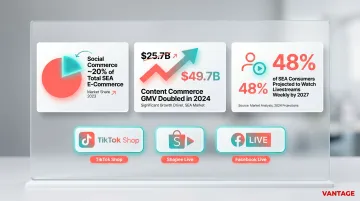
The central role of livestreaming: livestreaming via Shopee Live, TikTok Live, and Facebook Live is a brand-building and conversion tool unique to SEA. Content commerce nearly doubled from $25.7 billion to $49.7 billion in GMV in 2024. By 2027, 48% of SEA consumers are projected to watch livestreams at least once a week. In Thailand, 73% of shoppers have already used livestream shopping—the highest recorded rate in SEA.
Brand identity and messaging need to be built into these commerce formats from the start — not retrofitted as an afterthought.
Social commerce as the dominant commerce model: the line between brand discovery, engagement, and purchase happens in a single social session. Social commerce platforms (led by TikTok Shop) now account for approximately 20% of total e-commerce in SEA, with triple-digit GMV growth rates between 2022 and 2024 in Thailand, Vietnam, Malaysia, and the Philippines. Brands that design for this — with consistent visual identity, tone, and messaging across every social touchpoint — are better positioned to convert discovery into lasting preference.
Use a Phased Approach to Scale Across SEA Markets
Start with a Pilot Market and Prove the Model
Singapore-based brands typically begin with Malaysia as their first expansion market due to cultural proximity, geographic accessibility, shared heritage, and straightforward regulatory processes and established IP protection. Singapore-Malaysia bilateral trade totalled $78.70 billion as of October 2025, accounting for 13.5% of Malaysia's total trade.
Why Malaysia works as a pilot:
- Geographic proximity allows quick operational oversight
- Shared English proficiency reduces language barriers in business dealings
- Cultural affinity smooths negotiations and collaborations
- Lower operational costs (labour, real estate, cost of living)
- Access to 32+ million consumers and a growing middle class
- Tax incentives (Pioneer Status, Investment Tax Allowance, Special Economic Zones)
- ASEAN Free Trade Area (AFTA) reduces tariffs for cross-border trade
A pilot market allows you to test positioning, messaging, channel mix, and pricing assumptions before committing to more complex markets like Indonesia or Vietnam.
Build Local Trust Through Partnerships and Localisation
Local influencers, respected brand ambassadors, and established business partnerships serve as cultural translators — providing the social proof audiences need before engaging with an unfamiliar brand.
80% of social media users in Asia who follow influencers are likely to purchase products recommended by those influencers. Purchase likelihood is highest in Indonesia (61%) and the Philippines (60%). Trustworthiness and authenticity are the most important influencer traits in Thailand and Vietnam.
Plan partnership and localisation activities before launch — not as a fix for a slow start.
Localised digital touchpoints are baseline trust signals:
- Website and content in local languages (not just English)
- Support for local payment methods (e-wallets, cash-on-delivery where relevant)
- UX adapted to local device and connectivity realities
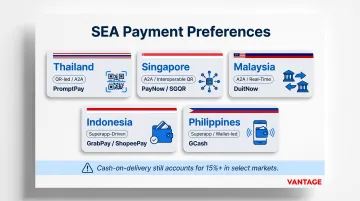
Regional payment preferences:
| Market | Primary Payment Model | Key Details |
|---|---|---|
| Thailand | A2A-dominant | 44% online, 43% in-person via PromptPay |
| Singapore | Card-led, wallets gaining | Cards 44% online; PayNow and SGQR growing |
| Malaysia | Superapp-driven | DuitNow real-time network |
| Indonesia | Superapp-driven | GrabPay, ShopeePay lead digital payments |
| Philippines | Superapp-driven | GCash dominant e-wallet |
Cash-on-delivery still accounts for over 15% of online purchases in select SEA markets. Ignoring local payment preferences creates friction at the final conversion step.
Once your pilot validates the model — positioning, pricing, channels, and payment flows — centralised brand guidelines become the scaling engine. They give each new market a consistent brand foundation without requiring bespoke creative from scratch.
Frequently Asked Questions
What makes Southeast Asia different from other regional markets for brand strategy?
SEA's unique combination of cultural diversity across 10 nations, mobile-first consumer behaviour, rapidly growing middle class, and fragmented digital platform landscape distinguishes it from more homogeneous regional markets like North America or Western Europe.
Should I adapt my brand identity for each SEA country or keep it consistent?
Maintain a consistent core brand identity — positioning, logo, key visual language — while adapting messaging, tone, storytelling, and channel approach to each country's cultural context. This balance protects brand integrity while allowing local relevance.
Which Southeast Asian market should Singapore brands enter first?
Malaysia is the most logical first market for most Singapore brands. Cultural proximity, language overlap, geographic access, and a relatively open regulatory environment make it a natural stepping stone before progressing to Indonesia or Vietnam.
How important is social media for brand growth in Southeast Asia?
Social media is the primary channel for brand discovery, community building, and purchase in SEA — particularly through social commerce formats like livestreaming. Treat it as a core channel, not an add-on.
How long does it take to build brand recognition in a new SEA market?
Brand recognition in a new SEA market typically takes 12–24 months of consistent, culturally relevant activity. Scaling spend without a localised strategy burns budget without building anything that lasts.
Do I need a local partner to succeed in Southeast Asia?
Not always, but local partners — whether agencies, distributors, or cultural consultants — sharply reduce the time and cost of getting things wrong. They accelerate trust-building in ways that outside teams rarely can replicate on their own.