The challenge is real: customer expectations change faster than business cycles. Competitors redefine categories overnight. Cultural values shift beneath your feet. The brand that built your business may no longer be the brand that grows it.
This guide provides a strategic breakdown of what brand repositioning is, when it's needed, the four core repositioning strategies, how to execute them effectively, and the costly mistakes to avoid.
TLDR:
- Brand repositioning shifts customer perception by updating your target audience, brand promise, competitive frame, or brand personality — while retaining core brand equity
- Repositioning differs from rebranding: it adjusts market perception without a complete identity overhaul
- Successful repositioning requires rigorous customer research, strategic clarity, internal alignment, and consistent execution
- The four types — audience, value proposition, competitive frame, and image repositioning — often work together in practice
What Is Brand Repositioning (and How Is It Different from Rebranding)?
Brand repositioning is a strategic effort to shift how a brand is perceived by its target audience. According to Harvard Business School Professor Jill Avery, it involves "refining and rewriting the brand's customer value proposition" across four levers:
- New consumer target — who you're speaking to
- New promise of value — what you offer them
- New competitive frame of reference — who you compete against
- New reasons to believe — why they should trust you
Crucially, repositioning doesn't discard your brand's core identity. It adjusts associations, promises, or competitive framing while preserving the equity you've already built.
How Repositioning Differs from Rebranding
Jim Heininger, founder of Rebranding Experts, clarifies the distinction in Forbes:
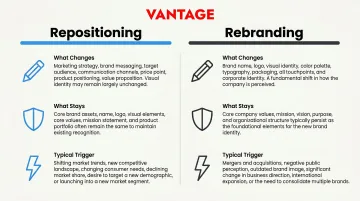
| Repositioning | Rebranding | |
|---|---|---|
| What changes | Messaging, pricing, distribution, product emphasis | Name, logo, visual system, sometimes business model |
| What stays | Existing brand name and visual identity | Little to nothing — identity is rebuilt from scratch |
| Typical trigger | Shifting audience, competitive pressure, growth goals | Crisis recovery, mergers, fundamental strategic pivots |
What Repositioning Changes (and What It Doesn't)
Repositioning can shift:
- Target audience or segment focus
- Brand promise or emotional positioning
- Competitive set or category framing
- Brand personality, tone, or visual expression
It should not abandon the core brand attributes customers already value. The strongest repositioning work builds on what already resonates — dropping what limits the brand, not what defines it.
Signs It's Time to Reposition Your Brand
Not every brand needs repositioning. But when market dynamics shift or customer perception lags behind reality, strategic repositioning becomes essential.
Common Repositioning Triggers
Brand awareness stays high, but purchase intent drops. Sales soften. Younger customers don't engage. There's a gap between what your brand represents and what customers value today — and that gap is widening.
New competitors are reframing the category. Established players shift positioning. Differentiation erodes. You find yourself competing on price rather than value, which is rarely a battle worth fighting long-term.
Your offering has outgrown your brand. Your business has expanded, pivoted, or refined its focus — but your brand still reflects what you did five years ago.
The market environment has shifted underneath you. Consumer values evolve, technology disrupts categories, and regulatory changes create new opportunities. What resonated three years ago may actively work against you now.
These triggers are warning signs — but they're not the only reason to reposition. The strongest moves often happen before performance declines.
Repositioning as Opportunity, Not Crisis
The most successful repositioning efforts are proactive, not reactive. Brands sense opportunity before performance declines:
- Reaching an untapped customer segment
- Responding to a meaningful shift in consumer values
- Expanding into an adjacent category
- Elevating to premium positioning
Self-Assessment Framework
Consider repositioning if:
- Customers can no longer clearly articulate what your brand stands for
- Your messaging no longer resonates with your ideal audience
- You compete on price because differentiation has eroded
- Internal teams struggle to explain your competitive advantage
Research cited by Landor found that 74% of S&P Global 100 companies rebranded within their first seven years — suggesting that staying static, not evolving, is the real anomaly.
The 4 Types of Brand Repositioning Strategies
The right repositioning strategy depends on whether you need to change your audience, your message, your competitive footing, or your perceived image. In practice, repositioning efforts often combine multiple types.
Repositioning by Target Audience
This involves shifting which customer segment you primarily address — either expanding to attract a new demographic or narrowing to a higher-value niche.
Gucci's millennial pivot exemplifies this strategy. When Creative Director Alessandro Michele joined in 2015, Gucci repositioned from traditional exclusivity toward authenticity and personal expression. The brand targeted millennials and Gen Z through cultural partnerships, hip-hop integration, and digital-native marketing.
The results: 44.6% annual sales growth in 2017 and 48.7% quarterly growth in Q1 2018, with millennials and Gen Z accounting for nearly 50% of total sales.

Audience repositioning typically requires updating visual identity, tone of voice, and channel strategy alongside messaging.
Repositioning by Brand Promise or Value Proposition
This shifts what the brand fundamentally claims to offer — moving from functional attributes to emotional resonance, or from product benefits to values-based positioning.
Dove's "Real Beauty" campaign is the canonical example. In 2004, Dove repositioned from "gentle soap with moisturisers" to champion of self-esteem and inclusive beauty. The shift was grounded in research showing that only a small percentage of women considered themselves beautiful.
By 2023, Dove delivered €6 billion in annual turnover for Unilever and achieved brand value nearing $6.5 billion. The brand now holds the #1 body wash position in America.
This type of repositioning demands the strongest internal alignment — because it changes the brand's emotional core, not just its communications.
Repositioning by Competitive Framing
This changes the competitive set your brand positions itself against — moving up-market, down-market, or into an entirely new category.
Domino's repositioned from "pizza delivery company" to "technology company that delivers pizza." After acknowledging publicly that customers thought their pizza "tasted like cardboard," Domino's reformulated every ingredient and launched the "Pizza Turnaround" campaign in 2010.
What followed was a full operational shift:
- Invested in digital ordering, the pizza tracker, and GPS delivery technology
- By 2025, more than 85% of U.S. retail sales came through digital channels
- Stock rose from under $10 to $530 per share
Competitive repositioning works when it unlocks entirely new advantages in how customers evaluate your offering — not just how you describe it.
Repositioning by Image or Personality Refresh
This updates the brand's tone, aesthetic, or cultural associations to feel more current — without necessarily changing core audience or promise.
Old Spice repositioned from "old man's cologne" to a witty, culturally fluent brand for younger men through the "Smell Like a Man, Man" campaign in February 2010.
Nielsen data confirmed body wash sales rose 55% over three months and 107% in the most recent month following the campaign launch. The product itself hadn't changed — only how the brand showed up in the world.
This approach suits brands whose core offering is sound but whose public image has drifted out of step with their audience.
How to Execute a Brand Repositioning Strategy
Most repositioning efforts don't fail at the strategy stage — they fail in execution. These five steps give you a structured path from diagnosis to launch.
Step 1: Audit Your Current Brand Health
Before repositioning, understand where you stand. Conduct a thorough brand health assessment covering:
- Customer awareness — who knows you exist
- Perception — what they believe you stand for
- Emotional associations — how they feel about you
- Competitive positioning — where you sit relative to alternatives
- Purchase behaviour — who buys, why, and how often
Use customer surveys, perceptual mapping, social listening, and competitor analysis. Repositioning built on assumptions — rather than evidence — is one of the most common failure points.
Step 2: Define the Repositioning Goal and New Position
Translate audit insights into a clear, specific repositioning objective:
- Who is the new target customer?
- What is the refined brand promise?
- What is the new competitive frame of reference?
- What are the reasons to believe?
Vague goals lead to diluted execution. This step should produce a concrete positioning statement — one that is specific enough to guide every creative and communications decision that follows.
Step 3: Retain What Works, Change What Doesn't
Not everything about the existing brand needs to change. Wholesale abandonment of established equity is a common mistake — one that destroys value rather than creating it.
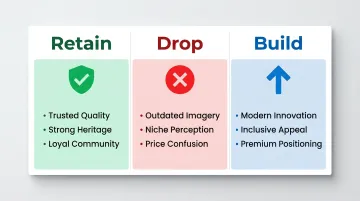
Before making changes, map what to keep versus what to shed:
- Retain: Core attributes customers already value and associate with you
- Drop: Perceptions that are unfavourable, too narrow, or no longer relevant
- Build: New associations that support the repositioned direction
Step 4: Align Internal Stakeholders Before Going External
Repositioning fails when internal teams — sales, customer service, operations — aren't bought in. Ensure the new positioning is:
- Understood across all levels
- Believed by frontline staff
- Reflected in every customer touchpoint
Frontline employees are brand ambassadors. They must experience the new positioning before customers do.
Step 5: Launch with Conviction and Consistency
Repositioning requires a confident, visible launch — not a quiet rollout. Anchor the launch to a meaningful milestone, campaign, or product moment.
After launch, maintain strict consistency across all brand touchpoints. Changing customer perception takes time and repetition. Brands that waver at the first sign of friction undo months of careful work — consistency is what makes the new perception stick.
Brand Repositioning Examples That Actually Worked
These four case studies span different industries and decades — but each one succeeded by changing how audiences perceived the brand, not just what the brand sold.
Old Spice: Image and Personality Repositioning
Old Spice transformed from a heritage grooming product associated with older men into a culturally fluent, humorous brand for younger consumers.
The "Smell Like a Man, Man" campaign launched in February 2010, featuring rapid-fire, single-shot commercials with Isaiah Mustafa. Nielsen confirmed a 107% sales increase in the month following launch. The category didn't change. The personality did.
Domino's: Competitive Repositioning Through Radical Transparency
Domino's publicly acknowledged that critics said their pizza "tasted like cardboard." Rather than deflect, the company reformulated its recipes — testing 10 new crust types and 15 different sauces — then repositioned as a technology-first delivery brand.
New capabilities rolled out in sequence:
- Online ordering and the real-time pizza tracker
- GPS delivery tracking for individual orders
- Pinpoint Delivery for precise drop-off locations
By 2025, digital channels accounted for more than 85% of U.S. retail sales. Naming the weakness publicly gave customers a reason to believe the fix was real.
Dove: Value Proposition Repositioning with Cultural Impact
Dove shifted from functional soap attributes to a values-driven position built around real beauty, self-esteem, and inclusivity. The "Real Beauty" campaign launched in 2004, grounded in research showing only a fraction of women felt beautiful.
By 2023, Dove achieved the highest underlying sales growth in more than a decade and delivered EUR6 billion in annual turnover for Unilever. The brand didn't manufacture a new belief — it gave language to one that already existed.
Lego: Audience Expansion Through Focus and Partnerships
In 2003, Lego was losing $1 million per day with $800 million in debt. CEO Jorgen Vig Knudstorp cut component complexity by 40%, refocused on the core brick, and pursued licensing partnerships with Star Wars, Harry Potter, and Marvel.
The move expanded Lego's audience beyond children to include adult fans and parents prioritising educational play. Revenue grew from $1 billion to $7.5 billion by 2020. The repositioning wasn't about changing the product — it was about redefining who it was for.
Common Brand Repositioning Mistakes to Avoid
Moving Without Sufficient Customer Research
One of the most cited failure patterns is acting on internal assumptions rather than validated customer insight.
Netflix's Qwikster misstep exemplifies this. In September 2011, Netflix announced it would split into two services — streaming (Netflix) and DVD-by-mail (Qwikster) — requiring separate accounts and billing. Customer reaction was immediate: confusion, anger, and derision.
Netflix lost approximately 1 million subscribers and shares dropped more than 50% before the company reversed course three weeks later.
Overstock.com's O.co rebrand suffered similarly. The company rebranded to O.co in 2011 but didn't anticipate that customers would type O.com instead — a domain Overstock didn't own. The company reversed the rebrand within months.
Both cases share the same root cause: the decision was made inside a boardroom, not in conversation with customers. Test your repositioning assumptions before committing at scale.
Abandoning Core Brand Equity in Pursuit of Novelty
Repositioning should build on what already works, not erase it. Brands that overhaul identity too aggressively risk alienating loyal customers.
Every successful repositioning example retained something essential while changing the framing around it:
- Old Spice kept its heritage masculine identity but updated the tone to self-aware humour
- Dove stayed in personal care but shifted its message from product features to real-beauty values
- Domino's acknowledged its product failures openly, then rebuilt around a quality promise — not a new brand name
The throughline in each case: the equity customers already recognised was preserved. Only the story changed.
Inconsistent Execution Across Touchpoints
McKinsey research confirms that 70% of transformations fail to achieve their objectives, primarily due to insufficient aspirations, lack of engagement, and underinvestment in capabilities.
A repositioning strategy communicated in advertising but not reflected in product, customer service, or internal culture will feel inauthentic. Repositioning is a strategic commitment, not a campaign. It needs to hold across every touchpoint:
- Messaging and visual identity
- Customer-facing staff behaviour and training
- Product or service delivery
- Internal communications and culture
If any of these lag behind, the gap becomes visible to customers — and credibility erodes quickly.
Frequently Asked Questions
What is brand repositioning?
Brand repositioning is a strategic effort to shift how a brand is perceived by its target audience — adjusting its promise, associations, or competitive framing — without abandoning its core identity. It involves refining the customer value proposition to remain relevant as markets evolve.
What is an example of brand repositioning?
Old Spice repositioned from a heritage grooming product for older men to a witty, culturally relevant brand for younger consumers through its "Smell Like a Man, Man" campaign in 2010, resulting in a 107% sales increase in one month.
What are the 4 types of positioning strategies?
The four types are repositioning by target audience (who you speak to), brand promise or value proposition (what you offer), competitive framing (who you compete against), and image or personality (how you express the brand). Most successful efforts combine more than one type.
What are the 4 C's of brand positioning?
The 4 C's framework refers to Customer (understanding who you're positioning for), Competition (knowing what you're positioning against), Channel (where the brand is experienced), and Communication (how the position is expressed).
What is the difference between brand repositioning and rebranding?
Repositioning adjusts how a brand is perceived while retaining its core identity. Rebranding involves a more comprehensive overhaul — often including name, logo, and identity changes — typically used to signal a strategic shift or recover from crisis.
How long does brand repositioning take?
Repositioning is a sustained strategic effort, not a campaign — meaningful shifts in perception typically take months to years of consistent execution across all touchpoints. Old Spice saw sales impact within months; Dove's value repositioning has sustained growth for over 20 years.