Introduction
Many brands rush to redesign their logo or rewrite messaging when growth stalls—but skip the most important step: understanding what's actually broken. A new visual identity won't fix a misaligned value proposition. And if your audience doesn't understand what you do, a fresh tagline won't reverse declining sales either.
The decision to audit or rebrand is a strategic one, not a visual one.
Choosing the wrong path wastes budget, confuses customers, and can erase years of hard-built equity. A brand audit tells you what's wrong and whether change is needed. A rebrand implements the solution. This article breaks down both tools — and the decision criteria that separate them.
TL;DR
- A brand audit diagnoses perception gaps between how your brand sees itself and how the market actually sees it
- A rebrand is a strategic overhaul—ranging from visual updates to complete repositioning
- Audit first, rebrand second — that's the right sequence
- Use an audit when you're unsure what's causing declining results or team misalignment
- Consider a rebrand when the audit confirms your brand no longer connects with your audience or market
Brand Audit vs Rebrand: Quick Comparison
Purpose
A brand audit is diagnostic. It reveals gaps between perception and reality without changing anything. A rebrand is transformative: it repositions or redesigns the brand to close those gaps.
Scope
An audit examines existing brand assets, messaging, customer perception, and competitive positioning. A rebrand actively changes brand elements: identity, messaging, positioning, or even the company name.
Timeline and Cost
Audits are shorter and less expensive than full rebrands:
Brand Audit Timelines:
- Strategy and audit phase: 2–6 weeks for most businesses
- Enterprise-level audits with extensive stakeholder input: 6–12+ weeks
Rebrand Timelines:
- Visual identity development: 3–6 weeks following strategy
- Full corporate transformation: 3–12 months for established organisations
- Total engagement duration: 3–6 months on average
Global Cost Benchmarks
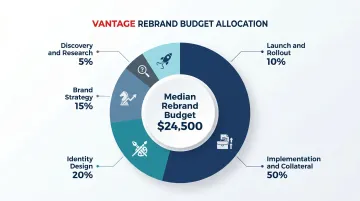
According to Sortlist's analysis of 1,000 rebranding projects, rebrand budgets typically range from $10,000 to $60,000, with a median of $24,500. Budget allocation breaks down as:
- Discovery and research: 5%
- Brand strategy: 15%
- Identity design: 20%
- Implementation and collateral: 50%
- Launch and rollout: 10%
Singapore Market Context
For Singapore-based businesses, branding costs typically range:
- Brand Strategy: $6,000–$40,000
- Visual Identity: $5,000–$30,000+
- Brand Guidelines: $2,500–$15,000
- Full Rollout: $50,000+
Singapore SMEs can access Enterprise Development Grant (EDG) funding covering up to 50% or more of qualifying branding costs.
Risk Level
Rebrands carry higher risk — particularly losing brand equity or alienating loyal customers. Two data points illustrate the stakes:
- Research from Brand Finance analysing 3,000 public acquisitions found rebranded companies averaged -2.1% returns versus -0.4% for unrebranded companies in the first year
- 82% of consumers say they feel less trusting of brands that change their name or logo without clear reason
Brand audits are low-risk by design. They surface the strategic intelligence needed before any brand changes are made.
Output
An audit produces strategic insights, perception gap analyses, and recommendations. A rebrand produces new brand deliverables: identity systems, messaging frameworks, positioning statements, and visual guidelines.
What is a Brand Audit?
A brand audit is a structured evaluation of how your brand is currently perceived by customers, positioned in the market, expressed across channels, and understood internally. Unlike a design review, it examines strategic positioning, not just visual consistency.
Core Components
A comprehensive brand audit covers four key areas:
- Interviews with leadership and teams to surface how they define the brand's value proposition and differentiation
- Customer surveys, interviews, and review mining to capture how the market actually experiences your brand
- A touchpoint audit checking whether messaging and visuals are consistent across channels
- Competitive mapping to understand how your brand sits relative to others in the market
The key output is identifying the perception gap—the difference between how a brand sees itself and how the market sees it. This gap determines whether a rebrand is needed and what specifically needs to change.
Common Mistakes Brands Make
Many organisations audit design instead of positioning, relying only on internal opinions without customer research. Others treat it as a one-time marketing exercise rather than a strategic business tool.
According to Branded Agency, "too many rebrands begin with design exploration—new logos, colour palettes, and messaging concepts—before anyone has examined how the existing brand actually performs in the market."
Vantage Branding's brand strategy process addresses this directly: discovery comes first, establishing what the brand's current state actually is before any recommendations are made.
Use Cases of a Brand Audit
Key signals that indicate your brand needs an audit first:
- Sales cycles are lengthening without clear operational causes
- Customers can't articulate what differentiates your brand from competitors
- Leadership disagrees internally on brand positioning or value proposition
- The brand is about to enter a new market or target a new audience segment
- Marketing messaging doesn't resonate with the language customers actually use
A brand audit is especially critical in industries where trust is central to the relationship: healthcare, government, and B2B sectors. Misaligned perception in these categories carries higher stakes than in consumer goods, where brand changes can be tested and iterated more quickly.
What is a Rebrand?
A rebrand is a strategic decision to significantly change how a brand is perceived. It covers visual identity, messaging, positioning, or in some cases the company name itself. This can mean updating select visuals and voice, or going all the way to a full transformation — new name, new architecture, new market position.
What a Successful Rebrand Involves
A strategic rebrand requires:
- Repositioning grounded in market data, not subjective preference
- Developing a new visual identity: logo, colour palette, typography, visual language
- Rewriting messaging and tone to reflect the new positioning
- Building a coordinated rollout plan across all brand touchpoints
Brand Refresh vs Full Rebrand
A brand refresh updates select elements without changing core identity or positioning. A rebrand fundamentally transforms how the brand is experienced.
Example of a Full Strategic Rebrand: Poppi's transformation from Mother Beverage represents a total brand transformation. Following a 2018 Shark Tank deal, the brand underwent a complete overhaul in 2020: name change (Mother Beverage to Poppi), packaging shift (glass bottles to vibrant cans), and repositioning (from "vinegar health drink" to "prebiotic soda"). The rebrand targeted Gen Z and Millennials with a lifestyle product aesthetic. Post-rebrand results: viral growth in 2021, #1 Soda on Amazon in 2023, approximately $500 million in revenue in 2024, and acquisition by PepsiCo for $1.95 billion in March 2025.

Legitimate Business Triggers for a Rebrand
Valid reasons to rebrand:
- Significant business pivot or evolution of core offerings
- Merger or acquisition requiring brand integration
- Entry into new markets where current positioning doesn't resonate
- Outdated positioning that no longer reflects the company's audience or capabilities
- Recovery from a reputational crisis
Bad Reasons to Rebrand
The most common mistakes are leadership boredom, competitor envy, and declining sales — without first diagnosing whether the brand is actually the problem.
Cautionary Example: Tropicana 2009 Tropicana's 2009 packaging rebrand remains a textbook failure. The company replaced its iconic "orange with a straw" symbol with a generic glass of orange juice. Consumer reaction was swift and brutal—customers described the new packaging as "ugly" and resembling a "store brand." Within two months, sales dropped 20%, resulting in a $30 million immediate revenue loss. The total cost of the failed initiative exceeded $50 million. Tropicana reversed course just seven weeks after launch, returning to the original packaging.
Use Cases of a Rebrand
Rebrands deliver highest impact for:
- Businesses that have undergone significant structural change (M&A, new business model)
- Organizations entering competitive new markets where differentiation is critical
- Companies where a brand audit has identified fundamental misalignment between brand identity and market expectations
When the evidence points clearly to structural brand problems, a data-informed rebrand becomes the right call — as Slack demonstrated in 2019.
Data-Informed Rebrand Example: Slack 2019 Slack's 2019 rebrand was driven by specific inconsistencies revealed through internal discovery. The original hashtag logo used 11 different colors, making it "extremely easy to get wrong." It looked terrible on any color other than white and required a precise 18-degree rotation. Pentagram replaced the plaid hashtag with a four-color pinwheel designed to be "more practical, more comfortable to replicate, and hard to screw up." The rebrand launched in anticipation of Slack's 2019 direct IPO when the company was valued at $8 billion with 8 million daily active users.
Brand Audit vs Rebrand: Which Does Your Brand Need?
Decision Framework
If your brand's challenges are unclear or undiagnosed, start with an audit. If the audit has confirmed fundamental misalignment between your brand and your market position or audience, proceed to a rebrand. Rebranding without an audit is like prescribing medication without a diagnosis — you might fix the symptom while missing the actual problem.
When to Choose Each
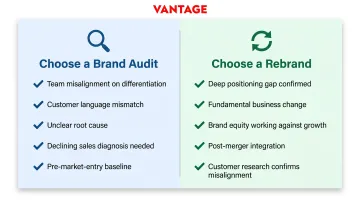
Choose a Brand Audit if:
- Your team cannot agree on what makes your brand different
- Customer language doesn't match your website copy
- You're unsure whether your brand problem is visual, strategic, or operational
- Sales are declining but the root cause isn't clear
- You're about to enter a new market and need baseline insights
Choose a Rebrand if:
- The audit reveals a deep positioning gap with your target audience
- Your core business offering or target audience has fundamentally changed
- Brand equity is actively working against growth (outdated perception)
- You've completed a merger or acquisition requiring brand integration
- Customer research confirms your brand doesn't reflect your actual value
How They Work Together
These aren't competing choices. A brand audit and rebrand are sequential stages in brand evolution — one sets the direction, the other executes it. The audit produces the brief that makes a rebrand strategic rather than cosmetic. Without it, a rebrand risks repeating the same problems in new visual packaging.
Analysis of 26 major rebrands found approximately 1 in 3 rebrands underperform expectations when measured by actual business results rather than design awards.
Unsure whether you need a brand audit or rebrand? Reach out to Vantage Branding for a brand assessment. We work with businesses across Singapore and Asia to diagnose what's not working and determine whether an audit, a rebrand, or both is the right next step.
Conclusion
A brand audit and rebrand are not competing choices—they are sequential stages in a brand's evolution. The audit tells you what's wrong and whether change is needed. The rebrand implements the solution with evidence behind it. Skipping the audit and jumping straight to a rebrand risks discarding brand equity that was actually working.
Investing in a brand audit before a rebrand protects brand equity, reduces wasted spend, and increases the likelihood that any changes made will resonate with your intended audience. If you're unsure where your brand stands, the audit is the right place to start.
Frequently Asked Questions
What is the difference between a brand refresh and a rebrand?
A brand refresh updates select elements such as visuals, tone, and messaging without changing core identity or positioning. A rebrand involves a more fundamental transformation of how the brand is perceived, often including new positioning, identity, and audience targeting.
What is the main difference between a brand audit and brand tracking?
A brand audit is a one-time (or periodic) deep diagnostic of how a brand is currently perceived and positioned. Brand tracking is ongoing measurement of brand health metrics over time—such as awareness, sentiment, and recall.
What are the 7 stages of the branding process?
The general stages are:
- Discovery and research
- Brand audit
- Strategy and positioning
- Brand identity development
- Messaging framework
- Guidelines and rollout
- Ongoing brand management
Stages may vary by agency or business complexity.
Can a brand audit lead to a rebrand?
Yes. Audits often uncover a significant perception gap or misaligned value proposition that makes a rebrand the recommended next step. That said, audits can also confirm that only minor refinements are needed.
How long does a brand audit take?
Timelines vary by company size and scope:
- Small businesses: 2–4 weeks
- Mid-market companies: 4–8 weeks
- Enterprises: 6–12+ weeks
Depth of customer research and number of stakeholders involved are the primary variables.
How much does a rebrand typically cost?
Rebrand costs vary widely based on scope. According to industry data, light-touch refreshes start around S$6,000, targeted identity overhauls range from S$15,000–S$25,000, and full corporate transformations can run from S$40,000 to S$350,000+. In Singapore, EDG grants can cover 50% or more of qualifying branding costs for SMEs.