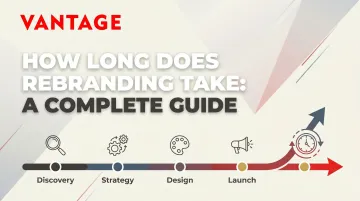
The real answer depends on three critical variables: the scope of change you're pursuing, the size and structure of your organisation, and how prepared your team is before the project begins. A light visual refresh might take just a few weeks, while a complete strategic and identity overhaul can stretch beyond a year.
This guide provides a practical, phase-by-phase breakdown to help you plan with confidence. You'll learn the difference in timelines between a brand refresh and a full rebrand, understand what happens during each phase, and discover the factors that compress or stretch the process.
TLDR
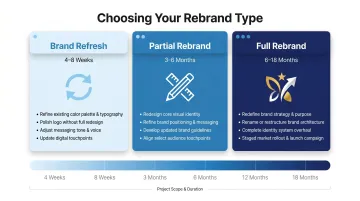
- A brand refresh (updating visual elements and messaging tone) typically takes 4–8 weeks
- A partial rebrand (new visual identity and updated positioning) usually requires 3–6 months
- A full rebrand (complete strategy, identity, and rollout overhaul) generally takes 6–18 months
- The biggest timeline drivers are organisational size, stakeholder complexity, and brief clarity at project outset
Brand Refresh vs. Partial vs. Full Rebrand: Understanding the Spectrum
Rebranding spans a wide spectrum — from light visual updates to complete strategic transformation. Most timeline confusion comes from treating all three types as the same thing.
Defining a Brand Refresh
A brand refresh updates surface-level elements without changing your core positioning or company name. You're refining rather than rebuilding.
Common updates include:
- Logo refinement for better legibility
- Updated colour palette
- Modernised typography
- Refreshed messaging tone
According to Focus Lab, "A refresh is more of an evolution... Colours may get updated, the logo may get redrawn for better legibility, but overall, the change will be subtle." This approach typically takes 4–8 weeks because it requires fewer stakeholders and no strategy overhaul.
Defining a Partial Rebrand
A partial rebrand involves meaningful shifts: new visual identity systems, repositioned messaging, and updated brand guidelines. Your company name and overall strategic direction stay intact.
This is the most common scope for growing businesses — you're correcting market misalignment or differentiation gaps without starting from scratch. Research from Ramotion confirms that partial rebrands "target specific weaknesses while retaining core brand equity," focusing on "improving differentiation, tightening the narrative, and elevating execution."
Timeline: 3–6 months
Defining a Full Rebrand
A full rebrand transforms everything from the foundation up. This includes new brand strategy, possibly a new name, entirely new visual identity, and coordinated rollout across all touchpoints.
Full rebrands typically respond to:
- Company mergers or acquisitions
- Major market pivots
- Serious reputation repair needs
- Complete business model transformations
Each of these scenarios demands work across every layer of the brand. Ramotion notes that complete rebrands involve "brand strategy development, audience definition, competitive positioning, messaging architecture, naming if required, and a full identity system." Real-world timelines reflect this scope: the Washington Commanders rebrand took nearly 18 months, while Airbnb overhauled its brand identity in under a year by keeping its core essence intact.
Timeline: 6–18 months
Quick Comparison:
| Rebrand Type | Typical Timeline | What Changes |
|---|---|---|
| Brand Refresh | 4–8 weeks | Visual refinement, messaging tone |
| Partial Rebrand | 3–6 months | Visual identity, positioning, guidelines |
| Full Rebrand | 6–18 months | Strategy, name (possibly), identity, rollout |
The Rebranding Process: A Phase-by-Phase Timeline
Understanding each phase—and how long it takes—allows you to plan realistically rather than underestimate the project. Survey data from Bynder shows that the average rebrand takes 7 months, with almost 1 in 10 taking 1–2 years.
Phase 1: Discovery and Brand Audit (2–4 weeks)
Discovery covers stakeholder interviews, competitor analysis, brand perception research, and audits of existing brand assets.
Why it matters: Skipping or rushing discovery is the single most common cause of late-stage rework. Ramotion warns that "when strategy is rushed, messaging becomes inconsistent. When identity is compressed, visual systems lack scalability."
Research must uncover:
- Current brand perception gaps
- Competitive positioning opportunities
- Stakeholder alignment (or misalignment)
- Asset inventory and touchpoint mapping
Phase 2: Brand Strategy Development (3–6 weeks)
Strategy development defines or redefines your positioning, target audience, brand personality, and core messaging framework.
For full rebrands involving new names, this phase expands significantly. Naming exploration alone can add 2–4 weeks when multiple testing rounds are required. SmashBrand's research shows that complete rebrands allocate 6–8 weeks to this phase, while partial rebrands require 4–6 weeks.
Key outputs:
- Positioning statement and differentiation framework
- Messaging architecture
- Brand personality definition
- Name exploration and testing (if applicable)
Phase 3: Creative Identity Development (4–8 weeks)
Visual design happens here: logo creation, colour systems, typography, and brand guidelines. This phase is inherently iterative—initial concepts, feedback rounds, and refinement cycles determine duration.
The number of revision rounds directly impacts timeline. Branded Agency notes that "rushing one phase usually creates delays later," and unstructured feedback loops can extend creative development indefinitely.
For complex organisations — government bodies, healthcare groups, or multi-subsidiary businesses — this phase requires structured stakeholder sign-off at each milestone to prevent costly late revisions.
Phase 4: Touchpoint Design and Asset Production (3–6 weeks)
Now you apply the brand: website design, stationery, signage, social media templates, and internal communications materials.
This phase is consistently underestimated. Bynder's survey found that organisations require an average of 215 assets to be updated in a typical rebrand, with "updating marketing assets" cited as the top challenge by 47% of marketers.
Larger organisations with retail locations, product ranges, vehicle livery, uniforms, and co-branded partnerships face significantly longer timelines.
Phase 5: Stakeholder Alignment and Internal Launch (1–3 weeks)
Internal rollout involves training staff, briefing partners and vendors, and ensuring consistent brand application before going public.
For organisations with multiple departments or regional offices — common among Vantage Branding's clients like government agencies (Enterprise Singapore, MPA) and healthcare groups (Jurong Health, Allium Healthcare) — this phase deserves dedicated schedule time. When staff apply the brand inconsistently from day one, the external launch loses its impact before it gains traction.
Phase 6: Public Launch and Transition (2–4 weeks)
The external rollout coordinates public announcements, simultaneous digital and physical asset updates, and manages the transition period where old and new materials may coexist.
Branded Agency research shows that rollout models significantly affect planning. Your choice of approach shapes both preparation load and transition length:
- Soft launch: Longer transition period, lower day-one preparation pressure
- Big bang launch: Compressed transition, but requires everything ready simultaneously
- Staged rollout: Often the best fit for established brands with significant brand equity across multiple touchpoints
Key Factors That Influence How Long Rebranding Takes
Two organisations pursuing the same rebrand scope can experience wildly different timelines. These variables determine pace.
Organisational Size and Decision-Making Structure
The more stakeholders involved in approvals—leadership committees, board sign-offs, multiple regional offices—the longer each phase takes.
Motto's research shows clear patterns:
- Small businesses/startups: 1–2 months (fewer decision-making layers)
- Mid-sized companies: 3–4 months (balancing internal input with external execution)
- Enterprise brands: 5–7 months (ensuring alignment across teams, stakeholders, and markets)
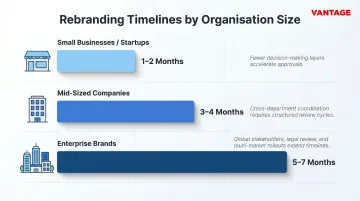
A flat-structured SME can review creative concepts in days. A larger institution may need weeks per round.
Clarity of the Brief and Internal Alignment
Projects starting with clear, agreed-upon briefs move faster. When internal alignment is lacking, it surfaces as repeated revisions and scope creep mid-project.
Branded Agency identifies that "if leadership disagree on positioning, the timeline will likely extend beyond initial expectations." Invest time in internal consensus before engaging an agency.
Trademark and Legal Registration
Trademark registration with IPOS (Intellectual Property Office of Singapore) runs on its own timeline and cannot be rushed. Key timelines to plan around:
- Standard registration: IPOS states the process takes approximately 9 months
- Typical range: Legal practitioners note 7–9 months for standard applications across Asia
- Fast Track option: Singapore's Trade Marks Fast Track programme can reduce this to 3 months for an additional S$200–S$250 per class
If your rebrand involves a new name, file the trademark application before finalising any other brand assets.
Number and Complexity of Brand Touchpoints
A business with a single website and social channels moves much faster through asset production than an organisation with retail locations, product ranges, vehicle livery, uniforms, and co-branded partnerships.
Map your full touchpoint inventory early. Branded Agency warns that if a company has "more than 50 branded assets," the "timeline will likely extend beyond initial expectations."
In-House Capacity vs. Agency Partnership
Agencies and in-house teams move at different speeds for different reasons.
An experienced agency brings dedicated resources and can run phases in parallel. BLVR notes that agencies offer "access to experts with experience and knowledge in branding, design, and marketing" along with "unique brand-building approaches honed from doing hundreds of branding projects."
In-house teams face competing priorities that stretch timelines. That said, they can move faster on approvals when internal alignment is already strong.
What Can Delay a Rebrand—and How to Prevent It
Most rebrand delays are predictable and preventable.
Revision Overload
When feedback cycles aren't structured—too many stakeholders providing conflicting input at different stages—the creative phase can loop indefinitely. Bynder's survey found that 36% of marketers cited "creative alignment" as a top rebranding challenge.
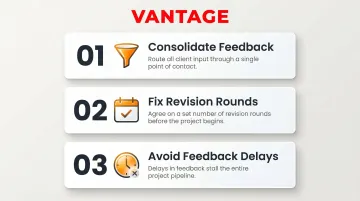
To keep revisions from spiralling:
- Consolidate feedback through a single point of contact
- Agree on a fixed number of revision rounds before work begins
- Agency Reporter notes that "feedback delays don't just slow one task, they stall the whole system"
Undefined Scope
When scope isn't finalised before the project starts, new requests surface mid-project ("can we also redo the packaging?"), adding weeks or months. PMI research identifies "ambiguous or unrefined scope definition" as the top cause of scope creep.
Prevent this by:
- Creating a detailed scope document before kick-off
- Implementing a change management process for any mid-project additions
Asset Production Bottlenecks
Delays in sourcing photography, copywriting sign-off, or vendor lead times for printed materials can stall rollout even when creative work is complete.
Build in safeguards early:
- Add buffer time to the production phase
- Identify vendors at the outset and book capacity in advance
How to Set a Realistic Rebranding Timeline
Start by defining your scope clearly. Then work backwards from a target launch date — such as a company anniversary, product launch, or new financial year — to set phase milestones.
Build in buffer time on top of estimated phase durations. A good rule of thumb: add 20–30% extra time to absorb:
- Revision rounds between stakeholders
- Internal approval delays
- Unexpected scope complexity
- Late-stage feedback that reopens earlier decisions
Working with an experienced branding agency helps compress timelines without sacrificing quality. Vantage Branding's structured process, built around clear deliverables and defined milestones, keeps each phase on track from strategy through implementation — so teams across Singapore and Asia spend less time on back-and-forth and more time moving forward.
Frequently Asked Questions
How long does a rebrand usually take?
Rebrands typically range from 4 weeks to 18 months depending on scope. A brand refresh takes 4–8 weeks, partial rebrands require 3–6 months, and full strategic overhauls need 6–18 months.
What is the difference between a brand refresh and a full rebrand in terms of time?
A refresh updates surface elements (logo refinement, colours, typography) and takes 4–8 weeks. A full rebrand involves strategy, identity, and comprehensive rollout, typically requiring 6–18 months.
What factors make a rebranding take longer than expected?
Common causes include too many decision-makers without consolidated feedback processes, unclear briefs that lead to scope creep, unplanned touchpoints discovered mid-project, and legal/trademark timelines running in parallel.
Can a rebrand be done faster without sacrificing quality?
Yes, with a well-defined scope, consolidated feedback, and an experienced agency partner managing the process. Avoid compressing timelines so aggressively that research and strategy phases get skipped — cutting these corners tends to create costly rework down the line.
How long does it take to see results after a rebrand?
Brand perception shifts take time. Visual Soldiers research shows digital metrics often shift within 1–3 months, deeper perception changes emerge after 6–12 months, and revenue impact typically appears within 12–24 months of consistent brand expression.
Should I plan my rebrand around a specific launch date?
Working backwards from a meaningful milestone (new financial year, product launch, industry event) makes strategic sense. However, ensure the launch date is realistic and doesn't force the team to cut corners on strategy or design quality.