Introduction
Most brands already have a value proposition. The problem is it sounds identical to their competitors, relies on vague claims like "quality" or "excellence," and fails to make a decisive case for why customers should choose them.
Research from Marketing Week reveals that 68% of B2B buyers believe competing brands in their category sound and act exactly the same. When your value proposition blends into the background noise, buyers default to the only differentiator left: price.
Having a value proposition and having an effective one are two very different things. This guide focuses on stress-testing, auditing, and refining what already exists — so it earns its place at the heart of your brand communications and commercial decisions. You'll find practical frameworks for diagnosing weak positioning, tools for sharpening your messaging, and criteria for knowing when your value proposition is genuinely working.
TLDR
- A value proposition answers who you help, what outcome you deliver, and why you're the credible choice—it is not a tagline or a slogan
- Vague or feature-led VPs are the most common reason brands struggle to differentiate in competitive markets
- Strong VPs rest on customer understanding, honest competitor analysis, and clearly defined brand strengths
- Refining a VP follows a structured process: audit, research, rewrite, and test
- A VP only works when it is consistent across messaging, identity, and the actual customer experience
What a Value Proposition Really Is — and Why Most Brands Get It Wrong
A value proposition is a clear, credible statement that explains what your brand does, for whom, and why it is the better choice. It is not a slogan, not a mission statement, and not a list of services. It is the single thread connecting brand strategy, messaging, and customer experience.
The most common mistakes brands make fall into three categories:
Leading with features instead of outcomes. Brands describe what they do—methodology, process, technology—rather than why it matters to the customer. A cybersecurity firm might say "We provide multi-layered threat detection" when buyers care about "We stop breaches before they cost you customers."
Written for insiders, not buyers. Many value propositions are crafted to impress board members or industry peers, not to answer the urgent question a prospect has: "Why should I choose you over the alternative?"
Trying to be relevant to everyone and ending up resonant with no one. Broad positioning dilutes impact. "We deliver quality solutions for businesses" could apply to thousands of firms. Compare that to "We help mid-sized manufacturers reduce production downtime by 30% through predictive maintenance."
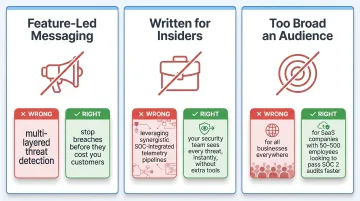
Each of these mistakes compounds the same underlying problem: when a brand fails to articulate distinct value, buyers default to comparing on price.
Why Sounding Like Everyone Else Is the Most Damaging Failure
In markets where buyers compare multiple options quickly, a generic value proposition defaults the decision to price. Forrester's State of Business Buying 2024 found that 86% of B2B purchases stall during the buying process, and 81% of buyers express dissatisfaction with the provider they ultimately choose.
Clarity and specificity create perceived differentiation, not breadth. When every competitor claims "excellence," "innovation," or "customer focus," those words carry zero weight. The brands that break through do one thing differently: they make a specific, credible promise to a specific audience — and every element of their messaging backs it up.
Signs Your Brand's Value Proposition Needs Refinement
Watch for these signs that your VP has become stale or ineffective:
- Sales conversations keep reverting to price — your team can't articulate why the brand is worth it beyond cost
- No consistent one-sentence answer — internal teams describe the business differently depending on who's speaking
- Messaging varies across touchpoints — website copy, pitch decks, and team communications all tell a different story
- Customer feedback indicates confusion about what the brand actually offers or who it serves
Internal symptoms are only half the picture. External shifts can make a previously strong VP just as irrelevant.
External Triggers That Should Prompt a VP Review
- A major shift in the competitive landscape (new entrants, consolidation, disruption)
- A new product or service launch that changes your offering
- Entering a new market segment or geography
- Shifts in customer expectations or buying behaviour driven by technology, economic change, or both
Treat VP refinement as a recurring check, not a one-time project. The right question to ask: does this VP still reflect who we serve, what we do best, and why we are the right choice right now?
The Foundations of a Strong Brand Value Proposition
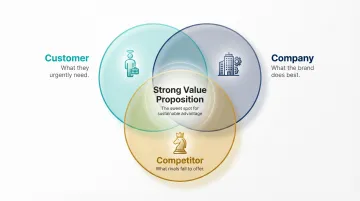
The "3 C's of brand positioning" framework—Customer, Company, Competitors—provides the diagnostic lens through which every strong VP is built. Developed by Kenichi Ohmae in The Mind of the Strategist (1982), sustained competitive advantage requires all three factors working in balance — and a VP is only as strong as the research underpinning each one.
Customer: Start with the Felt Problem
The starting point is always the customer's felt problem—not the surface-level need, but the underlying friction, aspiration, or risk they are trying to resolve.
Map customer jobs (what they are trying to accomplish), pains (what frustrates or costs them), and gains (what success looks like to them). Clayton Christensen's Jobs-to-be-Done framework emphasises that people buy products and services to get a "job" done—understanding that job provides a stable focal point for value creation.
Critical principle: Assumptions must be validated through direct customer engagement—interviews, feedback, and observation—rather than internal guesswork. Research by Strategyn shows that outcome-driven innovation based on validated customer needs achieves an 86% success rate, compared to the 17% industry average for assumption-based ideas.
Company: Identify Your Genuine Strengths
Conduct an internal audit to identify the brand's genuine strengths, proven capabilities, and the outcomes it reliably delivers. Mine client testimonials and case studies for the language customers actually use — this is often more accurate and more compelling than what a leadership team would write themselves.
Use these questions to guide the audit:
- What do clients consistently praise about working with you?
- What outcomes do you repeatedly deliver across engagements?
- What capabilities distinguish your work from standard practice?
Competitors: Find the White Space
Conduct a competitive audit — review how direct competitors position themselves, what language they use, what outcomes they promise, and where the gaps or oversaturation are.
The goal is not to imitate but to identify white space: the angle, audience, or outcome claim that competitors are not owning. Blue Ocean Strategy's strategy canvas plots competitors' value curves to reveal exactly where diverging from the industry standard creates the most opportunity.
Bringing the Three Together
A strong VP sits at the intersection of:
- What customers urgently need
- What the brand is genuinely best at
- What competitors are failing to offer or articulate clearly
When one of these three elements is weak or unexamined, the VP either blends into competitor noise, overpromises what the brand can't deliver, or targets a need that doesn't actually drive decisions. Getting all three right is what makes a value proposition defensible — not just distinctive on paper.
How to Refine Your Brand's Value Proposition: A Step-by-Step Process
Step 1 — Audit Your Existing VP
Before rewriting anything, evaluate what you currently have against these questions:
- Is the audience identifiable?
- Does it promise an outcome or just describe a service?
- Could a competitor copy it without looking out of place?
- Is it used consistently across all channels?
This audit surfaces the specific weaknesses to fix rather than prompting a complete rebuild from zero.
Step 2 — Gather Evidence, Not Opinions
Refinement must be grounded in real data. Primary research — customer interviews, sales team debrief sessions, win/loss analysis — outperforms internal brainstorming.
McKinsey research shows that augmenting presales efforts with subject matter experts deployed at critical evaluation points leads to a 5-point improvement in conversion rates and a 6–13% improvement in revenue.
Agencies like Vantage Branding approach VP refinement through an insight-led process—bringing structured research and an external perspective that internal teams are too close to the business to replicate.
Step 3 — Draft Using an Outcome-Led Structure
Use this natural-language framework:
"We help [specific audience] achieve [meaningful outcome] by [the distinct advantage only you offer]."
Fill each element with precision:
- Specific audience: Private healthcare groups expanding across Southeast Asia
- Meaningful outcome: Build patient trust and referral rates before entering a new market (transformation, not task)
- Distinct advantage: Through healthcare-specific brand positioning and identity systems developed across 30+ regional health brands
Example: "We help private healthcare groups entering Southeast Asian markets build patient trust and referral momentum through healthcare-specific brand positioning developed across 30+ regional engagements."
Step 4 — Pressure-Test It Like a Buyer
Before any VP goes live, run these five tests:
- Is it immediately clear who this is for?
- Does it promise a future state, not an activity?
- Is it believable given your current proof points?
- Could a competitor copy it word-for-word?
- Can every member of your team say it naturally in conversation?
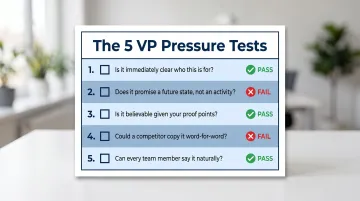
If it fails any of these tests, iterate: do not polish.
Step 5 — Rewrite in Loops, Not Drafts
Write multiple versions — each pass removing jargon, increasing specificity, and improving believability. Read each version aloud. The goal is a line that feels natural when spoken, not just readable on a screen.
Add one concrete proof point beneath the final line to give it weight: "Proven across 47 manufacturing clients in APAC, with an average 18% reduction in unplanned downtime."
Step 6 — Validate Before Embedding
Before rolling out the refined VP across brand touchpoints, test it with a small external audience — ideally current clients and prospects, not colleagues.
Ask them:
- What do you understand the brand to do?
- Who do you think it is for?
- Does the claim feel credible?
Their responses reveal whether the VP lands as intended — or needs another pass.
Aligning and Activating Your Value Proposition Across Brand Touchpoints
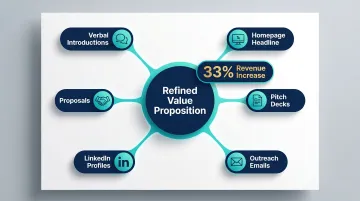
A refined VP creates no value sitting in a strategy document. It must be embedded consistently across every place a buyer encounters the brand:
- Homepage headline and subheader
- Pitch decks
- Outreach emails
- LinkedIn profiles
- Proposals
- Verbal introductions
Inconsistency across these channels undermines trust and signals that the brand lacks a clear sense of itself. Research by Marq (formerly Lucidpress) found that maintaining consistent branding across all platforms can increase revenue by up to 33%.
Visual and Verbal Alignment
Alignment extends beyond verbal messaging to visual identity—the brand's design language, tone of voice, and customer experience must all reinforce the same promise the VP makes.
A VP that claims premium positioning but delivers generic design, or one that promises agility but is backed by slow, bureaucratic service, creates a credibility gap that erodes customer trust faster than no VP at all.
This is where integrated brand work matters most. Across sectors like healthcare, investment, and government, Vantage Branding builds verbal and visual systems in tandem — ensuring that what a brand says and how it looks tell the same story at every touchpoint.
Internal Activation
Ensure that all team members—not just marketing—can articulate the VP clearly. Three mechanisms keep a VP alive in day-to-day behaviour rather than fading into a forgotten slide:
- Brand training — equipping every team member to speak the brand consistently
- Internal brand guidelines — giving staff a practical reference for messaging and tone
- Leadership modelling — senior voices embodying the VP in how they communicate and decide
Forrester research reveals that B2B buyers now engage in an average of 27 interactions (15 digital and 12 human) with a vendor before making a purchase decision. Consistency across all those touchpoints is non-negotiable.
Frequently Asked Questions
How to improve customer value proposition?
Improvement starts with re-grounding the VP in current customer research—specifically identifying the most urgent pain points and desired outcomes. Stress-test the existing language against whether it clearly communicates a differentiated outcome rather than a generic service claim.
What are the 3 C's of brand positioning?
The 3 C's are Customer, Company, and Competitor. Together they define the three lenses for building a compelling brand position: what customers need, what the brand genuinely does best, and where competitors fall short or leave space.
What is the difference between a value proposition and a brand positioning statement?
A value proposition is customer-facing, focused on the specific benefit delivered to a defined audience. A brand positioning statement is an internal strategic document that defines where the brand sits in the market relative to competitors. Both inform each other but serve distinct functions.
How often should a brand revisit its value proposition?
Conduct a formal review at least once a year. Trigger an immediate review after a major change: a new service launch, a shift in target audience, entry into a new market, or a notable competitive shift.
What are the signs that a value proposition needs refinement?
Key warning signs include: sales conversations consistently default to price negotiation, internal teams describe the brand differently, customers show confusion about what the brand actually offers, or the VP is indistinguishable from competitor language.
Can a brand have different value propositions for different customer segments?
Yes. Adapting the emphasis, language, and proof points for different segments is standard practice. The core brand VP stays consistent; what changes is which pain points and outcomes are prioritised for each audience.