The stakes are real. According to research on rebranding failures, choosing wrong wastes budget and risks losing brand equity built over years. Yet the right move can accelerate growth. Consistent brand presentation increases revenue by an average of 33%, and strong brands outperformed the MSCI World Index by 176 percentage points between 2006 and 2018.
This article gives you a practical framework to make the call with confidence.
TLDR
- A brand refresh updates visual and verbal elements (logo tweaks, colour palette, typography, messaging tone) while keeping your core positioning intact
- A full rebrand overhauls identity, strategy, and positioning from the ground up — triggered by mergers, pivots, new audiences, or reputation resets
- The decision is strategic, not financial: choose based on whether your current brand can support where your business is headed
- If your core positioning is sound but your identity feels dated, refresh; if something fundamental about your business has changed, rebrand
Rebrand vs. Brand Refresh: Quick Comparison
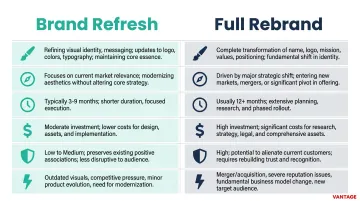
| Dimension | Brand Refresh | Full Rebrand |
|---|---|---|
| Scope of Change | Visual and verbal updates; core identity retained | Complete identity, strategy, and positioning overhaul |
| Strategic Depth | Surface-level modernisation | Fundamental repositioning |
| Timeline | 2–3 months | 4–6+ months |
| Cost Level | Lower investment | Higher investment; requires research, strategy, and extensive rollout |
| Risk to Brand Equity | Low (preserves existing recognition) | Higher (potential equity loss if poorly managed) |
| Best Triggered By | Dated visuals, inconsistent application, growth without strategic shift | Merger/acquisition, business model pivot, new market entry, reputation reset |
These aren't rigid categories. Burger King's 2021 redesign drew from heritage while overhauling execution — landing somewhere in between. The goal is to locate where on the spectrum your situation falls.
Where you land on that spectrum matters more in some markets than others. In Singapore and the wider region, tighter professional networks and longer buyer trust cycles mean brand missteps travel faster and recover slower. Edelman Trust Barometer data shows Singapore's institutional trust at 62%, and the income-based trust gap in APAC has more than doubled since 2012. Getting the scope wrong — refreshing when you need to reposition, or overhauling what didn't need to change — can erode hard-won credibility with exactly the stakeholders you're trying to reach.
What Is a Full Rebrand?
A full rebrand is a strategic transformation of a company's identity — how it's positioned, what it stands for, and how it's perceived across every touchpoint. The design work comes later. The business case comes first.
Core Components
Typical elements include:
- New or significantly overhauled brand name or logo
- Rewritten brand strategy and positioning
- New visual identity system (colours, typography, imagery)
- Refreshed messaging pillars and brand voice
- Updated digital and physical touchpoints (website, collateral, signage)
Clear Triggers for a Full Rebrand
A rebrand becomes necessary when:
- Merger or acquisition — two entities need to become one coherent brand
- Fundamental business model or audience pivot — your offering or target market has materially changed
- Market expansion — entering new geographies or sectors that require repositioning
- Reputation reset — distancing from negative brand perception or legacy issues
- Major leadership change — signalling a new company direction and strategic vision
Risks of Getting It Wrong
Rebrands carry real risks:
- Loss of existing brand equity — throwing away recognition built over years
- Customer confusion — unclear messaging about what's changed and why
- High cost and time investment — research, strategy, design, and rollout add up
- Treating it as cosmetic — the most common failure mode is skipping strategy and focusing only on design
Tropicana's 2009 packaging redesign caused a 20% unit sales drop and approximately $33 million in losses within two months. The company reverted to the original packaging. Why? The rebrand was purely visual, ignored brand equity, and failed to communicate why the change mattered.
Use Cases of a Full Rebrand
Each of these scenarios points to the same underlying problem: the existing brand no longer reflects who the business has become. A surface-level refresh can't fix that.
- A healthcare group expanding from a single facility into a regional network needs a brand that signals scale and institutional trust — not just an updated logo
- A government-linked agency shifting its public mandate requires repositioning that reflects new responsibilities and stakeholder expectations across communities
- A B2B technology firm moving upmarket into enterprise sales needs credibility and authority the original startup brand was never designed to carry

When the business has fundamentally changed, the brand must follow — not catch up.
What Is a Brand Refresh?
A brand refresh updates how a brand presents itself without changing what it stands for. The core identity and positioning stay intact — what changes is the execution. Think of it as: "Keep the concept. Adjust the look."
Typical Elements Involved
A refresh usually includes:
- Logo refinement that improves legibility or modernises the mark without changing its concept
- Colour palette updates to feel current against competitors
- Typography upgrades that replace dated fonts with cleaner alternatives
- Messaging tone-up to better reflect current audience expectations
- Visual consistency improvements that standardise brand application across channels
The refresh may also extend to verbal identity — mission statements, value propositions — but the overall brand story stays unchanged.
Signals That Point Toward a Refresh
Consider a refresh when:
- The visual identity feels dated relative to competitors
- Brand is inconsistently applied across touchpoints
- The business is growing (new locations, new channels) but the core audience and positioning haven't changed
- A specific project like a website redesign or marketing collateral overhaul makes a visual tidy-up a natural fit
What a Refresh Does NOT Fix
A refresh will not solve:
- Misaligned positioning — if your brand doesn't reflect your actual audience or value proposition
- Fundamental strategy shifts — if your company's direction has significantly changed
- Significant perception problems — if there's a gap between how you want to be seen and how stakeholders see you
Attempting a refresh when a rebrand is needed is one of the most common (and costly) branding mistakes.
How Often Should You Audit Your Brand?
Run a brand audit every 3 years to check whether your brand still reflects your company and holds up against competitors. A foundation built on solid strategy should last close to a decade before needing anything beyond refresh-level attention — so periodic checks help you catch drift early, not after it compounds.
Use Cases of a Brand Refresh
Relevant scenarios:
- An established F&B brand refreshing packaging and social presence to compete with newer entrants
- An arts or cultural organisation updating its visual identity for a new campaign or venue
- A professional services firm standardising its brand across multiple offices as it scales
The higher your brand equity, the more a refresh makes sense over a full rebrand. Rebuilding recognition from scratch costs more than protecting what you've already earned.
Rebrand or Refresh: How to Decide
Before committing to either path, work through five key questions. Think of it as a decision filter, not a definitive formula. The answers should point clearly in one direction.
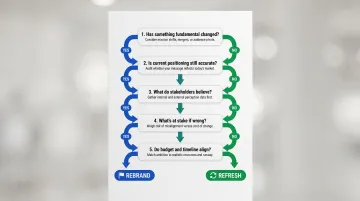
Question 1: Has something fundamental changed?
If your business model, core audience, or strategic direction has shifted materially, a refresh won't be enough. If your company today is essentially the same as it was when your brand was created — just older and more established — a refresh is sufficient.
Question 2: Is your current positioning still accurate?
Run a quick positioning check:
- Does your brand still reflect your value proposition?
- Does it speak to your target audience?
- Does it fit the competitive space you operate in?
If yes to all three, a refresh is the right move. If your brand no longer reflects what you do or who you serve, it's time to rebrand.
Question 3: What do customers and stakeholders currently believe about your brand?
Research this before drawing conclusions. Brand audits, customer surveys, and stakeholder interviews surface perception gaps.
If the gap between intended and perceived brand identity is large, a rebrand may be needed. If it's minor, a refresh can close it.
Question 4: What's at stake if you get this wrong?
Weigh two failure modes:
- A full rebrand when a refresh was sufficient — you lose hard-won brand equity and burn budget on unnecessary change
- A refresh when a rebrand was needed — you treat the symptoms without fixing the underlying problem
Both are real and costly. The right choice depends on honest diagnosis.
Question 5: Do your budget and timeline align with the scope of change your business actually needs?
If budget forces a choice between a well-executed refresh and a rushed rebrand, the refresh almost always wins. A half-done rebrand does more damage than a polished refresh.
Real-World Examples and Lessons
Walmart 2025: Clear Refresh
What changed: New custom typeface inspired by founder Sam Walton's trucker hat; updated colour shades ("True Blue" and "Spark Yellow"); refreshed photography, illustration style, and brand voice to be "relatable and approachable."
What stayed: The Spark symbol; core blue-and-yellow colours; "Save Money. Live Better" mission; heritage references to Sam Walton and 1951 origins.
Trigger: Evolution from brick-and-mortar to "people-led, tech-powered omnichannel retailer"; need for digital-first identity; expansion into health services.
Lesson: Walmart's first new logo in 17 years demonstrates that a refresh can modernise without disruption. The company explicitly called it a "comprehensive brand refresh" — not a rebrand.
Facebook to Meta: Clear Rebrand
What changed: Corporate name (Facebook Inc. to Meta); corporate logo (thumbs-up replaced by blue infinity symbol); stock ticker (FB to META); corporate positioning shifted from social media to "metaverse" company.
What stayed: Individual platform names (Facebook, Instagram, WhatsApp).
Trigger: Business model pivot toward metaverse/VR; reputational pressure following whistleblower testimony; need for parent brand architecture.
Lesson: When the business fundamentally changes, a rebrand is the only credible option. Cosmetic updates wouldn't have addressed Meta's strategic pivot or reputation challenges.
Dunkin': In Between
What changed: Name shortened from "Dunkin' Donuts" to "Dunkin'"; logo simplified to wordmark only; "Next Generation" store designs introduced.
What stayed: Pink and orange colours; iconic rounded font introduced in 1973; core menu offerings.
Trigger: Transformation into "premier beverage-led, on-the-go brand." The rebrand reflected that consumers already referred to it as "Dunkin'" informally.
Lesson: Name changes signal strategic shifts. Dunkin' was no longer just about donuts — it was about beverages. The rebrand followed revenue reality.
Asian Market Context
Brands across Singapore and the region face the same fundamental decision, with added complexity: multi-stakeholder environments and market-specific audience expectations.
DBS holds its position as Singapore's most valuable brand at $18.6 billion for the 14th consecutive year. Its evolution shows how each change served a clear strategic purpose:
- 2003: "The Development Bank of Singapore Limited" shortened to "DBS Bank Ltd." — signalling corporate modernisation
- 2006: "Living, Breathing Asia" — repositioning as a pan-Asian bank with regional ambition
- 2018: "Live more, Bank less" — shifting to a customer-first, digital-forward identity
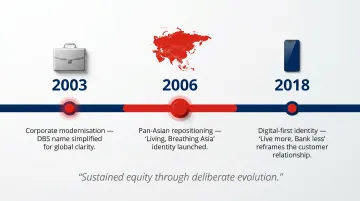
Lesson: Sustained brand equity in Asian markets isn't built by staying still — it's built by evolving deliberately, one strategic move at a time.
Conclusion
There is no universally "better" choice between a rebrand and a refresh. The right choice depends on where your business stands today and where it needs to go — and that answer only emerges from honest strategic analysis, not aesthetic preference.
The best outcomes, whether refresh or rebrand, begin with a clear audit of your brand: what it stands for, who it serves, and whether the gap between perception and reality is cosmetic or structural. Start there before committing to any direction.
Vantage Branding works with businesses across Singapore and Asia to answer that question honestly — then build the strategy and identity to act on it. Whether the work involves a focused refresh or a full rebrand, the process starts with understanding your business, not just updating your logo.
Frequently Asked Questions
What is the best way to rebrand a company?
Start with strategy, not design. Run a brand audit and stakeholder research to identify perception gaps, then lock in your new positioning before any visual work begins. Roll out internally first — then externally.
What is the difference between a rebrand and a brand refresh?
A refresh updates the surface of your existing identity (logo, colours, typography, messaging tone) while keeping core positioning intact. A rebrand involves a fundamental rethinking of identity, positioning, and strategy — typically triggered by major business change.
How do I know if my brand needs a refresh or a full rebrand?
Start with two questions: Is your positioning still accurate? Has something fundamental changed in your business? If your positioning holds but visuals feel dated, a refresh is enough. If your business has shifted in direction, audience, or model, a full rebrand is the right move.
How much does a brand refresh or rebrand cost?
A brand refresh typically costs less and takes less time than a full rebrand — the gap depends on scope, agency, and market complexity. In Singapore, refresh projects can range from mid four-figures to low five-figures; full rebrands go higher. Either way, an under-resourced project tends to need redoing — so budget for doing it properly once.
How long does a rebrand take compared to a refresh?
A brand refresh typically takes 2–3 months, while a full rebrand can span 4–6 months or more depending on complexity, number of stakeholders, and market scope. Rushing either process risks strategic gaps and inconsistent execution.
Can a brand refresh damage existing brand equity?
A well-executed refresh protects and enhances equity by modernising what's already working. The risk comes from over-refreshing (changing too much) or making changes without strategic rationale — which can dilute recognition. The key is knowing which brand assets carry the most value before touching anything.