Introduction
Picture this: You've invested thousands of dollars in a polished logo, carefully selected brand colours, and a sleek new website. Your brand looks professional. Yet when prospects ask what makes you different from competitors, your team stumbles through inconsistent answers. Sales conversations default to price comparisons.
This happens because businesses confuse brand positioning with brand identity — or worse, skip positioning entirely and jump straight to visual design. The result: messaging that shifts depending on who's talking, marketing spend that fails to build recognition, and no meaningful differentiation in crowded markets.
This article clarifies both concepts, explains how they differ, and shows the order in which they must be built. Whether you're launching a new brand or auditing an existing one, getting this sequence right determines whether your brand can command premium pricing — or just look the part.
TLDR
- Brand positioning defines the unique mental space your brand owns relative to competitors—the strategic foundation everything else builds on
- Brand identity translates that positioning into consistent visual and verbal signals (logo, colors, tone, typography)
- Positioning answers "Why choose us?"; identity answers "How do customers recognize us?"
- Positioning must come first—identity built without clear positioning lacks strategic direction
- When aligned, positioning and identity build recognition and trust; when misaligned, even polished visuals fail to differentiate
What is Brand Positioning?
Brand positioning is the strategic process of claiming a distinct and meaningful space in your target customer's mind—relative to competitors. Unlike a tagline or logo, positioning answers the fundamental question: "Why us, not them?"
Philip Kotler, widely regarded as the father of modern marketing, defines brand positioning as "the act of designing the company's offering and image to occupy a distinctive place in the mind of the target market." This definition captures positioning's dual nature: it's both strategic (what you stand for) and perceptual (how customers see you).
The Four Core Elements of Brand Positioning
Harvard Business School Online identifies four components that form the foundation of any positioning statement:
- Target market — the specific audience segment you serve
- Competitive set — the category or frame of reference you compete within
- Unique value claim — the distinct benefit only your brand delivers
- Reasons to believe — proof points that support your claim
These elements combine into an internal North Star statement: "For [target market], our brand is the only one among all [competitive set] that [unique value claim] because [reasons to believe]." This isn't public-facing copy—it's the strategic foundation guiding every brand decision.
Four Types of Brand Positioning Strategies
Brands typically employ one or more of these positioning approaches:
- Value/price-based positioning — winning customers through affordability, without sacrificing perceived quality
- Quality or prestige-based positioning — commanding premium prices by signalling superior craftsmanship, luxury status, or exclusivity
- Differentiation-based positioning — owning a specific feature, experience, or philosophy that rivals structurally cannot replicate
- Competitor-based positioning — framing your brand explicitly against a named rival to capture switchers already in the market
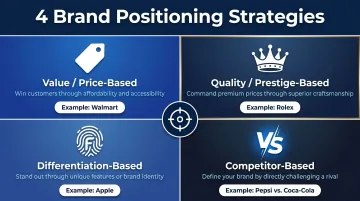
Most successful brands blend two or more strategies. IKEA, for instance, combines value-based positioning with differentiation through its "Democratic Design" philosophy—offering well-designed furniture at prices accessible to everyday people.
Why Sharp Positioning Outperforms Generic Positioning
That blend only works when the positioning is deliberate. Consider Volvo's unwavering commitment to safety as its core positioning since 1927. The company invented the three-point seat belt in 1959 and open-sourced the patent to save lives. This single-attribute positioning has sustained premium pricing and fierce customer loyalty for nearly a century. Research published in the European Journal of Marketing confirms that narrow brand positioning—focusing on fewer, highly accessible associations—leads to competitive advantage over broad positioning.
Positioning Must Come Before Identity
Without defined positioning, design decisions become subjective preferences rather than strategic choices. Brand communication becomes directionless. Teams argue about colours and fonts while ignoring the fundamental question: what distinct mental space are we claiming?
Brands that skip positioning face predictable consequences:
- They look polished, but nothing changes commercially
- They attract the wrong audiences
- They compete primarily on price
- They rebrand every few years because their visual identity has no strategic foundation
What is Brand Identity
Brand identity is the structured visual and verbal system that translates your positioning into consistent, recognizable signals across every customer touchpoint. It's not just a logo—it's the complete design and communication rulebook for how your brand shows up in the world.
Key Components of Brand Identity
Brand identity divides into two interconnected systems:
Visual elements:
- Logo system and variations
- Color palette with specific usage rules
- Typography hierarchy
- Imagery style and photography guidelines
- Layout principles and design language
- Iconography and graphic elements
Verbal elements:
- Tone of voice and personality
- Messaging frameworks and hierarchies
- Taglines and positioning statements
- Communication style guidelines
- Vocabulary and language conventions
Each element serves a strategic function, not just an aesthetic one. Typography choices signal sophistication or accessibility. Color palettes trigger emotional responses. Tone of voice builds relationship dynamics.
Brand Identity vs. Brand Image: A Critical Distinction
Brand identity is what you project—the intentional signals your organisation creates. Brand image is what customers perceive—their actual mental associations with your brand. The gap between these two indicates a positioning or execution problem.
Jean-Noël Kapferer's Brand Identity Prism, developed at HEC Paris, organises identity into six facets that distinguish sender (what the brand projects) from receiver (what customers perceive). Strong brands achieve tight alignment across all three layers: positioning, identity, and image.
How Powerful Identity Systems Work
Coca-Cola demonstrates systematic identity management at global scale. The company serves nearly 2 billion beverages daily across 200+ countries using a "one brand, one visual identity" policy.
The red colour, script typography, and iconic bottle silhouette trigger instant recognition—even without the logo present. That's what a disciplined identity system achieves: the brand communicates before a single word is read.
Business Impact of Brand Identity Consistency
Visual consistency directly affects business performance. Research from Lucidpress and Demand Metric links consistent brand presentation to measurable revenue outcomes:
- Up to 33% revenue increase from consistent brand presentation
- 2× more likely to report revenue growth for organisations with very consistent brand usage
- 3–4× more likely to experience high brand visibility
- Only 10% of marketing professionals describe their brand presentation as "very consistent"
- 71% of companies acknowledge that brand inconsistency creates market confusion
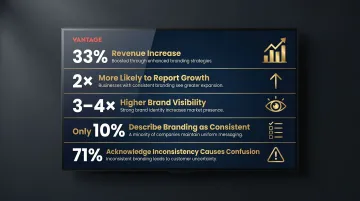
The data is clear: identity inconsistency isn't just a design problem—it's a business problem.
Brand Positioning vs. Brand Identity: Key Differences
| Dimension | Brand Positioning | Brand Identity |
|---|---|---|
| Primary focus | Strategic: what the brand stands for | Executional: how the brand appears and sounds |
| Purpose | Claim distinct mental territory vs. competitors | Express positioning consistently across touchpoints |
| Key components | Target market, competitive frame, unique value, proof points | Visual system (logo, color, typography) + verbal system (tone, messaging) |
| Business impact | Drives differentiation and pricing power | Builds recognition and emotional connection |
| Measurement | Market share, customer preference, positioning clarity | Brand awareness, recall, consistency scores |
The Directional Relationship
Positioning defines what you stand for and who you're for. Identity translates that into what people see and hear. The sequence isn't interchangeable — positioning always comes first, and identity follows from it.
The Most Common Mistake
Businesses jump straight to identity work—logo design, color selection, website aesthetics—without clarity on positioning. Industry practitioners observe this pattern constantly, describing it as "choosing an outfit before you know where you're going."
The consequences are predictable:
- Generic visuals that don't differentiate
- Messaging that shifts depending on who's writing it
- A brand that looks professional but lacks a compelling reason to choose it
- Competing on price instead of value
- Rebranding every few years because the identity lacks strategic foundation
Different Audiences, Different Timelines
Positioning work is primarily internal and strategic, revisited during major business transitions — entering new markets, launching new offerings, responding to competitive shifts. Identity is externally facing and evolves more gradually, shaped by how positioning is expressed over time.
Rebranding your visual identity without first revisiting positioning is a common and costly mistake. Without strategic grounding, even a polished new look won't fix a brand that lacks a clear reason to be chosen.
How Brand Positioning and Brand Identity Work Together
The most impactful brands treat positioning and identity as a single, connected system—not separate projects handed off to different teams. When these layers are coherent, customers understand the brand faster, trust it sooner, and need less convincing.
Patagonia: Positioning-Identity Coherence in Action
Patagonia's mission—"We're in business to save our home planet"—isn't marketing copy. It's genuine positioning that shapes every business decision. The company demonstrates alignment through concrete actions:
- 1% of all sales donated to environmental groups ($161 million by 2021)
- The "Don't Buy This Jacket" campaign encouraging consumers to buy less
- Founder Yvon Chouinard transferring the $3 billion company to a trust ensuring all future profits fight environmental crisis
This eco-conscious positioning flows consistently through earthy visual language, sustainable material choices, and activist-tone messaging. Customers recognise Patagonia's identity instantly because it authentically expresses the brand's positioning.

What Breaks Down When Positioning and Identity Misalign
Research shows the business cost of misalignment. The same Lucidpress study found that 81% of companies experience off-brand content being distributed, and 46% believe brand inconsistency significantly damages customer trust. When positioning and identity don't align:
- Customers receive mixed signals at different touchpoints
- Marketing must constantly re-explain the brand instead of building on recognition
- Teams struggle to articulate value clearly
- Premium pricing becomes difficult to justify
- Brand assets feel disconnected from business strategy
Vantage Branding addresses this by developing positioning and identity as integrated, insight-led work—not separate phases completed by different teams. This approach has helped organisations across healthcare, B2B, government, and other sectors build coherent brand systems where strategy and identity reinforce each other at every touchpoint.
Conclusion
Brand positioning and brand identity are not interchangeable. They serve distinct but interdependent roles. Positioning defines the strategic territory your brand claims in the market and in customers' minds. Identity ensures that territory is expressed consistently enough to become recognisable and trusted.
Getting both right, in the right order, is what separates a business from a brand. Start with positioning — that strategic clarity should drive every identity decision that follows. When positioning, identity, and customer perception align, recognition builds faster, pricing power increases, and customers become advocates.
Whether you're building a new brand or auditing an existing one, ask this first: "Do we have a clear, differentiated position in our market?" Answer that question before touching visuals.
For brands ready to align both layers with intention, Vantage Branding works with businesses across Singapore and Asia to develop brand strategy and identity that move together — from positioning through to visual execution.
Frequently Asked Questions
What is the difference between brand positioning and brand identity?
Brand positioning is the strategic definition of the unique space your brand occupies in customers' minds relative to competitors. Brand identity is the visual and verbal system (logo, colors, tone, messaging) that expresses that positioning across touchpoints. Both are necessary, but they serve different functions—strategy versus execution.
What are the 4 types of brand positioning?
The four main positioning approaches are:
- Value/price-based: competing on affordability
- Quality or prestige-based: emphasizing superior quality or luxury
- Differentiation-based: highlighting unique features competitors can't match
- Competitor-based: defining your brand directly against a specific rival
Most strong brands blend more than one approach.
Which comes first: brand positioning or brand identity?
Brand positioning must come first. Identity decisions—colors, fonts, imagery, tone—should be directly informed by the strategic direction positioning defines. Skipping this order leads to visual design that lacks strategic meaning, resulting in brands that look polished but fail to stand out.
Can a business have a strong brand identity without clear positioning?
Yes, but polished visuals without clear positioning typically produce appearance without differentiation. The practical result: messaging drifts across channels, teams default to competing on price, and the brand struggles to hold a distinct place in the market.
How do you know if your brand positioning and identity are misaligned?
Common warning signs include:
- Customers can't articulate what makes you different
- Marketing messages vary across channels
- Price is the primary reason customers choose you
- The visual identity doesn't reflect the brand's stated values or personality
- Teams struggle to maintain consistency in brand communications
How often should a brand revisit its positioning and identity?
Positioning should be reviewed during major business transitions—entering new markets, launching major new offerings, or responding to competitive shifts. Identity evolves more gradually and is refreshed every 5–7 years. Both should be audited together periodically to ensure continued alignment and market relevance.