Introduction
When Verizon acquired Yahoo in 2017, the original $4.83 billion price tag shrank to $4.48 billion — a $350 million reduction triggered by data breaches that damaged customer trust. Here's the revealing part: Verizon's own brand studies confirmed Yahoo's reputation was "holding up" in consumer perception. Yet the financial valuation still dropped.
This disconnect illustrates why treating brand equity and brand value as interchangeable concepts leads to flawed decisions. A brand can maintain strong customer perception (equity) while its financial worth (value) declines — or vice versa.
Knowing the difference determines where you invest: in perception-building, financial performance, or both.
This article clarifies the definitions, key differences, how they interact, and what brands in Singapore and Asia can do to strengthen both.
TL;DR
- Brand equity is the perceived value in customers' minds — driven by trust, loyalty, and awareness
- Brand value is the financial worth assigned to a brand, used in acquisitions and investment decisions
- Strong equity typically drives higher value, but they're measured differently
- Businesses should manage both: equity through customer experience, value through financial benchmarks
- Neither is more important; strong brands actively invest in both
Brand Equity vs Brand Value: At a Glance
| Dimension | Brand Equity | Brand Value |
|---|---|---|
| Definition | Commercial value based on customer perception | Financial worth assigned to a brand |
| Nature | Intangible, perception-driven | Quantitative, expressed in currency |
| Measured by | Customer surveys, NPS, brand tracking, social listening | Financial models (royalty relief, income approach, market comparables) |
| Key drivers | Customer perceptions, loyalty, word-of-mouth | Market forces, financial performance, competitive dynamics |
| Who uses it | Marketers, brand strategists, customer experience teams | Investors, analysts, M&A teams, CFOs |
| Time horizon | Long-term perception building | Point-in-time valuation |
The two concepts overlap more than they diverge. Strong equity builds financial value over time; when equity erodes, financial value follows.
What is Brand Equity?
Brand equity is the commercial advantage a brand holds because of how customers perceive it. It encompasses brand awareness, associations, perceived quality, and loyalty — intangible elements that directly impact business performance by influencing purchase decisions and pricing power.
Four Core Components
David Aaker's foundational model identifies four key components:
- Brand Awareness — How easily customers recognise and recall your brand
- Brand Associations — The attributes, benefits, and feelings customers connect to your brand
- Perceived Quality — Customer beliefs about your product or service quality relative to alternatives
- Brand Loyalty — The strength of customer commitment and repeat purchase behaviour
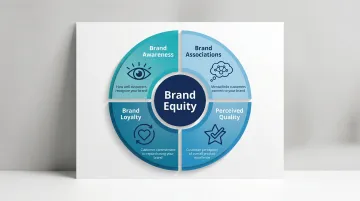
Each component reinforces the others. High awareness without positive associations won't drive loyalty; perceived quality without awareness limits market impact.
How Brand Equity is Built
Brand equity develops over time through consistent messaging, positive customer experiences, and emotional connection. It cannot be purchased outright. Building it requires deliberate brand strategy and consistently keeping brand promises over time.
Measuring Brand Equity
Because equity is intangible, measurement combines multiple data points:
- Customer surveys — Net Promoter Score (NPS), brand perception studies
- Brand tracking tools — Kantar's Meaningful Different and Salient framework
- Social listening — Monitoring sentiment and conversation volume
- Market research — Purchase intent studies, brand recall tests
Research from Edelman's Trust Barometer confirms that when consumers trust a brand, they're 59% more likely to purchase its products and 67% more likely to stay loyal. Interbrand's Role of Brand Index shows that a 1% rise in how much a brand influences purchase decisions correlates with a 2.3% increase in share price — a direct line from perception to financial performance.
Use Cases of Brand Equity
Brand equity proves most valuable in three contexts:
- Product launches — Trusted brands face lower adoption barriers when introducing new offerings
- Pricing power — High-equity brands command premium prices without losing market share
- Talent attraction — Employees prefer working for brands they respect and admire
A concrete example: When Kraft Heinz systematically cut marketing investment from 2.8% of revenue in 2016 to 2.1% in 2018, multiple legacy brands received zero advertising for up to a decade. Customer loyalty eroded before financial value collapsed — brand equity declined first, signalling trouble ahead.
What is Brand Value
Brand value is the financial worth assigned to a brand — typically expressed as a monetary figure used in business valuations, mergers and acquisitions, or licensing deals. It answers: "How much would someone pay to own this brand?"
Main Valuation Methodologies
The ISO 10668 standard recognises three core approaches:
- Cost Approach — Estimates value based on what it would cost to create or replace an equivalent brand
- Market Approach — Estimates value by comparing recent sales of similar brand rights or licence agreements
- Income Approach (Royalty Relief) — Calculates the present value of royalty payments a company would pay to licence the brand if it didn't own it

The Royalty Relief method is most widely used among valuation firms and complies with ISO 10668 standards.
Brand Value vs Company Valuation
Brand value is just one intangible asset among others (patents, customer lists, proprietary technology). However, for consumer-facing businesses, it often represents the largest portion of intangible worth.
According to Brand Finance's Global Intangible Finance Tracker 2025, intangible assets reached $97.6 trillion globally in 2025 — a 23% increase from 2024. In mature markets, intangible value can represent upwards of 78% of total market capitalisation — a figure that underscores how much brand and intellectual assets drive business worth globally.
Use Cases of Brand Value
Brand value matters most in three scenarios:
- M&A transactions — Buyers pay premiums for brands with high assessed value
- Investor relations — Brand value signals growth potential and future revenue streams
- Brand licensing or franchising — The brand's worth determines licensing fees and royalty rates
Key Differences Between Brand Equity and Brand Value
Nature and Measurability
Brand equity is largely qualitative and perception-based, making it difficult to assign an exact number. Brand value is quantitative and expressed in monetary terms — dollars, pounds, Singapore dollars, euros.
This difference shapes how each is tracked internally. Marketing teams monitor equity through ongoing customer research and sentiment analysis. Finance teams calculate value periodically using formal financial models that appear in M&A prospectuses and balance sheets.
Who Drives Each Metric
Brand equity is driven primarily by customers — their perceptions, loyalty, and word-of-mouth recommendations. Brand value is driven by market forces, financial performance, and competitive dynamics.
When Wells Fargo's fake account scandal broke in September 2016, customer sentiment shifted immediately: the brand's YouGov Index score dropped from +5.8 to -23.1 in just four months. Purchase consideration fell from 15.2% to 8.4%.
Those equity measures moved well before the financial damage fully materialised — more than $5 billion in legal settlements and regulatory penalties followed.
How Success is Measured
Brand equity success is tracked through customer experience metrics:
- Net Promoter Score (NPS)
- Brand recall and recognition rates
- Sentiment scores and social listening data
- Purchase intent and preference studies
Brand value is assessed through financial indicators:
- Revenue multiples
- Royalty rates in comparable transactions
- M&A premiums
- Formal brand valuation reports from firms like Brand Finance or Interbrand
Strategic Application
Brand equity informs marketing and brand strategy — messaging, positioning, customer experience design. Brand value informs financial and corporate strategy — M&A decisions, investment pitches, licensing negotiations.
Both inform brand investment decisions, but at different organisational levels: CMOs focus on equity-building initiatives while CFOs and boards protect and grow assessed value.
The Critical Interplay
A brand can have high equity but not yet have a formally assessed value — common in early-stage companies with passionate customer bases but limited revenue. Conversely, a brand can have a high assessed value that is eroding because equity is declining.
The Kraft Heinz case demonstrates this clearly: the company recorded a $15.4 billion goodwill impairment on the Kraft and Oscar Mayer brands in Q4 2018. The value destruction followed years of equity erosion through underinvestment in brand-building. Monitoring both is essential to catching problems early.
How Brand Equity and Brand Value Work Together
Strong brand equity — built through consistent brand-building, customer trust, and loyalty — translates into stronger brand value over time. When a brand invests in equity for years, it commands significant acquisition premiums. Equity, in other words, is the engine behind financial value.
However, focusing exclusively on one creates risk. Brands that chase financial value without investing in equity become hollow. Customer trust erodes, loyalty declines, and long-term value suffers. The Kraft Heinz case is instructive: marketing spend fell from $750 million to $550 million while competitors invested 9-20% of sales in brand equity. The combined entity lost more than half its value.
The reverse problem is just as costly. Brands that build equity without tracking value risk underestimating — or underselling — what they've built. Formal valuation exercises surface the financial premium that strong customer relationships create, which becomes critical intelligence for funding rounds, licensing deals, or exit planning.
The Singapore and Asia Context
For businesses in Singapore and Asia operating in competitive, trust-driven markets, building brand equity is often the foundational step. Kantar's BrandZ Most Valuable Southeast Asian Brands 2024 report found that 93% of the Top 30 brands possess "potent levels" of Meaningful Difference — and those that strengthened this dimension grew at more than double the rate of peers.
Singapore leads the region with 11 brands in the Top 30, including DBS ($11.8 billion) and UOB ($7.2 billion). These brands demonstrate that equity-building — through differentiation, customer trust, and consistent experience — translates into measurable financial value over time.

For companies looking to build both dimensions deliberately, the starting point is usually brand strategy: defining a clear positioning, developing a consistent identity, and creating the kind of stakeholder experience that builds trust over time. This is the work that connects equity to financial value — and where a specialist branding partner can make the difference between incremental growth and a compounding brand asset.
Conclusion
Brand equity and brand value are complementary forces, not competing priorities. Equity is the perception your customers carry; value is the financial result of that perception. Brands that invest in both tend to command stronger pricing power, weather competitive pressure more effectively, and attract acquisition interest at higher multiples.
For brands in Singapore and Asia looking to grow sustainably, the first step is investing in brand equity — through strong positioning, consistent identity, and meaningful customer relationships. If building a brand that lasts is the goal, Vantage Branding works with businesses across Singapore and Asia to develop brand strategy and identity that drives long-term impact.
Frequently Asked Questions
What is the difference between brand value and brand equity?
Brand equity is the intangible, perception-based worth of a brand in customers' minds — encompassing trust, awareness, and loyalty. Brand value is the quantifiable financial worth typically expressed in currency. Strong equity typically drives higher value over time.
What does brand equity mean?
Brand equity is the commercial advantage a brand holds through customer perception — built on awareness, trust, and loyalty. These factors enable pricing power and preference over competitors.
What are the 4 types of brand equity?
Aaker's model identifies four components: Brand Awareness (recognition and recall), Brand Associations (attributes and feelings), Perceived Quality (beliefs about superiority), and Brand Loyalty (commitment and repeat purchase). Together, these components determine how much pull a brand has in its market.
Can a brand have high equity but low value?
Yes — a brand can be loved by customers (high equity) but still have a low formal valuation, especially if revenue or market penetration is limited. This is common with early-stage or niche brands that haven't yet scaled financially.
How is brand equity measured?
Brand equity is measured through a combination of customer surveys, Net Promoter Score, social listening, and market share analysis. Because it's intangible, no single metric tells the whole story.
Which matters more for long-term business growth — brand equity or brand value?
Both matter, but they serve different roles. Equity is the foundation — it drives loyalty, pricing power, and resilience. Value is the financial outcome. For sustainable growth, building equity first tends to produce stronger, more durable results.