Introduction
Picture this: A Singapore-based healthcare provider rolls out a new brand identity. The logo looks different on their website, Instagram, and printed brochures. Colours don't match. Tone shifts from formal to chatty without reason. Patients notice. Trust wavers.
Now consider the opposite: A B2B technology firm clings so rigidly to its brand template that when a cultural moment arrives—Lunar New Year, a major industry shift—it can't adapt. Its campaigns feel stale. Competitors who moved faster capture the conversation.
Most brands face this tension daily: "Stay consistent" versus "Stay relevant." It feels impossible. In practice, brand consistency and brand flexibility work together — not against each other. This article breaks down which brand elements should stay fixed, which can flex, and how to build a system that holds both in balance.
TLDR
- Consistency builds recognition and trust; flexibility keeps brands relevant and culturally connected
- Define non-negotiables (mission, logo, core voice) versus adaptable elements (tone by channel, imagery, local references)
- Brand guidelines are strategic frameworks that enable both consistency and smart adaptation across contexts
- Rigidity leads to staleness; inconsistency erodes trust—both have real business costs
- Multi-market and multi-channel brands gain the most from getting this balance right
Why Brands Need Both: The Case for Consistency AND Flexibility
The Revenue Case for Consistency
Brand consistency isn't aesthetic preference—it's a revenue driver. Companies maintaining consistent brand presentation see revenue increases of up to 23%, according to research by Marq (formerly Lucidpress) in partnership with Demand Metric. A separate study found 68% of companies reported brand consistency contributed to revenue growth of 10% or more.
Consistency goes beyond logos and colour palettes. It includes tone of voice, messaging hierarchy, values, and the emotional experience a brand delivers at every touchpoint. When these elements align, recognition builds. When they don't, confusion sets in—and 32% of customers will walk away after a single inconsistent experience.
Trust Now Rests on Brands, Not Institutions
The 2025 Edelman Trust Barometer reveals that 80% of people trust the brands they use more than government (54%), media (55%), or NGOs (60%). Brands have become the stable anchors consumers rely on during uncertainty.
That trust is fragile, and consistency is what protects it. When a brand behaves unpredictably, confidence erodes fast. But rigidity carries its own risk: Edelman's research shows 73% of people say their trust increases when a brand authentically reflects today's culture. Brands must adapt to stay relevant without losing their core identity.
What Brand Flexibility Actually Means
Brand flexibility is the ability to adapt brand expression in response to cultural context, platform behaviour, market conditions, or audience expectations—without changing what the brand fundamentally stands for.
Coca-Cola's "Share a Coke" campaign illustrates the principle clearly. The core visual identity—red and white palette, Spencerian script, iconic logo—held firm across 50+ countries. The personalisation strategy, however, adapted to each market:
- Individual first names in Western markets
- Social nicknames and relationship labels in China
- Kinship terms in Vietnam
- Popular nicknames in Thailand
Grab tells a similar story. The Southeast Asian super-app kept its signature green identity and consistent app interface across all markets. Product offerings, though, flexed to local realities: cash payments from day one (credit card penetration was below 10% in many markets), GrabBike for motorbike-dominant cities, GrabTrike for the Philippines.
Grab reached a $40 billion valuation. Uber, which applied a rigid global model, exited Southeast Asia in 2018.
Why Neither Extreme Works Alone
A brand that is only consistent risks becoming rigid, formulaic, and out of touch. A brand that is only flexible risks losing its identity in the noise—perceived as unreliable or incoherent.
The balance is a strategic design decision, not a compromise. The strongest brands build this in from the start: a fixed core that defines what never changes, and a flexible layer that determines how far adaptation can go.
What to Lock In vs. What to Let Flex
The "Lock vs. Flex" Framework
This mental model separates core brand identity (immovable) from brand expression (adaptable). It's the practical tool brand teams use when making decisions: "Does this change affect who we are, or just how we show up?"
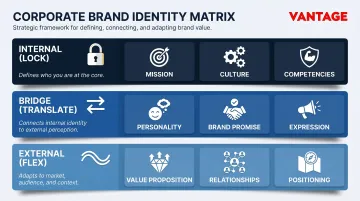
The Corporate Brand Identity Matrix (CBIM), developed by Mats Urde and Stephen Greyser and featured in Harvard Business Review, provides the academic framework:
| Layer | Elements | Function |
|---|---|---|
| Internal (Lock) | Mission, culture, competencies | Define the organisation's "soul"—stable, hard to imitate |
| Bridge (Translate) | Personality, brand promise, expression | Interface between internal reality and external perception |
| External (Flex) | Value proposition, relationships, positioning | Market-facing elements adapted to audiences and markets |
Lock In: Brand Purpose, Mission, and Values
These define why the brand exists and what it stands for. They should never shift based on trends or convenience—they're the anchor that makes flexibility possible without losing coherence.
If your brand values transparency, that doesn't change whether you're posting on LinkedIn, speaking at a conference, or responding to a crisis. The expression may vary, but the underlying value remains constant.
Lock In: Core Visual Identity Elements
Primary logo, brand colour palette, and typography system must remain consistent. Inconsistency here erodes recognition instantly.
"Consistent" doesn't mean "identical in every context"—it means governed by a system. Secondary colour ranges, alternate logo lockups, and icon families can exist within the system. But the primary visual anchors stay firm.
Flex: Tone and Messaging by Channel and Audience
The way a brand speaks on LinkedIn is appropriately different from Instagram or a healthcare brochure. Tone can shift—more formal, more playful, more empathetic—as long as the brand's underlying voice and values remain recognisable.
A financial services firm might be authoritative and data-driven in client reports, but more conversational and accessible on social media. The shift is deliberate, guided by audience needs and platform norms.
Flex: Creative Expression and Cultural Context
Imagery, campaign themes, seasonal messaging, and local cultural references can all flex—and for brands operating across Asia, getting this right matters as much as consistency does. Culturally tone-deaf uniformity erodes trust just as quickly as a fragmented identity.
Colour alone illustrates the complexity:
- Red signals prosperity and good fortune in China and Vietnam
- Green carries strong Islamic identity associations in Malaysia and Indonesia
- Yellow holds royal significance in Thailand
Grab's localisation strategy demonstrates the balance in practice: hyper-local imagery (Warungs in Indonesia, urban tech aesthetics in Singapore), local slang in notifications, and market-specific product features — all while holding the green visual identity and core brand promise constant across every market.
How to Build Brand Guidelines That Enable Both
The Role of Brand Guidelines
A brand guidelines document—often called a brand guide, brand bible, or brand playbook—is the single source of truth that enables both consistency and flexibility. The goal isn't to restrict creativity, but to create a framework within which creativity can operate safely.
Core Guidelines to Always Include
Non-negotiable elements:
- Logo usage rules (placement, size, clearance, approved lockups, misuse examples)
- Primary and secondary colour systems (Pantone, CMYK, RGB, HEX codes)
- Typography hierarchy (headings, body, captions—with fallback fonts)
- Brand voice and tone descriptors (personality traits, language guidelines)
- Approved imagery style (photography direction, illustration principles)
These are the "locked" elements, consistent across all teams, channels, and markets.
Build in Flexibility Intentionally
Great brand guidelines don't just show what to do—they show how the brand can adapt.
Include:
- Guidance on how tone shifts across different audiences or platforms (B2B vs. consumer, formal vs. casual contexts)
- Examples of approved creative variations (dark mode, festive adaptations, local language versions)
- A clear list of what is permissible versus what requires sign-off
This prevents paralysis. Teams know they can adapt seasonal imagery for Lunar New Year without seeking approval, but changing the primary logo colour requires sign-off.
Make Guidelines Accessible and Actionable
None of that flexibility matters if teams can't find or use the guidelines. A brand guide living as a static PDF in a shared folder invites version chaos—multiple files circulate, each claiming to be "final," and teams reuse outdated templates without realising it.
Better approaches:
- Digital brand portals with real-time updates
- Approved asset libraries teams can access instantly
- Templates for common formats (social posts, presentations, email signatures)
- Brand checklists for quick reference
Everyone—internal teams, external agencies, vendors—should work from the same up-to-date resources.
Getting the guidelines right from the start matters. Vantage Branding has developed brand frameworks for organisations across healthcare, arts, government, and financial services in Singapore and across Asia—each one built to be both rigorous and genuinely usable in the field.
The Risks of Getting the Balance Wrong
Over-Consistency: When Rigidity Breeds Irrelevance
When brands apply guidelines too rigidly, they become predictable in a negative way—unable to respond to cultural moments, slow to evolve, perceived as outdated.
Symptoms:
- Campaigns that feel out of touch or formulaic
- Inability to participate in timely conversations or trends
- Audiences disengage over time
- Creative work feels stale and repetitive
Brands stuck in this mode lose market share to more agile competitors who adapt faster.
Over-Flexibility: When Inconsistency Erodes Trust
When brands adapt too readily without a governing framework, the result is incoherent identity. Inconsistent logos, mismatched tone, conflicting messaging across channels—all signal unreliability.
When brands adapt too readily without a governing framework, the result is incoherent identity. Inconsistent logos, mismatched tone, conflicting messaging across channels—all signal unreliability.
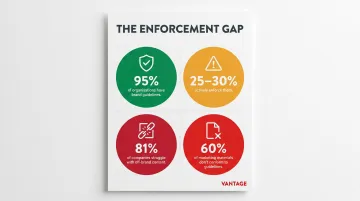
Research shows 81% of companies struggle with off-brand content creation, and 59% of content is published without completing the approval cycle. Even though 95% of organisations have brand guidelines, only 25-30% actively enforce them.
That enforcement gap is where brand identity unravels. 60% of marketing materials do not conform to established guidelines—a failure of systems and governance, not effort or intent.
The Internal Alignment Problem
Those statistics point to an operational problem, not a creative one. Without clear governance, different teams—marketing, sales, HR, external vendors—create assets independently, resulting in visual and tonal drift.
Common causes:
- Guidelines that describe intent ("be conversational") rather than execution
- Manual review queues that don't scale
- Fragmented tool stacks that don't communicate
- Tribal knowledge dependency—experienced staff carry brand knowledge informally, but it's absent when content is actually created
How to Course-Correct
If a brand has drifted toward either extreme:
- Brand audit: Identify inconsistencies across touchpoints, re-anchor the identity, and update guidelines with clearer governance.
- Brand refresh: Build appropriate flexibility into updated guidelines, evolving visual or messaging elements while retaining the core identity markers your audience already recognises.
Maintaining the Balance Across Multiple Markets and Channels
Multi-Market Brand Management
For brands operating across several countries—a common reality for Singapore companies scaling across Southeast Asia—the challenge is balancing unified regional identity with local adaptation.
The core brand identity stays the same; market-specific execution gets structured flexibility. This matters especially in Asian markets, where cultural nuances around colour, language, imagery, and tone vary considerably from country to country.
Domestically headquartered brands enjoy a 15-percentage-point average trust lead over foreign counterparts. Global brands entering Southeast Asian markets must localise expression to close this trust gap.
Practical example: A healthcare brand maintains its logo, colour system, and core values across Singapore, Malaysia, and Vietnam. But imagery reflects each market (diverse patient photography, local healthcare settings), language adapts to local dialects and formality norms, and cultural references shift (Ramadan messaging in Malaysia, Tet in Vietnam).
Multi-Channel Brand Management
A brand's identity must perform across wildly different environments—corporate website, social media profile, outdoor billboard, product brochure, pitch deck.
Core elements remain consistent:
- Logo and visual identity
- Colour palette
- Typography
- Brand voice
Format, tone, and creative expression adapt:
- Social media: shorter copy, conversational tone, platform-specific formats
- Corporate website: detailed information, professional tone, accessibility standards
- Print brochure: tactile quality, concise messaging, high-resolution imagery
- Outdoor billboard: minimal text, bold visuals, split-second comprehension
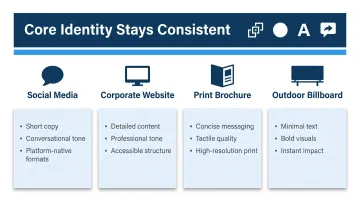
What changes across channels is the delivery — not the identity behind it.
Practical Governance for Teams
The balance is not set once and forgotten—it evolves as the brand, market, and audience change.
Effective governance includes:
- Regular brand audits (quarterly or biannually) to identify drift
- A designated brand guardian (internal or external) who oversees consistency
- Periodic reviews of guidelines to reflect new channels, markets, or strategic shifts
- Cross-team communication and shared brand ownership
Frequently Asked Questions
Is brand consistency important?
Yes, brand consistency is critical—it builds recognition, trust, and brand equity over time. Consistent brands are more memorable and credible, which matters not just for customer acquisition but for long-term loyalty and retention.
What is the difference between brand consistency and brand flexibility?
Brand consistency keeps core identity elements—values, logo, visual identity, and voice—uniform across all touchpoints. Brand flexibility is how that expression adapts to different contexts, channels, or markets within boundaries the brand has defined.
What elements of a brand should always remain consistent?
The non-negotiables are brand purpose and values, primary logo and colour system, typography, and core tone of voice. These elements remain fixed so the brand stays recognisable even as creative execution changes.
How do you maintain brand consistency across multiple channels?
Use brand guidelines, shared asset libraries, approved templates, and team training. When teams understand the boundaries—not just the rules—they make better decisions independently.
Can a brand refresh its identity without losing consistency?
Yes, brand refreshes are a normal and healthy part of brand evolution. The key is to evolve intentionally—updating visual or messaging elements while retaining the core values and identity markers that existing audiences already recognise.
How does brand flexibility differ from rebranding?
Brand flexibility is the ongoing, planned adaptability built into a brand's system—tonal shifts, campaign variations, local adaptations. Rebranding is a more significant, deliberate overhaul of the brand's core identity, typically triggered by a strategic pivot, merger, or major audience shift.