Introduction
Vietnam ranks among the world's top exporters of rice, pepper, coffee, cashews, and durian — yet most international consumers will never see a Vietnamese brand name on these products. The shelves of Tokyo supermarkets, European hypermarkets, and American grocery chains stock Vietnamese agricultural goods daily — but they arrive under foreign labels with no trace of origin. Vietnam excels at growing and exporting. Capturing the value that brands command is a different challenge entirely.
The gap between export volume and brand recognition translates directly into lost revenue. When Vietnamese coffee, rice, or pepper enters global markets as raw material rather than branded product, it competes solely on price. Without brand identity to signal quality, origin, or differentiation, Vietnamese agricultural goods earn lower prices than branded equivalents from competitor countries — often 30–50% less per kilogram.
Closing that gap requires more than better packaging. This article examines the scale of Vietnam's agricultural branding deficit, the specific elements required to build credible brand identity for agricultural exports, and the coordinated three-level strategy needed to compete in international retail markets.
TLDR
- 80% of Vietnam's $70 billion in agricultural exports lack Vietnamese branding; 90% leave as raw materials
- Agricultural brand-building rests on quality consistency, supply chain traceability, visual identity, and origin storytelling
- Brand strategy must work at three levels: national credentials, regional geographical indications, and individual corporate identity
- Processing investment is essential; branded ST25 rice commands $1,250/tonne versus $522/tonne for standard exports
- Success requires structured collaboration between farmers, processors, government agencies, and branding specialists
The Brand Gap: Where Vietnam's Agriculture Stands Today
Export Scale Without Brand Capture
Vietnam's agricultural sector achieved record-breaking performance in 2025, with total agro-forestry-fishery exports reaching $70 billion. The country holds dominant positions across multiple commodity categories: largest global Robusta coffee exporter, second-largest rice exporter (surpassing Thailand), and top-tier positions in cashews, pepper, and tropical fruits.
Key export values (2025):
- Coffee: $8.92 billion
- Fruits and vegetables: $8.6 billion (durian alone: $4 billion)
- Cashews: $5 billion
- Rice: 7.9 million tonnes exported
- Pepper: $1.6 billion
Yet this volume success masks a critical value leakage problem. Research shows that 80% of Vietnam's agricultural exports carry no established Vietnamese brand, logo, or label. Approximately 90% leave the country as raw or minimally processed materials. For pepper specifically, 82.3% of exports in early 2026 consisted of unprocessed raw pepper.
The Price Penalty of Anonymity
The absence of brand identity creates measurable financial consequences. Vietnamese agricultural products consistently earn lower per-unit prices than branded competitors:
Rice: Vietnam's average export price in Q1 2025 was $522/tonne, down 20.1% year-on-year. Standard 5% broken rice trades below $400/tonne. Meanwhile, branded ST25 rice exported to European markets (Italy, Denmark, Sweden) commands approximately $1,250/tonne, nearly triple the national average.
Coffee: Vietnamese premium Robusta prices at $5-6.50/kg, roughly 30-40% less than Brazilian Arabica despite serving different market segments.
Certified specialty rice: Low-emission rice exported to Japan achieved $820/tonne versus standard rice at $650-700/tonne, a 26% premium driven by certification and positioning alone.
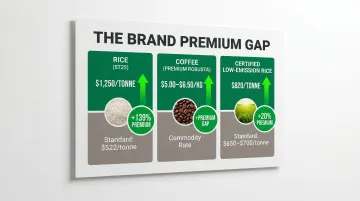
These price differentials reveal a consistent pattern: when Vietnamese products carry certification, brand identity, or origin protection, they command measurably higher prices. Without these signals, they compete as generic commodities.
The Raw Material Trap
Exporting unprocessed goods means Vietnamese products become inputs for foreign brands rather than finished consumer products. A kilogram of raw Vietnamese coffee beans becomes Italian espresso, German blends, or American café offerings, with the brand premium, consumer loyalty, and margin captured by foreign companies. Vietnamese producers receive commodity prices; foreign brands receive consumer prices.
That structural position systematically limits pricing power. When global supply conditions shift, such as India resuming non-basmati rice exports in October 2024, Vietnamese exporters face immediate price pressure because they compete on volume rather than brand differentiation.
Registration and Protection Gaps
That pricing vulnerability is compounded by weak formal protection. Only a small fraction of Vietnam's key agricultural products have secured brand or geographical indication (GI) registration in major export markets. The "Gao Viet Nam" (Vietnam Rice) brand was registered in 22 countries as of 2021, yet no businesses had been granted usage rights due to legal and management issues.
Under the EU-Vietnam Free Trade Agreement (EVFTA), 39 Vietnamese geographical indications receive automatic EU protection, including Phu Quoc fish sauce, Moc Chau tea, and Buon Ma Thuot coffee. Beyond this framework, however, few products have completed individual GI registration in the United States, Japan, or China, leaving them exposed to imitation and misrepresentation.
Structural Obstacles to Brand Building
Several supply chain characteristics make brand building particularly challenging:
- Fragmented production: Agriculture employs 40% of Vietnam's workforce across predominantly smallholder farms, making consistent quality standards and traceability systems difficult to implement at scale.
- Quality inconsistency: The "bumper crops with falling prices" pattern reflects yield-focused farming without attention to quality differentiation or market segmentation.
- Infrastructure gaps: Supply of high-quality certified rice remains insufficient to meet premium market demand, where exporters must monitor nearly 600 active ingredient restrictions for Japan alone.
- Weak coordination: Limited integration between farmers, cooperatives, processors, and exporters undermines the consistent quality delivery that any brand promise requires.
What Builds a Strong Agricultural Brand Identity
Beyond Logos: The Complete Brand Package
In agricultural contexts, "brand identity" extends far beyond visual design. It encompasses the complete set of signals — origin story, quality certifications, traceability documentation, packaging design, and consistent product experience — that international buyers and consumers use to recognize and trust a product.
For agricultural exporters, brand identity is a shorthand promise: this product comes from a specific place, produced under defined standards, meeting verified quality criteria. Every element of the brand system exists to make that promise credible and memorable.
Quality and Consistency as Foundation
Brand investment without quality assurance is meaningless in export markets. International retailers and distributors require proof of consistent standards before granting shelf space. Brand building begins with operational capabilities:
- Stable raw material supply: Reliable access to consistent-quality inputs through contracted farming, cooperative relationships, or vertical integration
- Standardized production: Documented processes, quality control systems, and batch traceability
- Post-harvest handling: Proper storage, processing, and logistics that maintain product integrity
- Testing and verification: Regular quality testing against defined specifications
Without these operational foundations, no amount of branding investment will generate sustained market access. The brand promise must reflect production reality.
Traceability as Trust Infrastructure
International markets increasingly demand full supply chain transparency. The EU Deforestation Regulation (EUDR) requires geolocation-level traceability for coffee, rubber, and wood products — affecting over $2 billion of Vietnam's annual agricultural exports. Japan's market requires monitoring nearly 600 active ingredients for rice imports.
Traceability systems for agricultural exporters typically include:
- Farm-level data: GPS coordinates, land use history, input records, and harvest documentation
- Processing documentation: Batch tracking, processing records, and quality test results
- Chain of custody: Documented movement and handling from farm through export
- Certification integration: Links to third-party certifications (organic, fair trade, sustainability standards)
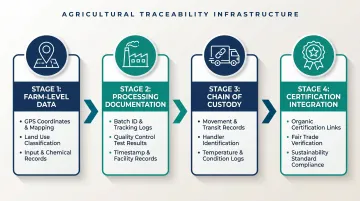
These systems serve dual purposes: regulatory compliance and brand credibility. When buyers can verify product origin and production practices, the brand's quality claims become verifiable rather than marketing assertions.
Visual Identity as Market Recognition
That operational credibility, however, only converts to sales when it's visible. In competitive retail environments — Japanese supermarkets, European hypermarkets, American specialty stores — packaging is the primary brand touchpoint. Professional visual identity signals quality, legitimacy, and market positioning within seconds.
Effective visual identity systems for agricultural products include:
- Logo design: Memorable mark that can work across package sizes and international markets
- Color palette: Strategic color choices that signal category, quality tier, and cultural relevance
- Typography: Font selections that balance legibility with brand personality
- Packaging structure: Physical format, materials, and information hierarchy
- Label content: Multilingual copy, certification marks, origin information, and usage guidance
Translating product quality and origin story into visual systems that resonate across cultures requires specialized expertise. Agencies like Vantage Branding, which works with businesses across Asia on brand strategy and identity design, help agricultural enterprises build that consumer-facing presence.
Origin Story as Differentiation
The strongest agricultural brands globally are rooted in place: Champagne, Darjeeling tea, Colombian coffee, Parmigiano-Reggiano cheese. Each treats specific geography, climate, farming traditions, and cultural heritage as core brand assets — not marketing add-ons.
Vietnamese agricultural products possess distinct regional identities with untapped brand potential:
- Dak Lak coffee: High-altitude growing regions, volcanic soil, specific climate conditions
- Mekong Delta rice: Unique water management, saline adaptation, centuries of rice culture
- Phu Quoc pepper: Island microclimate, traditional farming methods, distinct flavor profile
- Moc Chau tea: Mountain terroir, ethnic minority farming traditions, ecological diversity
Origin storytelling connects these geographic and cultural specifics to sensory product characteristics. The story explains why this coffee, rice, or pepper tastes the way it does — making origin a functional quality signal rather than a marketing flourish.
The Three-Level Brand Strategy: National, Regional, and Corporate
Why Three Levels Matter
Effective agricultural branding in Vietnam requires coordinated action across three distinct but mutually reinforcing levels. Each level serves different functions and requires different stakeholders:
| Level | Function | Primary Actors |
|---|---|---|
| National | Origin credential and minimum standards | Government, industry associations |
| Regional/GI | Geographic specificity and premium positioning | Regional governments, cooperatives, local enterprises |
| Corporate | Individual product differentiation and consumer loyalty | Companies, exporters, processors |
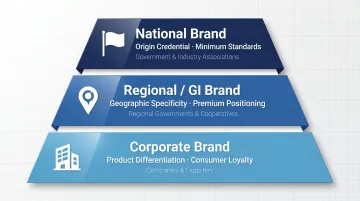
These levels work together: national brands provide baseline credibility, regional GIs add specific origin value, and corporate brands build consumer relationships and market differentiation.
National Brand Level: The Country Credential
National agricultural brands function as umbrella certifications that verify origin and establish minimum quality standards. They make individual products more trusted in foreign markets by connecting them to country-level reputation.
Vietnam's national brand initiatives include:
- "Gao Viet Nam" (Vietnam Rice): Registered in 22 countries but usage rights mechanism not yet operational
- "Cao Su Viet Nam" (Vietnam Rubber): Active usage rights for 89 products from 31 factories; registered in Taiwan, China, India, and Cambodia
- "Viet Nam Ca Phe" (Vietnam Coffee): Application submitted, status pending
- "Green Vietnamese Low-Emission Rice" label: Launched by VIETRISA in 2025, covering 3,000 hectares
International benchmark: Australia's True Aussie operates in 34 export markets as a country-of-origin brand for beef, veal, lamb, and goat. The program anchors its positioning on provenance, food safety assurance, and consumer enjoyment — creating "brand equity" that individual Australian meat exporters can licence and apply to their own products.
The governance gap for Vietnam's national brands is operational, not conceptual. Successful programs like True Aussie use trademark licensing systems that allow individual companies to use the national mark under defined standards. Vietnam's programs need that same infrastructure to move from registration to market impact.
Regional and Geographical Indication Level
Geographical indications legally link a product's reputation to its specific place of origin and traditional production method. This protects against imitation, supports premium pricing, and builds consumer trust grounded in regional specificity.
GI protection delivers measurable returns. Following EU registration, Phu Quoc fish sauce achieved price increases of 30-50% and expanded exports to the United States, Australia, Japan, and Canada. Nearly 500,000 litres have been sold in the EU market since protection was granted.
Under EVFTA, 39 Vietnamese GIs receive automatic EU protection — meaning they cannot be used for similar products from other origins, and labels using terms like "kind," "type," "style," or "imitation" are prohibited. This provides immediate market protection for products including:
- Phu Quoc (fish sauce)
- Moc Chau (tea)
- Buon Ma Thuot (coffee)
- Hai Hau (clam)
- Luc Ngan (lychee)
GI protection is market-specific, though. Vietnamese products covered under EVFTA may have no equivalent protection in the United States, China, or Japan without separate registration — leaving them exposed in those markets.
International benchmark: Colombia's Café de Colombia became the first non-EU product to receive EU Protected Geographical Indication (PGI) status in September 2007. The Colombian National Federation of Coffee Growers created the Juan Valdez character in the 1960s, evolved the strategy to "ingredient branding" (100% Colombian certification), and ultimately secured formal GI protection. U.S. consumer awareness of Colombia as coffee origin rose from 4% to over 91%.
Corporate Brand Level: Direct Market Relationships
Corporate brands are where individual enterprises build product identities — names, logos, packaging, and positioning — that earn shelf space and consumer loyalty in international retail.
This is where the commercial payoff is most direct, and where the investment requirement is highest. Companies must fund product development, certification, packaging design, marketing, and distribution while building recognition in unfamiliar markets. National and regional brand foundations reduce that burden by lending credibility before the corporate brand is established.
Success requires:
- International food safety certifications (HACCP, BRC, ISO 22000)
- Market-specific certifications (USDA Organic, JAS, EU Organic, Halal)
- Professional packaging and visual identity design
- Export partnerships and distribution agreements
- Sustained marketing investment
The next section examines specific Vietnamese enterprises that have built recognisable corporate brands — and what made the difference between products that remained commodities and those that didn't.
From Raw Commodity to Recognized Brand: The Processing Imperative
The Value Multiplication Logic
Raw agricultural materials generate a fraction of the revenue that finished, packaged, and branded consumer products command. Processing transforms price positioning fundamentally.
Vietnam's processing progress shows measurable results but remains incomplete. The share of high-value processed agricultural products in total exports rose from 20% in 2020 to over 30% in 2025. Processed coffee (instant, roasted, packaged) reached $1.78 billion in 2025 — up 50.4% year-on-year and the highest on record.
Processing unlocks value multiplication through:
- Higher per-kilogram sale prices for finished goods versus raw materials
- Access to retail markets rather than wholesale commodity markets
- Control over packaging, branding, and consumer communication
- Opportunity to create product ranges and quality tiers
- Margin sufficient to fund brand building and marketing
A concrete example: cascara tea (coffee husk byproduct) is valued at roughly four times the price of raw coffee beans, demonstrating how processing innovation multiplies value from the same agricultural input.
What Processing Investment Requires
Moving from raw commodity export to branded finished product requires investment across four operational areas:
1. Processing facilities with international certification:
- HACCP (Hazard Analysis Critical Control Points)
- ISO 22000 (Food Safety Management)
- BRC (British Retail Consortium Global Standard)
- Market-specific certifications (Halal, Kosher, Organic)
2. Automated packaging lines:
- Consistent package quality and presentation
- Efficient production at export scale
- Flexibility for multiple package sizes and formats
3. Quality control and testing:
- In-house or contracted laboratory testing
- Batch tracking and quality documentation
- Continuous improvement systems
4. Product development capacity:
- Creation of product ranges beyond single bulk grade
- Development of retail-ready formats and sizes
- Innovation in product categories (instant, flavored, convenience formats)
Vietnam now has nearly 8,000 industrial-scale processing facilities linked to exports and approximately 22,000 small processing units, with total processing capacity of 120-130 million tonnes annually. The challenge is directing that capacity toward branded, premium products rather than generic bulk.
Processing Enables Brand Viability
International retail buyers — whether Carrefour, Belc, Whole Foods, or regional supermarket chains — require consistent product quality, certified food safety, and professional packaging as baseline criteria before considering a brand for shelf placement.
Processing investment and brand investment must advance together. Strong processing capabilities without brand differentiation leaves facilities competing only on cost. Brand investment without the processing foundation to back it up produces promises that products can't keep.
The Vietnamese brands that have broken into international retail did so by treating these two investments as inseparable — certification and consistency on one side, identity and positioning on the other.
Lessons from Vietnam's Agricultural Brand Success Stories
ST25 Rice: Quality Recognition as Brand Foundation
ST25 won the World's Best Rice title at the 2019 World Rice Conference — the first Vietnamese rice variety to claim top prize. Developed by agronomist Ho Quang Cua through over 20 years of incremental breeding, ST25 is specifically adapted to saline soils in the Mekong Delta, turning previously marginal land into high-value rice production.
This international recognition created immediate brand credibility. ST25 now exports to European markets at approximately $1,250/tonne versus standard Vietnamese rice at $522/tonne. Plant variety protection was secured in March 2020, providing legal foundation for brand development.
Key lessons:
- International third-party validation (competitions, awards) creates brand credibility
- Product differentiation begins with agricultural research and variety development
- IP protection (plant variety rights) supports brand exclusivity
- Premium pricing requires proof points beyond marketing claims
ST24 and ST25 varieties are estimated to contribute approximately $88 million in incremental annual farmer revenue — proof that brand investment at the variety level pays dividends across the entire supply chain.
A An Rice: The Corporate Brand Export Model
Where ST25 built credibility through variety recognition, A An took a different route: corporate export infrastructure. The brand became the first Vietnamese rice sold under its own name in Japan in June 2022, clearing over 450 technical targets to meet Japanese standards — the world's most demanding rice market.
Certifications securing market access:
- BRC, HACCP, ISO 22000 food safety certifications
- GlobalG.A.P. agricultural practice certification
- USDA Organic, JAS (Japanese Agricultural Standards), EU Organic, and Halal certifications
Distribution and processing infrastructure:
- Five rice factories with 400,000 tonne capacity
- Exclusive EU distribution agreement with AWTC GmbH (Germany)
- Japan partnership network: Kiraboshi Bank, Sun-Tommy (importer), and Spice House (distributor)
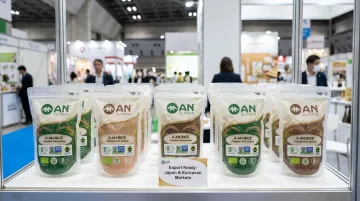
The company operates under the "three-pillar model" referenced in government agricultural strategy: enterprise-level brand investment, trade office support for market access, and strategic retail partnerships. A An was honored as a Vietnam National Brand in 2024, adding credibility with international buyers.
Key lessons:
- Premium market access requires a comprehensive certification stack
- Distribution partnerships are essential for retail market entry
- Corporate branding succeeds when supported by processing investment and quality systems
- Timeline from market entry preparation to shelf placement spans multiple years
Moc Chau: Territorial Brand Development
The ASSET (Agroecology and Safe Food System Transitions) project provides a model for regional territorial branding. Funded by AFD, the European Union, and FFEM, coordinated by GRET and CIRAD, the project runs from 2020–2025 in Moc Chau, Son La province.
The territorial branding strategy connects three elements:
- Establishing Moc Chau's reputation around sustainable agroecology practices
- Linking agricultural products to tourism experiences and regional identity
- Maintaining quality standards consistently from farm to end consumer
The "Moc Chau Certification Trademark" is expected by December 2025, creating a collective brand that individual farmers and cooperatives can use under defined standards.
The Moc Chau model illustrates a broader principle: regional agricultural brands rarely succeed through individual effort. They need coordinated infrastructure — shared quality standards, collective trademarks, and funding mechanisms that no single farmer or cooperative could sustain alone. International development funding played a critical enabling role here, filling gaps that market forces wouldn't close on their own.
Building the Ecosystem: Multi-Stakeholder Collaboration
Why Single-Actor Branding Fails
The brand promise an agricultural enterprise makes to international buyers depends on consistency across the entire supply chain — from farm input quality and growing practices through processing, packaging, cold chain logistics, and retail presentation. No single actor controls all these elements.
When a Vietnamese rice exporter promises "sustainably grown, low-emission rice" to a Japanese buyer, that promise depends on:
- Farmers applying specific cultivation practices
- Cooperatives aggregating and sorting consistent quality
- Processors maintaining certified facilities
- Testing laboratories verifying standards
- Logistics providers maintaining cold chain
- Government agencies certifying and monitoring compliance
Without structured cooperation across these stakeholders, the brand promise breaks down at the weakest link.
Specific Stakeholder Roles
Government agencies:
- Establish legal frameworks for brand protection and GI registration
- Negotiate market access and regulatory equivalence with trading partners
- Fund trade promotion, market research, and export support programs
- Provide certification infrastructure and standards monitoring
Industry associations:
- Coordinate collective action among competing enterprises
- Develop and maintain industry standards
- Represent sector interests in policy discussions
- Organize trade missions and market introduction programs
Research institutions:
- Develop improved varieties and production practices
- Conduct market research and consumer studies
- Provide technical training to farmers and processors
- Verify compliance with standards and certifications
Processing enterprises:
- Invest in certified facilities and quality systems
- Develop branded products and packaging
- Build distribution partnerships in export markets
- Contract with farmers for consistent supply
Farmers and cooperatives:
- Adopt production standards required for brand positioning
- Maintain quality consistency and traceability documentation
- Organize collective supply to achieve scale
- Share in value capture from premium pricing
Branding and marketing specialists:
- Develop brand strategy, positioning, and identity systems
- Create visual identity, packaging design, and communications materials
- Conduct market research and consumer testing
- Provide expertise in international market requirements and preferences
Operational Models
Vietnam's One Million Hectares Rice Project demonstrates this multi-stakeholder approach: sustainable development of specialized high-quality, low-emission rice in the Mekong Delta through 2030. The program coordinates government policy, research institution support, cooperative organization, and enterprise participation around a unified brand positioning.
The results are concrete. In June 2025, 500 tonnes of low-emission Japonica rice exported to Japan at $820/tonne — achieved by Trung An High-Tech Agriculture JSC working with Japan's MURASE Group. Coordinated supply chain alignment, not just product quality, unlocked that price point.
International benchmarks show two proven governance structures worth studying:
| Model | Structure | How It Works |
|---|---|---|
| Colombia — Café de Colombia | Grower federation | Represents farmers collectively; negotiates with roasters and retailers; manages GI globally |
| Australia — True Aussie | Levy-funded industry body | Centralized brand management; individual companies license the trademark annually |
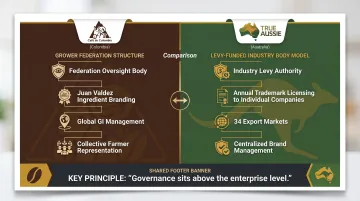
Both models share a common foundation: governance sits above the enterprise level. Individual companies compete on product and price, but brand standards, market access, and GI protection are managed collectively. Vietnam's path forward runs through building that same separation — establishing national and regional brand infrastructure that enterprises can plug into, rather than each exporter building brand equity from scratch.
Frequently Asked Questions
Why do Vietnamese agricultural products often sell at lower prices than competitors?
Most Vietnamese exports leave as unprocessed raw materials under foreign brand names, meaning they compete on price rather than differentiation. Without recognised brand identity, quality signals, or origin certification, Vietnamese goods cannot justify premium pricing even when quality merits it.
What is a geographical indication (GI) and how does it help Vietnamese farm produce?
A GI legally links a product's reputation to its place of origin and production method, enabling premium pricing, protection against imitation, and stronger consumer trust. Phu Quoc fish sauce achieved 30–50% price increases after GI registration. Yet few Vietnamese products have completed the process beyond the 39 automatically protected under EVFTA.
What is the difference between a national agricultural brand, a regional brand, and a corporate brand?
National brands like "Vietnam Rice" establish country-of-origin credentials and baseline quality. Regional/GI brands like "Phu Quoc" or "Dak Lak Coffee" tie quality to specific localities and traditional methods. Corporate brands — such as A An rice — are individual product identities built for consumer markets, using national and regional credentials as their foundation.
How does deep processing help Vietnamese agricultural products build stronger brands?
Processed products command significantly higher prices than raw materials — ST25 rice fetches $1,250/tonne versus $522/tonne for standard exports. Processing also enables the consistent quality and packaging standards international retailers require, generates the margin needed to fund brand building, and shifts positioning from commodity input to consumer product.
What international certifications do Vietnamese agricultural exporters need to build brand credibility?
HACCP, ISO 22000, and BRC are baseline food safety certifications for EU and US markets. Market-specific requirements include USDA Organic and FDA registration for the US, JAS for Japan, EU Organic for Europe, and Halal for Middle Eastern markets. Retailers and consumers rely on these certifications as trust signals when evaluating unfamiliar products.
How long does it take to build a recognized agricultural brand in international markets?
Meaningful brand recognition typically requires 3–5 years of consistent quality delivery, sustained marketing investment, and strategic retail partnerships. Early milestones — GI registration, international certification, initial shelf placement — can establish credibility within 2–4 years, as A An rice's Japan market entry demonstrates.