Introduction
Vietnam's transport sector is experiencing a profound transformation. Streets once dominated by 77 million registered motorcycles—representing 95% of all vehicles on the road—now accommodate emerging bus rapid transit systems, ride-hailing apps like Grab and Green SM, and expanding logistics networks serving the region's $4 billion Transport & Food digital economy. This rapid evolution has fundamentally changed how transport brands compete.
In this fast-moving landscape, brand strength directly determines survival. Gojek plummeted from 30% to 7% market share in two years, while Green SM (formerly Xanh SM) captured 18% within just seven months — a gap that strategy and identity, not product alone, explains.
This case study examines the branding challenges and decisions involved in building a transport brand in Vietnam. You'll find what separates the brands that gain traction from those that don't.
TLDR: Key Takeaways
- Vietnam's transport sector serves commuters, tourists, logistics clients, and government stakeholders—each requiring a different brand register
- Trust and reliability are paramount in a market where 84-89% of consumers agree trust is hard to gain and easy to lose
- With 84% smartphone penetration and 77.8 million Zalo users, mobile-first design and cultural nuance shape every effective brand touchpoint
- Consistent branding across app, vehicle, signage, and uniform builds recognition that sticks
- A strong brand accelerates user adoption and overcomes skepticism about new transport modes in conservative markets
Vietnam's Transport Landscape: The Branding Context
The Motorcycle Dominance Reality
Vietnam leads the world with over 77 million registered motorcycles—an ownership rate of 770 motorcycles per 1,000 people. The scale of this is hard to overstate:
- Motorcycles account for 85–90% of road traffic
- They represent 95% of all vehicles on Vietnamese roads
- Hanoi alone has approximately 6.9 million registered motorbikes
This creates a uniquely challenging branding environment. Personal mobility in Vietnam is culturally embedded—tied to identity, independence, and economic aspiration.
Any new transport brand is essentially asking consumers to trade complete autonomy and instant availability for something they don't yet fully trust.
The Digital Opportunity Window
Yet rapid urbanization—Vietnam's urban population reached 40.2% in 2024—combined with a young, digitally connected population creates real opportunity. Vietnam's median age is 33.9 years, with 84% smartphone penetration and nearly 78 million monthly active users on Zalo, Vietnam's dominant messaging platform.
According to PwC's 2024 Voice of the Consumer survey, 91% of Vietnamese consumers are influenced by social media advertising—higher than the 80% APAC average. For transport brands, this means the path to adoption runs through the phone—not the billboard.
The ride-hailing sector shows what's possible. Vietnam's market reached $1.7 billion in 2024 with 28.1 million users—projected to grow to $2.16 billion and 37 million users by 2029.
Green SM's entry is the clearest proof point: the brand captured nearly one-fifth of the ride-hailing market within seven months of launch. That kind of rapid share gain doesn't happen on service quality alone—it happens when brand positioning gives consumers a compelling reason to switch.
The Branding Challenge: What Made This Project Complex
Multiple Audiences, Single Brand Identity
Transport brands in Vietnam face a fundamental challenge: they must simultaneously appeal to multiple, distinct audiences with different priorities. Each group wants something different:
- Daily commuters prioritize reliability and cost-efficiency
- Tourists need trust and navigability in an unfamiliar environment
- Enterprise and logistics clients evaluate professionalism, security, and scale
- Government stakeholders assess public benefit, safety compliance, and infrastructure contribution
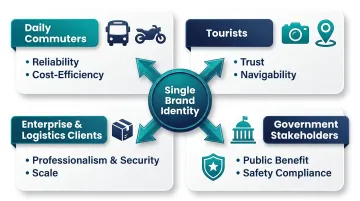
A single brand identity must speak coherently to all these groups without diluting its core message or confusing its positioning. This means building a brand narrative with multiple entry points: one coherent identity that different stakeholders can each find relevant.
The Trust Deficit Challenge
Vietnamese consumers, especially in newer transport categories like BRT systems, electric mobility, and app-based logistics, have limited historical reference points. According to Havas's 2024 "New Paths of Trust" study, 84-89% of Vietnamese consumers agree that trust is hard to gain and easy to lose—on par with global sentiment but particularly significant in a market dominated by personal vehicle ownership.
The cautionary tale of Hanoi's BRT system illustrates how trust erosion undermines brand value. The Kim Ma-Yen Nghia BRT Route No. 01, which cost $55 million and launched in 2017, faced immediate skepticism from motorcycle-dependent commuters. Despite government backing, voters questioned the system's effectiveness, with ridership averaging just 40-45 passengers per trip while subsidy rates ballooned from 26% to 65% within four years. Residents openly called the project a "failure" due to wrong vision and unreasonable planning. Lane encroachment by private vehicles—up to 707 vehicles per hour on some streets—demonstrated that even infrastructure investment cannot overcome a weak brand promise.
Historical Perception vs. Modern Reality
Vietnam's global image has historically been shaped by war-era associations rather than its current dynamism and modernity. This affects international transport and tourism brands operating in Vietnam—they must actively counter outdated perceptions and project a forward-looking identity.
Conversely, Vietnam's national brand has surged. Vietnam's national brand value reached $507 billion in 2024, ranking 32nd globally with 102% growth from 2019-2023—the fastest growth in national brand value globally during this period. Transport brands can leverage this rising national identity, positioning themselves as part of Vietnam's modernization story rather than external impositions.
Digital-Physical Brand Coherence
Vietnam is emphatically mobile-first: 168 million mobile connections serve a population of 100 million, with 72.7 million social media users across Zalo (77.8 million MAU), Facebook (72.7 million users), and TikTok (67.72 million users). Yet transport brands also operate through massive physical touchpoints—vehicles, stations, uniforms, printed materials.
Maintaining consistent brand identity across digital platforms (app UI, social media, booking interfaces) and physical environments (vehicle livery, station signage, driver uniforms, safety equipment) demands rigorous systems thinking. Inconsistency directly erodes consumer trust, signaling operational weakness before a customer even uses the service.
Competitive Volatility
Vietnam's transport sector has seen rapid entry of domestic and regional brands—Grab, Be, Gojek, Green SM, Mai Linh, and regional logistics players. Market share is highly volatile. Gojek's collapse from 30% to 7% share demonstrates how quickly consumer preference can evaporate. Green SM's rapid ascent to 18% share within seven months shows that a well-executed brand launch can displace established competitors.
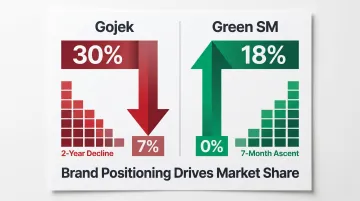
In this environment, a new transport brand must carve out a clear, differentiated positioning—not just "another option" but a brand with a distinct reason to exist that gives specific audiences a concrete reason to choose it over alternatives.
The Strategic Approach: Building a Transport Brand for Vietnam
Audience Insight as Foundation
Successful transport branding in Vietnam begins with deep research into Vietnamese consumer attitudes. What drives trust, preference, and loyalty? PwC's 2024 research reveals that 71% of Vietnamese consumers have purchased directly via social media—the highest rate in APAC—indicating that peer validation and social proof outweigh traditional marketing channels.
Word-of-mouth and peer recommendation play outsized roles in Vietnamese consumer decision-making. This insight fundamentally shapes brand strategy: rather than mass advertising, transport brands must design experiences that generate organic advocacy and visible social proof.
Emotional Positioning Beyond Functional Attributes
While functional attributes—speed, cost, coverage—set the baseline expectations, brand positioning around higher emotional values creates lasting differentiation. In Vietnam's aspirational, upwardly mobile market, transport brands positioned around reliability, freedom of movement, or empowerment resonate more powerfully than those competing solely on price or features.
For example, Green SM's positioning emphasizes environmental responsibility and technological modernity—attributes that appeal to Vietnam's young demographic, where 85% would consider a hybrid or EV in the next three years.
This emotional positioning differentiates Green SM from pure price competitors while aligning with regulatory trends like Hanoi's planned petrol motorbike restrictions from July 2026.
Vantage Branding's approach to transport sector projects, such as their work with Teehai—a 50-year supply chain solutions company operating across Southeast Asia—demonstrates this principle. The brand positioning centers on "Your trust, our pride," elevating the relationship beyond transactional service delivery to emotional partnership built on reliability and shared success.
Cultural Calibration
Brand strategy must incorporate Vietnamese cultural values—collectivism, respect for community benefit, pragmatic optimism—into the brand narrative. Language choices, color symbolism, and imagery all require scrutiny through a local cultural lens.
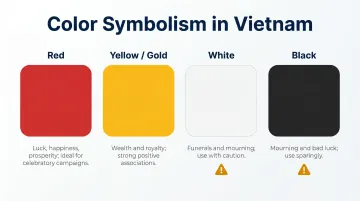
Color carries specific meaning in Vietnam:
- Red and yellow carry strong national and cultural associations—red symbolizes luck, happiness, and prosperity (ideal for celebratory campaigns), while yellow/gold conveys wealth and royalty
- White is traditionally the color of funerals and mourning—use with caution in marketing materials
- Black signals mourning and bad luck—use sparingly
Beyond color, cultural missteps—like using incorrect Vietnamese zodiac imagery—can instantly undermine brand credibility. Cultural calibration isn't a final checklist item; it's woven throughout strategy development, visual identity, verbal identity, and implementation.
Stakeholder Alignment Strategy
In Vietnam's transport sector, especially for infrastructure or public-adjacent services, brand trust must extend beyond end consumers to government stakeholders, investor audiences, and community groups. Brand messaging requires layering to address each audience without losing coherence.
Each audience applies a different lens:
- Government stakeholders evaluate policy alignment, safety standards, and contribution to public mobility goals
- Investor audiences prioritize growth trajectory, market differentiation, and the ability to scale operations
- End consumers care about convenience, reliability, and value
The brand narrative must speak authentically to all three—finding the intersection where public benefit, commercial viability, and user value converge.
Getting this alignment right early prevents costly messaging divergence as the brand scales across markets and regulatory environments.
Key Identity and Design Execution Decisions
Color and Visual Language
The color palette must balance brand differentiation with cultural appropriateness. In Vietnam's visually busy urban environments, where motorcycle traffic, street vendors, and dense signage compete for attention, bold energetic tones signal confidence and forward momentum while ensuring visibility.
Strategic color choices avoid associations with mourning (white, black) while leveraging colors that communicate trust, energy, and modernity. The palette must also function across diverse lighting conditions: bright daylight streets, dimly lit parking areas, and nighttime operations.
Logo and Symbol Design
The brand mark must work at scale across large-format physical applications (vehicle livery, station signage visible from distance) and small-scale digital uses (app icon, social media avatar, mobile notification). This requires radical simplicity and instant recognisability.
The logo must communicate the brand's core idea in a single glance, whether seen on a passing bus at 40 km/h or as a 48px app icon on a crowded phone screen. Complex details that work in presentations often fail in real-world transport environments. Test logo legibility across formats and distances before finalising.
Tone of Voice and Naming
The brand's verbal identity: its name, tagline, and communication tone, must feel approachable and locally grounded rather than corporate or foreign. Translatability and pronunciation ease in Vietnamese are essential. Names that sound awkward in Vietnamese or require explanation create friction at every customer interaction.
Grab succeeded partly because the name is short, memorable, and pronounceable across languages. Green SM's rebrand from "Xanh SM" (Vietnamese for green) to "Green SM" demonstrates strategic adaptation: moving from a purely Vietnamese name to one that maintains local recognition while enabling international expansion.
Tone of voice should avoid formal corporate language. Vietnamese audiences respond to communication that feels direct and personal, not distant or scripted.
Brand System Scalability
The full brand identity system must be designed for scalability, so drivers, station staff, fleet managers, and marketing teams can apply it consistently without design expertise. Clear, practical brand guidelines are particularly necessary in Vietnam's transport sector, where brand touchpoints are distributed across many frontline workers.
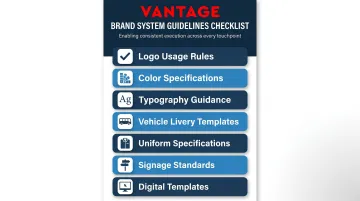
Guidelines must include:
- Logo usage rules with clear do's and don'ts
- Color specifications for digital (hex/RGB) and physical applications (Pantone, vinyl wrap specifications)
- Typography guidance with approved fonts and fallback options
- Vehicle livery templates showing exact placement and sizing
- Uniform specifications with approved vendors and color matching
- Signage standards for stations, wayfinding, and promotional materials
- Digital templates for app screens, social media, and marketing materials
A well-designed brand system empowers consistent execution across hundreds or thousands of touchpoints without requiring constant design oversight.
Lessons and Takeaways for Transport Brands in Vietnam
Lesson 1 — Localize Before You Launch
Transport brands that enter Vietnam with globally standardized identity without local adaptation consistently underperform. Cultural resonance is not optional—it's a prerequisite for brand adoption, especially in a sector as intimate and daily-use as transport.
The contrast is stark. Generic branding that ignores Vietnamese color symbolism or communication preferences creates immediate distance. Brands that localize do the opposite:
- Use culturally calibrated visual identity and color choices
- Lead with Vietnamese-language-first communication
- Draw on locally relevant imagery that reflects real consumer contexts
These brands build trust faster and achieve measurably higher adoption rates.
Lesson 2 — Brand Consistency is a Trust Signal
In Vietnam's transport market, inconsistency erodes trust before a consumer takes a single ride. Different-looking vehicles, mismatched app and physical branding, unclear communication, unprofessional driver appearance—each gap chips away at perceived reliability.
A disciplined brand system closes those gaps. It signals competence before the service even begins.
When every vehicle carries identical livery, every driver wears the same professional uniform, and the app interface matches the physical brand experience, consumers perceive operational competence and professionalism. This consistency becomes especially critical when competing against informal transport options (unlicensed motorcycle taxis) where visual branding is absent or inconsistent.
Lesson 3 — Mobile-First, But Not Mobile-Only
While Vietnam's digital engagement is predominantly mobile—67% of consumers shop via mobile, the highest in APAC—transport brands cannot neglect the physical brand experience. The in-vehicle environment, driver appearance, vehicle cleanliness, and station design are brand touchpoints that either reinforce or undermine what the app promises.
A beautifully designed app with a filthy, poorly branded vehicle creates cognitive dissonance that destroys trust. When the physical experience matches or exceeds the digital promise, trust builds at every touchpoint—and riders keep coming back.
Frequently Asked Questions
What is the most popular mode of transportation in Vietnam?
Motorcycles (motorbikes) are by far the dominant mode, with over 77 million registered nationally—770 per 1,000 people. They account for 85-90% of road traffic. Ride-hailing apps, buses, and emerging BRT systems are gradually expanding options in major cities, but motorcycles remain culturally and economically central to Vietnamese mobility.
How to do marketing in Vietnam?
Marketing in Vietnam requires a mobile-first approach, strong social proof through influencer partnerships and user-generated content, and culturally resonant messaging. Platforms popular in Vietnam—Facebook, Zalo, TikTok—are essential channels. Localization is far more effective than direct translation; campaigns must feel authentically Vietnamese rather than adapted from global templates.
Why is branding important for transport companies in Vietnam?
Vietnam's transport market is competitive and trust-driven. A strong brand signals reliability, accelerates adoption of new services, and builds loyalty that pricing alone cannot sustain. In a market where trust is hard to earn and easy to lose, brand consistency is what separates lasting players from those competing on fares.
What cultural factors should a transport brand consider in Vietnam?
Several factors demand attention: color symbolism (red/yellow are auspicious; white/black carry mourning associations), language tone (respectful yet approachable), imagery of community and progress, and the outsized role of peer recommendation. Getting any of these wrong doesn't just weaken a campaign—it can instantly erode credibility with Vietnamese consumers.
How do you build consumer trust for a new transport brand in Vietnam?
Trust comes from consistent branding across physical and digital touchpoints, visible service quality, and social proof through reviews and word-of-mouth. The brand narrative must feel locally rooted, not imported. In a market where consumers default to personal motorcycle ownership, any inconsistency or cultural misstep quickly triggers skepticism.