Introduction
Singapore functions as the regional headquarters for 4,200 multinational and Asian-born companies, making it one of Asia's most active job markets for brand communication professionals managing work across multiple markets simultaneously. Unlike local marketing roles, these positions require professionals to develop and coordinate brand strategy across Southeast Asia and wider APAC.
As more companies set up regional headquarters in Singapore, demand for professionals managing brand communication across Malaysia, Vietnam, Indonesia, Thailand, and beyond has grown sharply.
This guide covers what these roles actually involve, what employers expect, and how to position yourself as a strong candidate — in a market where 62% of organizations report moderate to extreme skill shortages.
TLDR:
- Regional brand communication roles manage strategy across multiple Southeast Asian markets, not just Singapore
- 4,200 MNC headquarters in Singapore drive concentrated demand for regional brand roles
- Salaries range from S$106,000 for mid-level managers to S$240,000+ for senior heads with 15+ years' experience
- Mandarin proficiency and cross-cultural communication skills are near-prerequisites for APAC roles
- Portfolio evidence of multi-market brand work matters more than qualifications alone
What Regional Brand Communication Jobs in Singapore Actually Entail
Managing Brand Strategy Across Multiple Markets Simultaneously
Regional roles carry responsibility for brand and communication strategy across multiple markets—typically Malaysia, Vietnam, Indonesia, Thailand, and sometimes wider APAC. That scope means navigating different languages, regulatory environments, and consumer expectations, all while keeping the brand coherent.
Core operational responsibilities include:
- Developing brand messaging frameworks that can be adapted (not just translated) across markets
- Overseeing campaign localization so messages resonate culturally without losing strategic intent
- Managing regional brand governance so country-level teams maintain consistency
- Providing strategic input for market entries or product launches in new geographies
Influencing Without Authority: The Stakeholder Management Challenge
Regional brand communication professionals typically work between global or regional headquarters and local-market teams. This requires:
- Influencing without direct authority over country-level teams
- Translating high-level brand strategy into practical execution guidelines
- Managing expectations across time zones and organizational hierarchies
- Coordinating with commercial, legal, creative, and operational stakeholders simultaneously
The stakeholder challenge is compounded by cultural factors—what counts as a persuasive argument, an appropriate escalation, or a reasonable timeline differs across markets. Getting alignment on a brand decision across Singapore, Malaysia, and Vietnam often requires more diplomacy than the strategy itself.
Cultural Intelligence as a Daily Requirement
Effective regional brand communication demands ongoing audience research across different markets, competitive monitoring, and sensitivity to cultural moments—festival calendars, political sensitivities, community values—that vary significantly even between neighbouring markets.
Practical examples:
- A Lunar New Year campaign needs distinct visual treatments in Singapore, Malaysia, and Vietnam—the festival carries different cultural weight and community meaning in each market
- Brand tone that works in English-language Singapore professional services may feel too formal or distant in community-oriented Indonesian markets
- Regulatory restrictions on health claims, comparative advertising, or promotional mechanics vary by country
Channel Strategy: Why One Approach Rarely Works Across Markets
Regional roles require proficiency across both digital and traditional communication channels, since consumer media habits vary dramatically by market. A digital-first strategy effective in Singapore may need significant adaptation for markets where television, print, or community-level activation remain more influential.
Channel decisions depend on:
- Internet penetration and mobile usage patterns by market
- Social media platform preferences (Instagram in Singapore versus Facebook in Vietnam)
- Trust in traditional versus digital media by country and demographic
- Accessibility and literacy considerations in rural versus urban markets
Why Singapore Is Southeast Asia's Regional Brand Communication Hub
4,200 Regional Headquarters Create Concentrated Demand
Singapore hosted 4,200 multinational regional headquarters in 2023, establishing it as the leading APAC hub for corporate functions including brand and marketing. The concentration spans technology and media, healthcare and sciences, consumer goods, and financial services.
Structural advantages include:
- Corporate tax rate of 17% with concessionary rates of 5–15% under International Headquarters (IHQ) Award
- 28 implemented free trade agreements and 100 jurisdictions covered by Double Taxation Agreements
- Ranked 1st among Asian cities in Mercer's Quality of Living 2024
- Ranked 2nd worldwide in IMD World Talent Ranking 2024
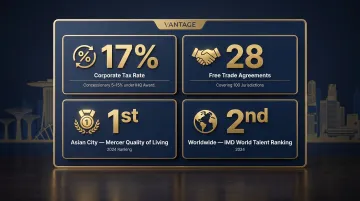
These rankings reflect why Singapore has consistently outperformed Tokyo, Shanghai, and Hong Kong in attracting headquarters — including lower productivity-adjusted labour costs than Tokyo and more transparent regulatory frameworks than other regional alternatives.
English-Language Environment and Regional Connectivity
Singapore's multilingual talent pool — covering English, Mandarin, Malay, and Tamil — enables direct engagement across diverse Asian markets. The English-language business environment reduces friction for multinationals, while proximity to other Southeast Asian capitals makes the headquarters model practically viable.
The Fair Consideration Framework also requires employers to advertise roles on MyCareersFuture before hiring non-Singaporeans, keeping these regional positions accessible to local talent.
Government Support Drives SME Brand Investment
Enterprise Singapore's Enterprise Development Grant (EDG) covers a range of brand-building activities for SMEs at up to 50% of qualifying costs:
- Brand audit and strategy development
- Brand positioning and messaging
- Brand identity design
That subsidy directly expands the hiring market — SMEs pursuing EDG-funded projects need brand communication professionals to execute them, not just the multinationals that anchor Singapore's reputation as a regional hub.
Key Job Titles and Career Levels in Regional Brand Communication
Entry and Mid-Level Positions
Common titles include:
- Brand Communications Executive
- Brand Communications Specialist
- Marketing Communications Associate (Regional)
These roles typically involve content development, campaign coordination, brand asset management, and supporting senior team members with regional project execution. Experience requirements range from one to four years, with emphasis on execution capability and attention to brand consistency.
Mid-to-Senior Management Tier
Titles at this level — Regional Brand Manager, Regional Communications Manager, Regional Marketing Manager (Brand) — carry strategic ownership of brand communication across markets. These professionals:
- Manage local-market brand teams or agency relationships directly
- Lead projects from brief through execution and measurement
- Make decisions on campaign adaptation by market
- Report on regional brand performance and ROI
LinkedIn shows 209 Marketing Director APAC jobs and 128 Director Brand Communications jobs in Singapore, confirming strong demand at this level.
Senior and Leadership-Level Roles
At the Regional Brand Director, Head of Brand Communications (APAC), and VP of Marketing (Regional) level, focus shifts from execution management to:
- Brand architecture decisions affecting multiple product lines or markets
- P&L responsibility for brand investment
- Organizational alignment of brand strategy with business goals
- Executive stakeholder management and board-level reporting
Morgan McKinley data shows median salaries of S$240,000 for Head of Marketing/Communications with 15+ years' experience, reflecting the seniority and scope of these positions.
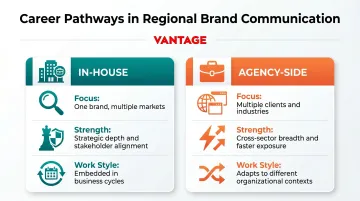
Agency-Side versus In-House Pathways
Both pathways develop distinct strengths:
| In-House | Agency-Side | |
|---|---|---|
| Focus | One brand, multiple markets | Multiple clients, multiple industries |
| Strength | Strategic depth, stakeholder alignment | Cross-sector breadth, faster exposure |
| Work style | Embedded in business cycles and culture | Adapts to different organizational contexts |
Agencies focused on regional brand work — such as Vantage Branding, which serves clients across Singapore, Malaysia, and Vietnam — offer practitioners hands-on exposure across diverse sectors within a short time. Most experienced professionals move between both tracks at some point, treating each as complementary rather than competing.
Hybrid and Emerging Titles
Newer titles reflect how brand and communication functions have expanded beyond traditional marketing:
- Regional Brand Communications Strategist
- Content and Brand Lead (APAC)
- Regional Employer Brand Manager
- Brand Experience Director (APAC)
These roles are particularly common in technology, financial services, and healthcare sectors.
Skills and Qualifications Employers Look For
Cross-Cultural Communication Competency: The Non-Negotiable Foundation
Employers expect candidates to demonstrate practical understanding of how brand messages land differently across Chinese, Malay, Indian, Vietnamese, Indonesian, and other Southeast Asian cultural contexts. Awareness of that diversity matters, but employers want proof of it: demonstrated experience adapting communication strategy for specific markets.
LinkedIn shows more than 1,000 marketing jobs in Singapore listing Mandarin as a requirement. For APAC-scope roles, Bahasa Indonesia, Malay, and Thai are also frequently sought. Language proficiency directly enables regional professionals to:
- Review localised messaging for accuracy and cultural appropriateness
- Engage with local-market teams and agency partners directly
- Understand consumer feedback and market research in local languages
Brand Strategy and Identity Fundamentals
Employers prefer candidates who understand the full brand development process—from strategy through implementation—over those with executional experience alone.
Key competencies include:
- Brand positioning and competitive differentiation
- Visual identity systems (logos, colour, typography, imagery)
- Tone of voice frameworks and messaging hierarchies
- Brand architecture for portfolio brands
- Brand governance and guidelines development
Candidates who can explain why specific adaptations were necessary for different markets—not just what was done—demonstrate the strategic thinking employers value most.
Integrated Channel Proficiency
Regional brand communication roles expect fluency in both digital platforms (social media, content marketing, digital advertising) and traditional channels (events, trade media, print), because the effective channel mix varies by market.
Strong candidates can speak to why certain channels outperform in specific markets, how to integrate messaging while adapting format, and how to measure effectiveness consistently across different environments. They also know when digital-first is the right call—and when it isn't.
Stakeholder and Project Management Capability
Beyond creative and strategic skills, regional roles require managing multiple workstreams and vendor relationships simultaneously—often across time zones. Employers look for:
- Experience with project management tools (Asana, Monday, Trello)
- Campaign briefing processes and creative review frameworks
- Cross-functional collaboration with commercial, legal, and creative teams
- Budget management and vendor negotiation
Qualifications and Portfolio Expectations
Most employers require a degree in marketing, communications, business, or a related discipline. That said, portfolio evidence carries significant weight.
Strong portfolios demonstrate:
- Brand communication work adapted or deployed across more than one market
- Evidence of strategic thinking behind execution decisions
- Results and outcomes, not just deliverables
- Understanding of cultural adaptation choices made
The Certified Professional Marketer (CPM) Asia designation from the Marketing Institute of Singapore signals regional marketing competence to employers. SkillsFuture-eligible courses in brand management, integrated marketing communications, and digital branding provide accessible upskilling pathways.
Salary Expectations and Career Progression
Salary Benchmarks by Career Level
| Role / Level | Annual Salary (SGD) | Source |
|---|---|---|
| Marketing Manager (median, all industries) | S$106,000 | MOM 2024 |
| Communications Manager (mid-level) | S$130,000 | Michael Page 2025 |
| Regional Marketing Manager (Healthcare) | S$180,000 | Michael Page 2025 |
| Head of Marketing/Communications (5-10 years) | S$160,000 | Morgan McKinley 2026 |
| Head of Marketing/Communications (10-15 years) | S$200,000 | Morgan McKinley 2026 |
| Head of Marketing/Communications (15+ years) | S$240,000 | Morgan McKinley 2026 |
| Marketing Director | S$276,000 | Michael Page 2025 |
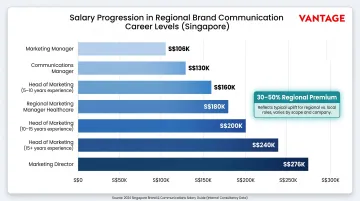
Regional scope typically commands a 30-50% premium over equivalent local-only roles. The Michael Page data showing Regional Marketing Manager (Healthcare) at S$180,000 versus general Marketing Manager at S$106,000 illustrates this differential.
Career Trajectory and Progression Speed
Professionals typically move from local marketing or communications roles into regional scope through:
- Demonstrating cross-market project experience in current roles
- Taking on regional campaigns or initiatives within existing organizations
- Transitioning into regional teams within the same company
- Moving from agency roles with multi-market client exposure
Progression speed depends on:
- Industry sector (FMCG, healthcare, financial services move faster)
- Company size (MNCs have more defined regional pathways than SMEs)
- Depth of specialization — healthcare or financial services brand expertise can accelerate advancement significantly
Morgan McKinley's experience-banded data suggests reaching senior regional head roles typically requires 10+ years, with the most senior APAC brand leadership positions requiring 15+.
Salary Movement and Market Dynamics
That seniority premium translates directly into negotiating leverage. Professionals who switch jobs typically see salary increases of 12-15%, with AI and data sectors seeing up to 20%. Those staying in current roles see only 2-5% adjustments.
With 57% of Singapore professionals planning to seek new jobs and 43% citing lack of career progression as the top driver, candidates with demonstrable regional brand expertise hold strong negotiating positions.
How to Position Yourself for Regional Brand Communication Roles
Build a Portfolio Demonstrating Multi-Market Thinking
Even if your current experience is primarily local, look for opportunities to work on projects with regional scope. Document how you navigated cultural adaptation decisions and frame work in terms of brand strategy outcomes rather than just execution deliverables.
Portfolio best practices:
- Show before/after examples of messaging adapted for different markets
- Explain the strategic rationale behind adaptation choices
- Include results metrics specific to each market where possible
- Demonstrate understanding of cultural context that informed decisions

Working alongside agencies handling multi-market client work can accelerate portfolio development — and it naturally builds the market knowledge employers expect next.
Develop Market Knowledge Beyond Singapore
Employers consistently value candidates who can speak credibly about consumer behaviour, media landscape, and brand norms in at least two or three Southeast Asian markets.
Practical steps:
- Follow regional marketing publications and industry news
- Attend industry events and conferences with regional focus
- Build professional networks across markets through LinkedIn and associations
- Study brand campaigns launched regionally, analyzing adaptation approaches
The Marketing Institute of Singapore offers SkillsFuture-eligible courses that build regional marketing competence systematically.
Navigate the Job Search Strategically
Where regional brand communication roles are listed:
- LinkedIn (primary platform for APAC-scope positions)
- MyCareersFuture (mandatory for Employment Pass roles)
- JobStreet (broader mid-level regional positions)
- Industry association job boards (MIS, IAS)
How to identify genuinely regional roles:
- Look for "APAC," "SEA," "Regional," or specific multi-country references in job titles
- Check reporting structure (regional roles typically report to regional or global leadership, not local country managers)
- Review responsibilities for multi-market scope, not just Singapore-plus language
- Confirm location is Singapore but service area includes multiple countries
Following Singapore-based branding agencies on LinkedIn — including those working across Malaysia, Vietnam, and broader APAC — gives you a live view of the regional work being commissioned, which sharpens both your job targeting and your portfolio direction.
Frequently Asked Questions
What does a regional brand communication manager do in Singapore?
A regional brand communication manager develops messaging, campaign strategy, and communication frameworks across Southeast Asian or APAC markets. They sit between regional HQ and local teams — ensuring brand consistency, enabling cultural adaptation, managing agency relationships, and tracking performance across countries.
What is the difference between a regional and a local brand communication role?
A local role covers brand communication within one market (usually Singapore only). Regional roles span multiple markets simultaneously, requiring cross-cultural adaptation, multi-country stakeholder management, and the ability to balance brand consistency with local relevance — skills that single-market roles rarely demand.
What qualifications are needed for regional brand communication jobs in Singapore?
A degree in marketing, communications, or business is the baseline, but employers prioritise portfolio evidence of multi-market brand work and cross-cultural communication experience. Language proficiency (particularly Mandarin for Greater China markets, Bahasa for Indonesia/Malaysia) provides competitive advantage. The CPM (Asia) credential from the Marketing Institute of Singapore signals regional competence.
Which industries in Singapore hire the most regional brand communication professionals?
Financial services, technology, healthcare, consumer goods (FMCG), and government-linked organisations with regional mandates are the most active employers. Singapore's role as an APAC headquarters hub concentrates these opportunities, with multinational corporations and regional offices of global companies creating the majority of demand at mid-to-senior levels.
What salary can I expect in a regional brand communication role in Singapore?
Mid-level regional marketing managers earn S$130,000–S$180,000 annually, with regional scope commanding a 30–50% premium over local-only roles. Senior heads of marketing or communications with 10–15 years' experience earn around S$200,000, rising to S$240,000+ at 15+ years. Job switches typically yield 12–15% salary increases, compared to 2–5% for staying in your current role.
Is agency or in-house experience better for building a regional brand communication career?
Both paths have merit, and many senior professionals have moved between them. Agency roles build cross-industry breadth quickly; in-house roles develop deeper strategic ownership within a single brand. Starting in an agency, then transitioning in-house, is a common route to senior regional positions.