Introduction
Malaysian construction companies face intense competition. Over 72,000 contractors are registered with CIDB (Construction Industry Development Board), all competing for government tenders and private projects. Yet most compete on price alone, undercutting margins and positioning their businesses as commodities rather than trusted partners.
A strong brand shifts this dynamic. When developers, procurement officers, and private clients recognise your company as the specialist in green building, high-rise fit-outs, or infrastructure delivery, you move from the bottom of the tender list to the shortlist before formal evaluation begins.
Research shows that 82% of B2B buyers ultimately purchase from vendors already on their pre-research shortlist. Brand recognition directly determines whether you're even considered.
Branding for construction companies extends far beyond a logo. This guide covers brand positioning, visual identity, trust signals (CIDB grade, ISO, BEM credentials), digital presence, and content marketing—all tailored to Malaysia's regulatory environment and multicultural market.
TLDR:
- Define a niche positioning that differentiates you from price-competing contractors
- Develop a cohesive visual identity across site hoardings, vehicles, uniforms, and digital channels
- Make Malaysia-specific credentials visible: CIDB grade, PKK, ISO 9001/45001, and QLASSIC ratings
- Build a mobile-optimised website with real project photography and clear portfolio sections
- Stay visible to corporate and government decision-makers through LinkedIn and consistent content publishing
Why Construction Company Branding Is Different in Malaysia
Regulatory Frameworks Shape Brand Credibility
Malaysia's construction sector operates under strict regulatory oversight. CIDB registers and grades contractors from G1 to G7, determining tendering capacity from RM200,000 (G1) to unlimited (G7). PKK (Pusat Khidmat Kontraktor) certifies Bumiputera status for contractors bidding on reserved government projects, while PUKONSA serves a similar function at the Sabah state level.
Unlike consumer brands where emotional appeal dominates, construction branding in Malaysia is filtered through compliance requirements first. G7 contractors must hold ISO 9001 certification as a registration condition — quality management is not optional differentiation but a baseline credential. Your brand must establish regulatory credibility before it can communicate innovation or quality.
Multicultural Client Base Requires Universal Credibility
Malaysian construction clients span Malay, Chinese, and Indian decision-makers across government ministries, state agencies, corporate developers, and private investors. Each group brings distinct communication styles, trust cues, and procurement behaviours. Effective branding must project professionalism across all these audiences — without falling back on generic corporate language that says nothing distinctive.
A few credibility signals that travel across audiences:
- Language coverage: English and Bahasa Malaysia as standard; Chinese-language materials for developer and investor audiences
- Visual identity: Culturally neutral but locally grounded — avoid symbols or colour conventions with unintended cultural associations
- Credentials display: Certifications, past projects, and client logos prominently featured on all materials
- Tone: Direct and professional, not boastful — trust is built through evidence, not claims
Dual Market Reality: Government vs. Private Clients
Companies competing for government contracts face different evaluation criteria than those pursuing private developers. Malaysia's Budget 2025 allocated RM86 billion in development expenditure, with major projects including Pan Borneo Sabah Phase 1B (RM9.7 billion), Sabah-Sarawak Link-Road Phase 2 (RM7.4 billion), and flood mitigation (RM3 billion). Tendering for these projects demands demonstrated regulatory compliance, financial capacity, and technical personnel credentials.
Private sector clients — developers building condominiums in Klang Valley, data centre operators in Johor, or corporate fit-out projects — prioritise speed, innovation, and quality track records. Your brand must flex to communicate reliability and compliance for tender submissions while projecting quality and technical sophistication for private pitches.
Market Size Underscores Competitive Urgency
Malaysia's construction work done value reached RM178.6 billion in 2025, growing 12.5% year-on-year after 20.2% growth in 2024 — driven by data centre construction in Johor and Selangor, the East Coast Rail Link (ECRL), and sustained government infrastructure investment.
A surging market means more contractors entering the field and existing firms expanding aggressively. When procurement shortlists are drafted, evaluators often work from memory and reputation — not just the tender document in front of them. That's where consistent, professional branding creates an advantage that technical capability alone cannot.
Step 1: Define Your Brand Positioning and Core Identity
What Positioning Means for Construction Companies
Brand positioning is the specific promise your company makes that competitors cannot credibly claim. It answers: "Why should a client choose you over another G6 contractor with similar credentials?"
Positioning examples:
- "The green building specialist for Klang Valley developers" (environmental focus + geographic niche)
- "The fastest high-rise fit-out contractor in Kuala Lumpur" (speed + project type + location)
- "IBS-certified residential contractor for affordable housing" (technology + sector specialisation)
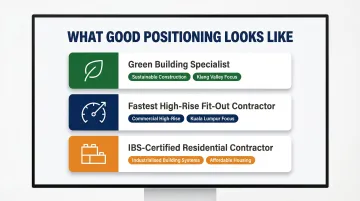
Your positioning should be narrow enough to be defensible and broad enough to sustain a pipeline. "General contractor" is not positioning—it's a category description.
How to Identify Your Positioning
Audit your top 5 completed projects:
- What type of client did you serve? (Government ministry, private developer, corporate tenant)
- What scope did you perform best in? (Civil engineering, building construction, M&E, fit-out)
- What common challenges did you solve repeatedly? (Tight timelines, complex coordination, sustainability requirements)
- Where do repeat clients and referrals come from?
Look for patterns. If four of your five best projects involved residential developers in Selangor and you consistently delivered ahead of schedule, your positioning might centre on "on-time residential construction for Selangor developers."
Craft Your Brand Mission and Values
Construction values like safety culture, on-time delivery, or sustainable building practices are operational standards—but they are also brand promises when communicated consistently.
Your mission statement should articulate why your company exists beyond profit. Example: "We deliver safe, on-time residential projects that give Malaysian families quality homes they can afford."
Values should be specific and observable:
- Safety culture: Zero-harm jobsites with daily toolbox talks and visible PPE compliance
- On-time delivery: Milestone tracking with client updates at every phase completion
- Sustainable building: IBS-certified components and green building material sourcing
If your values could appear on any competitor's website unchanged, they're not doing branding work—they're just filling space.
Develop Consistent Brand Messaging
Your brand messaging is how you introduce your company in tenders, pitch decks, and initial conversations. Consistency across these touchpoints builds recognition.
Brand tagline: A short phrase capturing your positioning. Example: "Building Selangor's residential future, on time."
Company narrative (one paragraph): Notice how the example below leads with specialisation, anchors credibility with specific certifications, and closes with a client-facing outcome—not a list of internal qualities:
"Since 2015, [Company Name] has specialised in residential construction for developers across Selangor and Kuala Lumpur. We hold CIDB Grade G6, ISO 9001:2015, and ISO 45001:2018 certifications, and have delivered over 2,000 residential units on time with zero major safety incidents. Our clients choose us for technical precision, transparent communication, and a track record of beating project timelines without compromising quality."
This narrative can be adapted for tender submissions, website About pages, and client presentations.
Partner with an Experienced Branding Agency
Many construction companies develop positioning through internal discussion or informal consensus. This often results in generic statements that don't differentiate.
A professional branding agency brings external perspective, market research, and strategic frameworks that ground positioning in evidence rather than preference. Agencies with B2B and construction sector experience—such as Vantage Branding, which works with construction and industrial clients across Malaysia and Singapore—can facilitate brand discovery workshops, stakeholder interviews, and competitor analysis to surface positioning opportunities your internal team may not see.
Step 2: Develop a Distinctive Visual Identity
Visual Identity Components for Construction Companies
A complete visual identity includes:
- Logo (primary, secondary, monochrome versions)
- Colour palette (primary and secondary colours)
- Typography (headers, body text, technical documents)
- Graphic style (photography style, iconography, layout grids)
These elements must work across physical and digital touchpoints: site hoardings, vehicle livery, worker uniforms, safety helmets, letterheads, proposals, websites, and social media.
Colour and Tone Choices for Malaysian Construction Brands
Colours communicate subconscious associations:
- Navy, grey, charcoal: Strength, reliability, professionalism—common for civil engineering and infrastructure contractors
- Orange, yellow: Visibility, energy, construction industry standard (used in PPE and safety signage)
- Green: Sustainability, environmental focus—effective for contractors specialising in green building or IBS
- Red: Boldness, urgency—less common but effective for brands emphasising speed or innovation
Overly bright or playful palettes signal inexperience — avoid them. Equally, avoid generic stock-photo aesthetics (hard hats on white backgrounds) that make your brand indistinguishable from competitors.
Brand Consistency Across Physical and Digital Touchpoints
A contractor whose website looks polished but whose site signage is inconsistent sends mixed signals about organisational quality. Brand consistency signals operational discipline.
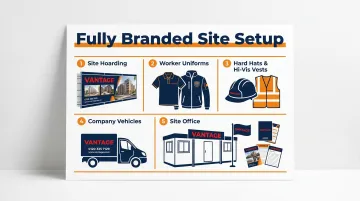
Fully branded site setup:
- Site hoarding with company logo, contact details, and project renders
- Worker uniforms (shirts, jackets) with embroidered logo
- Branded hard hats and high-visibility vests
- Company vehicles with logo, contact number, and website URL
- Site offices with branded signage and visitor materials
Photography is where this consistency pays off — because every branded touchpoint becomes evidence of quality when captured well.
Invest in Professional Project Photography
Stock images of construction sites and generic hard-hat photos actively harm your credibility. They signal you don't have real work to showcase.
Professional photography of completed projects, active worksites, and your team gives you concrete proof to put in front of clients, evaluators, and tender committees. High-quality images:
- Populate your website portfolio with proof of completed work
- Support case studies in tenders and proposals
- Provide social media content showcasing capabilities
- Demonstrate scale, complexity, and quality standards
Schedule shoots at key project milestones: groundbreaking, structural completion, and handover. Budget RM3,000–RM8,000 per shoot for a professional industrial photographer in Malaysia.
Step 3: Build Trust Through Credentials and Social Proof
Malaysian Industry Credentials as Trust Signals
Credentials are gatekeeping mechanisms and trust signals. Display them prominently on every brand touchpoint—not buried in appendices.
CIDB Registration and Grade: CIDB grades range from G1 (up to RM200,000 tendering capacity) to G7 (unlimited). Your grade signals financial capacity and technical capability. G7 contractors must employ degree and diploma holders and hold ISO 9001 certification. Display your grade on your website homepage, email signatures, proposals, and site hoardings.
PKK/PUKONSA Certification: If you hold PKK (federal Bumiputera contractor certification) or PUKONSA (Sabah state contractor registration), display these credentials prominently when bidding for reserved projects.
ISO Certifications:
- ISO 9001 (Quality Management System): Required for G7 contractors, signals process discipline and consistency
- ISO 45001 (Occupational Health and Safety Management): Essential for high-risk construction operations, demonstrates commitment to worker safety
BEM and PAM Affiliations: If your company employs registered Professional Engineers (PE) or collaborates with architects, affiliation with the Board of Engineers Malaysia (BEM) or Pertubuhan Akitek Malaysia (PAM) adds third-party professional credibility.
Case Studies and Client Testimonials
Credentials confirm your qualifications — but case studies show what you actually do with them. Generic testimonials ("Great service, highly recommended") add little value. Strong case studies include:
- Project scope: "350-unit affordable housing development, Nilai, Negeri Sembilan"
- Challenge: "Tight 18-month timeline with coordination across 12 subcontractors"
- Approach: "Implemented weekly progress meetings, IBS precast components, and milestone-based subcontractor payments"
- Outcome: "Delivered 2 weeks ahead of schedule, zero major safety incidents, client awarded follow-on contract"
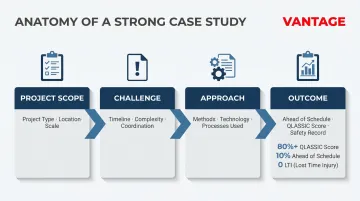
Quantify outcomes wherever possible: "Reduced construction waste by 22%," "Achieved QLASSIC score of 78%," "Completed handover 3 weeks early."
Request written testimonials from clients on company letterhead or via LinkedIn recommendations. Video testimonials from project owners or consultants are harder to dispute and more persuasive in tender evaluations.
Awards, Media Features, and Industry Recognition
Third-party recognition validates claims that self-promotion cannot. Relevant awards and recognitions include:
- CIDB QLASSIC (Quality Assessment System for Building Construction Works) scores above 70%
- CIDB Construction Industry Excellence Awards
- Media features in The Edge Property, Malaysian Construction, or trade press
- Green Building Index (GBI) or equivalent certifications for completed projects
Display logos, certificates, and media excerpts on your website and in proposals. In Malaysian construction tendering, evaluators often shortlist based on track record before reviewing pricing — a dedicated "Recognition" page can make the difference between getting on that list and being screened out.
Step 4: Build and Optimise Your Digital Presence
Why a Professional Website Is Non-Negotiable
97.9% of Malaysians access the internet via mobile devices, and clients research contractors online before shortlisting. If your website is outdated, slow, or missing key information, you won't make the list.
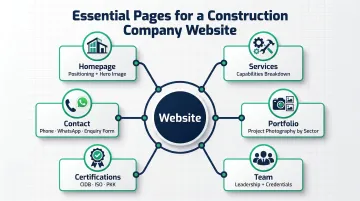
Essential website pages:
- Homepage: Clear positioning statement, hero image of flagship project, call-to-action
- Services: Detailed breakdown of construction capabilities (civil, building, M&E, fit-out, etc.)
- Portfolio: Real project photography, organised by sector or project type (residential, commercial, industrial, infrastructure)
- Team: Leadership profiles with credentials (PE, BEM registration, years of experience)
- Certifications: CIDB grade, ISO certificates, PKK/PUKONSA, industry affiliations
- Contact: Phone, email, WhatsApp, physical office address, enquiry form
Every page should load in under 3 seconds on mobile. Use professional photography, not stock images. Include clear calls-to-action: "Request a Quotation," "View Our Portfolio," "Download Company Profile."
Google Business Profile and Local SEO
Many contractor searches are location-based: "construction company Johor Bahru," "renovation contractor Petaling Jaya," "G6 contractor Penang."
Claim and optimise your Google Business Profile:
- Add accurate business name, address, phone number, and website
- Select primary category ("Construction Company" or "General Contractor")
- Upload high-quality project photos (minimum 10 images)
- Encourage satisfied clients to leave Google reviews
- Post updates on completed projects or new certifications
WhatsApp Business for Client Communication
WhatsApp reaches 91.2% of Malaysian internet users, making it a primary business communication channel. Many clients prefer WhatsApp over email or phone calls for initial enquiries.
Set up WhatsApp Business:
- Use your company phone number (not a personal number)
- Create a professional business profile with logo, description, and operating hours
- Set up automated greeting messages for after-hours enquiries
- Use Quick Replies for common questions (pricing, service areas, certifications)
- Maintain professional tone and response times under 2 hours during business hours
Make your WhatsApp number easy to find — list it on your website, Google Business Profile, and any printed materials.
Step 5: Drive Brand Visibility Through Content and Digital Marketing
Use Project Updates and Visual Content
Consistent content keeps your brand visible to developers, architects, and procurement teams who follow the industry. Post regularly on:
- LinkedIn: 9.10 million Malaysians use LinkedIn, making it the primary B2B platform for reaching corporate and government decision-makers. Share project milestones, certifications, team achievements, and industry insights.
- Instagram: Before-and-after project imagery, site progress time-lapses, team spotlights, and behind-the-scenes content show the people and process behind your work — making your company memorable, not just searchable.
- Facebook: Broader reach for local community engagement, project announcements, and client testimonials.
Content types that drive engagement:
- Project completion announcements with professional photography
- Time-lapse videos of construction progress
- Team spotlights highlighting safety culture or technical expertise
- Industry news commentary and regulatory updates
Build Thought Leadership Through Technical Content
For contractors targeting government or large private tenders, content demonstrating technical knowledge builds authority.
Publish blog articles or LinkedIn posts on topics like:
- Sustainable construction methods and Green Building Index compliance
- IBS (Industrialised Building System) adoption and IMPACT certification
- Safety compliance best practices and ISO 45001 implementation
- QLASSIC scoring improvement strategies
Evaluators shortlisting firms often research beyond the tender submission. A well-argued article on QLASSIC improvement or IBS adoption can shift perception before a single proposal is scored.
Maintain Visibility Through Consistent Posting
Consistency matters more than volume — an irregular presence is easy to overlook.
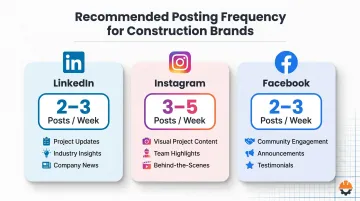
Recommended posting frequency:
- LinkedIn: 2–3 posts per week (project updates, industry insights, company news)
- Instagram: 3–5 posts per week (visual project content, team highlights, behind-the-scenes)
- Facebook: 2–3 posts per week (community engagement, project announcements, testimonials)
Use scheduling tools (Buffer, Hootsuite, Meta Business Suite) to plan content in advance and maintain consistency even during busy project periods.
Frequently Asked Questions
Frequently Asked Questions
How do you brand a construction company?
Branding a construction company starts with defining a clear positioning: your niche and the specific promise you make to clients. From there, develop a consistent visual identity (logo, colours, typography), build trust signals (CIDB grade, ISO certifications, portfolio, testimonials), and maintain a professional digital presence across your website, Google Business profile, and social platforms.
How much does branding design cost in Malaysia?
Branding design costs vary widely in Malaysia. A basic logo and style guide from a freelancer may cost a few thousand ringgit, while a full brand strategy and identity package from a professional agency typically ranges from RM15,000 to RM50,000 or more. Scope, deliverables, and agency experience are the main cost drivers.
What certifications should a Malaysian construction company display in its branding?
Prioritise displaying the following credentials:
- CIDB registration grade (G1–G7)
- PKK or PUKONSA certification (if applicable)
- ISO 9001 (quality management) and ISO 45001 (health and safety)
- Professional affiliations such as BEM or PAM
These credentials signal compliance, quality, and safety to clients and procurement evaluators.
What is the difference between a company profile and a brand identity?
A company profile is a document showcasing your services, projects, and credentials—typically a PDF or printed brochure. Brand identity is the broader strategic and visual system defining how your company is perceived, including positioning, tone of voice, logo, colours, typography, and all customer-facing touchpoints.
How long does it take to build a strong construction brand in Malaysia?
The foundational work—brand strategy, visual identity, and website—can be completed in 2–4 months. Building genuine brand recognition in the market is an ongoing effort that compounds over 1–3 years through consistent project delivery, digital presence, client testimonials, and referrals.
Should small construction companies in Malaysia invest in professional branding?
Yes. Professional branding directly affects a smaller contractor's ability to win tenders, attract better clients, and justify competitive rates. Many agencies offer tiered packages suited to SME budgets, and some Malaysia-based programmes provide grant support to offset costs further.